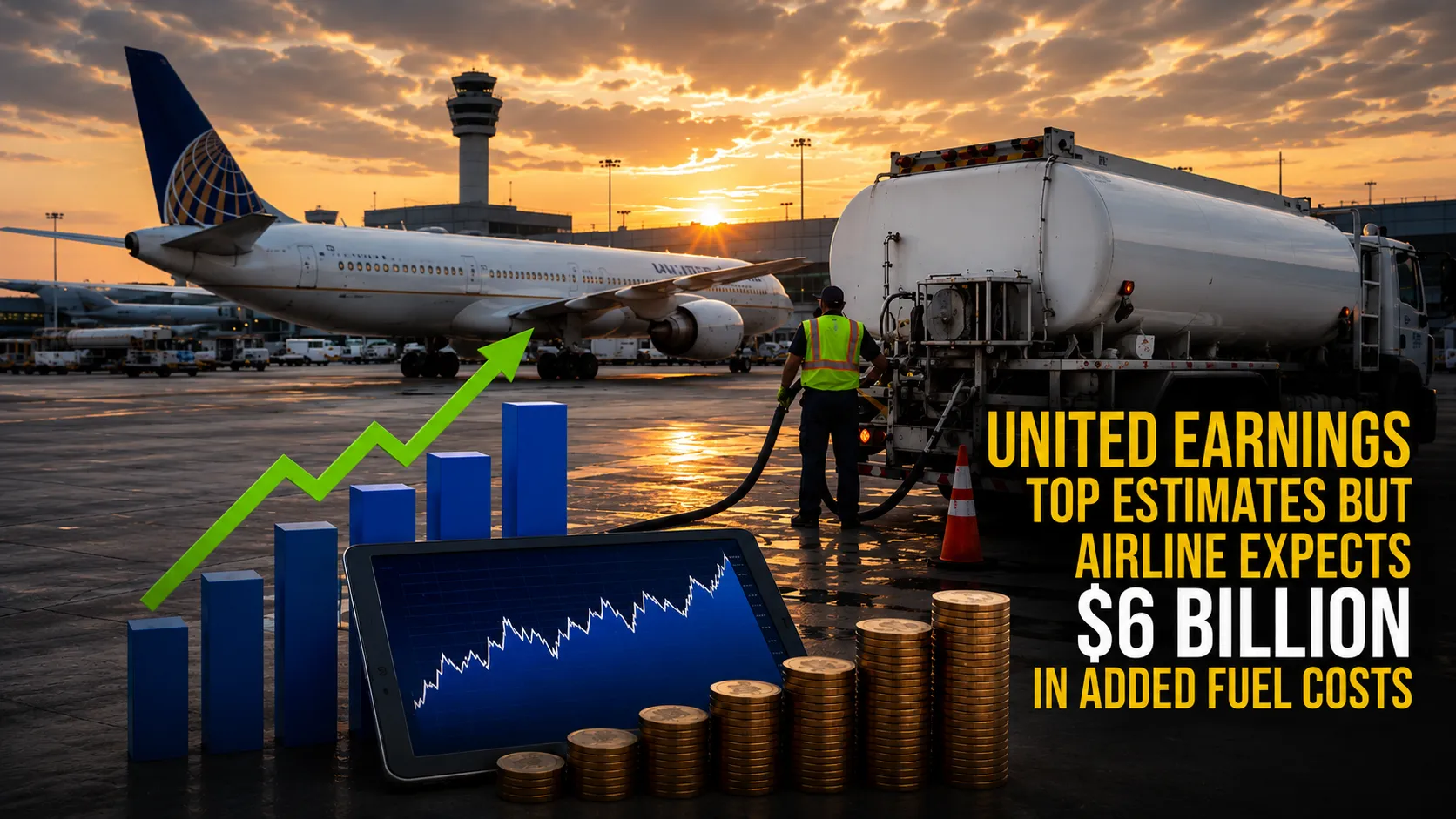
United Airlines delivered a genuinely strong second-quarter earnings report on Wednesday, July 15, 2026, posting results that comfortably beat Wall Street's expectations and prompting the airline to raise its full-year profit guidance — even as the company simultaneously disclosed one of the most striking cost warnings of the current earnings season: nearly $6 billion in additional fuel expenses now expected for full-year 2026 compared to the assumptions built into its original guidance at the start of the year. The combination of a genuine earnings beat alongside a dramatically worsened cost outlook offered a vivid illustration of just how directly the aviation industry remains exposed to the kind of volatile global energy markets that have characterized much of 2026.
For the quarter ended June 30, United posted adjusted diluted earnings per share of $1.99, comfortably ahead of the $1.88 Wall Street had been modeling, on total revenue of $17.67 billion, also above the $17.61 billion analysts had expected. On a GAAP basis, diluted earnings per share came in at $2.46, though that figure represented a decline of more than 17 per cent compared to the year-ago quarter, with net income landing at $805 million for the period.
The Fuel Cost Shock, By the Numbers
The centerpiece of United's second-quarter disclosure was the sheer scale of the fuel cost pressure the airline now expects to absorb through the remainder of 2026. Aircraft fuel expenses during the second quarter alone jumped 84 per cent year-on-year to $5.11 billion, with the average price United paid per gallon climbing to $4.19 — a dramatic increase from the $2.34 per gallon the airline had paid in the same quarter a year earlier. Based on fuel prices as of July 14, United now estimates that higher oil prices could add close to $6 billion to its full-year 2026 fuel costs compared to what it had originally budgeted for at the start of the year, a figure the company explicitly attributed to the ongoing volatility in global energy markets tied substantially to escalating tensions in the Middle East.
Crucially, United's management team emphasized that the company managed to recover roughly half of this fuel cost increase during the second quarter itself, primarily through higher fares and yield management, with yields — a measure of average fare revenue per passenger mile — climbing 12 per cent during the quarter. Looking ahead, United said it expects to recover between 80 and 90 per cent of the fuel cost increase during the third quarter, and to fully offset the entirety of the increase by the fourth quarter — an ambitious but, based on the second quarter's demonstrated pricing power, not implausible recovery trajectory.
Raising Guidance Despite the Headwind
Perhaps the most notable aspect of United's disclosure was the company's decision to actually raise its full-year 2026 adjusted earnings per share guidance to a range of $9.00 to $11.00, up from the $7.00 to $11.00 range it had provided back in April — even as it simultaneously disclosed the nearly $6 billion fuel cost headwind. That April guidance had itself represented a significant reduction from the airline's original January forecast of $12.00 to $14.00 per share, reflecting how dramatically the operating environment shifted over the course of the first half of the year. The fact that United chose to raise the lower bound of its guidance range despite the worsening fuel picture speaks to management's confidence in the underlying strength of demand and the company's demonstrated ability to pass rising costs through to customers via fares.
For the third quarter specifically, United guided to adjusted earnings per share of $2.50 to $3.50, while flagging that fuel prices had already increased by $575 million, or $1.12 per share on an adjusted basis, since the beginning of July alone — underscoring just how volatile and fast-moving the cost environment has remained even in the days immediately following the quarter's close.
Where the Revenue Growth Came From
United's revenue performance during the quarter was notably broad-based across virtually every category the airline tracks. Total operating revenue climbed 16 per cent year-on-year, with revenue per available seat mile — a key industry efficiency metric — up 12 per cent. Premium cabin revenue grew 16 per cent, reflecting continued strong demand for United's higher-margin Polaris and premium economy offerings, while basic economy revenue increased 11 per cent and loyalty program revenue climbed a further 11 per cent. Cargo revenue posted the strongest growth of any category, advancing 23 per cent compared to the second quarter of 2025, while contracted business travel revenue — a closely watched indicator of corporate travel demand recovery — rose an impressive 27 per cent.
Chief Executive Scott Kirby specifically credited the company's sustained, multi-year investment program across every cabin class for driving both the revenue growth and improving customer satisfaction scores during the quarter, pointing to the airline's continued rollout of Starlink satellite-based in-flight WiFi as a standout differentiator, alongside newer onboard product innovations such as the airline's "Relax Row" seating configuration, which management has cited as another example of the kind of incremental, customer-facing investment that has helped United command a pricing premium relative to some of its more budget-focused domestic competitors. United disclosed that it now has Starlink installed on 450 aircraft, with plans to reach nearly 1,000 installations by the end of the year — a rapid rollout pace that management has repeatedly cited as a genuine competitive advantage in an industry where in-flight connectivity has become an increasingly important factor in premium customer loyalty and satisfaction.
Balance Sheet Discipline Amid the Volatility
Beyond the headline revenue and earnings figures, United's results disclosure emphasized the airline's continued progress on balance sheet strengthening, a priority management has repeatedly highlighted as central to the company's broader strategic positioning. The airline reported operating cash flow of $1.6 billion for the quarter and free cash flow of $322 million, while ending the period with $19.6 billion in available liquidity. During the quarter, United pre-paid approximately $1 billion of higher-cost debt while separately raising $3.7 billion in new liquidity through private bank transactions — a deliberate strategy management described as building a buffer against continued geopolitical instability and cost volatility.
United reiterated that it remains on track to achieve investment-grade credit rating status sometime in 2026, a milestone that would mark a significant achievement for an airline that, like most major US carriers, took on substantial debt during the pandemic-era travel collapse and has spent much of the years since working methodically to repair its balance sheet.
Operational Performance Improvements
Beyond the financial metrics, United's second-quarter results also highlighted meaningful operational improvements, with the airline recording its best-ever on-time departure rate since 2021 — a genuinely notable achievement given the broader operational challenges that have periodically affected the US aviation industry, including air traffic control staffing shortages and weather-related disruptions that have complicated flight scheduling reliability across the sector throughout 2026.
How United Compares to Rival Delta
United's results arrived in the same week that rival Delta Air Lines also reported its own second-quarter numbers, offering investors a useful side-by-side comparison point within the broader US airline sector. While United's headline earnings beat and raised guidance drew considerable investor attention, some market commentary noted that Delta ultimately posted stronger absolute profitability for the quarter, even as both carriers pointed to similarly robust underlying demand trends and both airlines highlighted their ability to pass rising fuel costs through to customers via higher fares — a dynamic that has emerged as a defining theme of this particular earnings season across the US airline industry.
The Read-Through for Global Travel Demand
United's genuinely robust revenue growth across virtually every category — premium, basic economy, loyalty, cargo, and contracted business travel alike — offers a reassuring signal for the broader global travel and tourism industry at a moment when some economists had worried that elevated fares, driven by rising fuel costs, might begin to meaningfully dampen consumer travel demand. Instead, United's results suggest that travelers across income and purpose-of-travel segments have, at least so far, continued absorbing higher fares without any clear evidence of significant demand destruction, a dynamic that bodes reasonably well for the broader global aviation and hospitality ecosystem heading into the traditionally strong summer and early autumn travel season.
Investor Reaction and Stock Movement
Despite the genuine earnings beat and raised guidance, United's shares initially traded lower by as much as 3 per cent in the immediate aftermath of the results release, a reaction that some market analysts attributed to the stock's already substantial run-up heading into the print — shares had climbed more than 39 per cent over the trailing twelve months — meaning a routine beat-and-raise quarter may have already been largely priced in by investors ahead of the actual announcement. That dynamic, where a genuinely strong quarter still produces a muted or even negative initial share price reaction because expectations had already climbed so high beforehand, has become an increasingly familiar pattern across this earnings season, playing out similarly for several other companies that have posted strong headline results only to see shares initially retreat as investors parsed more nuanced details buried within management commentary and forward guidance.
Why This Matters Beyond the Airline Sector
For readers tracking the broader intersection of energy markets, corporate earnings, and global business, United's results offer a genuinely instructive real-time case study in how directly and immediately volatile energy prices — driven substantially by the ongoing tensions around the Strait of Hormuz and broader Middle East instability that have rattled markets throughout July — translate into concrete cost pressure for capital-intensive, fuel-dependent industries like commercial aviation. The fact that United was nonetheless able to raise its full-year guidance despite absorbing a nearly $6 billion fuel cost shock speaks to genuinely resilient underlying travel demand, both from leisure travelers willing to absorb higher fares and from a corporate travel market that appears to be recovering more durably than many analysts had anticipated earlier in the year.
For India-focused business audiences specifically, United's fuel cost disclosure carries indirect but meaningful relevance, given how directly global crude oil price volatility — whatever its proximate geopolitical cause — tends to flow through to input costs across multiple sectors of the Indian economy simultaneously, from domestic aviation and logistics to energy-intensive manufacturing, reinforcing just how interconnected global energy market shocks have become across seemingly unrelated industries and geographies in the current volatile environment.
The Broader Airline Sector Fuel Hedging Question
United's disclosure has reignited broader industry discussion about the merits and limitations of fuel price hedging strategies across the airline sector. Unlike some international carriers that maintain more extensive fuel hedging programs to lock in prices months or years in advance, United — like most major US carriers — has historically relied more heavily on its ability to pass through cost increases via fares rather than extensive hedging, a strategic choice that leaves the airline more directly exposed to sharp, short-term fuel price spikes like the one it disclosed this week, but also preserves greater flexibility to benefit fully if energy prices were to unexpectedly decline. That strategic posture has become an increasingly prominent talking point among airline industry analysts as Middle East-driven energy volatility has repeatedly whipsawed jet fuel costs across the industry throughout 2026.
What Comes Next
With United now guiding toward full recovery of its elevated fuel costs by the fourth quarter, the coming months will serve as an important real-world test of whether the airline's demonstrated pricing power can hold up if energy prices remain elevated or climb even further amid continued Middle East tensions. Investors and industry analysts will be watching closely for confirmation, in United's third-quarter results due later this year, that the 80-to-90-per-cent fuel cost recovery management has projected for the current quarter is actually materializing as forecast — a checkpoint that will offer a clearer read on whether Wednesday's guidance raise proves durable or requires further revision as the year progresses.