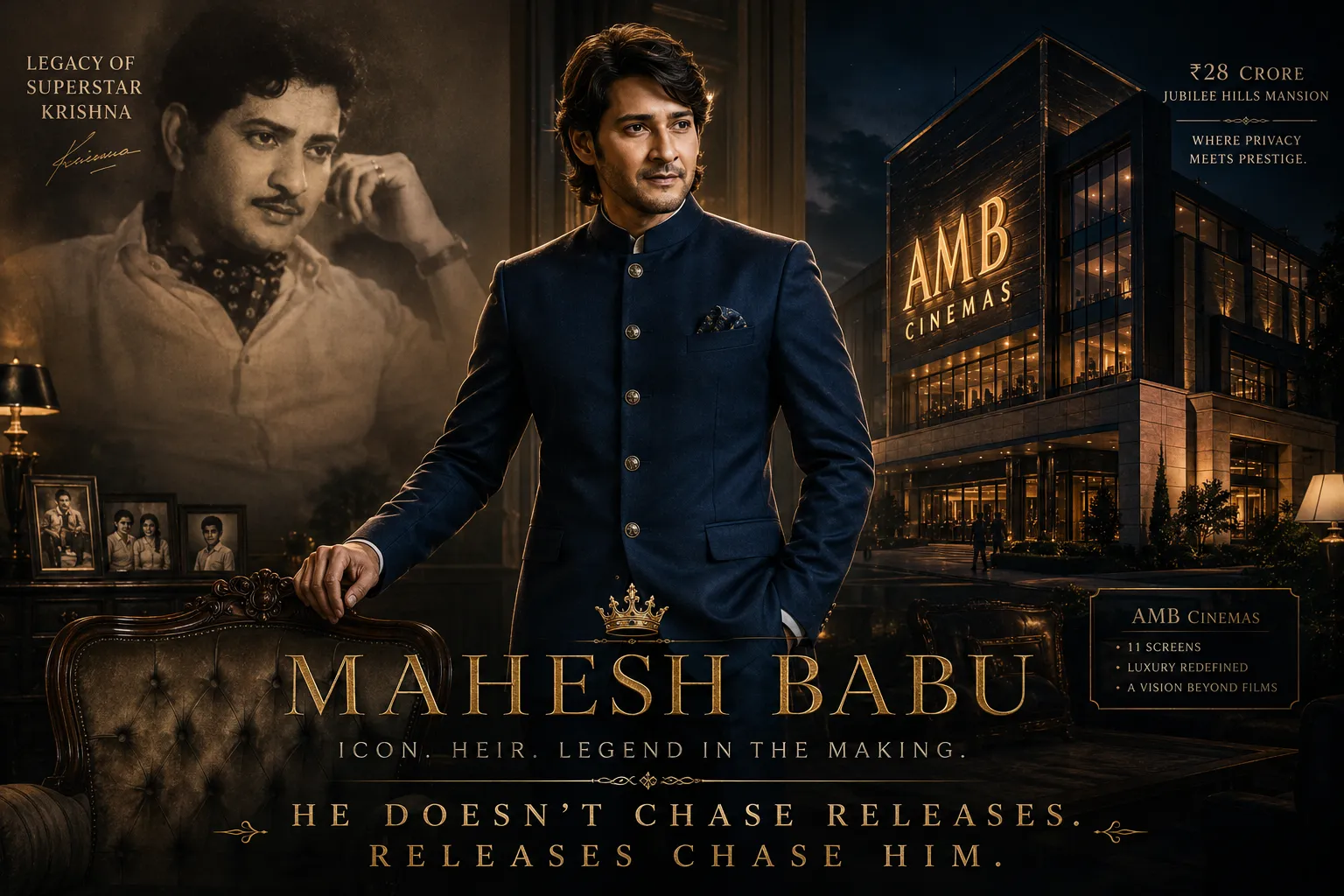
The Prince of Tollywood: How Mahesh Babu Built an ₹850 Crore Kingdom on Silence, Selectivity, and SS Rajamouli
HYDERABAD — May 2026 From a child artist at four to the most selective superstar in Indian cinema, the Ghattamaneni heir has mastered the art of scarcity — and it has made him a fortune.
The ₹850 Crore Question
In an industry that glorifies speed — four films a year, constant social media chatter, relentless brand visibility — Mahesh Babu has chosen the opposite path. He makes one film every two years. He posts on Instagram once a week (if that). He endorses fewer than a dozen brands at a time. And yet, when Sarkaru Vaari Paata crossed ₹100 crore in four days in 2022, or when the mere announcement of his collaboration with SS Rajamouli broke the internet, the world was reminded of a simple truth: scarcity creates value.
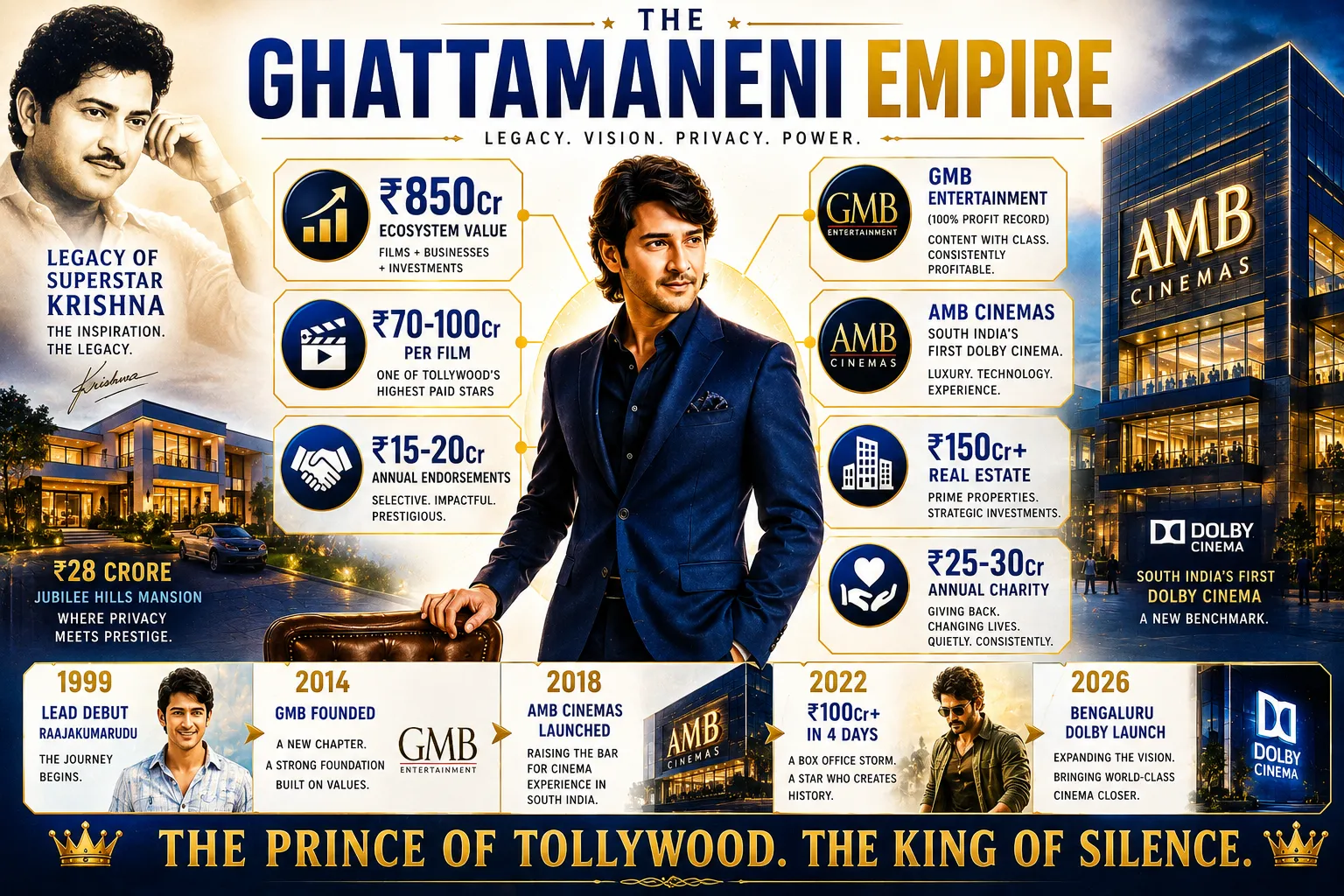
Today, Mahesh Babu's net worth is estimated between ₹350 crore and ₹400 crore ($42–48 million) — with expected inheritance of ₹48 crore from family assets — and his brand empire, when valued as an ecosystem, crosses ₹850 crore ($102 million). He charges ₹70–100 crore per film, plus profit share. He earns ₹15–20 crore annually from brand endorsements. He owns a production house (GMB Entertainment), a premium multiplex chain (AMB Cinemas), a luxury restaurant, and a growing startup portfolio. And he does it all while being called, without irony, the "Prince of Tollywood" — a title that once felt like nepotism but now feels like destiny.
This is not a story of a star who happened to be born into royalty. This is a story of a prince who learned that the crown means nothing unless you know when to speak — and when to remain silent.
The Ghattamaneni Legacy: Born into the Reel Kingdom
Mahesh Babu was born Ghattamaneni Mahesh Babu on August 9, 1975, in Madras, into a family that was Telugu cinema. His father, Krishna Ghattamaneni, was a legendary actor known as the "Andhra James Bond" — a superstar who had acted in over 350 films and produced dozens more. His mother, Indira, came from a family of film distributors. His elder brother, Ramesh Babu, was a producer and actor. The Ghattamaneni name was not just a surname; it was a production logo, a box-office guarantee, and a burden.
Mahesh made his screen debut as a child artist at the age of four in Needa (1979), appearing in eight more films as a child before taking a decade-long break to complete his education. His lead debut came in 1999 with Rajakumarudu — a modest success, but not the explosion his surname promised.
For the next eight years, Mahesh delivered hits (Murari, Okkadu, Athadu) and flops (Arjun, Sainikudu) in equal measure. By 2007, exhausted and questioning his place in an industry that demanded constant output, he took a three-year break — an eternity for a Telugu hero.
"When I returned, I decided I would never again make a film for the sake of making a film," he told a rare interviewer. "I would only make films that I would want to watch."
The Selective Superstar: One Film, Two Years, Infinite Patience
That decision transformed his career. Post-2010, Mahesh Babu's filmography became a study in curation: Dookudu (2011), Businessman (2012), Seethamma Vakitlo Sirimalle Chettu (2013), 1: Nenokkadine (2014), Srimanthudu (2015), Bharat Ane Nenu (2018), Maharshi (2019), Sarileru Neekevvaru (2020), Sarkaru Vaari Paata (2022), Guntur Kaaram (2024). Almost every film crossed ₹100 crore. Almost every film was profitable.
Today, his per-film remuneration is ₹70–100 crore — among the highest in Indian cinema. But the real genius lies in his profit-share model: for Bharat Ane Nenu, he reportedly took no upfront fee in exchange for a 30% share of theatrical, OTT, satellite, and music rights. The film grossed ₹225 crore. His share? Approximately ₹67 crore — plus ownership of the intellectual property.
"Mahesh Babu doesn't act in films," a trade analyst told this magazine. "He invests in them. And he never invests in a losing proposition."
The Rajamouli Gambit: Working for Free for Glory
In 2023, Mahesh Babu made an announcement that sent shockwaves through the industry: he would star in SS Rajamouli's next film, titled Varanasi (now slated for April 7, 2027). The budget is estimated at ₹1,000 crore — India's most expensive film to date, surpassing even RRR and Kalki 2898 AD.
But here is the astonishing detail: he is reportedly taking no remuneration.
Instead, he has structured a deal that gives him an unprecedented share of the film's lifetime earnings — including theatrical, OTT (Netflix has already bid ₹400 crore for streaming rights), satellite, music, and merchandise. If Varanasi performs anywhere close to RRR (₹1,200 crore), Mahesh Babu's share could exceed ₹300 crore — and he will own a permanent stake in the film's intellectual property.
"The Rajamouli film is not a job," a source close to the actor explained. "It is a long-term asset. Mahesh is treating it like a startup where he is the founder, not an employee."
GMB Entertainment: The Production House That Makes Money Quietly
In 2014, Mahesh Babu and his wife Namrata Shirodkar founded G. Mahesh Babu Entertainment (GMB Entertainment) — a production house that has quietly become one of Tollywood's most profitable.
Under the GMB banner, Mahesh has produced or co-produced:
Srimanthudu (2015) — ₹150 crore box office.
Major (2022) — starring Adivi Sesh, a pan-Indian biopic of 26/11 martyr Sandeep Unnikrishnan, which grossed ₹150 crore and won critical acclaim.
Sarileru Neekevvaru (2020) — ₹260 crore blockbuster.
Rao Bahadur (scheduled for July 3, 2026) — a psychological drama starring Satyadev, directed by Venkatesh Maha, presented by GMB.
GMB is not a vanity project. It is a financially disciplined production house that greenlights only mid-budget films with clear commercial potential. Unlike many actor-led banners that lose money on passion projects, GMB has a 100% profit record.
AMB Cinemas: The Multiplex Empire
In 2018, Mahesh Babu partnered with Asian Cinemas to launch AMB Cinemas — a premium multiplex chain in Hyderabad's Gachibowli. The seven-screen superplex, equipped with state-of-the-art 4K laser projection and Dolby Atmos, became an instant hit.
In January 2026, Mahesh expanded the empire to Bengaluru, launching South India's first Dolby Cinema at the iconic Kapali Theatre in Gandhinagar. The nine-screen multiplex features the second-largest Dolby Cinema screen in India, with each screen measuring 60 feet in width and seating approximately 600 viewers. The launch was so successful that Chiranjeevi's Mana Shankara Vara Prasad Garu played to a housefull show on its opening Sunday.
AMB Cinemas now has three more properties in the pipeline — one more in Bengaluru, one in Hyderabad, and a new market: Chennai. Each property will have 5–7 screens, with a capex of ₹3–3.5 crore per screen.
"Mahesh Babu's presence at the complex was electrifying, as fans thronged the theatre," said Suniel Narang of Asian Cinemas. "It was a special moment, with their favourite star getting closer to his Bengaluru fans through this swanky new cinema."
The Endorsement Portfolio: ₹15–20 Crore Annually from Select Brands
Unlike Ranveer Singh (40+ brands) or Virat Kohli (40+), Mahesh Babu endorses only 8–10 brands at any time, charging ₹7.5 crore per endorsement. His roster includes:
Thums Up — the flagship cola brand, a long-standing association.
Myntra — fashion e‑commerce.
Flipkart — e‑commerce giant.
Mountain Dew — high-energy campaigns.
PhonePe — for which he famously charged ₹5 crore for a 5-second voiceover.
His endorsement earnings total ₹15–20 crore annually. But he has famously refused offers from tobacco, liquor, and gambling companies — preserving a family-friendly image that has served him for three decades.
The Real Estate Kingdom: From Jubilee Hills to Goa
Mahesh Babu's real estate portfolio is both luxurious and strategic:
Jubilee Hills Mansion — a sprawling property valued at ₹28 crore, featuring modern interiors, a home gym, and a private swimming pool.
A second home in Jubilee Hills — located in the same upscale neighbourhood, for extended family.
A holiday home in Goa — estimated ₹15 crore.
Farmland near Gandipet Lake — purchased in 2016, approximately 3 acres, with plans for a farmhouse.
2.5 acres near Shankarpally — a recent acquisition with wife Namrata, registered in 2024.
Commercial real estate in Bengaluru and Chennai — leased to retail chains, generating steady rental income.
His total real estate holdings exceed ₹150 crore.
The Lifestyle: ₹6.2 Crore Vanity Van and a Gold Range Rover
Mahesh Babu's possessions reflect his philosophy: few things, but the best things.
A custom-made vanity van by DC Design — costing ₹6.2 crore, featuring soft furnishings, modern amenities, and the ultimate comfort for his shooting schedules.
A gold Range Rover SV LWB — worth ₹5.4 crore, the crown jewel of his car collection.
Other luxury cars — Rolls-Royce Ghost (₹8 crore+), Lamborghini Gallardo, Audi e-tron, BMW 7 Series, Mercedes-Benz S-Class, and a Toyota Land Cruiser.
The Investment Portfolio: Fitday and Beyond
In September 2024, Mahesh Babu's GMB Entertainment made a strategic investment in Fitday — a Hyderabad-based nutraceutical startup specializing in nutrition and healthy snacking. The startup already has a presence in over 10,000 retail stores. The investment amount remains undisclosed, but the move signals Mahesh's entry into India's booming nutraceutical sector, which is growing at 20% CAGR (three times the global average) and is expected to become a ₹2.5 lakh crore market by 2026.
"I'm thrilled to support Fitday's pioneering work in the nutrition, snack, and nutraceutical markets," Mahesh said in a statement.
He also co-owns AN Restaurants — a luxury dining venture in Hyderabad's Banjara Hills, launched in 2022 in partnership with Asian Group and Minerva. The "AN" stands for Asian Namrata, reflecting his wife's integral role in the business.
The Namrata Factor: The Strategic Partner
Mahesh Babu's wife, Namrata Shirodkar — a former Miss India (1993) and actress — is not merely a celebrity spouse. She is his business partner and strategic advisor. Together, they run GMB Entertainment, manage his brand portfolio, and oversee the family's investments.
"Namrata left films after marriage, but she never left ambition," a family friend told this magazine. "She is the CFO of the Ghattamaneni empire."
The Philanthropy: India's Most Charitable Superstar
Here is the statistic that sets Mahesh Babu apart from every other Indian celebrity: he donates 30% of his annual income to charity. That is ₹25–30 crore every year. He is, by a significant margin, India's most charitable actor — more than Salman Khan, more than Shah Rukh Khan, more than Sonu Sood.
Through the Mahesh Babu Foundation (which recently received FCRA registration to accept foreign donations), he has:
Funded over 2,000+ heart surgeries for children, in collaboration with Andhra Hospitals and Rainbow Hospitals.
Adopted two villages — including his ancestral village — providing roads, electricity, schools, and health facilities.
Supported education for poor children and girls' empowerment initiatives.
The inspiration came from personal trauma: his son Gautam was born prematurely and spent days in the NICU. "There are families who cannot afford expensive treatments," the Foundation's mission statement reads.
The Bottom Line
Mahesh Babu's ₹850 crore empire is built on a philosophy that most celebrities cannot afford: less is more. Fewer films, higher quality. Fewer endorsements, higher fees. Fewer announcements, louder impact. He has mastered the art of making his audience wait — and in an era of content overload, waiting has become the ultimate luxury.
He is not the wealthiest actor in Tollywood — Prabhas holds that crown. But he may be the most strategic. Every film, every endorsement, every business move is calculated for long-term wealth, not short-term visibility. And with Varanasi on the horizon, his empire is poised for its biggest leap yet.
The Prince of Tollywood has never needed to shout. His silence, it turns out, is the loudest statement of all.


