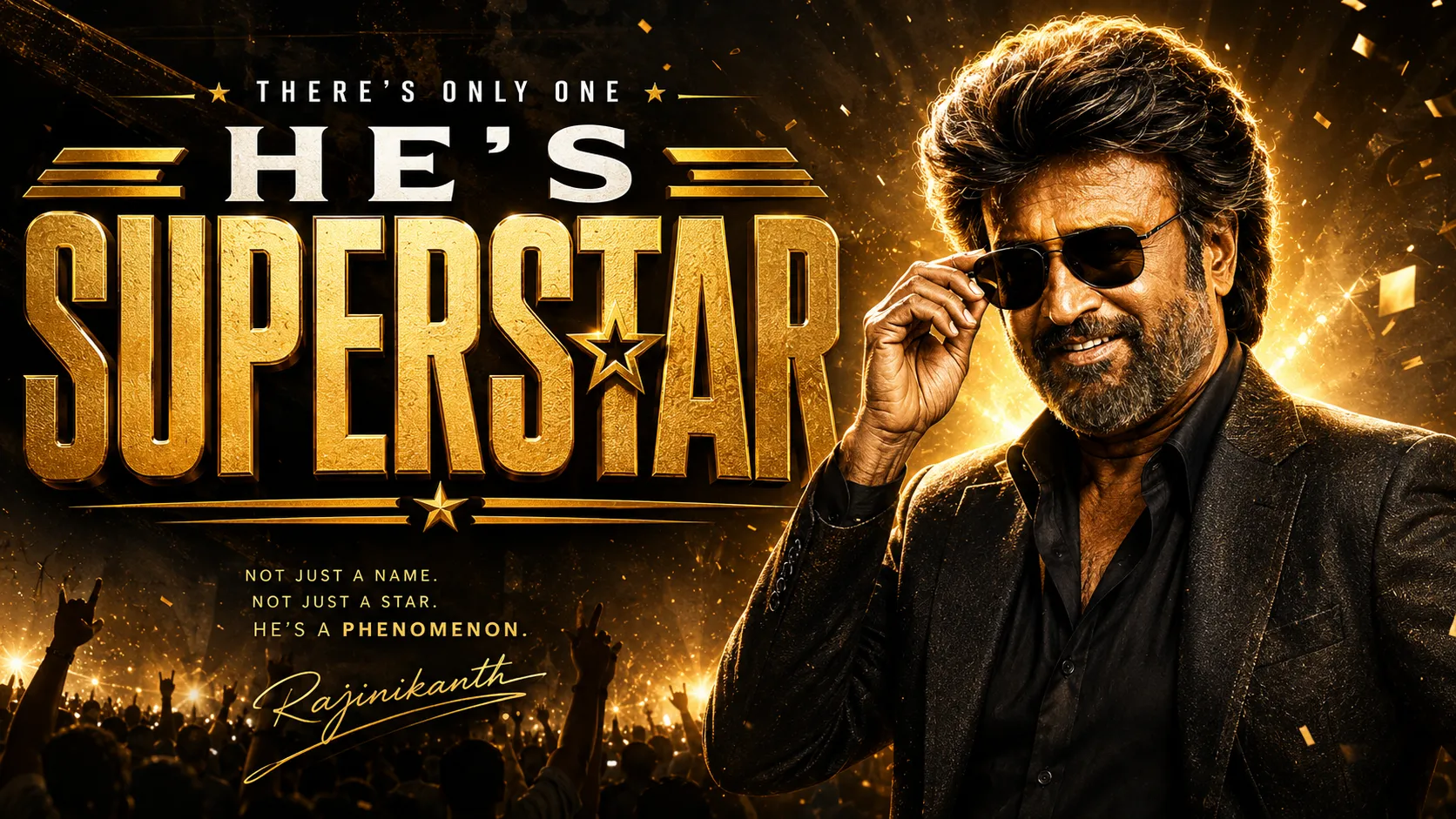
The Thalaivar's Trillion: How Rajinikanth Built a ₹1,200 Crore Empire on Style, Devotion, and One Signature Flick
CHENNAI — May 2026 He started as a bus conductor. He became the highest-paid actor in Asia. And at 75, the Superstar is still the undisputed emperor of Indian cinema.
The ₹1,200 Crore Question
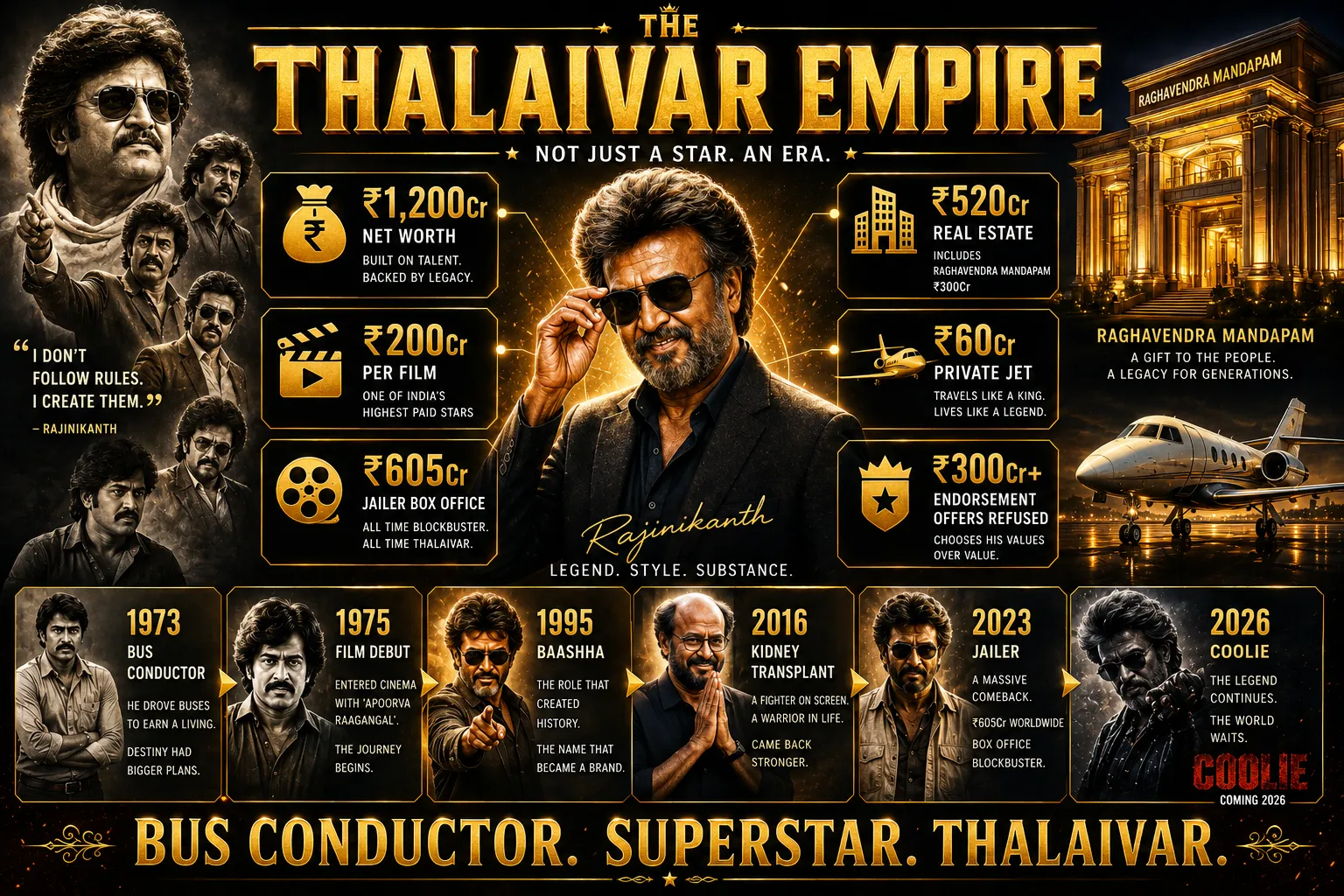
He is the only Indian actor whose fans bathe his cutouts with milk. The only one whose film releases are treated as festivals, with state holidays declared and tickets selling for ₹5,000 on the black market. The only one who, at 75, commands a per-film fee of ₹200 crore – the highest in Indian history. And the only one who has never needed a pan-Indian strategy, because he has always been universal.
Rajinikanth – or simply "Thalaivar" (The Leader) to his millions of devotees – has an estimated net worth of ₹1,200 crore (approximately $145 million) , making him the wealthiest actor in South India and second only to Shah Rukh Khan nationally. His brand valuation, according to Kroll 2025, is $180 million . He owns a production house (V Creations, run by his son-in-law), a sprawling real estate portfolio, a fleet of vintage cars, and the unwavering loyalty of a generation.
But the numbers are almost beside the point. Rajinikanth is not an actor with a business empire. He is a cultural phenomenon that happens to generate billions.
The Bus Conductor Who Became a God
Shivaji Rao Gaekwad was born in 1950 in Bengaluru, to a Marathi family. His father was a police constable; the family lived in a single-room tenement. Rajinikanth worked as a bus conductor for the Bangalore Metropolitan Transport Corporation, collecting tickets, and dreaming of something more.
At 23, he enrolled in the Madras Film Institute. His first role was a small but scene-stealing villain in Apoorva Raagangal (1975), directed by K. Balachander. The director gave him his name – Rajinikanth – and told him, "You will become a star, but only if you create your own style."
That style became legend: the cigarette flip, the punch dialogue, the stylised walk, the sunglasses toss. He turned mannerisms into mythology.
The 1980s: Becoming the Superstar
Throughout the 1980s, Rajinikanth delivered a string of blockbusters that defined Tamil cinema: Billa (1980), Muthu (1985), Thalapathi (1981), and Padayappa (1999). But it was Baashha (1995) that transformed him from a star into a deity. His dialogue – "Naan oru thadava sonna, nooru thadava sonna maadhiri" (If I say it once, it's as if I've said it a hundred times) – became the anthem of every oppressed fan who dreamed of rising.
By 2000, Rajinikanth's salary had climbed to ₹15 crore – unheard of at the time. By 2010, with Enthiran (Robot), it crossed ₹45 crore. By 2025, with Vettaiyan and Coolie (announced but delayed), it reached ₹200 crore.
"You are not paying for an actor," a producer once said. "You are paying for a festival."
The Business Model: Profit Sharing, Not Salary
Rajinikanth's genius lies in his equity-first approach. For Jailer (2023), which grossed ₹605 crore worldwide, he took ₹100 crore upfront plus a 40% share of profits – earning approximately ₹250 crore total. For his upcoming Coolie (directed by Lokesh Kanagaraj, budget ₹500 crore), he is reportedly taking a 50% profit share with a reduced upfront fee.
This model ensures that his interests are aligned with the producers. When his film does well, he does exceptionally well. And his films always do well.
The Production House: V Creations
In 2007, Rajinikanth's daughter, Soundarya Rajinikanth, founded V Creations (originally Ocher Studios). The production house has produced:
Kochadaiiyaan (2014) – India's first photorealistic motion-capture film, starring Rajinikanth. It was a commercial failure (₹75 crore budget, ₹50 crore box office), but a technological milestone.
Darbar (2020) – co-produced with Lyca Productions. A hit.
Lal Salaam (2024) – directed by Aishwarya Rajinikanth, the superstar's elder daughter. A modest success.
V Creations has since pivoted to digital content, producing web series for Amazon Prime and Disney+ Hotstar. Soundarya now runs the company as CEO, and Rajinikanth serves as chairman. The company is valued at approximately ₹300 crore.
The Brand Endorsements: A Rarity
Unlike almost every other top-tier Indian actor, Rajinikanth endorses very few brands. His entire career, he has endorsed only a handful:
Tamil Nadu Tourism (pro bono)
Indian Bank (1990s)
TVS (two-wheelers)
Muthoot Finance (gold loans)
He refuses most offers, not for lack of interest, but because he believes overexposure dilutes his mystique. Industry estimates suggest he has turned down over ₹300 crore in endorsement deals over the last two decades.
"I am not a product," he famously said. "I am a person."
The Real Estate Kingdom
Rajinikanth's real estate portfolio is as legendary as his filmography:
Raghavendra Kalyana Mandapam – a massive wedding hall and convention centre in Chennai's Kodambakkam, built on a 2.5-acre plot. Valued at over ₹300 crore, it hosts hundreds of weddings and events annually, generating steady rental income.
The Superstar's residence – a sprawling bungalow in Chennai's Poes Garden, valued at ₹100 crore. It is not just a home; it is a pilgrimage site for fans.
A farmhouse near Sriperumbudur – estimated ₹25 crore.
Agricultural land in Karnataka – inherited from his father, valued at ₹15 crore.
Commercial real estate in Bengaluru and Hyderabad – ₹80 crore, leased to retail and office spaces.
His total real estate holdings are estimated at ₹520 crore.
The Vintage Car Collection
Rajinikanth is an avid collector of luxury and vintage cars:
Rolls-Royce Phantom (₹10 crore)
Bentley Continental GT (₹5 crore)
Mercedes-Benz S-Class (₹3 crore)
BMW 7 Series
A vintage Cadillac – his personal favourite.
He is also known to own a private jet (a Bombardier Learjet 60XR) for travel between Chennai, Hyderabad, and Mumbai, valued at approximately ₹60 crore.
The Political Chapter (That Never Was)
In 2017, Rajinikanth announced his entry into politics, promising to bring "spiritual politics" to Tamil Nadu. He launched a political party and began campaigning. The state waited with bated breath.
Then, in 2020, he withdrew – citing health reasons. His kidney transplant (2016) and recurring health issues made political life impossible.
"I will serve the people through my films," he said.
The decision may have saved his brand. Had he entered politics, he risked dividing his fanbase. Instead, he remains the only figure in Tamil Nadu who is loved by all – DMK, AIADMK, and the public alike.
The Philanthropy: A Quiet Legend
Rajinikanth's philanthropy is understated but significant:
The Raghavendra Mandapam Trust – runs a free school for underprivileged children, a medical clinic, and a marriage hall at subsidised rates for the poor.
Rajinikanth Foundation – focuses on kidney health, in memory of his own transplant. Has funded over 500 kidney transplants for the poor.
COVID-19 relief – donated ₹50 crore to the Tamil Nadu government and various relief funds.
Flood relief – contributed ₹10 crore to the Chennai flood relief efforts (2015, 2023).
He does not publicise these donations. They are discovered only through government receipts or grateful beneficiaries.
The Legacy: No One Will Replace Him
At 75, Rajinikanth continues to act. Vettaiyan (2024) grossed ₹450 crore. Jailer 2 is in pre-production. Coolie (directed by Lokesh Kanagaraj) is scheduled for late 2026.
But the question everyone asks is: who will replace him?
The answer, according to fans and analysts, is no one. Rajinikanth is not a star; he is a zeitgeist. He emerged at a time when Tamil pride was rising, when the common man needed a hero who looked like him – dark-skinned, from a humble background – and yet performed feats of godly strength. He became the symbol of every underdog's fantasy.
No actor since – not Vijay, not Ajith, not Suriya – has achieved that level of mythological status. And no actor ever will.
The Bottom Line
Rajinikanth's ₹1,200 crore empire is not the result of business strategy, diversification, or savvy investments. It is the result of devotion – the devotion of hundreds of millions of fans who will line up for days, pay any price, and celebrate every release as a festival.
He started as a bus conductor. He became a god. And in between, he built an empire that no balance sheet can fully capture.


