Among the wave of Indian IT services results landing this week, few carry quite the same brokerage optimism as Tech Mahindra's. The Pune-headquartered technology major's board is scheduled to consider and declare audited financial results for the quarter ended June 30, 2026 — the first quarter of fiscal year 2026-27 — later today, July 16, with an earnings conference call to follow shortly after. And unlike much of the cautious, "stabilising rather than recovering" commentary that has characterized brokerage previews across the broader Indian IT sector this earnings season, the consensus view heading into today's Tech Mahindra print is unambiguously upbeat: profit after tax growth of 40 per cent or more, year-on-year, driven substantially by the ramp-up of a handful of enormous telecom sector contracts.
The scale of the expected turnaround is worth pausing on. According to brokerage estimates compiled ahead of today's release, analysts broadly expect Tech Mahindra's profit growth to outpace nearly every other major Indian IT services peer reporting this quarter, at a moment when the broader sector narrative has leaned toward caution given weak discretionary technology spending among global corporate clients and the still-unresolved question of whether generative and agentic AI adoption will prove a net tailwind or headwind for the traditional IT services billing model.
What the Brokerages Are Modeling
Domestic brokerage house Mirae Asset Sharekhan has projected Tech Mahindra will post a 46.3 per cent jump in profit to roughly ₹1,669 crore for the June quarter, alongside revenue growth of 15.6 per cent year-on-year in rupee terms — a forecast substantially more bullish than the sector-wide average. YES Securities has modeled a similarly strong quarter, projecting revenue of ₹15,290 crore, up 14.6 per cent year-on-year and 1.4 per cent sequentially, with EBITDA expected to climb 34.5 per cent year-on-year to roughly ₹2,600 crore and profit after tax projected at ₹1,610 crore, representing growth of nearly 41 per cent year-on-year and close to 19 per cent quarter-on-quarter.
ICICI Securities, meanwhile, has forecast a 16.3 per cent year-on-year and 3 per cent sequential revenue increase to ₹15,530 crore, attributing the strength to the continued ramp-up of large deal wins secured during FY26, even while flagging some seasonal softness in the company's Comviva telecom software subsidiary as a partial offsetting factor. Broader Bloomberg consensus estimates compiled ahead of the print peg consolidated revenue at approximately ₹15,458 crore, with EBIT projected at around ₹2,189 crore — a roughly 5 per cent increase — and EBIT margin expected to expand to somewhere in the region of 14.16 per cent, continuing a trend of margin improvement the company has been building on for several consecutive quarters.
Domestic brokerage Anand Rathi, while cautious on the broader Indian IT sector's near-term trajectory, singled out Tech Mahindra as a top pick heading into this earnings season, attributing the constructive view specifically to the company's approximately one-third revenue exposure to the telecom vertical — what the brokerage described as a genuine competitive "moat" — combined with disciplined execution under chief executive Mohit Joshi's leadership. The firm has projected new deal total contract value (TCV) for the quarter in the range of $900 million to $1 billion, a figure that, if confirmed today, would represent a meaningfully strong bookings quarter relative to recent history.
The Orange and Telefónica Effect
At the heart of the bullish brokerage narrative sits a specific and well-documented catalyst: the ramp-up of enormous, multi-year telecom sector contracts with two of Europe's largest telecommunications operators, Orange and Telefónica. These so-called mega-deals, secured over the course of FY26, span a range of services from network operations and digital transformation support to customer experience management, and they represent exactly the kind of large-scale, long-duration engagements that Indian IT services companies have increasingly prioritized as a source of more predictable, recurring revenue compared to the shorter-cycle discretionary project work that has been under pressure across the sector amid macro uncertainty.
Telecom has long been one of Tech Mahindra's defining vertical strengths — a legacy of its origins as a joint venture between Mahindra Group and British Telecom — and the company's ability to continue winning and, crucially, successfully ramping large telecom engagements at a moment when much of the rest of the Indian IT sector has struggled to convert deal pipeline into billable revenue has become a genuine point of competitive differentiation. Analysts say that as these Orange and Telefónica engagements move further into their execution and delivery phases, they should provide a meaningful, multi-quarter tailwind to both revenue growth and operating leverage, since large, established contracts of this nature typically carry improving margin profiles as delivery teams move up the efficiency curve after the initial ramp-up period.
Margins: The Other Half of the Story
Beyond the headline profit and revenue numbers, analysts say today's results will also be closely watched for continued evidence of margin expansion, an area where Tech Mahindra has historically lagged some of its larger Indian IT peers but has been steadily closing the gap over the past several quarters. Brokerages including Equirus Research and Motilal Oswal have projected a sequential EBIT margin improvement in the range of 25 to 50 basis points for the June quarter, attributing the gains primarily to Project Fortius — Tech Mahindra's company-wide operational efficiency initiative — alongside improved delivery cost management and optimized resource allocation.
That said, some analysts have flagged potential headwinds that could partially offset these margin gains, including an estimated $30 million foreign exchange loss during the quarter and cost pressures stemming from new Indian labour code implementation, which is expected to affect employee-related expenses across the sector more broadly this quarter, not just at Tech Mahindra. Management's ability to demonstrate continued progress toward its previously stated FY27 margin target of 15 per cent — even amid these headwinds — will likely be one of the most closely tracked qualitative signals emerging from today's post-results commentary.
CEO Mohit Joshi's Turnaround Continues
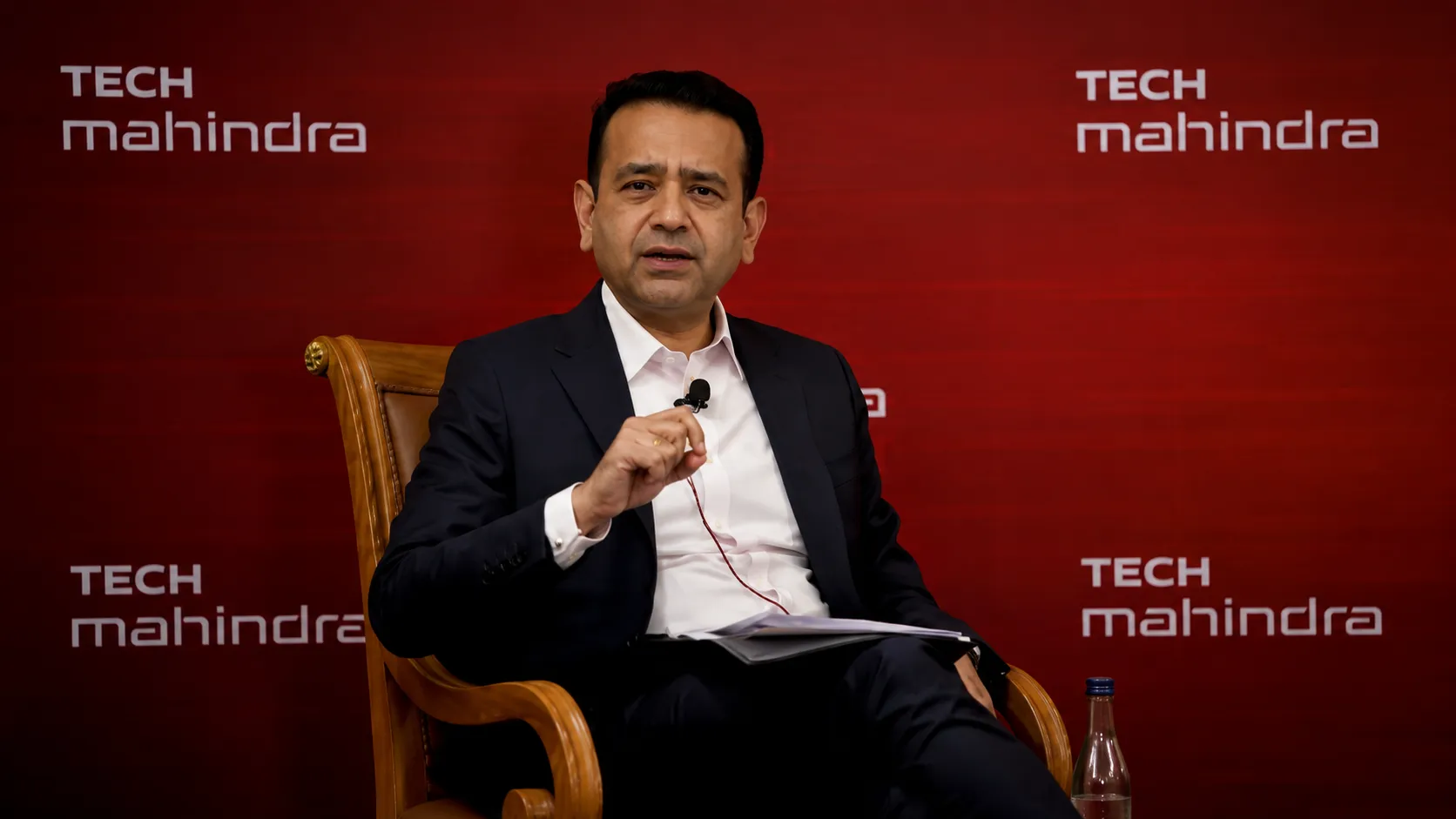
Today's results also serve as a fresh data point in the broader narrative of Tech Mahindra's multi-year turnaround under chief executive Mohit Joshi, who took the helm with an explicit mandate to sharpen the company's execution discipline, improve margins, and reposition Tech Mahindra as a more focused, higher-quality growth story within the increasingly competitive Indian IT services landscape. Joshi's tenure has been marked by a series of consecutive quarters of margin expansion, alongside continued emphasis on large deal-making — with the company reporting that deal wins have increased significantly on a trailing twelve-month basis, reflecting broad-based momentum across verticals and geographies rather than dependence on any single large contract.
The company has also been building out its artificial intelligence offerings, though analysts note that Tech Mahindra's public narrative around generative and agentic AI adoption has historically been somewhat less prominent than some of its larger peers. Today's management commentary on AI-related deal wins, enterprise adoption trends, and monetization pathways will be an important area of focus for investors trying to assess whether the company's AI positioning is translating into measurable, billable revenue, or remains largely at the pilot and proof-of-concept stage — a distinction that has become one of the central questions hanging over the entire Indian IT services sector's medium-term growth trajectory.
Same-Day Company: Wipro Also Reports
Today's Tech Mahindra results land on the same day that sector peer Wipro also reports its own Q1 FY27 numbers, creating an unusually direct, same-day comparison point for investors trying to assess relative competitive positioning across India's IT services landscape. While Wipro has faced brokerage expectations of margin compression driven by annual wage hikes and continued AI investment costs, Tech Mahindra's telecom-driven bullish setup offers a notably different narrative — one that industry watchers say reflects just how much company-specific vertical exposure and deal execution discipline have come to matter more than broad sector-wide demand trends in determining which Indian IT companies outperform in the current environment.
A Quarter Ago vs. Today: The Turnaround in Numbers
Tech Mahindra's expected performance today gains additional significance when viewed against its own recent history. In the corresponding quarter a year earlier, Q1 FY26, the company reported consolidated net profit of approximately ₹1,140.6 crore, itself a 34 per cent year-on-year increase at the time, on revenue of ₹13,351 crore. If today's brokerage estimates prove accurate — with profit projected in the ₹1,610 crore to ₹1,669 crore range on revenue approaching ₹15,300 crore to ₹15,530 crore — it would represent not just continued growth but a meaningful acceleration in the pace of that growth, with profit expansion this year expected to outstrip even last year's already-strong 34 per cent increase. That kind of compounding improvement, quarter after quarter, is precisely the pattern that has made Tech Mahindra one of the more closely watched turnaround stories within Indian IT services over the past two years.
The company's dollar-denominated revenue trajectory tells a similar story of steady, if unspectacular, improvement: from roughly $1,564 million in Q1 FY26, brokerage models suggest dollar revenue could climb toward the $1,750 million to $1,800 million range in today's print, reflecting both the rupee's movement against the dollar and genuine underlying constant-currency growth, aided significantly by the telecom vertical's mega-deal ramp-up.
Positioning Relative to Peers
Set against the broader Indian IT sector, Tech Mahindra's anticipated outperformance today stands out in sharper relief. Sector bellwether Tata Consultancy Services, which reported earlier this month, posted a more modest 4.6 per cent year-on-year net profit growth for the June quarter, even as its India-specific business grew a robust 22.9 per cent — underscoring how uneven growth has become across different geographies and verticals within Indian IT. Wipro, reporting on the very same day as Tech Mahindra, has faced brokerage expectations of margin compression driven by annual wage hikes and continued investment in AI capability, with analysts broadly characterizing the sector's current phase as one of "stabilising demand rather than a meaningful recovery."
Against that backdrop, Tech Mahindra's telecom-anchored growth story — built on the tangible, already-signed foundation of the Orange and Telefónica engagements rather than on more speculative AI-led demand recovery — offers a rare example within this earnings season of a company whose growth outlook rests on largely de-risked, already-contracted revenue visibility, rather than on hoped-for improvements in discretionary client spending that have yet to materialize across much of the rest of the sector.
Why This Matters for India's Broader Technology Talent Ecosystem
Beyond the immediate financial metrics, today's results carry significance for the tens of thousands of employees across Tech Mahindra's global workforce and for India's broader technology talent market more generally. Strong deal win momentum and confirmed revenue growth from major contracts like the Orange and Telefónica engagements typically translate into more confident hiring and campus recruitment commentary — a signal that carries meaningful weight for India's enormous pool of engineering graduates and early-career technology professionals who look to bellwether IT companies for cues about the health of the broader hiring environment.
For a publication tracking the achievements of Indian enterprise on the global stage, Tech Mahindra's expected outperformance this quarter — set against a backdrop of broader sector caution — offers a compelling illustration of how individual company execution and strategic vertical positioning can meaningfully diverge from macro-level industry trends, even within the same national IT services ecosystem and the same challenging global demand environment that peers are simultaneously navigating. If today's results confirm the more than 40 per cent profit growth that brokerages are broadly expecting, it would mark one of the standout results of this earnings season for Indian IT services, and would likely prompt renewed investor attention on whether Tech Mahindra's telecom-anchored strategy offers a template that other Indian IT majors might look to emulate as they navigate their own paths through the AI-era transformation of the services business model.