Every earnings season in Indian IT services has its bellwether moment, and this quarter, that moment arrived early. Tata Consultancy Services, the Tata Group's flagship technology arm and India's largest software services exporter, reported its first-quarter results for fiscal year 2026-27 on July 9, delivering a set of numbers that immediately set the tone for the rest of the sector's earnings season — a season that has since seen Wipro, Tech Mahindra, and a host of other IT majors report their own results in the two weeks since. TCS posted a consolidated net profit of ₹13,349 crore for the quarter ended June 30, 2026, marking a 4.6 per cent increase over the ₹12,760 crore reported in the same period a year earlier, while revenue from operations surged an impressive 13.9 per cent year-on-year to ₹72,275 crore, up from ₹63,437 crore in Q1 FY26.
The board also approved an interim dividend of ₹12 per equity share, with a record date of July 15, 2026, and payment scheduled for July 31, 2026 — a decision that reinforces TCS's long-standing reputation among Indian institutional and retail investors alike as one of the most consistent dividend-paying blue-chip stocks on the exchanges.
Reading the Headline Numbers Carefully
The topline growth figures deserve a closer look, because the picture shifts depending on which comparison window investors use. On a sequential, quarter-on-quarter basis, TCS's net profit actually declined by roughly 3 per cent compared to ₹13,718 crore reported in the January-March quarter of FY26 — a dip that some coverage attributed in part to the absence of one-off gains that had boosted the previous quarter's numbers. But the year-on-year comparison, which most analysts consider the more meaningful gauge of underlying business momentum given the seasonal and one-off effects that can distort quarter-to-quarter figures, painted a considerably more encouraging picture: profit excluding exceptional items stood at ₹13,849 crore for the quarter, and revenue growth of nearly 14 per cent year-on-year comfortably beat what had been a fairly cautious set of brokerage expectations heading into the print.
TCS's operating margin for the quarter came in at a healthy 24.0 per cent, with net margin at 19.2 per cent — figures that underscore just how disciplined the company's cost management has remained even as it continues to roll out annual wage hikes and invest heavily in artificial intelligence capability across its global delivery network. Management specifically flagged that the June quarter included the rollout of annual salary increments for all associates worldwide, alongside efforts to align compensation structures with the newly implemented Indian Labour Code requirements — cost pressures that made the quarter's margin performance all the more notable.
The AI Story Behind the Numbers
If there was a single theme that dominated TCS's earnings commentary this quarter, it was the accelerating scale of the company's artificial intelligence business. TCS disclosed that its annualized AI revenue run rate has now reached $2.6 billion, up 13.6 per cent on a sequential basis — a figure that chief executive K. Krithivasan highlighted prominently in his remarks accompanying the results, describing the AI business's growth trajectory as central to the company's broader strategic positioning heading into the rest of FY27.
The centerpiece of that AI narrative was a landmark deal announced alongside the results: an $800 million global AI-led business transformation engagement with SKF, the Swedish bearings and industrial technology major, under which TCS will redesign the client's enterprise operations around what the company described as an "intelligent digital core" — an ambitious mandate to harmonize fragmented processes, data, and platforms into a self-learning operational backbone capable of predictive decision-making and autonomous optimization at scale. Beyond the SKF deal, TCS also disclosed a significant AI-driven transformation engagement with a North American utility major, aimed at rebuilding the client's grid operations, customer experience, asset management, and workforce systems into a unified, AI-governed digital ecosystem, alongside a multi-million dollar agentic AI deal with a Europe-based Fortune Global 50 company focused on transforming employee experience and HR operations.
Taken together, these wins helped push TCS's total contract value for the quarter to a robust $9.5 billion — a figure that offers meaningful forward revenue visibility and, according to management commentary, reflects genuinely improving deal conversion and expanding ecosystem partnerships rather than a one-off surge tied to any single mega-deal.
What Leadership Had to Say
K. Krithivasan, TCS's Chief Executive Officer and Managing Director, struck a tone of measured confidence in his remarks, noting that the quarter reflected continued growth momentum and the strength of the company's strategic positioning despite ongoing geopolitical and macroeconomic headwinds. He pointed specifically to the strength of the order book, the SKF transformation deal, continued client additions across key revenue bands, and the scaling AI business as evidence that TCS's strong deal conversion and improving client engagement position the company well to convert opportunity into sustained growth through the remainder of the fiscal year.
Aarthi Subramanian, TCS's Executive Director, President, and Chief Operating Officer, characterized the quarter as one marked by strong growth across several service lines, while Chief Financial Officer Samir Seksaria highlighted the balancing act the company navigated during the quarter — rolling out annual wage hikes and strengthening its partnership ecosystem, while continuing targeted investment to enhance long-term competitiveness. Seksaria specifically emphasized the company's continued focus on building, acquiring, or partnering for AI-led capabilities, all while maintaining what he described as disciplined execution and industry-leading profitability and return ratios.
Innovation and Talent Metrics
Beyond the headline financial figures, TCS's results disclosure offered a window into the sheer scale of the company's innovation engine. As of June 30, 2026, TCS had applied for 9,803 patents cumulatively, including 207 filed during the quarter alone, and had been granted 5,670 patents in total, with 170 granted in Q1 specifically. Notably, a substantial and growing share of this innovation output is now AI-specific: the company disclosed 1,996 cumulative AI-led patent applications, with 163 filed during the quarter, and 602 cumulative AI-related patents granted, including 29 during Q1 — figures that illustrate just how central artificial intelligence research has become to TCS's broader intellectual property strategy.
On the talent front, TCS reported a global workforce of 593,798 employees as of quarter-end, with trailing-twelve-month attrition in its core IT services business holding at 13.6 per cent — a figure that remains within the range the company has typically targeted as it balances growth-driven hiring needs against ongoing efficiency and automation initiatives across its delivery network.
Industry Recognition and Ecosystem Partnerships
TCS's results disclosure also came accompanied by an unusually extensive list of industry accolades and partner recognitions earned during the quarter, underscoring the breadth of the company's ecosystem relationships across the global technology landscape. The company won five separate Google Cloud Partner of the Year Awards for 2026, recognizing excellence across categories including AI, infrastructure modernization, talent development, migration, and security. TCS was also ranked number one in Everest Group's Top 50 Store Services Providers 2026 report, was named Frost & Sullivan's Company of the Year for Global Outsourced Digital Workplace Services, and was recognized as a Leader in the ISG Provider Lens 2026 assessment for semiconductor industry services and solutions — a growing area of focus for the company as global chip manufacturers increasingly outsource digital transformation and engineering work.
The company also picked up systems integrator partner-of-the-year recognition across multiple regions from technology majors including OpenText, Nutanix, Fivetran, Qlik, Confluent, HPE GreenLake, and Veeam, alongside four separate honors at the North America Inspiring Workplaces Awards and six Newsweek recognitions spanning workplace excellence, employee trust, and sustainability — a combination that TCS's leadership has consistently framed as reinforcing the company's positioning as both a top global employer and a responsible corporate citizen.
Stock Market Reaction and Peer Positioning
The market's response to TCS's results offered its own layer of nuance. Shares of TCS had closed slightly lower on the day ahead of the results announcement, as traders positioned cautiously into the print, with the stock ending the pre-results session at ₹2,047.75 on the BSE. That cautious positioning reflected the genuinely mixed signals the market had been parsing heading into results day — a sequential profit decline set against an unambiguously strong year-on-year revenue beat, alongside genuine uncertainty about how much credit investors should give the AI order-book narrative relative to the more traditional, and still somewhat soft, discretionary technology spending environment across TCS's core Western markets.
Set against its own historical trading range, TCS's results this quarter offered a useful data point for assessing the company's relative positioning within India's IT services pecking order. With a market capitalization of roughly ₹7.44 lakh crore, TCS remains comfortably the largest company in the sector by scale, and its ability to combine double-digit revenue growth with an $800 million marquee AI deal gives it a genuine narrative advantage heading into the results season, one that peers reporting in the days following TCS's print — including Wipro, HCLTech, and Tech Mahindra — will inevitably be measured against, whether or not their own underlying growth drivers are directly comparable.
The BFSI Vertical: TCS's Structural Anchor
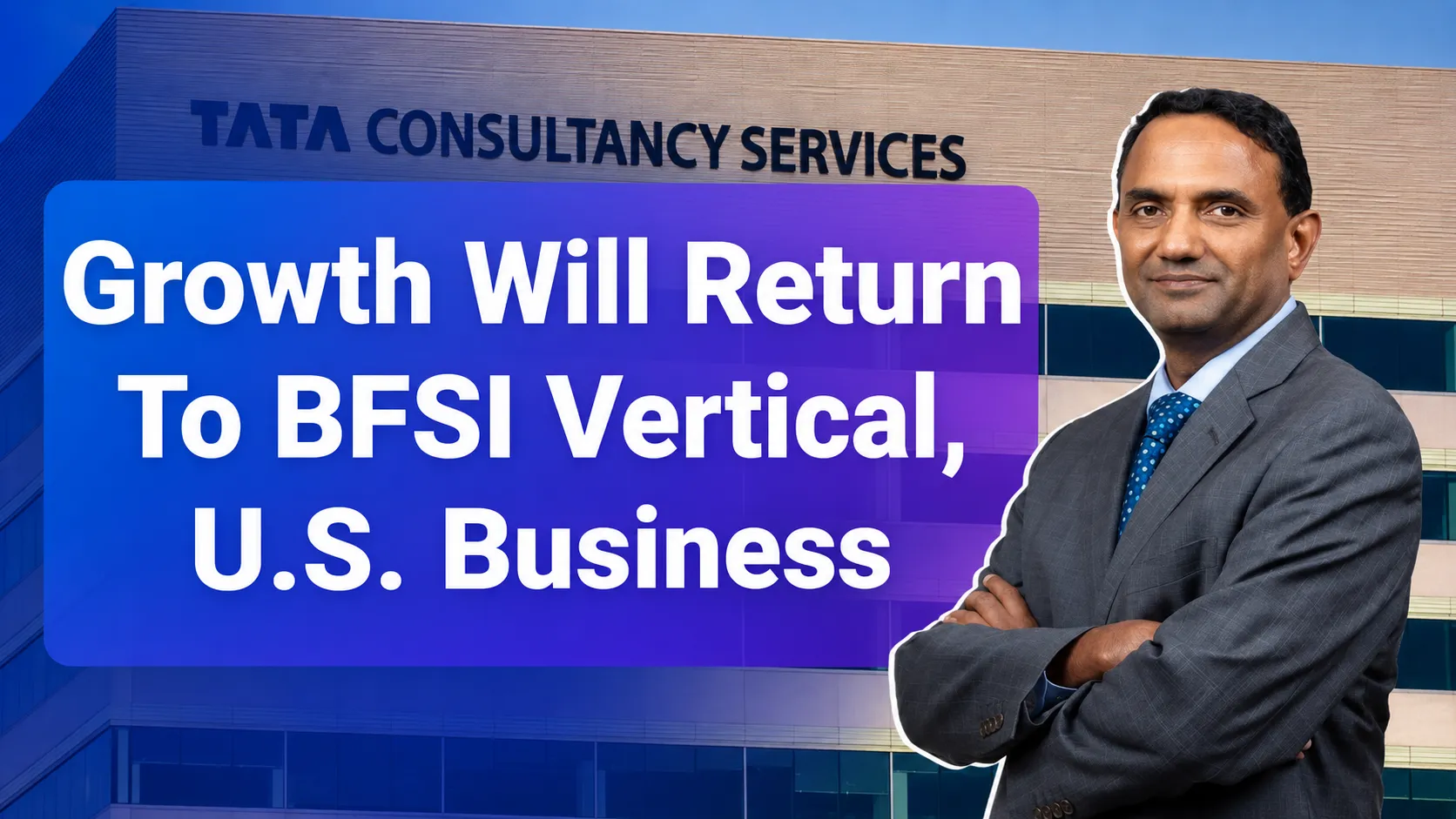
Much of the sell-side commentary heading into and following TCS's results has centered on the continued importance of the Banking, Financial Services, and Insurance vertical to the company's overall growth trajectory. BFSI has long stood as TCS's single largest structural revenue vertical, and this quarter's results benefited meaningfully from what analysts have described as a genuine pickup in technology spending among the company's banking clients, aided in part by a weaker rupee that has improved the relative economics of outsourced technology delivery from India. Sustained strength in BFSI demand — spanning core banking modernization, regulatory compliance technology, and increasingly, AI-driven fraud detection and customer experience platforms — will likely remain one of the most closely watched swing factors shaping TCS's growth trajectory through the remainder of FY27, given how directly the vertical's health tends to correlate with broader global financial services sector confidence and capital markets activity.
Why This Matters for India's IT Sector Narrative
TCS's results carry outsized significance for how the broader market reads the health of India's IT services industry this earnings season. As the sector's largest and most closely watched bellwether, TCS's performance functions as an early, high-visibility data point that shapes sentiment heading into results from peers including Infosys, Wipro, HCLTech, and Tech Mahindra. This quarter's combination of accelerating revenue growth, a robust order book, and a headline-grabbing AI transformation deal offered a notably more constructive narrative than some of the sector's more cautious recent quarters, even as the sequential profit dip and continued margin pressure from wage hikes served as reminders that the underlying demand environment remains far from fully resolved.
Crucially, TCS's India-specific business emerged as a standout within the broader results, posting growth of nearly 23 per cent year-on-year — a figure that has fueled broader industry commentary about the increasing importance of the domestic Indian market as a genuine growth lever for IT services companies that have historically derived the overwhelming majority of their revenue from North American and European corporate clients. That domestic strength, set alongside continued signs of stabilizing — if not yet fully recovering — discretionary technology spending among Western clients, offers a template that peer companies reporting in the days following TCS's print will inevitably be measured against.
The Dividend Signal
TCS's decision to declare a ₹12 per share interim dividend alongside these results is itself a meaningful signal to the market, reinforcing the company's decades-long track record of returning capital to shareholders even as it continues to invest heavily in AI infrastructure, talent development, and next-generation delivery capabilities. For the millions of Indian retail investors and institutional funds that hold TCS shares — a stock with a market capitalization of roughly ₹7.44 lakh crore, making it one of the most valuable listed companies in India — the dividend announcement offers a tangible, immediate return alongside the more forward-looking narrative embedded in the company's AI business scaling and its expanding order book.
Setting the Tone for the Rest of Earnings Season
With TCS's numbers now serving as the opening data point for what has become one of the busiest stretches of India's Q1 FY27 corporate earnings calendar — a period that has since included Wipro, Tech Mahindra, Reliance Industries, and a wave of major private sector banks reporting their own results — the company's blend of accelerating revenue growth, a marquee AI transformation win, and continued shareholder returns has offered the sector a genuinely constructive opening chapter. Whether that momentum can be sustained across the remainder of Indian IT's earnings season, and whether the AI-led deal momentum TCS showcased this quarter proves replicable at scale across its peers, will be among the most closely watched storylines for India's technology sector through the remainder of 2026.