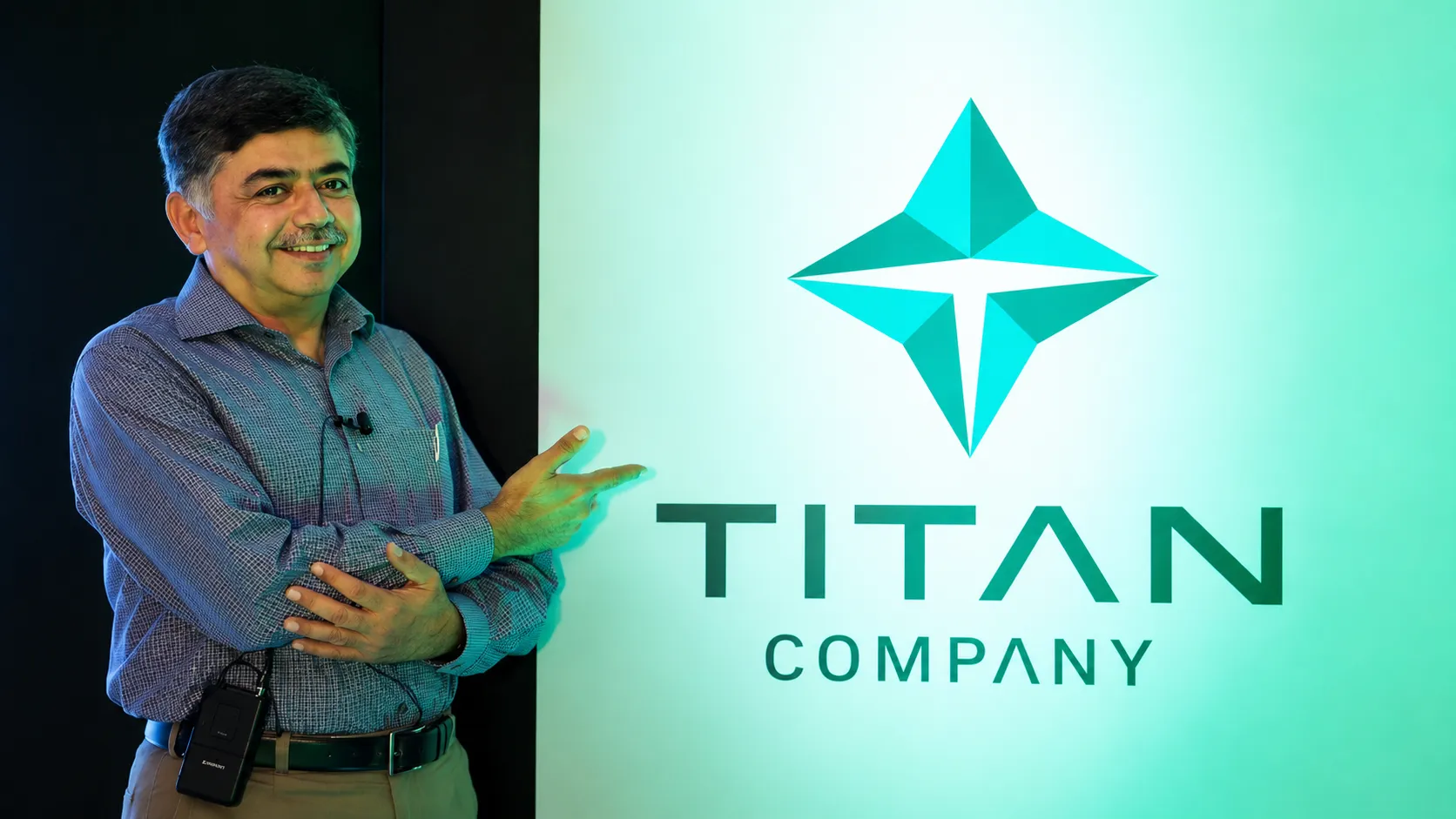
Some corporate milestones take decades to arrive and then, once achieved, seem to compound with startling speed. Few recent examples illustrate that pattern as vividly as Titan Company Limited, the Tata Group-backed jewellery, watches, and lifestyle conglomerate, which crossed ₹50,000 crore in annual revenue for the first time in fiscal year 2024-25 — a milestone reached only after nearly four decades since the company's founding as a watchmaking venture in 1984. What has followed since has stunned even seasoned Titan-watchers: in fiscal year 2025-26, the company added a further ₹25,000 crore in revenue in a single year, pushing consolidated total income to over ₹76,000 crore and, on a bullion-inclusive basis, closer to ₹88,000 crore.
"We had crossed the ₹50,000 crore annual revenue milestone in FY25 after nearly 40 years. The next ₹25,000 crore has been remarkably achieved in a single year of FY26," Titan's Managing Director Ajoy Chawla said, capturing in a single sentence the sheer scale of the acceleration the company has managed to pull off. For a business that began life selling analog wristwatches under the Titan and Fastrack brands, the scale and speed of this growth chapter represents one of the more remarkable transformation stories in recent Indian corporate history.
How FY25 Set the Stage
Titan's FY25 performance, reported earlier this year, already represented a landmark year in its own right. The company reported total income of roughly ₹57,818 crore for the twelve months ended March 31, 2025, marking 22 per cent growth over the prior year and, crucially, taking the company past the ₹50,000 crore revenue threshold for the first time in its history. Then-managing director C.K. Venkataraman, reflecting on the milestone at the time, noted that FY25 had been shaped by a range of external factors with varying effects across the company's different business lines, even as Titan's core operations delivered another year of strong 22 per cent revenue growth overall.
The FY25 growth story was driven overwhelmingly by Titan's jewellery division — the portfolio anchored by its flagship Tanishq brand alongside Mia, Zoya, and CaratLane — which posted a 21 per cent total income increase for the full year to roughly ₹46,571 crore, powered by a combination of strong festive-season demand, a healthy 30 per cent increase in gold jewellery and coin sales, and continued momentum in studded jewellery. Notably, even as elevated gold prices and a mid-year reduction in customs duty on gold imports weighed on profitability — Titan's profit before tax for FY25 actually declined marginally by around 2 per cent even as revenue surged — the jewellery division's underlying volume and value momentum remained robust, setting the stage for what was to come in FY26.
FY26: The Acceleration
If FY25 was a milestone year, FY26 was something closer to a step-change. Titan's consolidated total income for the fiscal year ended March 31, 2026, surged to approximately ₹76,078 crore, a roughly 33 per cent increase over FY25 — adding nearly ₹19,000 to ₹20,000 crore in incremental revenue in just twelve months, on top of an already-record base. On a bullion-and-digi-gold-inclusive basis, some reporting has pegged Titan's total consolidated revenue for the year at closer to ₹88,136 crore, or roughly $9.3 billion.
The growth was, once again, led overwhelmingly by jewellery, which now accounts for more than 90 per cent of Titan's consolidated income — a reflection of just how dominant Tanishq and its sister brands have become within the company's overall portfolio, even as Titan's original watches business, which contributed just ₹5,267 crore in FY26, has shrunk to roughly 6 per cent of total revenue. What makes the FY26 jewellery performance particularly striking is its accelerating quarterly trajectory through the year: the division posted year-on-year growth of 19 per cent in the first quarter, 21 per cent in the second, a sharp jump to 42 per cent in the third quarter, and an extraordinary 50 per cent growth in the fourth quarter alone — a pattern of consistently steepening momentum that is unusual for a business of Titan's scale.
Underlying this acceleration was a powerful combination of factors: a healthy double-digit increase in average selling prices across the jewellery portfolio, driven substantially by the sharp rise in gold prices over the course of the year, alongside genuinely strong underlying customer demand for gold jewellery, which company management said grew in the mid-thirties percentage range for the year. Gold coin sales proved a particularly notable bright spot, nearly tripling in value in the fourth quarter compared to the same period a year earlier — the second consecutive quarter of such dramatic coin sales growth, according to company disclosures, suggesting Indian consumers increasingly treated gold coin purchases as both an ornamental and investment decision amid the sustained rally in gold prices.
The Profitability Story
Crucially, unlike FY25 — when strong revenue growth had been partly offset by margin pressure tied to custom duty changes — FY26's growth translated far more cleanly into bottom-line expansion. Full-year EBIT climbed 47 per cent to approximately ₹8,082 crore, from ₹5,488 crore in FY25, while profit before tax surged 52 per cent to roughly ₹6,902 crore. Profit after tax followed a similar trajectory, rising 52 per cent for the full year to approximately ₹5,073 crore, up from ₹3,337 crore in FY25.
The fourth quarter of FY26 alone illustrated the scale of this momentum: consolidated total income for the quarter jumped 46 per cent year-on-year to roughly ₹20,300 crore, with net profit climbing 35 per cent to nearly ₹1,179 crore. Notably, even amid this blowout quarterly performance, Titan's EBIT margin for the fourth quarter actually contracted somewhat on a percentage basis compared to the prior year — a dynamic that some market analysts flagged as a point of concern, and one that contributed to a sharp roughly 7.6 per cent single-day decline in Titan's share price in the trading session following the FY26 results announcement, even as the headline growth numbers themselves were unambiguously strong. That reaction underscored a familiar pattern in how markets often respond to Titan's results: investors have grown accustomed to strong top-line growth from the company, and any signs of margin softness — even amid record revenue — can trigger disproportionate near-term stock price reactions.
Global Expansion and Strategic Acquisitions
Titan's growth story in FY26 was not confined to domestic markets. The company continued an aggressive international expansion push for its flagship Tanishq brand, opening new stores in markets including Sharjah in the United Arab Emirates and Atlanta and Santa Clara in the United States, extending Tanishq's international retail footprint to two dozen-plus stores across regions including Singapore and the broader Gulf Cooperation Council area — markets with substantial Indian diaspora populations that have proven a natural audience for Tanishq's blend of traditional Indian jewellery craftsmanship and contemporary design sensibility.
Perhaps most significantly for Titan's longer-term international ambitions, the company finalized the acquisition of a 67 per cent stake in Damas Jewellery during the fourth quarter of FY26, a deal that substantially strengthens Titan's presence across the Gulf Cooperation Council region and adds a further 123 stores to its global jewellery retail network. The Damas acquisition builds on Titan's earlier strategic moves in the jewellery M&A space, including its 2023 acquisition of a controlling stake in CaratLane, the contemporary, digitally-native jewellery brand that has itself become an important growth engine within the broader Titan portfolio, particularly among younger, urban Indian consumers seeking more affordable, everyday-wear jewellery options alongside Tanishq's more traditional, higher-ticket offerings.
Domestically, Titan continued to expand its physical retail footprint at a rapid clip throughout FY26, adding dozens of new stores across its Tanishq, Mia, and CaratLane formats each quarter, while the company's Watches & Wearables and Eyecare divisions — though now comparatively small relative to jewellery — continued posting healthy growth of their own, with premium watch brands and international eyewear labels delivering double-digit growth and Titan's Helios Luxe premium retail format continuing to expand.
Why Titan's Story Resonates Beyond the Balance Sheet
For a publication tracking the achievements of Indian enterprise on the global stage, Titan's growth trajectory carries significance well beyond its own shareholders. As one of the Tata Group's most valuable listed entities — with a market capitalization that has climbed to roughly ₹4 lakh crore, making it the conglomerate's second most valuable company after Tata Consultancy Services — Titan's performance functions as a powerful case study in how a legacy Indian manufacturing business can successfully reinvent itself as a consumer lifestyle powerhouse, diversifying well beyond its founding category into jewellery, eyewear, fragrances, ethnic wear, and international expansion, all while remaining anchored to the trust and brand equity built over four decades.
Titan's story also carries a broader signal about the trajectory of Indian consumer demand for gold and jewellery specifically. The company's ability to post accelerating growth throughout FY26 even amid historically elevated gold prices — a dynamic that might, in a more price-sensitive market, be expected to dampen demand — instead appears to have reinforced Indian consumers' relationship with gold as both an ornamental purchase and a store of value, with premiumization trends (reflected in rising average selling prices) proving a more powerful growth driver than any softening in unit volumes might have suggested.
The Businesses Beyond Jewellery
While jewellery has unquestionably been the engine behind Titan's extraordinary FY26 acceleration, the company's other business lines have continued to play meaningful, if smaller, supporting roles within the broader growth story. The Watches & Wearables division, the business that gave Titan its name and its original identity, posted total income growth in the mid-to-high teens for FY26, with analog watches continuing to show healthy demand and premium watch brands within Titan's portfolio achieving double-digit growth alongside rising average selling prices — evidence that even in a jewellery-dominated portfolio, the original watchmaking business retains genuine relevance and profitability, aided by Titan's continued investment in premium retail formats like Helios and the newer Helios Luxe concept aimed at discerning, higher-spending customers.
The Eyecare division, encompassing both prescription eyewear and sunglasses under various Titan-owned and licensed international brands, has also emerged as a quietly consistent growth contributor, with international eyewear brands posting particularly strong growth and sunglasses sales outpacing other product categories by a wide margin. Meanwhile, Titan's Emerging Businesses segment — which includes the Indian ethnic wear brand Taneira and the company's fragrances and fashion accessories portfolio — remains a comparatively small but strategically important part of the overall business, with the fragrances category in particular posting standout growth as Titan continues experimenting with new consumer categories that leverage its retail distribution strength and brand trust built over decades in jewellery and watches.
Titan's Position in India's Competitive Jewellery Landscape
Titan's dominant and accelerating growth has arrived at a moment of intensifying competition within India's organized jewellery retail sector, as a growing number of regional and national jewellery chains race to expand their own store networks and capture a larger share of India's shift away from unorganized, local jewellers toward branded, trust-driven retail formats. Titan's Tanishq brand has long been considered the gold standard — quite literally — for organized jewellery retail in India, and the company's FY26 performance suggests that lead has, if anything, widened further, aided by Tanishq's continued innovation around exchange programs that make it easier for customers to trade in old gold for new purchases, a mechanism that has proven particularly effective at driving incremental sales volume even amid historically elevated gold prices.
The CaratLane acquisition has also proven strategically prescient in this competitive context, giving Titan a genuine foothold among younger, digitally native, and more price-conscious jewellery buyers who might otherwise have been more receptive to newer, digitally focused jewellery challengers — allowing Titan to effectively compete across multiple price points and customer segments simultaneously, from Tanishq's premium, heritage-driven positioning to CaratLane's more contemporary, affordable, and digitally distributed offering.
What Comes Next
With Titan's next quarterly results — covering the first quarter of FY27 — scheduled for early August, investors and analysts will be watching closely to see whether the extraordinary momentum built through FY26 can be sustained into the new fiscal year, or whether the company's remarkable acceleration begins to moderate as it works against an increasingly difficult year-on-year comparison base. For now, though, Titan's journey from a modest Tata Group watchmaking venture to a nearly ₹90,000-crore consumer lifestyle powerhouse — one that added more revenue in a single year of FY26 than it took the company nearly four decades to first achieve — stands as one of the most compelling growth stories in contemporary Indian corporate history, and a powerful illustration of what disciplined brand-building, strategic acquisitions, and sustained category leadership can achieve over a long enough time horizon.