Magazine10 MIN READ

EPFO Launches 'VISHWAS 2026' One-Time Settlement Window For Employer Compliance Disputes

EPFO has launched VISHWAS 2026, a one-time settlement window for employer compliance disputes, aiming to clear years of pending penalty and damage litigation.

By Nisha Omkumar · Author20 July 2026
EPFO Launches 'VISHWAS 2026' One-Time Settlement Window For Employer Compliance Disputes

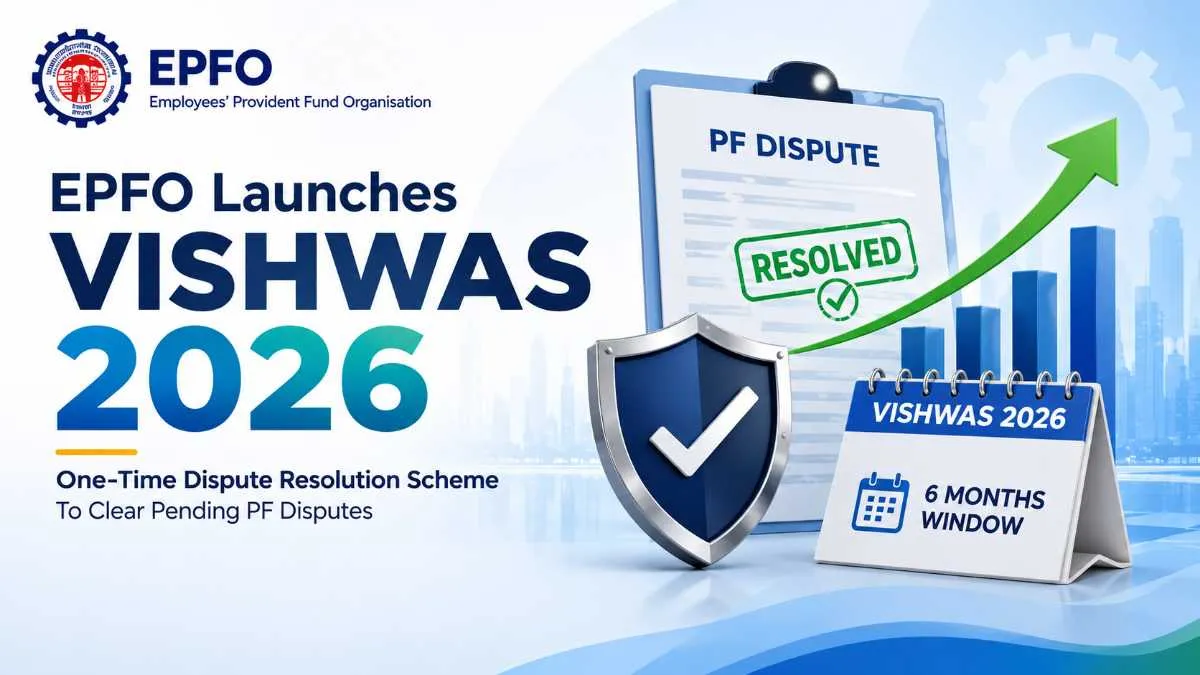
The Employees' Provident Fund Organisation has formally launched its "VISHWAS 2026" initiative, a significant one-time dispute resolution window designed to help employers settle outstanding penalty and damage-related compliance disputes with the retirement fund body amicably and out of court, rather than through the protracted litigation and appellate processes that have historically characterised such disagreements. The scheme, whose name evokes the Hindi word for trust, represents one of the most substantial administrative reforms EPFO has rolled out in recent years aimed specifically at clearing the enormous backlog of unresolved compliance disputes that have accumulated across the organisation's regional offices over decades of enforcement activity.

To understand the significance of this initiative, it helps to appreciate the scale and nature of the problem it is designed to address. EPFO, which administers retirement savings and pension benefits for tens of millions of formal-sector employees across India, has statutory powers to levy penalties and damages on employers found to be in violation of their provident fund contribution obligations — whether through late payment of dues, underreporting of employee wages for contribution purposes, or outright non-compliance with registration and reporting requirements. Over decades of enforcement activity, a substantial number of these penalty and damage assessments have been contested by employers, leading to disputes that frequently drag on for years, sometimes decades, as they wind their way through EPFO's internal appellate mechanisms and, in many cases, into the broader judicial system via labour courts, tribunals, and higher courts. This accumulated backlog has created a persistent source of friction between the organisation and India's employer community, while simultaneously tying up EPFO's own administrative and legal resources in prolonged adjudication rather than in more productive compliance and service delivery activities.

The VISHWAS 2026 scheme is explicitly framed as an effort to break this cycle by offering employers a defined, time-bound opportunity to settle their outstanding disputes through a negotiated, amicable process rather than continuing to pursue — or defend against — litigation that, in many cases, has already consumed years of legal costs and administrative effort on both sides without reaching a final resolution. While the precise mechanics of the settlement formula, including any reductions in penalty or damage amounts offered as an incentive for employers to opt into the scheme, have been detailed in EPFO's official scheme guidelines, the broader policy logic mirrors similar one-time settlement or amnesty-style schemes that various Indian regulatory and tax authorities have periodically rolled out over the years to clear litigation backlogs — schemes that have historically proven attractive to businesses seeking certainty and finality over the alternative of open-ended legal exposure, even when that certainty comes at the cost of accepting a settlement figure that may exceed what a company might have hoped to achieve through a fully litigated, favourable outcome.
optimized-image-1-57.jpg

For India's employer community, particularly small and medium enterprises that often lack the in-house legal resources or financial capacity to sustain protracted disputes with a well-resourced statutory body like EPFO, the VISHWAS 2026 window offers a potentially valuable opportunity to draw a line under legacy compliance issues and proceed with a clean compliance slate. Industry bodies representing small business interests have long flagged the burden that unresolved, long-pending EPFO disputes place on companies — not merely in terms of the direct financial exposure represented by contested penalty and damage assessments, but also in terms of the ongoing administrative and legal costs of maintaining active defences against claims that, in many cases, relate to compliance failures from years or even decades in the past, under different management, different regulatory interpretations, or different business circumstances entirely.

From EPFO's own institutional perspective, the scheme serves multiple strategic objectives simultaneously. Clearing a substantial volume of long-pending disputes through negotiated settlement rather than continued litigation frees up significant administrative and legal bandwidth within the organisation, allowing EPFO to redirect resources toward its core service delivery functions — processing provident fund withdrawals, pension disbursements, and account transfers for its vast base of subscriber employees — rather than sustaining an ever-growing docket of contested enforcement actions. The scheme also aligns closely with the broader "ease of doing business" agenda that the Indian government has pursued across multiple regulatory domains in recent years, an agenda explicitly aimed at reducing the compliance burden and legal uncertainty faced by businesses operating in India, particularly smaller enterprises that often cite regulatory and legal unpredictability as among their most significant operational challenges.

The timing of VISHWAS 2026's launch is also notable in the context of the broader wave of regulatory and administrative reforms rolling out across Indian government bodies this year. EPFO itself has separately introduced measures addressing address, name and signature mismatches to reduce administrative hurdles faced by nominees claiming provident fund units or proceeds after an investor's death — part of a broader pattern of the organisation working to streamline processes that have historically been criticised as bureaucratically cumbersome for both employers navigating compliance obligations and individual subscribers seeking to access their own retirement savings. Taken together, these parallel reform efforts suggest an organisation actively working to modernise its operational processes and reduce friction across multiple dimensions of its interactions with both employers and beneficiaries, rather than pursuing dispute resolution reform in isolation from its broader institutional modernisation agenda.

For labour law practitioners and compliance consultants who work closely with employers on EPFO-related matters, the launch of VISHWAS 2026 is likely to trigger a wave of activity as companies with pending disputes assess whether opting into the settlement window makes financial and strategic sense relative to continuing their existing legal defences. That assessment will typically hinge on factors including the strength of the employer's underlying legal position in the contested matter, the financial terms offered under the settlement scheme relative to the company's realistic assessment of its litigation risk, and the broader value the company places on achieving finality and certainty rather than continuing to carry an open, contested liability on its books indefinitely. Given that many such disputes involve penalty and damage assessments that have compounded over years of pendency, the settlement terms offered under VISHWAS 2026 could represent meaningful savings for employers relative to the cumulative exposure they might otherwise face if a dispute were ultimately resolved against them after years of continued litigation.
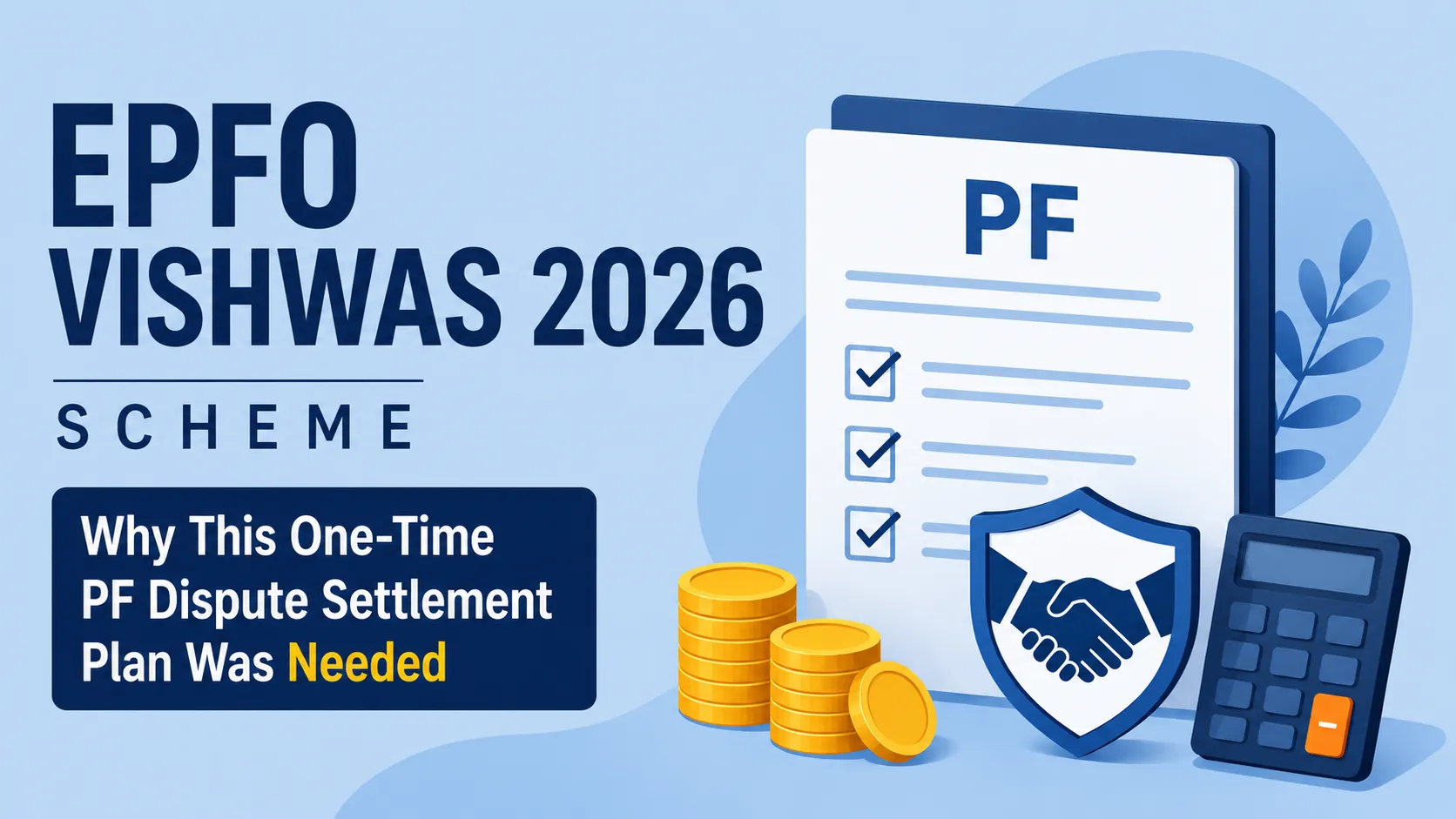

VISHWAS 2026 is designed to facilitate amicable, out-of-court settlements for outstanding penalty and damage-related employer compliance disputes — cutting through years of litigation that have benefited neither employers nor employees.
The Impactful Global Indian Business Desk

As the scheme's window remains open, EPFO officials and industry observers alike will be watching participation rates closely as an early indicator of how effectively the initiative is achieving its stated objectives. A strong uptake would suggest that Indian employers are increasingly receptive to structured, negotiated resolution mechanisms over adversarial litigation when it comes to statutory compliance disputes — a shift that, if it holds, could inform how other Indian regulatory bodies approach their own accumulated litigation backlogs in the years ahead. For now, VISHWAS 2026 stands as one of the more significant, if less headline-grabbing, administrative reforms to emerge from India's regulatory ecosystem in 2026, offering a practical, time-bound path for employers to finally close the book on years, and in some cases decades, of unresolved compliance disputes with one of the country's most consequential statutory bodies.

Historical precedent from other Indian regulatory domains offers useful context for how schemes of this nature tend to play out in practice. India's tax administration has periodically rolled out similar one-time settlement schemes for both direct and indirect tax disputes, including the Vivad se Vishwas scheme for income tax litigation and the Sabka Vishwas scheme for pre-Goods and Services Tax indirect tax disputes — both of which drew substantial participation from businesses seeking to close out long-pending litigation in exchange for negotiated settlement terms. EPFO's choice of the "VISHWAS" naming convention for its own scheme is unlikely to be coincidental, drawing directly on the demonstrated success and now well-recognised branding of these earlier tax dispute resolution initiatives, and signalling to the employer community that this scheme is being modelled on an approach that has previously delivered meaningful backlog reduction across other parts of India's regulatory apparatus.

Compliance and labour law experts advising employers on whether to participate in the scheme typically recommend a structured evaluation process: first assessing the total quantum of the disputed penalty and damage claim, including any accrued interest or compounding that may have occurred over the dispute's pendency; second, obtaining a realistic legal opinion on the likely outcome should the matter continue through existing litigation channels rather than being settled; and third, weighing the settlement terms on offer under VISHWAS 2026 against both of these factors to determine whether opting into the scheme represents genuine value relative to continuing an existing legal defence. For employers with a reasonably strong underlying legal position, continuing litigation may still make sense in some cases; but for the many employers facing genuinely uncertain outcomes after years of inconclusive proceedings, the certainty and finality offered by a structured settlement scheme is likely to prove attractive, particularly given the ongoing legal costs and management attention that prolonged EPFO disputes continue to consume even while their ultimate resolution remains undetermined.

The scheme's rollout also carries implications for EPFO's relationship with organised industry bodies and employer associations, several of which have for years advocated for precisely this kind of structured, negotiated resolution mechanism as an alternative to what they have characterised as an unnecessarily adversarial and protracted compliance enforcement culture within the organisation. Industry associations representing both large corporates and smaller enterprises have periodically flagged concerns that EPFO's enforcement approach, while rooted in legitimate statutory objectives of protecting employee retirement savings, has at times imposed disproportionate compliance burdens and legal costs on employers relative to the severity or intent behind the underlying compliance lapse — particularly for smaller businesses lacking the specialised payroll and compliance infrastructure of larger, more resourced corporates. Whether VISHWAS 2026 meaningfully addresses these longstanding industry concerns, or proves to be a more limited, narrowly targeted initiative, will become clearer as EPFO releases participation data and settlement outcomes over the coming months, offering the clearest test yet of whether this latest reform genuinely shifts the tenor of the relationship between India's retirement fund regulator and the employer community it oversees.

ChatGPT Image Jul 20, 2026, 12_39_59 PM.png

For India's broader ease-of-doing-business narrative, which the government has actively promoted both domestically and to international investors as evidence of a steadily improving regulatory environment, successful implementation of VISHWAS 2026 would offer a concrete, measurable data point beyond the more abstract improvements often cited in global business climate rankings and surveys. A meaningful reduction in EPFO's pending litigation caseload, achieved through voluntary employer participation in a negotiated settlement scheme rather than through continued adversarial enforcement, would represent exactly the kind of tangible regulatory modernisation outcome that both domestic industry bodies and international investors evaluating India's business environment have consistently identified as a priority area for continued reform, alongside parallel efforts already underway across India's tax administration, corporate registration processes, and other statutory compliance domains. If VISHWAS 2026 delivers even a fraction of the backlog clearance its tax-domain predecessors achieved, it would mark a genuinely consequential, if quietly executed, win for both EPFO and the employers it has spent years disputing with.

Employee and pension beneficiary advocacy groups, for their part, have offered a more cautious welcome to the scheme, emphasising that any settlement mechanism must be carefully designed to avoid inadvertently rewarding employers who deliberately withheld or delayed provident fund contributions at the expense of their employees' retirement savings, as opposed to those genuinely caught up in procedural or interpretive disputes over technical compliance requirements. EPFO officials have indicated that the scheme's design attempts to draw exactly this distinction, though the practical effectiveness of any such safeguards will only become fully clear once settlement outcomes begin accumulating and can be independently assessed against the organisation's stated objective of protecting employee retirement interests even while offering employers a genuine path to dispute resolution, rather than an inadvertent amnesty for wilful, deliberate non-compliance quietly dressed up and repackaged as a routine, well-intentioned technical settlement between a regulator and the very employers it is duty-bound to hold properly accountable.

As with any large-scale settlement initiative, the true measure of VISHWAS 2026's success will be visible only in hindsight, once EPFO publishes participation figures and the value of disputes formally closed under the scheme.

TagsEPFOVISHWAS2026EmployerCompliancePFIndiaLabourLawIndiaRetirementFundIndiaEasePlusOfDoingBusinessEPFOSchemeIndianBusinessNewsComplianceIndia

Reader reviews

Sign in to rate and review this article.
Loading reviews…

More from TIGI

The ₹7 Lakh vs. ₹45 Lakh Question: How the Telangana Theatre War Became a Battle for the Soul of Indian Cinema
Magazine

The ₹7 Lakh vs. ₹45 Lakh Question: How the Telangana Theatre War Became a Battle for the Soul of Indian Cinema

On the morning of May 28, a press note issued by the Telangana State Film Chamber of Commerce landed in the inboxes of journalists across the country, and the single-sentence announcement it contained—"The old rental system in theatres will be completely abolished from July 3"—was the culmination of a war that had been building for nearly four decades. The war was not fought between stars and studios, or between producers and directors, or between any of the glamorous combatants who dominate the business pages of the entertainment press. It was fought between the people who own the screens and the people who make the films, and it was fought over a question so fundamental that the industry had never thought to ask it: when a film earns a rupee at the box office, who deserves to keep it?

The Thalaivar's Trillion: How Rajinikanth Built a ₹1,200 Crore Empire on Style, Devotion, and One Signature Flick
Magazine

The Thalaivar's Trillion: How Rajinikanth Built a ₹1,200 Crore Empire on Style, Devotion, and One Signature Flick

He is the only Indian actor whose fans bathe his cutouts with milk. The only one whose film releases are treated as festivals, with state holidays declared and tickets selling for ₹5,000 on the black market. The only one who, at 75, commands a per-film fee of ₹200 crore – the highest in Indian history. And the only one who has never needed a pan-Indian strategy, because he has always been universal. Rajinikanth – or simply "Thalaivar" (The Leader) to his millions of devotees – has an estimated net worth of ₹1,200 crore (approximately $145 million) , making him the wealthiest actor in South India and second only to Shah Rukh Khan nationally. His brand valuation, according to Kroll 2025, is $180 million . He owns a production house (V Creations, run by his son-in-law), a sprawling real estate portfolio, a fleet of vintage cars, and the unwavering loyalty of a generation. But the numbers are almost besi

The Prince of Tollywood: How Mahesh Babu Built an ₹850 Crore Kingdom on Silence, Selectivity, and SS Rajamouli
Magazine

The Prince of Tollywood: How Mahesh Babu Built an ₹850 Crore Kingdom on Silence, Selectivity, and SS Rajamouli

In an industry that glorifies speed — four films a year, constant social media chatter, relentless brand visibility — Mahesh Babu has chosen the opposite path. He makes one film every two years. He posts on Instagram once a week (if that). He endorses fewer than a dozen brands at a time. And yet, when Sarkaru Vaari Paata crossed ₹100 crore in four days in 2022, or when the mere announcement of his collaboration with SS Rajamouli broke the internet, the world was reminded of a simple truth: scarcity creates value.