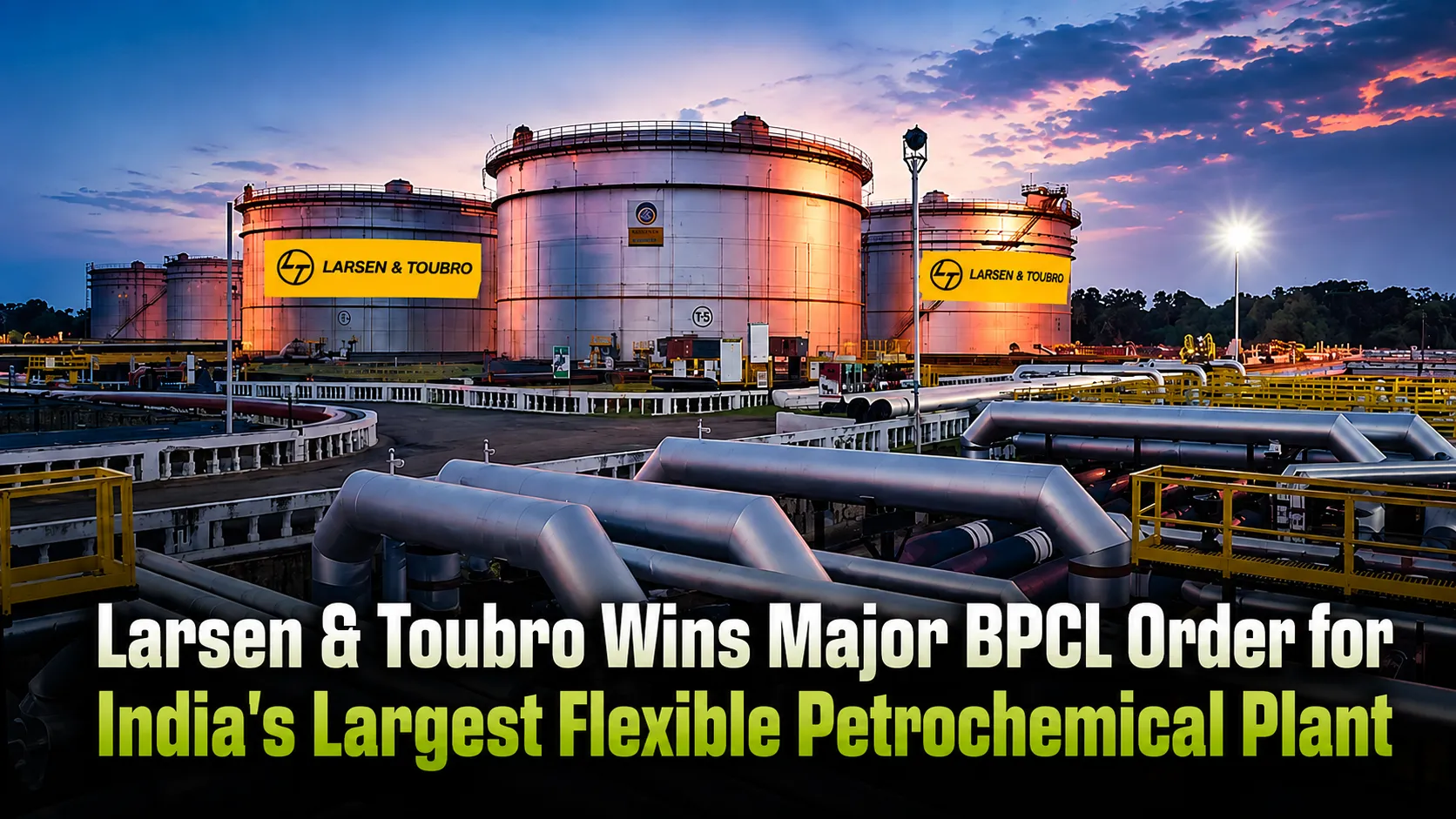
In the world of Indian infrastructure and engineering conglomerates, "major order" is a phrase that gets used often — but this week's announcement from Larsen & Toubro (L&T) carries a weight that goes beyond the usual corporate press release cadence. L&T's onshore energy vertical has secured what the company itself describes as a "major" order from Bharat Petroleum Corporation Limited (BPCL) to build what would become India's largest flexible petrochemical plant, a project that sits squarely at the intersection of two of the biggest themes shaping Indian industrial policy in 2026: energy security and domestic petrochemical self-reliance.
To understand why this order matters, it's worth stepping back and looking at the broader canvas on which it's being painted. India, over the past several years, has been engaged in an unusually candid and public reckoning with its dependence on imported energy and petrochemical products. The country imports roughly 85% of its crude oil requirements, a vulnerability that has been thrown into sharp relief throughout 2026 as renewed conflict in the Middle East — including the closure and reopening of shipping lanes through the Strait of Hormuz, and periodic surges in Brent crude prices above $85 a barrel — has repeatedly reminded policymakers just how exposed the Indian economy is to geopolitical shocks thousands of kilometers away. Against that backdrop, building domestic capacity not just to refine crude oil into fuel, but to further process it into the petrochemical feedstocks that underpin plastics, synthetic fibers, and countless other industrial inputs, has become a strategic priority rather than merely a commercial one.
What makes a petrochemical plant "flexible" — and why it matters
The term "flexible" in the context of a petrochemical plant isn't marketing language — it describes a specific and increasingly important engineering capability. Traditional petrochemical crackers are often optimized around a single feedstock and produce a relatively fixed slate of outputs, which works well when input costs and downstream product demand are stable, but leaves operators exposed when feedstock prices swing or when market demand shifts between different petrochemical derivatives. A "flexible" facility, by contrast, is engineered to process a range of different feedstocks — potentially including naphtha, propane, ethane, and other hydrocarbon streams — and to adjust its product mix depending on which combination is most economically advantageous at any given time.
For a company like BPCL, and for India more broadly, this flexibility translates into meaningful strategic optionality. It means the plant can pivot its sourcing depending on global feedstock price movements — insulating the facility, and by extension BPCL's petrochemical business, from being locked into a single, potentially volatile input cost structure. It also means the plant can respond more nimbly to shifts in downstream demand between different plastic and polymer product categories, which is particularly valuable in a domestic market like India's, where demand for packaging materials, synthetic textiles, automotive components, and construction materials is all growing simultaneously but at different, sometimes unpredictable rates.
L&T's role: engineering muscle for India's energy transition
For Larsen & Toubro, winning this order reinforces its position as one of the primary engineering, procurement, and construction (EPC) partners for India's largest energy infrastructure projects. L&T's onshore energy vertical has built a substantial track record executing complex hydrocarbon processing and infrastructure projects across the country, and contracts of this scale and technical complexity — large petrochemical crackers involve enormously sophisticated process engineering, specialized metallurgy to handle corrosive and high-temperature process streams, and integration with existing refinery infrastructure — tend to go to a relatively small pool of companies capable of managing that level of technical and project-execution risk.
This BPCL order arrives at a moment when L&T has been actively expanding its footprint across India's energy value chain, from renewable energy infrastructure to conventional hydrocarbon processing to, increasingly, green hydrogen and related emerging-technology projects. The petrochemical order fits into a broader pattern: L&T has positioned itself not merely as a construction contractor but as a long-term infrastructure partner for India's public sector energy companies as they navigate the dual mandate of expanding capacity to meet growing domestic demand while also modernizing and diversifying their asset base to remain competitive and resilient.
Why BPCL is making this move now
Bharat Petroleum's decision to invest in a large-scale flexible petrochemical facility should be read within the context of India's broader "petrochemical corridor" ambitions — a long-standing policy objective to reduce the country's reliance on imported polymers, synthetic rubber, and other petrochemical derivatives that currently form a meaningful chunk of India's non-oil, non-gold import bill. Public sector refiners like BPCL, Indian Oil Corporation, and Hindustan Petroleum have all, in various ways, been pursuing downstream diversification strategies that move them further up the value chain — from simply producing transportation fuels, which face long-term demand headwinds as electric vehicle adoption accelerates globally, toward petrochemicals, which benefit from structurally growing demand tied to packaging, construction, textiles, and consumer goods manufacturing.
This diversification strategy also serves a defensive economic purpose. Fuel retailing margins for public sector oil marketing companies are often subject to political sensitivity around retail pricing, particularly during periods of high crude oil prices when the government has historically been reluctant to allow full pass-through of costs to consumers at the petrol pump. Petrochemicals, by contrast, are priced according to global commodity market dynamics with fewer of the domestic political constraints that affect fuel pricing, giving companies like BPCL a more commercially unencumbered growth avenue. Building a large, flexible petrochemical facility, in other words, is as much about diversifying BPCL's own revenue and margin base as it is about serving the broader national interest in reduced import dependence.