Magazine9 MIN READ

$87 and Climbing: Why the Iran Standoff Is Once Again Holding India's Economy Hostage

Brent crude surged past $87 a barrel after the US reimposed a naval blockade on Iran, reigniting fears of a Strait of Hormuz disruption. Here's how the oil shock is rippling through India's currency, inflation, and markets.

By Aravind Kumar · Author15 July 2026Trending
$87 and Climbing: Why the Iran Standoff Is Once Again Holding India's Economy Hostage

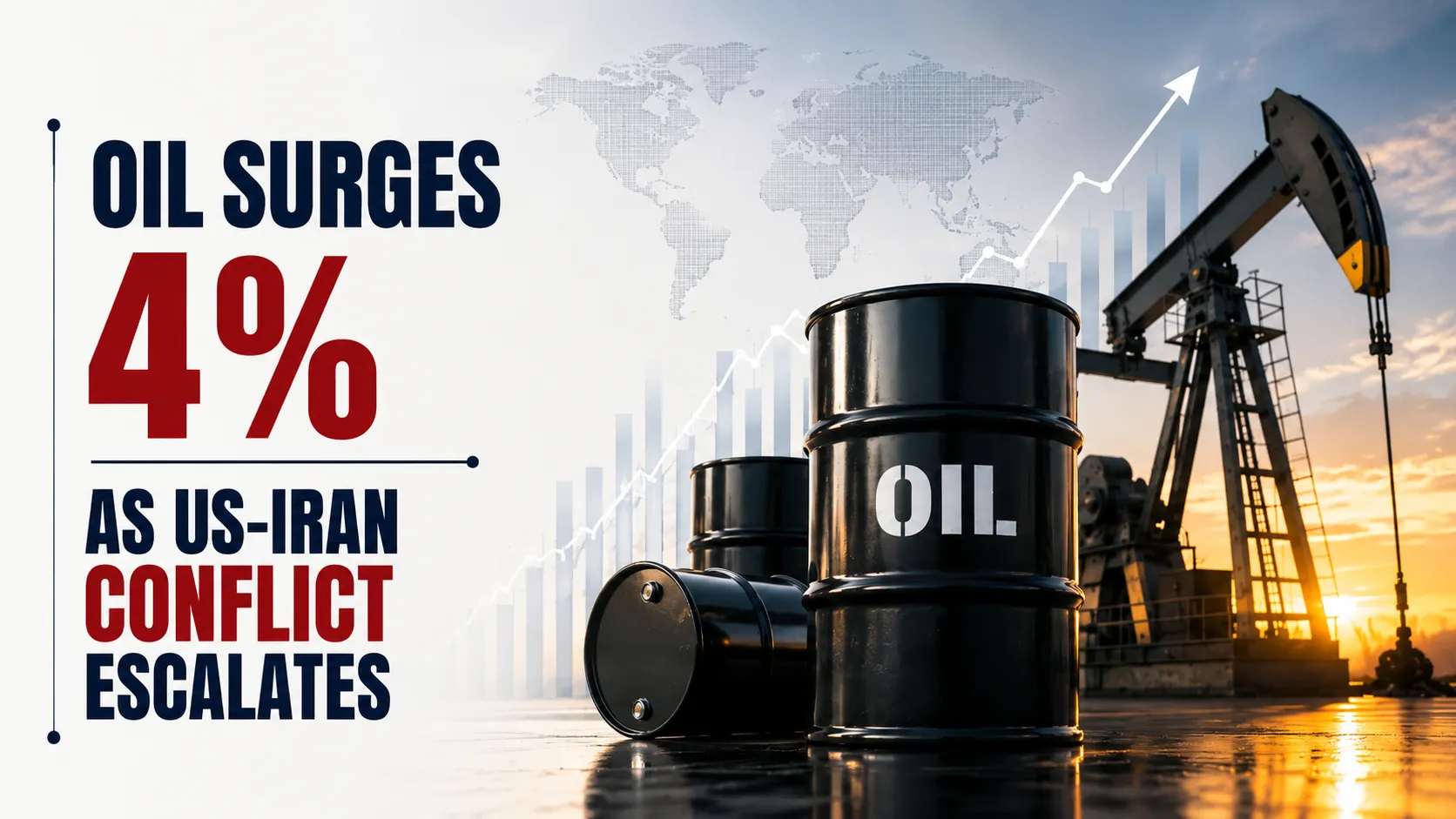
There are few economic relationships as tight, as immediate, and as consequential for India as the one between the price of a barrel of Brent crude oil and the health of the Indian economy. This week, that relationship was once again on full, uncomfortable display, as Brent crude futures surged more than 4% to touch $87 a barrel after the United States reimposed a naval blockade on Iranian shipping, reigniting fears of a broader disruption to one of the world's most critical energy corridors, the Strait of Hormuz.

For a country that imports roughly 85% of its crude oil requirements — a dependency that has remained stubbornly persistent despite decades of policy efforts to diversify India's energy mix and boost domestic production — a sustained move in oil prices of this magnitude isn't a distant geopolitical curiosity. It is a direct, near-immediate hit to the trade balance, the currency, inflation, and ultimately, the household budgets of over a billion Indians.

The trigger: a familiar conflict escalates again

The current bout of oil market volatility traces back to the renewed escalation of hostilities between the United States and Iran, a conflict that has flared and receded in intensity at multiple points throughout 2026, keeping global energy markets in a near-permanent state of elevated alertness. This latest escalation saw Washington move to reimpose a naval blockade targeting Iranian shipping — a measure explicitly designed to constrain Iran's ability to export crude oil and generate the revenue that funds its broader regional activities, but one that carries significant collateral risk for global energy markets given Iran's strategic position astride the Strait of Hormuz.

The Strait of Hormuz's significance to global energy markets is difficult to overstate: this narrow waterway, at its narrowest point barely 33 kilometers wide, serves as the transit route for a substantial share of the world's seaborne crude oil trade, connecting the oil-rich Persian Gulf producers — Saudi Arabia, Iraq, the UAE, Kuwait, and Iran itself — to global markets. Any credible threat to the free flow of shipping through this corridor, whether through direct military action, mining, or simply the kind of heightened tension that causes shipping insurers to raise premiums and vessel operators to reconsider transit routes, has historically been sufficient to send oil prices sharply higher, reflecting the market's pricing-in of tail risk even when an actual, sustained disruption to shipping volumes has not yet materialized.
ChatGPT Image Jul 15, 2026, 04_43_15 PM.png

Why India is uniquely exposed

While rising oil prices create economic headwinds for virtually every oil-importing nation, India's exposure is particularly acute for several interlocking reasons. First, the sheer scale of India's import dependency — at 85% of total crude requirements — means that oil price movements translate very directly into India's overall import bill and, by extension, its current account balance, a key metric that international investors and rating agencies watch closely as an indicator of a country's external financial stability.

Second, India's currency has historically shown a tight inverse correlation with oil price movements: as crude prices rise, demand for US dollars from Indian oil marketing companies and refiners (who need dollars to pay their overseas crude suppliers) increases correspondingly, placing direct downward pressure on the rupee. This dynamic has played out in textbook fashion through mid-July 2026, with the rupee sliding to as low as 96.2375 against the dollar — its weakest level in nearly two months — in the same trading sessions that saw Brent crude's sharp climb toward $87 a barrel.

Third, and perhaps most consequentially for ordinary households, oil price increases feed directly into India's inflation dynamics through multiple channels: higher transportation and logistics costs that raise the price of virtually every good that needs to be moved around the country, higher costs for petroleum-derived inputs like fertilizers that affect agricultural production costs, and — if the price increases prove durable enough that state-owned oil marketing companies eventually pass through higher costs to consumers at the pump — direct increases in the retail price of petrol and diesel. India's June 2026 CPI inflation reading of 4.38%, which breached the Reserve Bank of India's 4% target for the first time since January 2025, has already been partly attributed by economists to these oil-and-currency-driven imported inflation pressures.

The mechanics of how oil shocks ripple through the economy

To understand the full scope of an oil price shock's impact on India, it's worth walking through the transmission mechanism step by step. When crude prices rise, Indian oil marketing companies (state-owned entities like Indian Oil Corporation, Bharat Petroleum, and Hindustan Petroleum, which together handle the bulk of India's fuel refining and retailing) face higher costs to procure the crude oil they need to refine into petrol, diesel, and other fuel products. These companies then face a choice: absorb the higher costs themselves (which compresses their profit margins and can affect their own financial health and, in turn, their ability to invest in expansion, as illustrated by the ambitious petrochemical capacity expansion projects several of these companies have recently commissioned), or pass the higher costs through to consumers via higher retail fuel prices.

This pass-through decision is often politically sensitive, particularly in India, where fuel price increases have historically been a source of public discontent and have, at various points, become politically charged issues, especially during periods surrounding state or national elections. Governments have, in the past, intervened to moderate or delay full pass-through of higher crude costs to protect consumers from sudden price shocks, often at the cost of the oil marketing companies' own profitability or through fiscal measures like excise duty adjustments that affect government revenue.

For a country that imports roughly 85% of its crude oil requirements, a sustained move in oil prices isn't a distant geopolitical curiosity — it is a direct, near-immediate hit to the trade balance, the currency, inflation, and household budgets.
Editorial Desk

As of mid-July 2026, retail fuel prices had remained largely steady across the country, reflecting the fact that the latest price spike — while significant — is a relatively recent development that hasn't yet fully worked its way through the pricing decisions of oil marketing companies, who typically review and adjust prices based on rolling averages of international crude costs rather than reacting to single-day price spikes. Whether this stability holds depends heavily on how long the current elevated price environment persists.

Beyond fuel: the broader inflationary footprint

The transportation and fuel cost channel is only the most direct pathway through which oil prices affect the Indian economy. A less visible but equally important channel runs through India's chemical and petrochemical industries, many of which use crude oil derivatives as core production inputs — everything from plastics and synthetic fibers to fertilizers and various industrial chemicals. Higher crude prices raise input costs across this entire value chain, pressures that eventually work their way through to a broad range of consumer and industrial goods prices, from packaging materials to synthetic textiles to agricultural inputs that affect farmers' production costs and, ultimately, food prices.

This is part of why economists tracking India's June CPI data noted that the inflation uptick appeared to reflect both food price pressures and broader, non-food cost increases — a pattern consistent with an oil-and-currency-driven inflationary episode that extends well beyond the immediately visible fuel price line item in the CPI basket.

The equity market and investor response

Financial markets registered the oil price shock's significance in real time. India's benchmark Nifty 50 index declined roughly 0.7% as the combination of rising oil prices, a weakening rupee, and broader risk-off sentiment tied to the Middle East conflict spilled over into equity markets. Sectors with high sensitivity to oil prices and import costs — including aviation (which faces higher jet fuel costs), paints and chemicals companies (which use crude derivatives as key inputs), and tyre manufacturers (which rely on rubber and petrochemical inputs) — are typically viewed by analysts as the most directly exposed to sustained oil price increases, while conversely, upstream oil and gas exploration companies with domestic production assets can see relative benefit from higher realized prices on their own output.

Foreign institutional investors (FIIs), who have been broadly reducing exposure to emerging markets amid the global risk-off environment — contributing to a collective $46.1 billion in emerging-market equity outflows in June alone — turned net sellers of Indian equities in the sessions following the oil price spike, snapping what had been an eight-session buying streak, according to market data, underscoring how directly geopolitical and oil-market developments are shaping portfolio allocation decisions among global investors currently.

ChatGPT Image Jul 15, 2026, 04_44_15 PM.png

Government and RBI response options

Facing this combination of pressures, Indian policymakers have a limited but meaningful toolkit to draw upon. The Reserve Bank of India has been actively intervening in currency markets — through dollar sales in both the spot and non-deliverable forward markets — to moderate the pace of rupee depreciation, drawing on its substantial foreign exchange reserves of $674.19 billion to smooth what would otherwise likely be an even sharper currency decline. On the fiscal side, the government retains tools like excise duty adjustments on fuel, which can be used to moderate the pass-through of higher crude costs to retail consumers, though such measures come at the cost of government revenue and have historically been used judiciously given India's own fiscal deficit constraints.

Longer-term, India's energy policy has continued to emphasize diversification away from crude oil dependency — through expanded renewable energy capacity, growing electric vehicle adoption, and initiatives like the recently inaugurated hydrogen train pilot project in Haryana — though these structural shifts play out over years and decades, offering little immediate relief from the kind of acute, geopolitically-driven price shock currently working through the system.

What happens next depends on Tehran and Washington

Ultimately, the trajectory of oil prices — and by extension, much of the near-term path for India's currency, inflation, and market performance — depends on factors almost entirely outside India's control: whether the US-Iran standoff de-escalates, whether the naval blockade leads to any actual, sustained disruption of shipping through the Strait of Hormuz (as opposed to the current situation, where prices have moved sharply on the perceived risk of disruption even without significant actual supply loss), and whether other major oil producers, particularly Saudi Arabia and other OPEC+ members, respond to the price spike by adjusting their own production levels to help stabilize the market, as has occurred during previous periods of Middle East-driven oil price volatility.

For now, Indian policymakers, businesses, and households find themselves once again in a familiar but uncomfortable position: bracing for the economic consequences of a conflict playing out thousands of kilometers away, with little ability to influence its resolution, but with an economy structurally wired to feel its effects almost immediately.

TagsBrentCrudeOilPricesMiddleEastCrisisIndiaEnergyCrudeOilImportStraitOfHormuzEnergySecurityOilShock2026IndianEconomyGeopoliticalRisk

Reader reviews

Sign in to rate and review this article.
Loading reviews…

More from TIGI

The ₹7 Lakh vs. ₹45 Lakh Question: How the Telangana Theatre War Became a Battle for the Soul of Indian Cinema
Magazine

The ₹7 Lakh vs. ₹45 Lakh Question: How the Telangana Theatre War Became a Battle for the Soul of Indian Cinema

On the morning of May 28, a press note issued by the Telangana State Film Chamber of Commerce landed in the inboxes of journalists across the country, and the single-sentence announcement it contained—"The old rental system in theatres will be completely abolished from July 3"—was the culmination of a war that had been building for nearly four decades. The war was not fought between stars and studios, or between producers and directors, or between any of the glamorous combatants who dominate the business pages of the entertainment press. It was fought between the people who own the screens and the people who make the films, and it was fought over a question so fundamental that the industry had never thought to ask it: when a film earns a rupee at the box office, who deserves to keep it?

The Thalaivar's Trillion: How Rajinikanth Built a ₹1,200 Crore Empire on Style, Devotion, and One Signature Flick
Magazine

The Thalaivar's Trillion: How Rajinikanth Built a ₹1,200 Crore Empire on Style, Devotion, and One Signature Flick

He is the only Indian actor whose fans bathe his cutouts with milk. The only one whose film releases are treated as festivals, with state holidays declared and tickets selling for ₹5,000 on the black market. The only one who, at 75, commands a per-film fee of ₹200 crore – the highest in Indian history. And the only one who has never needed a pan-Indian strategy, because he has always been universal. Rajinikanth – or simply "Thalaivar" (The Leader) to his millions of devotees – has an estimated net worth of ₹1,200 crore (approximately $145 million) , making him the wealthiest actor in South India and second only to Shah Rukh Khan nationally. His brand valuation, according to Kroll 2025, is $180 million . He owns a production house (V Creations, run by his son-in-law), a sprawling real estate portfolio, a fleet of vintage cars, and the unwavering loyalty of a generation. But the numbers are almost besi

The Prince of Tollywood: How Mahesh Babu Built an ₹850 Crore Kingdom on Silence, Selectivity, and SS Rajamouli
Magazine

The Prince of Tollywood: How Mahesh Babu Built an ₹850 Crore Kingdom on Silence, Selectivity, and SS Rajamouli

In an industry that glorifies speed — four films a year, constant social media chatter, relentless brand visibility — Mahesh Babu has chosen the opposite path. He makes one film every two years. He posts on Instagram once a week (if that). He endorses fewer than a dozen brands at a time. And yet, when Sarkaru Vaari Paata crossed ₹100 crore in four days in 2022, or when the mere announcement of his collaboration with SS Rajamouli broke the internet, the world was reminded of a simple truth: scarcity creates value.