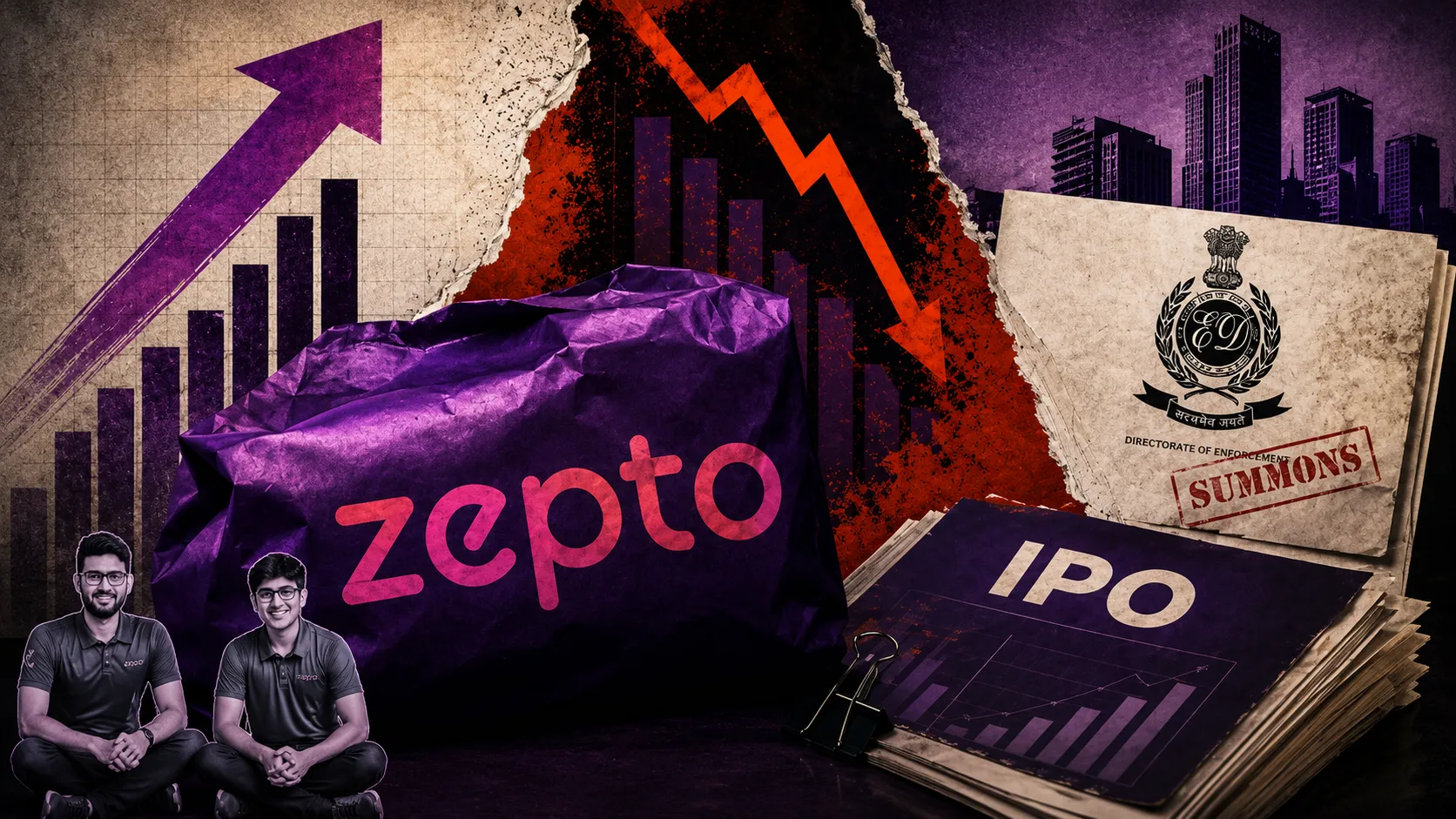
Mumbai, July 31, 2026 — When Zepto quietly shelved its long-anticipated initial public offering this week in favour of a smaller, more private pre-IPO placement, the headline story was straightforward enough: a valuation gap, a cooling market for loss-making consumer tech, a company buying time. But beneath that surface narrative lies a more specific and, in some ways, more consequential story about the changing psychology of India's mutual fund industry — the institutional gatekeepers whose collective judgment increasingly determines which of India's new-age technology unicorns get to become genuinely public companies, and on what terms.
According to people with direct knowledge of the process, the single most important reason Zepto's IPO stalled was not price alone, but the company's inability to secure committed anchor participation from the five largest mutual fund houses in India — the asset managers whose scale and market influence typically make or break sentiment around any large new-economy listing. This is not, on its face, an unusual occurrence; IPOs are priced through negotiation, and price discovery routinely involves some friction between issuer ambition and investor caution. What makes the Zepto episode notable is the scale of the mismatch and what it reveals about how differently India's largest fund managers are now approaching quick-commerce as a category, relative to how they approached it even eighteen months ago.
The portfolio overlap problem, explained
At the heart of mutual fund reluctance lies a straightforward, almost mechanical portfolio construction problem: concentration risk. Several of India's largest fund houses already carry substantial positions in Eternal, the parent company of Zomato and quick-commerce platform Blinkit, as well as in Swiggy, whose Instamart vertical competes directly with Zepto in the same category. Adding a third, large, richly-valued quick-commerce name to portfolios that already carry meaningful sector exposure through these two existing holdings would have meant a significant increase in aggregate quick-commerce concentration across many of India's largest actively managed equity funds — a trade that fund managers, when confronted with it directly during roadshow conversations, appear to have been unwilling to make at Zepto's proposed valuation.
This is a subtly different problem from simple valuation disagreement. A fund manager might be willing to pay up for a differentiated, uniquely positioned business even at a rich multiple; concentration risk, by contrast, is a portfolio-construction constraint that exists somewhat independently of how attractive any individual investment opportunity looks in isolation. Several fund managers reportedly indicated, in conversations during the roadshow process, that they viewed Zepto as a well-run, credible business but simply could not justify adding a third major position to an already concentrated sector bet within diversified equity portfolios that are themselves benchmarked against broad market indices in which quick-commerce carries a specific, limited weight.
The HNI outreach: a telling sign
Perhaps the most revealing detail to emerge from the process is the account of a senior investor already backing Zepto reportedly reaching out directly to high-net-worth individuals in the weeks before the IPO pause, in an apparent effort to shore up demand that institutional mutual fund investors were not providing. This kind of direct HNI outreach by an existing investor, ahead of a formal IPO process, is unusual and is generally read by market participants as a sign that the standard institutional book-building process was not generating the depth of committed demand that underwriters and company leadership had anticipated.
For a company of Zepto's scale and prior fundraising success — having raised $1.8 billion cumulatively from a roster of marquee global investors including CalPERS, General Catalyst and Nexus Venture Partners — needing to lean on HNI demand to compensate for institutional hesitation represents a meaningful signal about how the market's assessment of the company shifted between its private fundraising rounds and its public listing attempt. Private market investors, particularly the specialist venture and growth-equity funds that backed Zepto's earlier rounds, operate with fundamentally different return expectations, time horizons and risk tolerances than public market mutual fund managers, who must justify every position to retail unit-holders and are typically far more sensitive to near-term profitability visibility and valuation discipline.
What mutual fund managers actually want to see
Conversations with market participants familiar with how India's largest fund houses have approached quick-commerce as a category over the past year point to a fairly consistent set of concerns that appear to have shaped the Zepto decision. Chief among them: a credible, near-term path to sustained profitability, rather than continued reliance on the aggressive discounting and rapid dark-store expansion that has characterised the sector's growth phase. Fund managers have grown increasingly vocal, in both public commentary and private roadshow discussions, about wanting to see quick-commerce players demonstrate consistent, improving unit economics at the store level — evidence that the underlying business model works profitably at scale, not merely that it can capture market share through continued cash burn.
There is also a broader, category-level scepticism that appears to have hardened over the past year specifically. Having already lived through the post-listing performance of Eternal and Swiggy since their respective public debuts — performance that, while not disastrous, has at times tested investor patience around margin trajectory and competitive intensity — several large fund houses appear to have concluded that a third major quick-commerce bet needs to clear a meaningfully higher bar than the first two did, both on valuation and on demonstrated business quality, before it earns anchor investor commitment.
The view from Zepto's side
From Zepto's perspective, the company has consistently pointed to genuinely improving operating metrics as evidence that the business is maturing in exactly the direction institutional investors say they want to see. Daily order volumes have scaled to well over a million orders across the company's dark-store network, and management has previously described a majority of stores as turning toward profitability, alongside a stated ambition to deliver positive underlying Ebitda, excluding employee stock option costs, within specific near-term timeframes. The company has also undertaken a deliberate, multi-year effort to increase Indian domestic ownership of its capital table — from roughly 12% at one point to a targeted 40-50% ahead of listing — specifically to satisfy the kind of domestic-ownership expectations that Indian institutional investors and regulators typically favour for major public listings.
That these structural and operational efforts nonetheless failed to secure anchor mutual fund commitment suggests the gap that ultimately stalled the IPO was less about any single fixable deficiency and more about a fundamental difference in how growth-stage venture investors and public market mutual fund managers were pricing the same set of facts about Zepto's business.
A signal for the broader new-age IPO pipeline
The implications of this episode extend well beyond Zepto itself. India's pipeline of new-age technology companies eyeing public listings over the coming eighteen to twenty-four months includes a range of businesses across quick-commerce, fintech, SaaS and consumer internet — many of which will, like Zepto, need to secure meaningful anchor commitment from the same relatively small pool of large domestic mutual fund houses that effectively gatekeep large IPO success in India. Fund managers who have grown more disciplined and willing to walk away from a marquee name like Zepto are sending a clear signal to the broader pipeline: growth and brand recognition alone are no longer sufficient; demonstrated, near-term profitability discipline has become a genuine precondition for institutional buy-in, not merely a nice-to-have.
For founders and bankers preparing the next wave of Indian new-age IPOs, the lesson from Zepto's stalled listing is likely to reshape how roadshows are structured and how aggressively companies push valuation in initial conversations with anchor investors. Where earlier IPO cycles in 2021 and 2024 saw significant investor appetite for growth-at-scale narratives even amid ongoing losses, the current generation of India's largest fund managers appears to have recalibrated toward a more conservative, profitability-first framework — one that Zepto, for all its scale and market leadership, was not yet able to satisfy on the timeline and at the valuation it had originally targeted.
What happens next
For now, Zepto's roughly ₹1,000-crore pre-IPO placement offers a practical bridge, buying the company additional time to demonstrate further improvement in profitability metrics before it returns to institutional investors with what it will hope is a more compelling, better-substantiated case. Whether that renewed pitch, whenever it comes, proves more successful in winning over India's five largest mutual fund houses will likely serve as one of the more closely watched tests of investor sentiment toward India's quick-commerce sector — and toward new-age consumer technology more broadly — over the remainder of this IPO cycle.
How fund managers actually evaluate a roadshow
To understand why the Zepto process unfolded the way it did, it helps to walk through how institutional roadshows typically work in practice. In the weeks before a planned listing, company leadership and investment bankers conduct a series of structured meetings with the largest prospective institutional investors, presenting detailed financial projections, unit economics data, and a formal valuation justification. Fund managers, in turn, run these projections through their own internal models, stress-testing assumptions around growth rates, margin trajectory and competitive dynamics before arriving at an internal view of fair value — a view that may, and frequently does, diverge meaningfully from the valuation range the company and its bankers are seeking.
In Zepto's case, people familiar with the roadshow process describe a persistent and, in the final weeks before the pause, widening gap between the company's own valuation anchor near $7 billion — a figure established through its most recent private funding round — and the more conservative valuation ranges several large fund houses were reportedly modelling internally. This is not, in itself, an unusual dynamic; some degree of valuation tension between issuer and institutional investor is a normal feature of IPO price discovery. What made Zepto's situation more acute was the reported unwillingness of enough large funds to move meaningfully toward the company's preferred range, leaving underwriters unable to build the kind of committed anchor order book that would typically be required to proceed confidently with a listing of Zepto's intended size.

The role of investment bankers in the process
Investment banks managing Zepto's planned IPO would ordinarily have played a central role in bridging exactly this kind of valuation gap, using their own market intelligence and relationships with institutional investors to calibrate price expectations on both sides before a formal roadshow even begins. That the gap nonetheless proved wide enough to force a pause suggests either a significant miscalibration in initial price expectations, a genuine and rapid shift in institutional sentiment toward the quick-commerce sector during the specific window in which Zepto was preparing to list, or some combination of both factors. Market observers have noted that IPO timing itself carries real risk precisely because investor sentiment toward a given sector can shift meaningfully over the months-long preparation period between a company's decision to pursue a listing and its actual market debut — a dynamic that appears to have worked against Zepto in this instance.
Comparing Zepto's experience to Eternal and Swiggy's own listings
Both of Zepto's direct quick-commerce rivals successfully navigated their own public listings in recent years, offering a useful point of comparison for understanding what changed in institutional sentiment by the time Zepto attempted to follow. Eternal's 2021 listing and Swiggy's 2024 debut each occurred at different points in the broader market cycle and, importantly, before the current, more pronounced institutional emphasis on demonstrated profitability had fully taken hold among India's largest domestic fund houses. Both companies have, since their respective listings, faced their own share of investor scrutiny over margin trajectory and competitive intensity within quick-commerce — scrutiny that appears to have directly informed the more cautious, exacting standard fund managers applied when evaluating Zepto's own listing prospects.
What comes next for India's IPO market broadly
Beyond its implications for Zepto specifically, this episode offers a broader signal about the current state of India's primary market for new-economy listings. Investment bankers and legal advisers working across India's IPO pipeline suggest that the Zepto experience is likely to prompt more conservative initial price talk from other consumer technology companies preparing their own listings over the coming year, as founders and their advisers recalibrate expectations in light of the clear institutional message that growth alone, absent a credible profitability narrative, is no longer sufficient to guarantee anchor investor commitment at aggressive valuations.