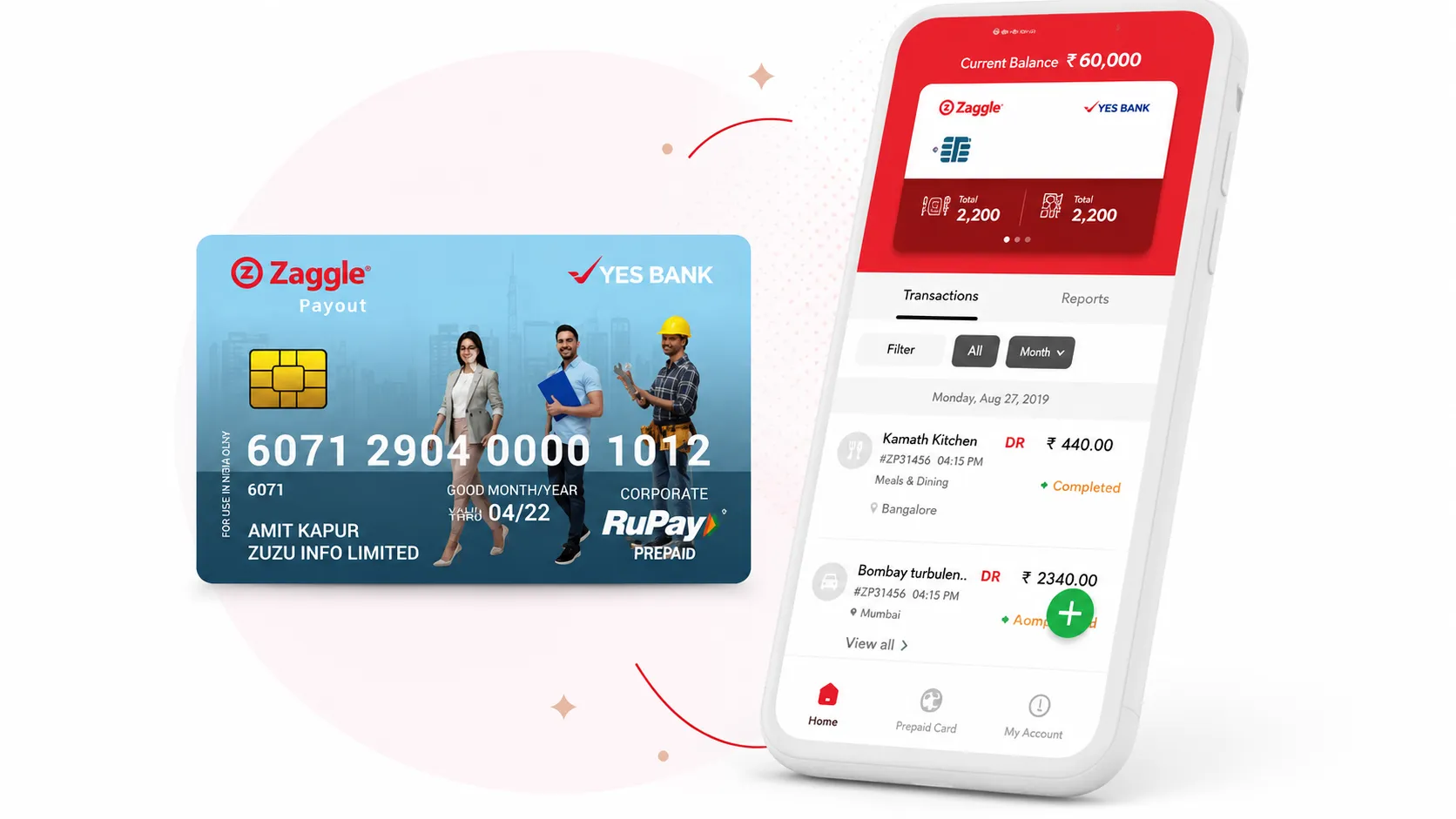
Zaggle, one of India's more prominent listed fintech players in the corporate spend-management space, has announced plans to acquire a 20 per cent strategic stake in Unobanc, a fintech firm focused on cross-border payment solutions, in a deal reportedly valued at approximately $1.5 million. The move, disclosed this week alongside a broader wave of funding and deal announcements across India's fintech and startup ecosystem, is being positioned by the company as a deliberate step to strengthen its cross-border corporate payment capabilities and expand its digital transaction infrastructure for businesses operating across international markets.
For readers less familiar with Zaggle's business, the company has built its reputation and listed market presence primarily around corporate spend-management solutions — a category that includes prepaid corporate cards, expense-management software, and a broader suite of tools that help businesses digitise and control how their employees spend company money, from travel and entertainment expenses to vendor payments and employee benefits disbursement. That core business has positioned Zaggle as one of the more closely watched fintech names on Indian exchanges, benefiting from the broader secular shift among Indian corporates away from manual, paper-based expense processes toward integrated digital spend-management platforms.
The strategic logic behind the Unobanc investment becomes clearer when viewed against that backdrop. As Indian businesses — from established exporters and multinational subsidiaries to a growing cohort of digitally native companies selling into international markets — increasingly require sophisticated tools to manage spend not just domestically but across borders, the ability to offer integrated cross-border payment rails alongside existing domestic spend-management capabilities represents a natural, adjacent expansion of Zaggle's core value proposition. Rather than building that cross-border payment capability entirely in-house, which would require significant regulatory navigation, correspondent banking relationships, and technology investment, a strategic minority stake in an already-operating cross-border payments specialist like Unobanc offers a considerably faster path to market for this specific capability.
Cross-border payments have, in fact, emerged as one of the more actively contested battlegrounds within India's broader fintech landscape over the past several years, driven by a combination of factors: the explosive growth of Indian companies' international trade and services exports, particularly in IT services, business process outsourcing, and increasingly direct-to-consumer e-commerce brands expanding into overseas markets; the persistent friction, cost, and settlement-time inefficiencies that have historically characterised traditional correspondent-banking-based international transfers; and rising demand from India's substantial freelancer and remote-work economy, whose participants increasingly need efficient ways to receive international payments for services rendered to overseas clients. Fintech players who can meaningfully reduce the cost, speed, and complexity of moving money across borders have found themselves addressing what remains one of the more persistently underserved corners of India's otherwise rapidly digitising financial infrastructure.
The relatively modest headline deal value of $1.5 million for a 20 per cent stake suggests this transaction is best understood as an early-stage strategic and technology partnership rather than a large-scale acquisition of a mature, revenue-generating business — a structure that is fairly common in the fintech sector, where an established, listed player takes a meaningful minority position in a smaller, more nimble specialist firm, gaining both financial upside and, often more importantly, technology integration rights, commercial partnership terms, and a pathway toward deeper collaboration or eventual full acquisition should the initial partnership prove successful. This kind of structured, minority-stake-first approach allows the acquiring company to test product-market fit and integration feasibility before committing the larger capital outlay that a full buyout would require.
This transaction also arrives amid what has been a notably active week for fintech and broader startup deal-making across India, with a cluster of funding announcements emerging in quick succession — including a wealthtech platform's ₹387 crore funding round led by a prominent venture capital firm, and the launch of a dedicated ₹1,500 crore venture fund aimed at backing early-stage deeptech and energy-transition startups. That broader flurry of activity suggests India's private capital markets, much like its public IPO pipeline, have continued to see robust deal flow even as the secondary equity market has weathered a challenging stretch driven by crude-oil volatility and currency pressure — a divergence that speaks to the relative insulation of private, venture-stage capital allocation decisions from the shorter-term sentiment swings that dominate public-market trading.
For Zaggle specifically, the Unobanc investment fits into a broader pattern of strategic, capability-expanding moves that listed fintech companies in India have increasingly pursued as they mature beyond their initial core product offering and look to build out more comprehensive, platform-style value propositions for their corporate customer base. Rather than remaining a single-product spend-management vendor, companies in this category have generally found that expanding into adjacent categories — whether cross-border payments, embedded lending, corporate card issuance partnerships, or broader banking-as-a-service infrastructure — both deepens customer stickiness and expands the addressable revenue opportunity per customer relationship, a dynamic that public-market investors have increasingly come to reward with premium valuations for fintech companies demonstrating successful platform expansion.
From Unobanc's perspective, meanwhile, securing a strategic investment and partnership from an established, listed fintech player like Zaggle offers meaningful advantages beyond the immediate capital infusion — including access to Zaggle's existing corporate customer base, potential integration into Zaggle's broader spend-management platform that could accelerate Unobanc's own customer acquisition, and the credibility and market validation that comes with securing backing from a recognised, publicly listed strategic partner rather than relying solely on traditional venture capital funding rounds. For early and growth-stage fintech companies operating in the cross-border payments space, this kind of strategic partnership model has become an increasingly common alternative — or complement — to traditional VC fundraising, particularly for companies whose product roadmap benefits directly from deep integration with an established platform's existing customer relationships.
The broader regulatory environment governing cross-border payments in India also forms an important backdrop to transactions of this nature. The Reserve Bank of India has, over recent years, been actively working to modernise India's cross-border payment infrastructure, including initiatives aimed at linking India's domestic Unified Payments Interface with payment systems in partner countries, and broader efforts to reduce the cost and friction associated with international remittances and business payments. Fintech companies operating in this space must navigate a fairly complex regulatory landscape spanning RBI guidelines on cross-border payment aggregation, foreign exchange management regulations, and increasingly stringent anti-money-laundering and know-your-customer compliance requirements — making established regulatory relationships and compliance infrastructure a genuinely valuable asset for any company operating in this category, and likely a meaningful part of what made Unobanc an attractive strategic partner for Zaggle in the first place.
Looking ahead, the success of this transaction will likely be measured not just by the financial returns on Zaggle's minority stake, but by how effectively the two companies can integrate their respective product offerings to deliver a genuinely differentiated cross-border corporate payments experience for Zaggle's existing customer base. Should the partnership prove successful, it would not be surprising to see Zaggle deepen its stake in Unobanc over time, following the kind of strategic-stake-to-full-acquisition pathway that has become a fairly well-established pattern in India's fintech M&A landscape over recent years, as larger, listed players progressively absorb smaller, specialised fintech capabilities to build out increasingly comprehensive financial services platforms for their corporate and consumer customers alike.
For now, the deal stands as one more data point in what has been an unusually active period for fintech dealmaking in India through the middle of 2026, reinforcing the broader thesis that cross-border payments remain one of the more actively contested, and commercially attractive, frontiers within the country's rapidly evolving financial technology landscape.
It is worth situating this transaction within the broader trajectory of Zaggle's own public-market journey. Since its listing, the company has been tracked closely by investors as a bellwether for India's broader corporate spend-management and fintech-enablement sector, with its quarterly results and strategic announcements often serving as a reference point for how the market is pricing growth prospects across comparable listed and pre-IPO fintech companies operating in adjacent categories. A strategic move of this nature — expanding into cross-border payments through a minority stake rather than organic build-out — is likely to be read by covering analysts as a signal of management's broader capital-allocation philosophy, favouring measured, partnership-led expansion into adjacent categories over more capital-intensive, higher-risk organic diversification bets.
The Indian fintech M&A landscape more broadly has, over the past two to three years, matured considerably beyond its earlier phase of predominantly venture-capital-funded growth, with an increasing number of transactions now involving established, often listed, fintech players acquiring or taking strategic stakes in smaller, more specialised companies — a pattern that mirrors the broader consolidation dynamics seen in more mature fintech markets internationally. That maturation reflects both the natural evolution of India's fintech sector as it moves beyond its initial hyper-growth, venture-funded phase, and the practical reality that building genuinely comprehensive financial services platforms increasingly requires the kind of broad capability stack that is often more efficiently assembled through selective acquisition and partnership than through purely organic product development.
For customers and end-users of both Zaggle's and Unobanc's respective platforms, the practical implications of this partnership, should it proceed toward deeper product integration, would likely centre on a more seamless experience for Indian businesses needing to manage both domestic corporate spend and cross-border payment obligations through a single, unified platform interface — reducing the operational friction that currently often requires businesses to work across multiple disconnected banking relationships, payment processors, and compliance workflows when managing international transactions alongside their domestic spend-management needs. That kind of platform consolidation has consistently proven to be one of the more durable value propositions in enterprise fintech, given how directly it translates into measurable time and cost savings for corporate finance and treasury teams managing increasingly complex, multi-currency operational footprints.

As with any strategic minority-stake investment of this nature, the coming quarters will offer the clearest read on whether this partnership evolves into the kind of deep, mutually reinforcing integration that both companies are presumably hoping for, or whether it remains a more limited, arms-length financial investment. Either way, the transaction adds one more data point to what has become an increasingly active and closely watched corner of India's broader fintech ecosystem, as the country's growing base of internationally engaged businesses continues to demand more sophisticated, integrated cross-border financial infrastructure. Investors and industry watchers tracking Zaggle's next few quarterly disclosures will likely be looking for early commentary on integration progress and any measurable contribution from the Unobanc partnership to the company's broader cross-border transaction volumes. Until then, the deal serves as a useful, concrete illustration of how India's fintech sector continues to knit itself together through exactly this kind of targeted, capability-driven strategic investment rather than relying solely on either pure organic growth or full-scale acquisition. It is precisely this kind of incremental, partnership-first dealmaking that industry observers expect to define the next phase of consolidation across India's crowded but still-maturing fintech landscape, as more established players look to plug specific capability gaps rather than attempt to build every adjacent product line from scratch. For Zaggle, Unobanc, and the broader ecosystem of Indian fintech companies watching this deal unfold, the coming quarters will offer a live, real-world test of whether that partnership-first playbook can deliver the kind of durable competitive advantage its proponents believe it can. Given the pace at which India's fintech landscape continues to evolve, it would not be surprising to see several more transactions of this size and structure announced before the year is out, each testing the same fundamental thesis: that specialised capability, acquired quickly through partnership, can compound faster than capability built slowly from scratch. That thesis, if it continues to hold, has real implications for how founders, investors, and strategists across India's fintech sector approach their own build-versus-partner decisions in the years ahead, and this transaction, modest as its headline value may be, offers one more real-world data point in that ongoing, sector-wide experiment that will keep shaping India's fintech landscape for years to come.