
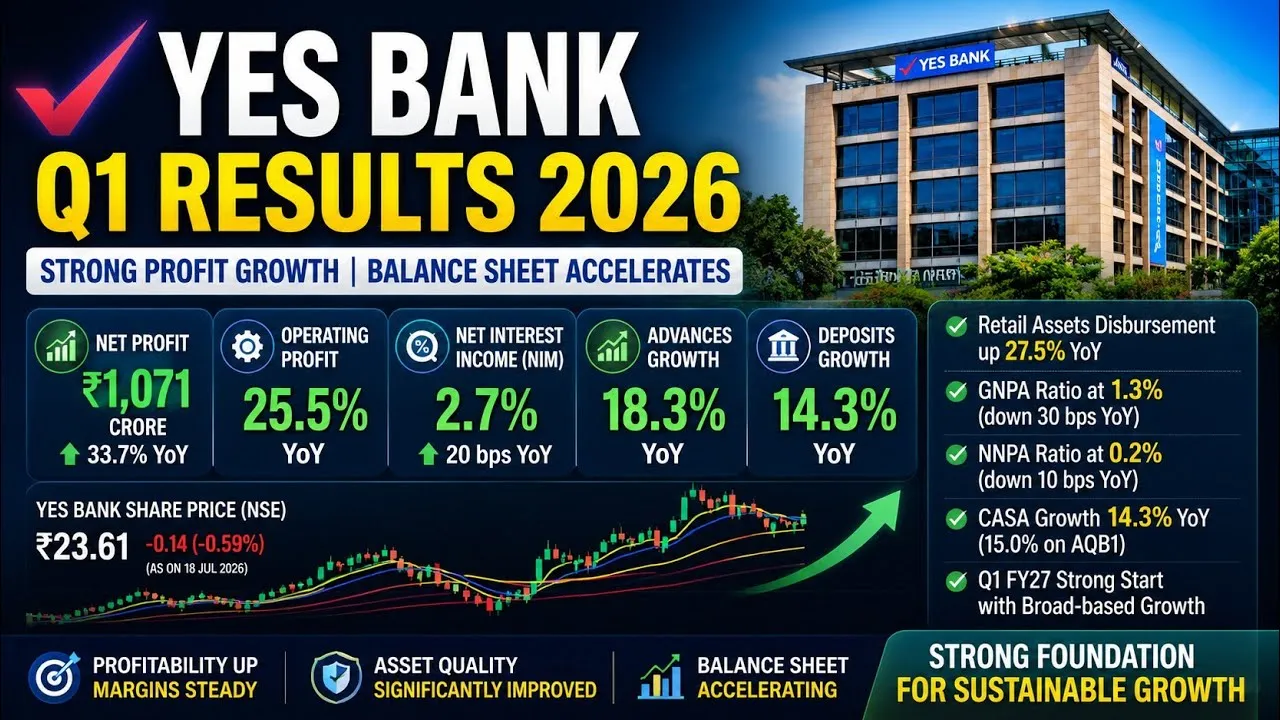
Yes Bank, the private sector lender that underwent a dramatic, regulator-led reconstruction scheme in March 2020 following a severe governance and asset quality crisis, reported a 33 per cent year-on-year jump in net profit to ₹1,072 crore for the first quarter of financial year 2027, extending what has become one of the more closely watched corporate turnaround stories in Indian banking over the past several years. The results, released as part of a broader wave of large-bank earnings within the same reporting window, reinforced a now multi-year trend of steadily improving financial performance at the bank, even as its profitability continues to trail significantly behind that of India's largest and most established private lenders in absolute terms.
Bank chief executive Vinay M Tonse, commenting on the results, credited the bank's continued focus on improving asset quality and disciplined cost management as the primary drivers behind the quarter's performance, themes that have consistently featured in the bank's management commentary through successive quarters of its ongoing recovery journey since the 2020 reconstruction.
The results landed within a broader Q1 FY27 banking earnings season that saw several of India's largest lenders report results within a tight, overlapping reporting window, giving investors an unusually direct opportunity to compare Yes Bank's continued recovery trajectory against both its larger, more established private-sector peers and other institutions navigating their own distinct post-crisis rebuilding journeys within India's broader banking system.
A Turnaround Half A Decade In The Making
Yes Bank's current trajectory stands in stark contrast to the crisis that gripped the institution in early 2020, when a combination of aggressive corporate lending practices, significant asset quality deterioration and governance failures brought the bank to the brink of collapse, ultimately requiring a Reserve Bank of India-orchestrated reconstruction scheme that saw a consortium of Indian banks, led by State Bank of India, inject fresh capital to stabilise the institution and protect depositors. The subsequent five years have been characterised by a methodical, if gradual, rebuilding process, encompassing a comprehensive clean-up of the bank's legacy loan book, a substantial overhaul of its risk management and underwriting practices, and a broader cultural and governance reset under new leadership.
This quarter's 33 per cent profit growth, while impressive in percentage terms, needs to be understood against this specific historical backdrop: the bank's profitability today, even after several years of consistent improvement, remains a fraction of what its balance sheet size might suggest is achievable, reflecting the lingering, if steadily diminishing, drag from its earlier crisis-era legacy issues. Analysts covering the stock have consistently framed Yes Bank's investment case as a multi-year normalisation story, one in which sustained, credible improvement in core profitability metrics — rather than any single quarter's headline growth rate — is the more meaningful signal of the turnaround's durability.
Asset Quality: The Central Storyline
Asset quality has remained the single most closely scrutinised metric in Yes Bank's post-reconstruction results, given the central role loan book deterioration played in the bank's original crisis. This quarter's results showed continued improvement on this front, with management specifically highlighting progress in reducing the bank's stock of legacy stressed assets, a process that has involved a combination of recoveries, write-offs and strategic sales of distressed loan portfolios to asset reconstruction companies over the preceding several years.
The bank's provision coverage ratio, closely tracked as an indicator of how well-cushioned the institution is against any further deterioration in its loan book, has also shown steady improvement over successive quarters, according to analysts who track the bank closely, even as it continues to trail the more conservative provisioning levels maintained by India's largest and most established private banks. This gap, analysts note, reflects both Yes Bank's still-recovering capital position and the bank's calculated strategy of balancing continued provisioning discipline against the need to demonstrate improving core profitability to reassure investors and depositors alike.
Cost Discipline And Operating Leverage
Alongside asset quality, cost management has emerged as an increasingly important theme in Yes Bank's turnaround narrative, with management pointing to improved operating leverage — the degree to which revenue growth outpaces growth in operating expenses — as a key contributor to this quarter's profit growth. The bank has, over recent years, invested significantly in digital banking infrastructure and process automation, initiatives management has credited with helping to control cost growth even as the bank's overall balance sheet and transaction volumes have continued to expand.
This focus on cost discipline is particularly significant for a bank in Yes Bank's position, given that a leaner, more efficient cost base provides greater flexibility to absorb any future asset quality shocks without the kind of severe capital erosion that characterised the bank's 2020 crisis, while also supporting a faster path toward return on equity metrics that could eventually approach those of the bank's more established private-sector peers.
Deposit And Loan Growth Trends
Yes Bank's deposit franchise, which suffered a severe and highly visible run during the 2020 crisis as depositor confidence collapsed, has been a particular area of management focus in the years since, with the bank investing heavily in rebuilding trust among both retail and corporate depositors. This quarter's results are understood to show continued, steady growth in the bank's deposit base, alongside a gradual improvement in the proportion of low-cost current account and savings account deposits within that base — a metric closely watched as an indicator of the bank's improving competitive positioning and customer trust levels relative to the depths of the 2020 crisis.
Loan growth has similarly continued at a measured, disciplined pace, with management emphasising a deliberate strategy of prioritising loan book quality over sheer growth velocity, a markedly different approach from the aggressive, and ultimately destabilising, lending practices that characterised the bank's pre-crisis era. This more conservative growth posture, while resulting in a comparatively modest pace of balance sheet expansion relative to some sector peers, has been broadly endorsed by analysts as the appropriate strategic priority for a bank still in the process of fully rebuilding institutional and investor trust.
How The Stock Has Responded
Yes Bank's stock has, over the multi-year course of its turnaround, attracted a distinctive and highly engaged base of retail investors, many of whom entered the stock at various points during and after the 2020 crisis, drawn by its comparatively low per-share price and the prospect of participating in a successful corporate turnaround story. This broad retail ownership base has, at times, contributed to periods of elevated stock price volatility around quarterly results, with the stock's reaction to this quarter's numbers understood to have been broadly positive, if measured, reflecting a market that has grown increasingly accustomed to steady, incremental improvement rather than any single dramatic turning point in the bank's results.
Institutional investor interest in the stock has also grown gradually over recent years, as successive quarters of clean, credible earnings growth have helped rebuild the kind of longer-term institutional confidence that was severely damaged during the 2020 crisis, even as many large institutional investors continue to maintain a relatively cautious position size in the stock pending further, sustained evidence of the turnaround's durability.
Comparing Yes Bank's Recovery To Sector Peers
Set against the broader Q1 FY27 earnings season, Yes Bank's 33 per cent profit growth represents one of the sharper percentage gains among India's listed banks, though analysts are careful to note that this needs to be read in the context of the bank's still-recovering base rather than treated as directly comparable to the growth rates posted by more established peers such as HDFC Bank or ICICI Bank, whose profit bases are many multiples larger. Even so, the consistency of Yes Bank's improvement — now stretching across a multi-year run of sequential quarters showing steady, rather than erratic, progress — has increasingly been cited by analysts as the more meaningful signal than any single quarter's specific growth percentage.
Public sector banks undergoing their own post-crisis recovery journeys, including several that reported sharp percentage profit gains within the same broader reporting window, offer a useful point of comparison, with analysts noting that India's banking sector as a whole has, over the past several years, been characterised by this broader pattern of institutions recovering from earlier asset quality crises delivering some of the sector's sharpest headline growth rates, even as the sector's more established leaders continue to deliver steadier, if more modest, percentage gains off a considerably larger base.
The Retail Depositor Trust Rebuilding Effort
A particularly important, if less frequently quantified, dimension of Yes Bank's turnaround has involved the multi-year effort to rebuild trust among retail depositors following the highly public 2020 crisis, during which the bank faced a severe deposit run and a temporary moratorium on withdrawals that left a lasting impression on public perception of the institution. Management has, over subsequent years, invested significantly in rebuilding this trust through a combination of transparent communication, technology-driven customer service improvements, and a demonstrable, sustained track record of financial stability that stands in deliberate contrast to the uncertainty of the crisis period.
Surveys of retail banking customer sentiment conducted by independent market research firms have, according to industry sources, shown gradual but measurable improvement in trust and satisfaction metrics for Yes Bank over the past several years, a trend that aligns with and helps explain the steady deposit growth reflected in the bank's recent quarterly results, and which analysts view as a necessary, if difficult to precisely measure, precondition for the bank's broader long-term recovery trajectory.
The Road Still Ahead
Despite the encouraging trajectory reflected in this quarter's results, analysts covering Yes Bank continue to emphasise that meaningful gaps remain between the bank's current performance and that of India's leading private banking franchises, particularly on metrics such as return on assets and return on equity, where Yes Bank continues to trail considerably behind sector leaders even after several years of consistent improvement. Closing this gap fully is expected to remain a multi-year project, dependent on continued execution across asset quality, cost management and deposit franchise rebuilding in roughly equal measure.
Management commentary accompanying the results reportedly reiterated the bank's medium-term ambition of achieving return ratios more comparable to established private sector peers, while acknowledging that this remains a longer-term goal requiring sustained execution across multiple further quarters rather than a target achievable in the immediate near term.
Independent equity research desks covering the stock have generally converged on a broadly similar view: that Yes Bank's fundamentals continue to improve in a genuine and credible manner, even as the stock's valuation already reflects a meaningful degree of that improvement, leaving a more limited margin of safety for investors relative to earlier stages of the turnaround when the stock traded at valuations more heavily discounted for uncertainty.
The Ownership Structure And Its Implications
Yes Bank's post-reconstruction ownership structure, which includes significant stakes held by the consortium of banks that participated in the 2020 rescue alongside a subsequent strategic investment from global private equity investors, continues to shape aspects of the bank's governance and strategic decision-making in ways that distinguish it from more conventionally structured private banking peers. This unusual ownership composition has, at various points, been the subject of market speculation regarding potential future stake sales or strategic ownership changes, dynamics that analysts say continue to represent both a source of overhang risk and, potentially, a catalyst for further re-rating should any such changes occur on terms viewed favourably by the market.
Management has, in various public communications, emphasised its focus on continuing to deliver consistent operational performance regardless of any eventual resolution of these ownership structure questions, a framing that analysts have generally accepted as the appropriate near-term priority given that sustained operational improvement remains the primary lever within management's direct control, irrespective of how the bank's ownership structure may or may not evolve over time.
What Analysts Are Watching Next
Looking ahead, analysts tracking Yes Bank say the key metrics to watch in coming quarters include the pace of further legacy stressed asset resolution, continued improvement in the bank's cost-to-income ratio, and whether the bank can begin to demonstrate a credible path toward return on equity levels that would put it on a more comparable footing with India's established private banking leaders, a milestone that would likely mark a meaningful further re-rating catalyst for the stock should it be achieved.
For now, this quarter's 33 per cent profit growth stands as further evidence that Yes Bank's multi-year recovery journey continues to progress in the right direction, even as both management and the analyst community covering the stock continue to emphasise that the full normalisation of the bank's profitability and valuation relative to sector peers remains, realistically, a story that will likely take several more years of consistent execution to fully play out.