She Had ₹25 Lakh Left. She Had Heard "No" Over a Hundred Times. She Kept Going Anyway.
Picture this: you have an IIT degree, an IIM MBA, and a startup that has burned through almost everything. Manufacturers are holding your products hostage over unpaid bills. Your co-founder is considering quitting to take a regular job. You have pitched to over a hundred venture capitalists and every single one of them said no. Your bank account has ₹25 to ₹30 lakh left.
Most people would fold. Vineeta Singh went back to her desk and kept building.
Now picture a different woman, in a baby store in Gurugram, reading ingredient labels on products meant to go on her newborn's skin, finding chemicals she could not pronounce. She asks the pharmacist for a safe alternative. He has none. She asks doctors. She searches online. Nothing. So she does not just find a solution — she builds one from scratch. But before a single product reaches any shelf or any investor, she recruits 700 mothers to test every formula on their own children and give her detailed feedback.
That is Ghazal Alagh. That is Mamaearth.
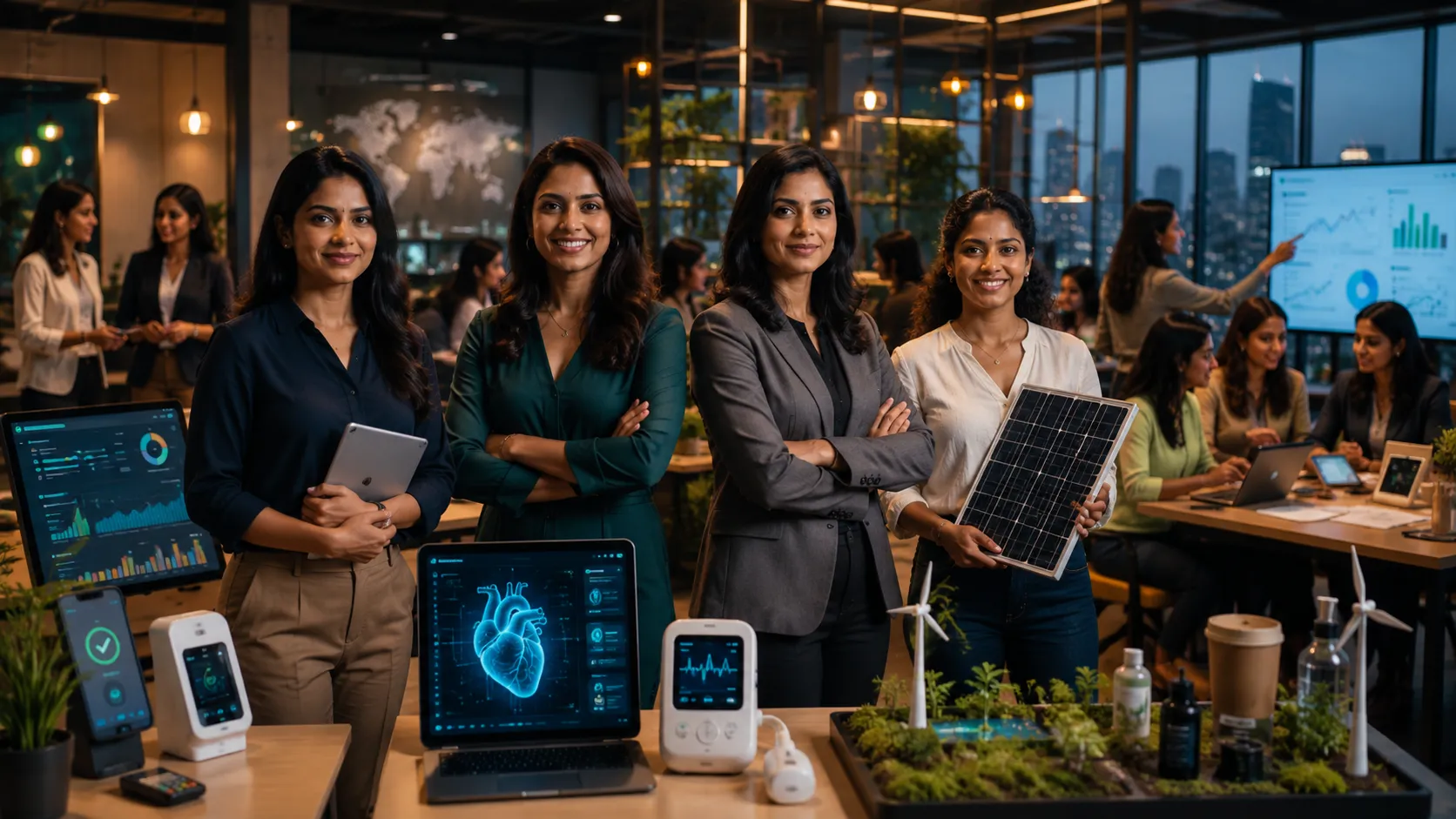
These two women did not build their companies in the same sector, at the same time, or in the same way. But they are the human story behind the headline that broke in H1 2026: women-led startups in India secured record venture capital funding, with investor confidence growing fastest in fintech, health-tech, and sustainability. India now has over 7,000 active women-led startups, $26 billion in cumulative funding, and ranks among the top three countries globally for women entrepreneur startup funding.
The record did not arrive because the system suddenly became generous. It arrived because these women — and the generation they represent — built companies so undeniably real that the system ran out of excuses to keep saying no.
Vineeta Singh: The Woman Who Treated Every "No" as Market Research
There is a version of Vineeta Singh's story that gets told at startup conferences. The IIT-IIM alumna who turned down a ₹1 crore job offer fresh out of business school to pursue entrepreneurship. The Shark Tank India judge who invested in 59 companies and counting. The beauty founder whose brand now sits in over 45,000 retail stores across 550-plus cities in India.
That version is accurate. It is also incomplete.
The part of the story that explains how any of the rest became possible is the 58 months in between. Starting in roughly 2012, before SUGAR Cosmetics even found its final form, Singh spent nearly five years building a beauty company for Indian women in a market dominated by multinationals who had no real interest in Indian skin tones, amid an investor community that had no real interest in funding a woman's conviction about a market they did not understand.

She pitched to over 100 venture capitalists. Over 100 times, the answer was no.
One of those rejections carried an additional sting she has spoken about publicly: a VC who was willing to fund the company — but only on the condition that her husband joined full time. She described it plainly to Business Today as gender discrimination. She did not accept the condition.
That observation — deceptively simple, commercially important — was the entire thesis. Indian women with Indian skin tones were being handed products built for someone else, by companies that viewed India as a secondary market. Singh saw this not as a cultural complaint but as a gap that size of which the multinationals had actually done her a favour by leaving open.
When India Quotient eventually stepped in with a personal loan that kept the company alive through its most precarious period, it was customer data — not a revised pitch deck, not a better story, not a more palatable ask — that sustained Singh's conviction. Every rejection had driven her deeper into customer obsession. By the time the right investor arrived, there was no longer any ambiguity about whether the market existed.
Today, SUGAR Cosmetics has raised over $96 million in funding. Its Series D closed in August 2025. Revenue has crossed ₹500 crore. The brand competes directly with global beauty giants on Indian shelves, and wins. An IPO is being planned for when revenue crosses ₹1,000 crore. Singh's net worth sits at approximately ₹300 crore.
Every single investor who said no watched her build what they refused to fund.
Ghazal Alagh: The Mother Who Built the Proof Before She Needed the Pitch
Ghazal Alagh's founding insight was not a market analysis. It was a mother's panic.
When her son Agastya was born in 2014, she could not find baby care products in India that were free of sulphates, parabens, mineral oils, or artificial fragrances. The imported options that met her standards were unaffordable at scale. The domestic options did not meet her standards. She was a new mother in one of the world's largest consumer markets, unable to find what she needed.
She did not write a business plan. She started talking to other mothers.
What followed before any investor saw a single slide was extraordinary in its discipline. Alagh recruited over 700 mothers to test every product formula on their children. She collected granular feedback — texture, absorption, scent, how it performed on different skin types, whether infants reacted, whether the mothers trusted it enough to use repeatedly. Only after that community had validated every product in the proposed range did she consider commercial launch.
This is the sentence that explains every number that followed. Alagh did not need to convince investors that mothers would trust Mamaearth. She arrived with proof that 700 of them already did.
Mamaearth launched in 2016 with 6 products and became India's first baby care brand to receive MADE SAFE certification — the same certification standard used in the United States for products guaranteed free of harmful ingredients. From those 6 products, Honasa Consumer — the parent company — has grown into a house of brands spanning Mamaearth, The Derma Co., Aqualogica, BBlunt, and Dr. Sheth's.
The most recent numbers tell their own story. In Q4 FY26, Honasa posted revenue of ₹657 crore — a 23 per cent year-on-year jump. Full-year FY26 net profit surged 175 per cent to ₹200 crore, up from ₹72 crore the year before. The company declared its maiden dividend of ₹3 per share. Its market capitalisation stood at approximately ₹11,768 crore as of May 2026.
Ghazal Alagh's own role as Chief Innovation Officer reflects how the company was built: innovation first, always, at the product level — not the marketing level.
The mother who could not find safe products for her son built one of India's most important consumer companies. She did it by refusing to skip the validation step that every impatient investor or accelerator programme would have told her to skip.
What H1 2026 Actually Represents — And Why It Took This Long
The record VC funding secured by women-led Indian startups in H1 2026 is not a market correction. It is a delayed reckoning.
Women founders in India have consistently demonstrated stronger capital discipline, deeper customer intimacy, and more resilient business models than the venture capital ecosystem gave them credit for. The sectors they chose disproportionately — health-tech, fintech for underserved communities, sustainability, consumer brands built on genuine product-market fit — are now precisely the sectors that institutional investors are most aggressively backing.
The data makes the case plainly. In 2024 alone, fintech was the top sector for women-led Indian startups, capturing $266.91 million — 28.7 per cent of total funding that year. Health-tech and cleantech each crossed $100 million. These were not hot-narrative bets. They were sectors where women had spent years building measurable proof of customer trust, unit economics, and retention.
The H1 2026 record extends that pattern. Digital banking, financial literacy platforms, AI-driven healthcare services, menstrual health tech, and eco-friendly consumer brands are all attracting serious institutional capital — and the founders at the helm of those companies largely built their proof the same way Vineeta Singh and Ghazal Alagh did: before anyone was paying attention.
Structurally, the investor side is also evolving. Ankita Vashistha's Saha Fund and StrongHer Ventures back female-led early-stage startups across fintech, health-tech, and consumer technology. Pearl D'Souza's Eximius Ventures has invested in companies including and Jar. Rema Subramanian's Ankur Capital consistently backs women-led ventures at pre-Series A — the stage where most institutional capital still does not go. These are not charity funds. They are conviction bets made by investors who spotted what the broader market was too slow to see.
The funding record of H1 2026 is not the beginning of the story. It is the market finally pricing in what was already there.
The Blueprint Is Not New. It Was Always This.
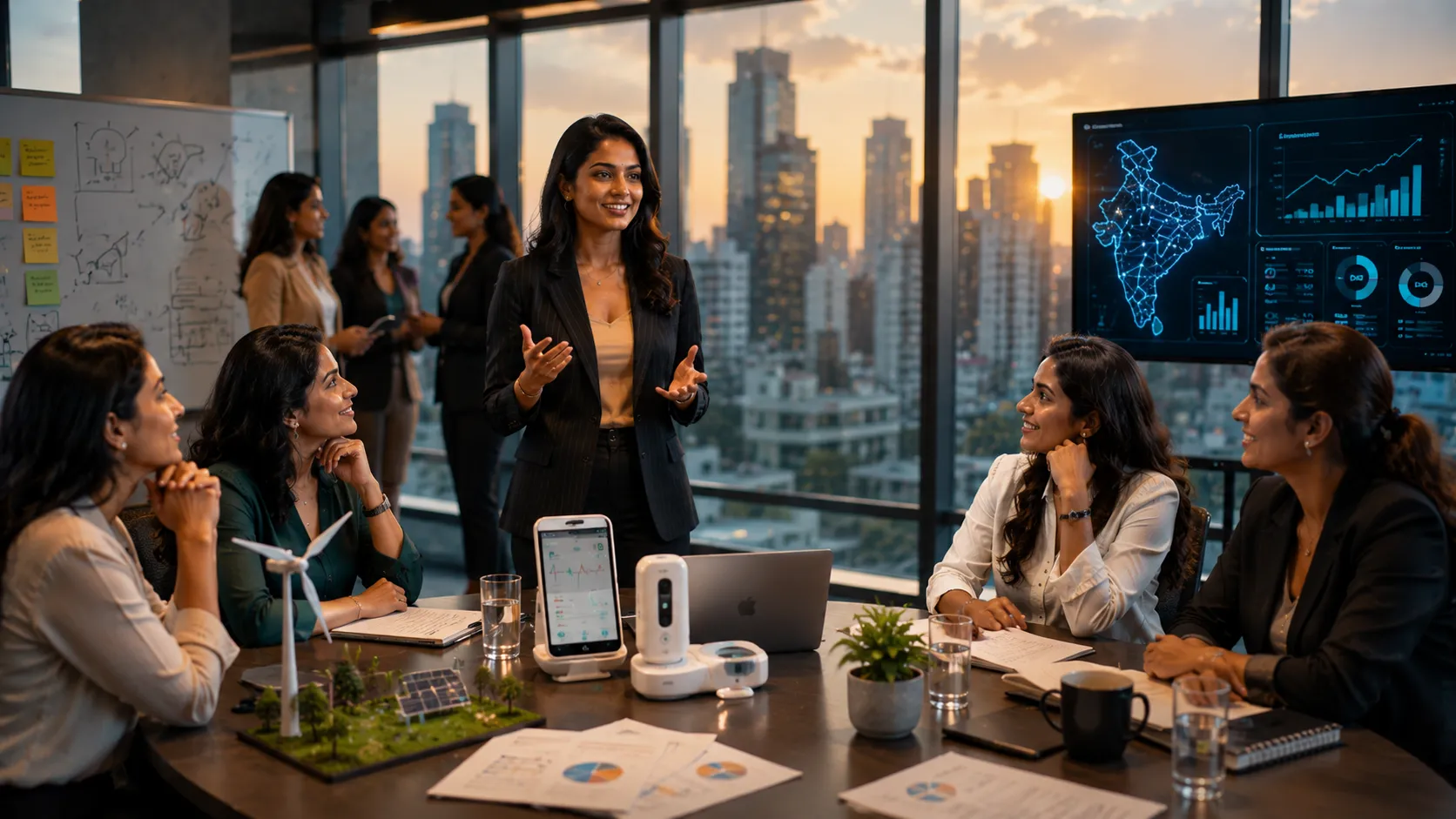
There is a throughline connecting Vineeta Singh's 58 months of rejection, Ghazal Alagh's 700-mother validation process, and the record numbers of H1 2026. It is not that these women were exceptional in some rare, unreplicable way. It is that they did the thing that most founders — men and women — avoid because it is slow and unglamorous: they built undeniable proof before they needed the money.
Singh did not wait for investors to believe in Indian beauty consumers. She built the customer data that turned belief into fact. By the time the right investor arrived, the question was not "does this market exist?" It was "how fast can this scale?"
Alagh did not rush to a pitch deck with a problem statement and a vision slide. She built the product, validated it with the exact community it was built for, and arrived at every funding conversation with something no narrative can replace: evidence that real people trusted her enough to put her formula on their children's skin.
This is the blueprint. Build the proof before you need the pitch. Let the customers make the case the investors wouldn't. Stay in the room — or go back to your desk — long after the comfortable choice would have been to walk away.
The 2026 funding environment is the most supportive for women-led startups in India's history. The capital is moving. The funds exist. The appetite is real. But the founders who will benefit most from this moment are not the ones calibrating their story to the trend. They are the ones building something today that will be impossible to ignore tomorrow — quietly, stubbornly, customer by customer — just like the two women who proved it was possible before the market was ready to admit it.