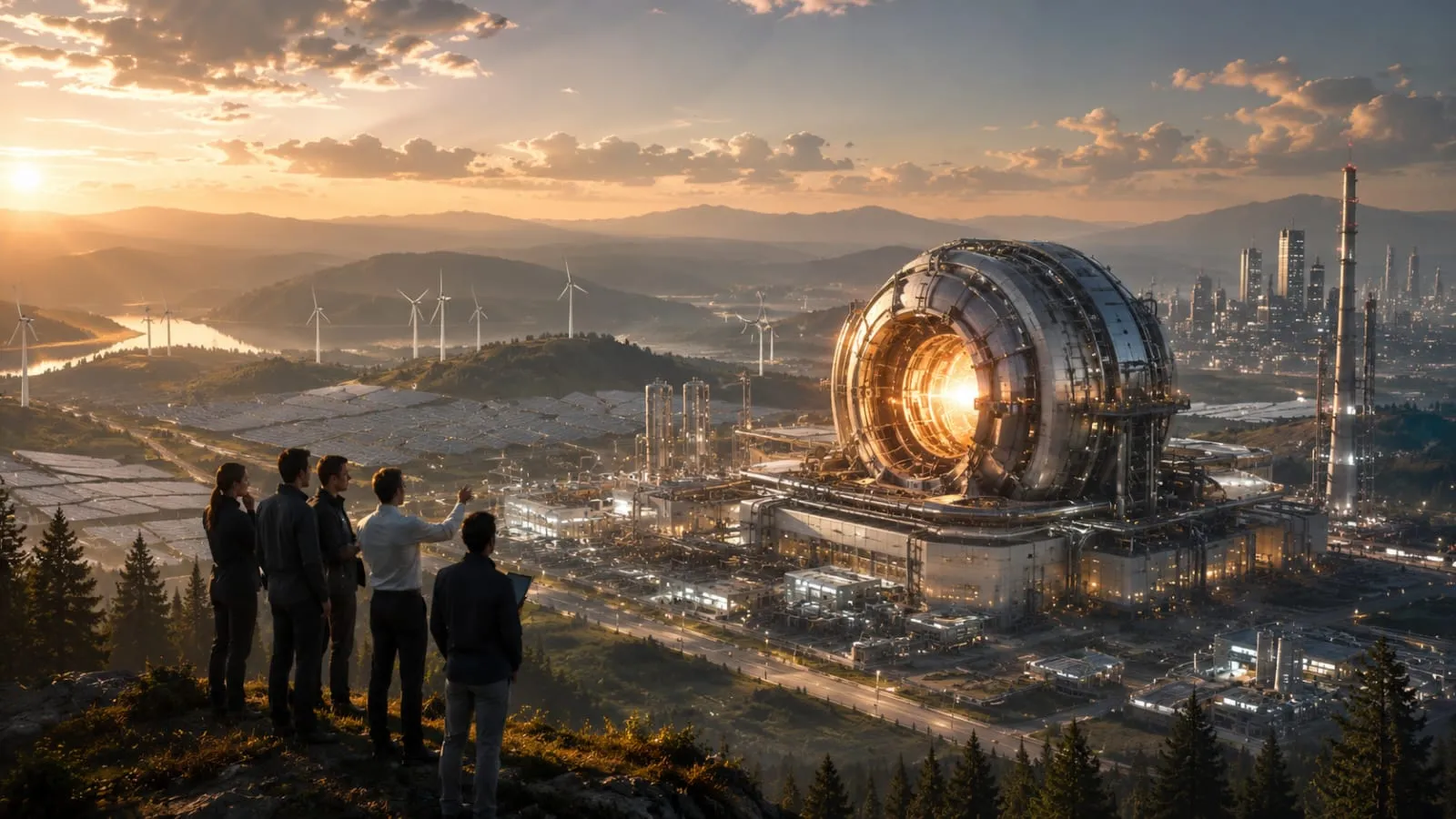
For Decades, Nuclear Fusion Has Been Described As The Energy Source Of The Future. Investors Are Still Funding It Because They Believe The Future May Finally Be Arriving.
Few industries receive as much skepticism and investment at the same time as nuclear fusion.
For generations, scientists have promised that fusion could transform the global energy system. The concept sounds almost too good to be true: abundant fuel, minimal emissions, no long-lived radioactive waste and the potential to generate enormous amounts of power. Yet despite decades of research and billions of dollars in spending, no company has successfully built a commercial fusion power plant capable of supplying electricity at scale. Critics often joke that fusion is perpetually thirty years away.
Investors continue writing checks anyway.
Over the past several years, nuclear fusion startups have attracted unprecedented levels of private capital. Companies such as Commonwealth Fusion Systems, Helion, TAE Technologies and others have collectively raised billions of dollars despite generating little or no commercial electricity. In most industries, that would be difficult to justify. In fusion, investors increasingly believe the rewards could be so large that the risks become acceptable.
The logic begins with the size of the opportunity.
Fusion Is Not Trying To Disrupt An Industry. It Is Trying To Replace One
Most startups target specific markets.
Some aim to improve software. Others seek to transform transportation, healthcare or financial services. Fusion startups are pursuing something much larger. Their ambition is nothing less than reshaping how humanity generates energy. Electricity powers modern civilization, influencing everything from manufacturing and transportation to artificial intelligence and economic growth. Any technology capable of producing cleaner, cheaper and more abundant energy would immediately become one of the most valuable innovations in history.
That possibility explains why investors remain interested.
Global energy demand continues growing as populations increase, economies expand and technologies such as artificial intelligence require more computing power. Data centers alone are projected to consume dramatically larger amounts of electricity in coming years. At the same time, governments are pursuing ambitious climate goals while attempting to maintain reliable energy supplies. Fusion sits at the intersection of these challenges because it promises abundant clean power without many of the limitations associated with existing energy systems.
For investors, the potential upside is difficult to ignore.
Even a modest share of the global energy market could create companies worth hundreds of billions of dollars. The scale of the opportunity means that success does not need to be highly probable for investments to appear attractive.
Recent Scientific Progress Has Changed The Conversation
For years, fusion funding was driven largely by scientific optimism.
Today, many investors believe there is also technical momentum. Recent breakthroughs have helped change perceptions of what is possible. Experiments demonstrating net energy gains and advances in superconducting magnets have provided evidence that some of fusion's most difficult engineering challenges may be solvable. While commercial deployment remains years away, progress is increasingly measurable rather than purely theoretical.
This shift matters enormously.
Venture capital typically avoids scientific projects that appear impossible within realistic timelines. Investors can tolerate uncertainty, but they prefer uncertainty accompanied by visible progress. Fusion startups are increasingly providing that evidence through successful demonstrations, engineering milestones and partnerships with governments and industrial players. The result is a sector that appears less speculative than it did a decade ago.
The narrative has therefore evolved.
Fusion is no longer viewed solely as a scientific experiment. It is increasingly viewed as an emerging industry.
Artificial Intelligence Is Creating A New Energy Problem
One reason fusion funding continues accelerating has little to do with fusion itself.
Artificial intelligence is dramatically increasing energy demand. Training advanced AI models requires enormous computational resources. Data centers are expanding globally. Cloud infrastructure continues growing. Governments and technology companies are actively searching for reliable long-term energy solutions capable of supporting future demand.
This creates an unexpected tailwind for fusion.
Investors increasingly recognize that technological progress depends not only on better software but also on access to sufficient power. AI may become one of the largest energy consumers in modern history, forcing companies and governments to rethink energy infrastructure. Technologies capable of generating abundant electricity therefore become strategically important far beyond the traditional utility sector.
Fusion startups are benefiting from this shift in thinking.
The conversation is no longer limited to climate change or energy security. It increasingly includes artificial intelligence, industrial competitiveness and economic growth.
The Talent Entering Fusion Looks Different Today
Another reason investors remain optimistic is the changing profile of the people building these companies.
Historically, fusion research was concentrated within universities, laboratories and government programs. Today's fusion startups increasingly attract engineers, entrepreneurs and executives from industries such as aerospace, semiconductors and advanced manufacturing. Many bring experience commercializing complex technologies rather than simply researching them.
This transition is important.
Scientific breakthroughs alone rarely create industries. Commercial execution, operational discipline and manufacturing expertise are equally important. Investors see value in teams capable of bridging the gap between research and commercialization because that gap has historically been one of fusion's greatest obstacles.The emergence of venture-backed fusion companies therefore represents more than new funding.It represents a different approach to solving the problem.
Why Investors Are Willing To Wait
Fusion remains one of the few sectors where investors openly acknowledge that returns may take years.
That patience stems from the extraordinary scale of potential outcomes. Most venture-backed businesses aim to become category leaders. Successful fusion companies could become foundational infrastructure providers for entire economies. The difference in magnitude changes how investors evaluate risk.
Large institutional investors are particularly interested.Pension funds, sovereign wealth funds and long-term capital providers often seek opportunities capable of generating transformational returns over extended periods. Fusion aligns naturally with those objectives because the technology requires significant development time but could ultimately address one of humanity's most important challenges.Not every company will succeed.Some will fail. Others may take longer than expected. Yet investors increasingly believe the category itself is worth backing because the potential reward is unlike almost anything else in technology.
The Bigger Story Is About Betting On The Impossible
The continued flow of capital into fusion reflects something deeper than energy economics.
It reflects the willingness of investors to back technologies capable of reshaping entire industries even when commercial success remains uncertain. Many of history's most important innovations appeared unrealistic before becoming inevitable. Aviation, semiconductors, space exploration and the internet all faced periods where skepticism and optimism existed simultaneously.
Fusion now occupies a similar position.It remains unproven at commercial scale. Significant engineering challenges remain. Timelines continue to be debated.Yet billions of dollars keep flowing into the sector.Because if fusion works, it may not simply become another successful industry.It could become one of the most important technologies humanity has ever developed.