FundingAnalysis7 MIN READ

Why AI Music Startup Suno Is Suddenly Worth $5.4 Billion

Suno's $5.4 billion valuation reflects growing investor belief that AI-generated music could fundamentally transform who creates music and how the entertainment industry operates.

By Nisha Omkumar · Author5 June 2026New
Why AI Music Startup Suno Is Suddenly Worth $5.4 Billion

The Last Time The Music Industry Faced A Disruption This Big, It Was Streaming. Investors Now Believe Artificial Intelligence Could Be Even More Transformational.

For more than a century, the music business operated around a simple reality.

Creating music was difficult. Recording a song required talent, equipment, technical expertise and access to distribution networks capable of reaching audiences. While technology gradually made music production more accessible, there remained a meaningful distinction between listeners and creators. Most people consumed music. A much smaller group actually produced it. Entire industries were built around that separation, from record labels and recording studios to publishers, producers and distributors.

Artificial intelligence is beginning to erase that boundary.

Today, someone with no musical training can generate a complete song in seconds using nothing more than a written prompt. Vocals, melodies, instrumentation and lyrics can all be produced through software. The technology is advancing rapidly enough that many industry executives, artists and investors are still trying to understand its long-term implications. Some view AI music as a powerful creative tool. Others see it as a threat to traditional music creation. Regardless of where the debate ultimately lands, venture capital has already made one thing clear: investors believe AI-generated music represents one of the largest opportunities in entertainment technology.

That belief helps explain why Suno has become one of the most valuable startups in artificial intelligence.

The company recently raised more than $400 million in fresh funding, pushing its valuation to approximately $5.4 billion. What makes that number remarkable is not simply its size but the speed at which it has grown. Less than a year ago, Suno was viewed primarily as an intriguing AI experiment. Today, investors are valuing it like a company that could help redefine how music is created, distributed and monetized in the future.

Suno Is Not Just Building An App. It Is Building A New Creative Category

One reason investors are paying such close attention to Suno is that the company is not trying to improve existing music-production workflows.

Instead, it is attempting to expand who can participate in music creation altogether. Traditionally, the process of making music required years of practice or collaboration with skilled professionals. Suno reduces that barrier dramatically. Users can describe a mood, genre, topic or style and receive a finished song within moments. The experience feels less like operating software and more like having a creative collaborator available on demand.

That distinction is important because it changes the potential size of the market.

Most music-production tools target musicians, producers and creators. Suno targets anyone interested in making music, regardless of experience. The company is effectively betting that millions of consumers who never considered themselves musicians may still enjoy creating songs if the process becomes simple enough. If that assumption proves correct, the addressable market becomes significantly larger than the traditional music-production industry.The history of technology suggests that tools often become transformative when they expand participation.Social media allowed anyone to become a publisher. Video platforms allowed anyone to become a creator. AI music platforms are attempting to make anyone a musician.

Investors See A Platform, Not A Product

The valuation attached to Suno reflects more than enthusiasm for artificial intelligence.

Investors increasingly believe the company could become a platform operating at the intersection of music, social media, content creation and entertainment. Modern technology companies often achieve their largest valuations when users do more than consume content. Platforms become particularly powerful when users actively create and share content themselves.

Suno fits naturally into that framework.

Every song generated on the platform has the potential to become content that can be shared, remixed, discussed and distributed across digital networks. The more users create, the more content enters the ecosystem. The more content circulates, the more awareness the platform generates. This dynamic resembles the growth loops that helped drive the expansion of social-media platforms and creator-economy businesses over the past two decades.

That possibility helps explain why investors are willing to support the company at such a substantial valuation.

They are not simply evaluating software revenue. They are evaluating whether AI-generated music could evolve into an entirely new form of digital creativity with its own ecosystem, audience and economy.

The Real Opportunity Extends Beyond Music
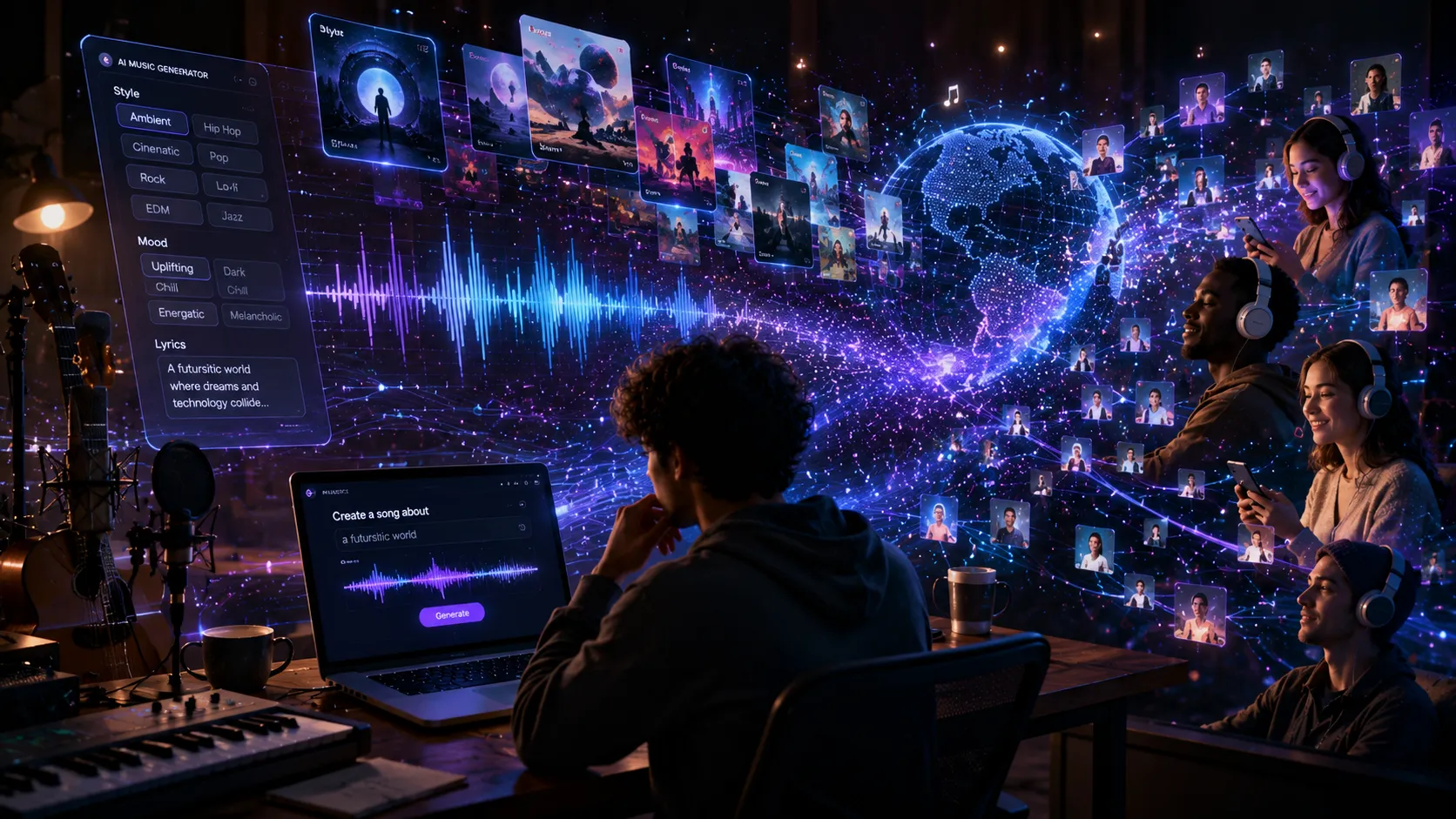
image.png

Perhaps the most interesting aspect of Suno's rise is that the company may ultimately be participating in a much larger transformation.


The biggest disruption in music may not be a new genre. It may be a future where anyone can create one.

Artificial intelligence is changing how creative content is produced across multiple industries simultaneously. Images, videos, writing, design and software development are all experiencing similar shifts. The underlying theme is that AI is dramatically reducing the cost and complexity associated with creation. Activities that once required specialized expertise are becoming increasingly accessible to broader audiences.

Music happens to be one of the most emotionally powerful forms of content.

People connect with songs in ways that extend beyond simple entertainment. Music shapes identity, culture and community. Because of this, tools capable of generating personalized music experiences may possess commercial potential far beyond traditional production software. AI-generated music could eventually support gaming, advertising, social media, education and countless other industries where audio plays an important role.

Investors understand that possibility.

The funding round reflects confidence not only in Suno's current product but also in the broader trend toward AI-powered creativity. The company sits at the center of one of the most significant technological shifts currently reshaping the entertainment industry.

The Music Industry Is Not Watching Quietly

Suno's rapid growth has also generated controversy.

Major record labels have raised concerns about how AI music systems are trained and whether copyrighted works were used during development. The debate touches on some of the most important legal and ethical questions facing artificial intelligence. If AI systems learn from existing creative works, what obligations do they owe to the artists whose content contributed to that learning? Regulators, courts and industry leaders are still attempting to answer those questions.

These disputes highlight how disruptive the technology could become.

Industries rarely challenge innovations that pose little threat to existing business models. The intensity of the debate surrounding AI-generated music reflects growing recognition that the technology may fundamentally alter how music is produced and consumed. Similar tensions emerged during earlier technological transitions involving file sharing, streaming and digital distribution.The difference today is that AI is affecting creation itself.Previous disruptions changed how music reached audiences. AI has the potential to change how music comes into existence in the first place.

Why The $5.4 Billion Valuation Matters

The significance of Suno's valuation extends beyond one company.

It provides insight into how investors currently view artificial intelligence. Venture capital firms are no longer focusing exclusively on AI infrastructure, chips and foundation models. Increasingly, they are searching for applications capable of changing consumer behavior at scale. Companies that successfully translate AI capabilities into products people use daily may become some of the biggest winners of the next decade.

Suno represents one of the clearest examples of that trend.

The company has built a product that demonstrates AI's capabilities in a way ordinary consumers can immediately understand. Users do not need technical expertise to appreciate the value proposition. They type a prompt and receive a song. That simplicity makes the technology accessible while simultaneously showcasing how dramatically AI can alter creative workflows.The funding round therefore represents more than confidence in a startup.It represents confidence in the idea that creativity itself is entering a new technological era.

The Bigger Story Is About Who Gets To Create

At its core, the rise of Suno is not really about artificial intelligence.

It is about access. Throughout history, technological breakthroughs have often expanded participation in activities once reserved for specialists. Publishing, photography, video production and software development all became more accessible as technology evolved. Each transition created controversy, disrupted incumbents and ultimately expanded the number of people capable of creating.

Music may be entering a similar phase.

Whether AI-generated songs become mainstream or remain a niche category, the underlying shift is already visible. The tools required to create music are becoming dramatically more accessible. Millions of people who previously lacked the skills or resources to produce songs can now participate in the creative process.

That possibility is what investors appear to be funding.Because if artificial intelligence succeeds in turning music creation into something anyone can do, the impact could extend far beyond one startup.It could reshape one of the world's most influential creative industries.

TagsSunoAI musicartificial intelligencemusic industrystartup fundingAI startupscreator economygenerative AIentertainment technologyventure capitalmusic technologydigital creativityAI contentrecord labelsfuture of music

Reader reviews

Sign in to rate and review this article.
Loading reviews…