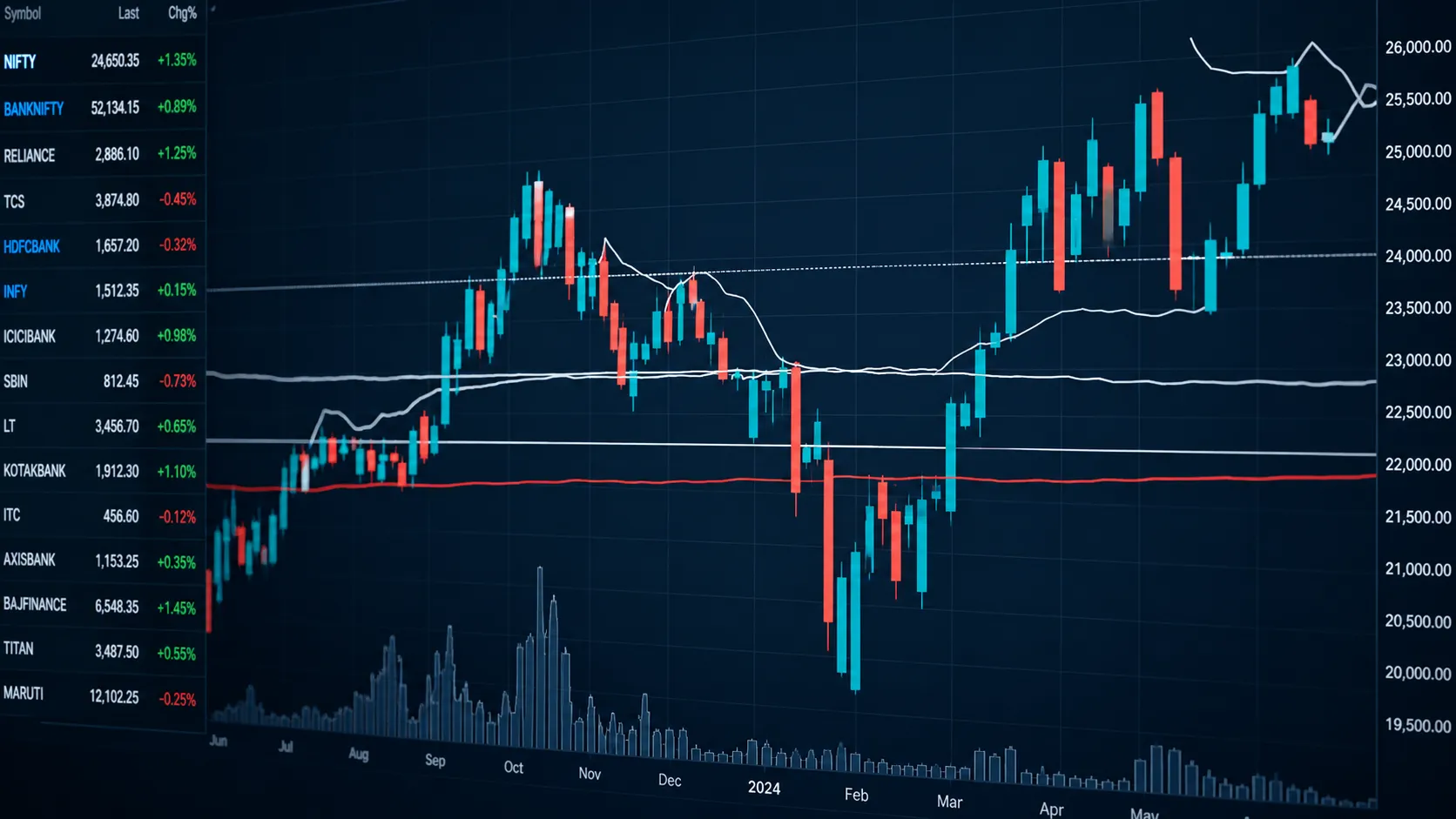
India VIX dropped 4.4 percent this week to settle around 12.0 — comfortably within the zone most derivatives desks associate with calm, low-turbulence markets, and a meaningful decline from the more elevated readings the index had touched earlier in July amid tariff-related uncertainty. For casual market watchers, a falling VIX alongside a rising Nifty is typically read as an unambiguously bullish combination: stocks going up, fear going down, nothing to see here. The reality, as is so often the case in derivatives markets, is considerably more layered — and this week's underlying options and futures positioning data tells a story that is genuinely more cautious than the headline VIX number alone would suggest.
India VIX, formally the NSE's volatility index, measures the market's expectation of near-term volatility — specifically, the annualised standard deviation of Nifty 50 returns implied by the prices market participants are currently willing to pay for Nifty options over the next 30 days. It is not, contrary to a common misconception, a measure of actual historical price swings; rather, it is a forward-looking gauge derived entirely from options premiums, reflecting how much uncertainty traders are collectively pricing into the near-term future, regardless of which direction they expect the market to move. A VIX reading in the low teens, where the index currently sits, has historically corresponded to periods when the market anticipates relatively modest month-to-month price swings — a meaningful contrast to readings above 20 or 25, which typically accompany genuine market stress, sharp corrections, or acute macroeconomic uncertainty of the kind India's markets experienced at various points during the 2025-26 US tariff escalation.
The mechanics behind why VIX fell this specific week are worth unpacking, because they connect directly to the broader market narrative playing out simultaneously. As Q1 FY27 corporate earnings — particularly from the technology sector — came in ahead of what had become cautiously pessimistic expectations, and as foreign institutional investors turned net buyers in the cash segment after weeks of selling, options traders collectively reduced the premium they were willing to pay for downside protection, since the immediate catalysts that had been driving elevated uncertainty through much of July appeared, at least temporarily, to be resolving in a market-friendly direction. That combination — improving fundamental news flow plus returning institutional buying — is precisely the kind of environment in which options-implied volatility tends to compress, as market participants collectively judge near-term tail risk to have diminished.
Yet the futures and options positioning data beneath that headline VIX decline tells a more nuanced story that deserves closer attention than it typically receives in mainstream market commentary. Even as foreign institutional investors bought roughly ₹2,982 crore worth of shares in the cash segment this week — their strongest single-session net buying in several weeks — the same investor category simultaneously held a substantial net short position of nearly 195,000 contracts in Nifty index futures. On the options side, data tracking FII positioning showed heavy buying of call options alongside heavy shorting of put options — a combination that, read together, points toward what derivatives strategists describe as protective hedging layered onto the long book: genuine cash-market accumulation, protected by downside insurance in the derivatives segment, rather than an unconditionally bullish, all-in directional bet on continued near-term gains. As one widely cited derivatives-data reading put it, FIIs are buying calls while shorting puts — that suggests protective hedging layered onto the long book, caution beneath the surface of an otherwise bullish cash market.
Understanding why sophisticated institutional investors would simultaneously buy stocks in the cash market while hedging that same exposure through derivatives requires appreciating the distinct risk-management functions each market segment serves. Cash-market purchases represent genuine, long-term portfolio conviction — an institution's actual view that Indian equities, at current valuations, represent attractive long-term value. Derivatives positioning, by contrast, is frequently used not to express a directional view at all, but specifically to manage near-term risk around a position an investor already holds and intends to keep — insurance against a sharp, unexpected reversal that would otherwise force a costly, disorderly unwind of a genuinely held long-term position. A large institutional investor holding, say, several billion dollars of Indian equity exposure accumulated over multiple quarters has every incentive to use relatively inexpensive index put options or short futures positions to protect that accumulated position against a two-week shock, even while remaining fundamentally bullish on the twelve-month outlook for the same holdings.
The put-call ratio — a simpler, more widely followed derivatives metric that measures the relative volume or open interest of put options traded against call options — offered a complementary read on sentiment through the same period. A put-call ratio meaningfully above 1.0 typically signals elevated hedging or bearish positioning, while readings below 1.0 suggest more bullish, call-heavy activity. Options desks tracking the ratio through late July noted it had moved to levels consistent with what technicians typically characterise as constructive-but-not-euphoric positioning — genuine bullish tilt, but not the kind of extreme, one-sided call-buying that has historically preceded sharp, sentiment-driven reversals once a market becomes excessively crowded on one side of a trade.
For retail investors trying to translate this layered derivatives picture into practical positioning decisions, market veterans consistently offer the same caution: no single data point — not VIX in isolation, not the put-call ratio alone, not cash-market FII flows by themselves — should be read as a definitive signal. The genuinely informative picture only emerges from triangulating multiple signals together, and this week's data offers a useful case study in why that discipline matters. Taken purely at face value, a falling VIX alongside strong FII cash buying might suggest unambiguous, high-conviction bullishness. Layer in the futures short position and the call-buying-versus-put-shorting pattern, however, and a more textured picture emerges: genuine improvement in sentiment and positioning, but a market that remains meaningfully hedged against the possibility that the year's persistent sources of uncertainty — tariff policy chief among them — could resurface with little warning.
That hedging instinct is not difficult to understand given 2026's track record. The Indian market has, over the course of the year, been repeatedly whipsawed by trade-policy headlines arriving with minimal advance notice — the initial 50 percent US tariff escalation in August 2025, the surprise February 2026 de-escalation to 18 percent, and the fresh 10 percent Section 301 duty added just days before this week's VIX decline. Institutional investors who have lived through that entire cycle have, unsurprisingly, developed a structural preference for maintaining downside protection even during periods of genuine optimism, precisely because the year has repeatedly demonstrated how quickly sentiment can reverse on a single trade-policy announcement out of Washington.
Options market infrastructure itself has also evolved meaningfully over the past several years in ways that make this kind of granular positioning data more accessible than it once was. Real-time tracking of FII futures and options positioning, once available only to institutional trading desks with direct exchange data feeds, is now widely disseminated through retail-facing analytics platforms, allowing individual investors and financial media to parse exactly the kind of "cash-buying-but-derivatives-hedged" pattern this week's data revealed — a genuine democratisation of market information that has, if anything, made unsophisticated single-metric analysis of market sentiment less defensible than it might have been a decade ago, when VIX alone or FII cash flows alone were often the only readily available signals for retail commentary.

Looking ahead, the durability of this week's calmer volatility backdrop will depend substantially on whether the positive earnings and institutional-flow catalysts that drove VIX lower prove sustainable through August, or whether the next major macro catalyst — whether a Federal Reserve policy signal, further developments on the US tariff front, or the remaining tranche of India Inc's Q1 results — reintroduces the kind of uncertainty that has periodically spiked India VIX throughout 2026. For now, the combination of a calmer headline volatility reading and a genuinely hedged underlying derivatives book offers what might be the most honest possible summary of where institutional sentiment currently sits: meaningfully improved, but not yet fully convinced.
Historical context helps calibrate just how "calm" the current VIX reading genuinely is relative to India's own volatility history. During the height of the August 2025 tariff escalation, when the US imposed its combined 50 percent duty on Indian goods, India VIX spiked well above levels considered comfortable by most institutional risk models, reflecting genuine, acute uncertainty about the near-term trajectory of Indian equities. The current reading in the low teens represents a meaningful normalisation from those stressed conditions, though it remains worth noting that VIX readings in this broad range have historically still been consistent with periods of underlying market nervousness rather than genuine complacency — a nuance that distinguishes India's current volatility regime from the unusually placid, historically low VIX readings some developed markets have occasionally posted during periods of sustained, low-volatility bull markets.
For options traders specifically looking to translate this data into actionable strategy, the combination of moderate absolute volatility levels alongside genuinely hedged institutional positioning has practical implications for premium pricing across different options strategies. Option-selling strategies, which tend to perform best when implied volatility is elevated relative to what subsequently materialises, face a less favourable risk-reward setup in the current environment than they would during genuinely high-VIX periods, since option premiums have already compressed alongside the falling VIX reading. Conversely, traders looking to purchase relatively inexpensive protective puts or calls to position for a potential resumption of volatility — whether from a fresh tariff headline, a disappointing earnings surprise, or a global macro shock — may find current option pricing more attractively valued than it would be during a period of already-elevated implied volatility, a dynamic several derivatives desks have specifically flagged to clients evaluating hedging strategies heading into August.
Retail participation in India's options market has grown dramatically over the past several years, adding an additional dimension to how VIX and broader derivatives data should be interpreted relative to a decade ago, when options activity was overwhelmingly the preserve of institutional and proprietary trading desks. That broadened retail participation means a meaningful share of the options open interest data now feeding into market commentary reflects a genuinely different mix of participants and motivations than in earlier periods — some genuinely sophisticated retail hedgers managing personal portfolio risk in ways similar to institutions, but also a considerable volume of shorter-horizon, more speculative retail options activity that can, at times, distort simple readings of aggregate positioning data if not carefully separated from the institutional flows that data services like FII-specific futures and options tracking are specifically designed to isolate.
For readers newer to derivatives markets, the core lesson from this week's VIX and options data is a useful, generalisable one: headline volatility indices and single-metric sentiment gauges are genuinely useful starting points, but they compress a great deal of underlying complexity into a single number. The market's true positioning — how convinced institutional money genuinely is, how much protection is being purchased alongside directional bets, and how crowded any given trade has become — requires looking beneath that single number to the fuller set of futures, options and flow data increasingly available to sophisticated retail investors as well as professional trading desks. That fuller picture, this week, points to a market that has grown genuinely more comfortable, but has not yet fully let its guard down.