
Mumbai, July 31, 2026 — Amid a June-quarter earnings season dominated by headline results from India's largest conglomerates, Waaree Energies delivered a performance that underscored just how dramatically India's domestic solar manufacturing sector has scaled over the past several years. The company reported a 15.39% increase in consolidated net profit to ₹891.87 crore for the first quarter of FY27, up from ₹772.89 crore in the corresponding April-June period of the previous fiscal year, while revenue from operations surged an even more dramatic 79.22% year-on-year to ₹7,931.79 crore, up from ₹4,425.83 crore in the year-ago period.
This combination of numbers — profit growth in the mid-teens percentage range alongside revenue growth approaching 80% — tells an important story about where Waaree Energies currently sits in its own growth trajectory. A company scaling revenue this dramatically while profit grows at a considerably more modest pace is typically either investing heavily in capacity expansion that has not yet reached full operating efficiency, absorbing margin pressure from a highly competitive pricing environment even amid strong volume growth, or some combination of both dynamics — a pattern common among companies in rapidly scaling manufacturing sectors where near-term capacity investment often takes precedence over near-term margin optimisation.
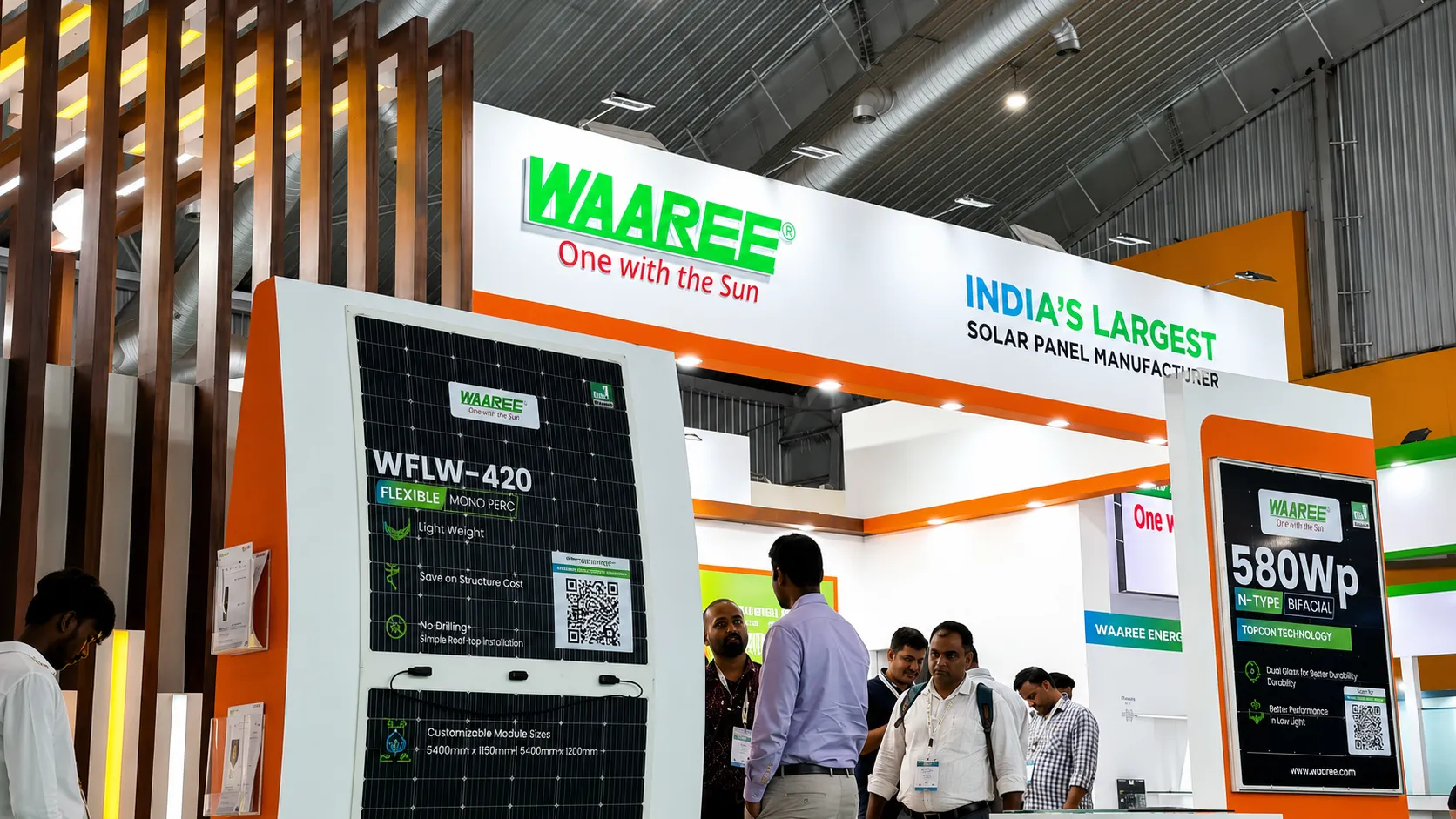
India's solar manufacturing moment
Waaree Energies' results arrive at a moment when India's domestic solar manufacturing sector has become one of the most closely watched segments of the country's broader renewable energy and manufacturing policy story. For years, India's solar power sector relied heavily on imported solar modules and cells, predominantly sourced from Chinese manufacturers who had achieved significant scale and cost advantages through years of aggressive government-supported capacity expansion within China's own domestic solar manufacturing industry. This import dependence had long been viewed by Indian policymakers as a strategic vulnerability, particularly given solar power's central role in India's broader renewable energy transition and climate commitments.
Government policy responses over recent years, including production-linked incentive schemes specifically targeting domestic solar module and cell manufacturing, along with import duty structures designed to favour domestically produced solar equipment over imported alternatives, have collectively helped catalyse a substantial expansion in India's domestic solar manufacturing capacity. Waaree Energies has positioned itself as one of the primary beneficiaries and drivers of this policy-supported manufacturing buildout, scaling its own production capacity substantially over recent years to capture an increasing share of India's rapidly growing domestic solar module demand, alongside a growing export business serving international markets seeking to diversify their own solar supply chains away from near-total dependence on Chinese manufacturing.
Understanding the revenue-profit growth gap
The specific dynamic of revenue growing at nearly five times the pace of profit this quarter reflects several distinct factors likely at play simultaneously within Waaree's business. First, the company has been engaged in substantial capacity expansion investment, adding new manufacturing lines and facilities that, in their initial ramp-up phases, typically operate at lower efficiency and higher per-unit costs than fully mature production capacity, creating a natural drag on near-term margins even as absolute revenue scales rapidly on higher overall production volumes.
Second, India's domestic solar manufacturing sector has attracted substantial new capacity investment from multiple competing players simultaneously, drawn by the same favourable policy environment that has benefited Waaree, creating a more competitive pricing environment for solar modules that can compress margins even for well-positioned incumbent manufacturers experiencing strong volume growth. This combination of capacity ramp-up costs and competitive pricing pressure helps explain why Waaree's profit growth, while solidly positive at 15.39%, has not kept pace with the company's dramatic revenue expansion over the same period.
The export opportunity
Beyond serving India's rapidly growing domestic solar demand, Waaree Energies has increasingly positioned itself to capture international export opportunities, as solar developers and utilities across various global markets have sought to diversify their supply chains away from heavy dependence on Chinese-manufactured solar equipment, partly in response to trade policy measures in markets including the United States that have specifically targeted Chinese-origin solar products with tariffs and other restrictions. This dynamic has created a meaningful opportunity for Indian solar manufacturers with sufficient scale and quality certification to capture export market share that might otherwise have gone to Chinese suppliers, a trend that Waaree's management has previously highlighted as an important element of the company's broader growth strategy alongside its core domestic market focus.
The company's ability to serve both domestic and export markets simultaneously provides a degree of revenue diversification that helps insulate Waaree's overall growth trajectory from any single-market demand fluctuation, even as it also means the company must navigate the distinct regulatory, quality certification and logistics requirements associated with serving multiple different international markets simultaneously, each with their own specific solar equipment standards and import requirements.
How Waaree's results fit into India's broader renewable energy story
Waaree's strong quarter arrives within a broader context of accelerating investment across India's renewable energy sector, as the country continues working toward its stated goal of achieving 500 gigawatts of non-fossil fuel electricity generation capacity by 2030, a target that requires sustained, large-scale investment not just in renewable power generation capacity itself, but across the entire supporting manufacturing and supply chain ecosystem, including solar modules, wind turbine components, battery storage systems and the broader grid infrastructure needed to integrate large volumes of variable renewable generation into India's overall power system.
Within this broader ecosystem, Waaree's performance offers a useful data point suggesting that India's solar manufacturing buildout continues to scale successfully in volume terms, even as the sector works through the kind of margin pressure and capacity ramp-up costs that typically accompany periods of rapid capacity expansion across capital-intensive manufacturing industries more broadly. Whether this margin pressure proves a temporary, transitional phase as new capacity matures and reaches fuller operating efficiency, or a more durable feature of an increasingly competitive domestic solar manufacturing landscape as multiple players scale simultaneously, will likely become clearer over the coming several quarters as both Waaree and its domestic competitors continue reporting results.
Market reaction and analyst perspective
Waaree Energies shares have, since the company's own public listing, attracted substantial investor interest tied to the broader renewable energy and domestic manufacturing investment themes that have gained significant momentum among both Indian and international investors over recent years. This quarter's results, demonstrating continued strong volume growth alongside more modest but still positive profit growth, are likely to reinforce existing investor narratives about the company's growth trajectory, even as some analysts may focus closely on margin trends specifically, given the meaningful gap between this quarter's revenue and profit growth rates, as a key variable to monitor in assessing the sustainability of the company's current growth strategy over coming quarters.
What comes next for Waaree
Looking ahead, the key variables likely to shape Waaree Energies' performance through the remainder of FY27 include the pace at which recently added manufacturing capacity reaches full operating efficiency, the trajectory of domestic solar module pricing amid continued competitive capacity additions across the broader Indian solar manufacturing sector, and the company's continued success in capturing export market share amid ongoing global supply chain diversification away from Chinese solar manufacturing dominance. For a company operating at the intersection of India's renewable energy transition ambitions and its broader domestic manufacturing policy push, this quarter's results offer encouraging evidence of continued strong top-line momentum, even as the path to translating that revenue growth into proportionally stronger profit growth remains a story still very much in progress.
The policy scaffolding behind India's solar manufacturing push
Understanding Waaree's growth trajectory requires appreciating the specific policy architecture that has underpinned India's domestic solar manufacturing expansion over recent years. The production-linked incentive scheme for high-efficiency solar modules has provided direct financial incentives tied to actual domestic manufacturing output, rewarding companies that successfully scale genuine production capacity rather than simply assembling imported components. This has been complemented by a structured import duty framework that has progressively increased the cost of importing finished solar modules and cells relative to domestically manufactured alternatives, creating a meaningful, policy-engineered price advantage for companies like Waaree competing against what would otherwise be a considerably more cost-competitive Chinese import alternative.
Government procurement policies for India's own large-scale solar power tenders have similarly incorporated domestic content requirements in various forms, mandating that a specified proportion of solar modules used in government-supported or government-tendered solar projects be sourced from domestically manufactured, rather than imported, equipment. This combination of production incentives, import duty protection and domestic content procurement requirements has collectively created the kind of supportive policy environment within which companies like Waaree have been able to justify the substantial capital investment required to build out large-scale domestic solar manufacturing capacity, even while competing against globally scaled Chinese manufacturers with inherent cost advantages built up over many years of their own capacity expansion.
Competitive dynamics within India's solar manufacturing sector
Waaree operates within an increasingly crowded domestic solar manufacturing landscape, with several other Indian companies having similarly scaled up their own manufacturing capacity in response to the same favourable policy environment. This growing competitive intensity, while beneficial for India's overall solar manufacturing capacity and, by extension, the country's broader renewable energy transition goals, does create genuine near-term pricing pressure for individual manufacturers, including Waaree, as multiple well-capitalised competitors simultaneously expand capacity and compete for market share within what remains, ultimately, a finite near-term domestic and export demand pool. How this competitive dynamic evolves over coming quarters, and whether India's solar manufacturing sector begins to see the kind of consolidation that has characterised other rapidly scaling Indian manufacturing sectors as they mature, will likely shape the medium-term margin trajectory for all major domestic solar manufacturers, Waaree included.
Backward integration into cell and wafer manufacturing
A further strategic dimension shaping Waaree's longer-term competitive positioning involves the extent of the company's backward integration into upstream stages of the solar manufacturing value chain, spanning solar cell production and, further upstream still, polysilicon and wafer manufacturing. Companies capable of controlling a greater share of this upstream value chain, rather than relying on imported cells or wafers that are simply assembled into finished modules domestically, generally enjoy greater margin capture and reduced exposure to upstream supply chain disruptions or pricing volatility originating outside India. Waaree has, in line with the broader industry trend, been investing in expanding its own cell manufacturing capacity as part of this backward integration strategy, a capital-intensive undertaking that, while adding to near-term investment costs reflected in the current quarter's margin profile, is generally viewed by industry analysts as an important long-term strategic positioning move as India's solar manufacturing sector matures beyond its earlier, more purely module-assembly-focused phase of development.
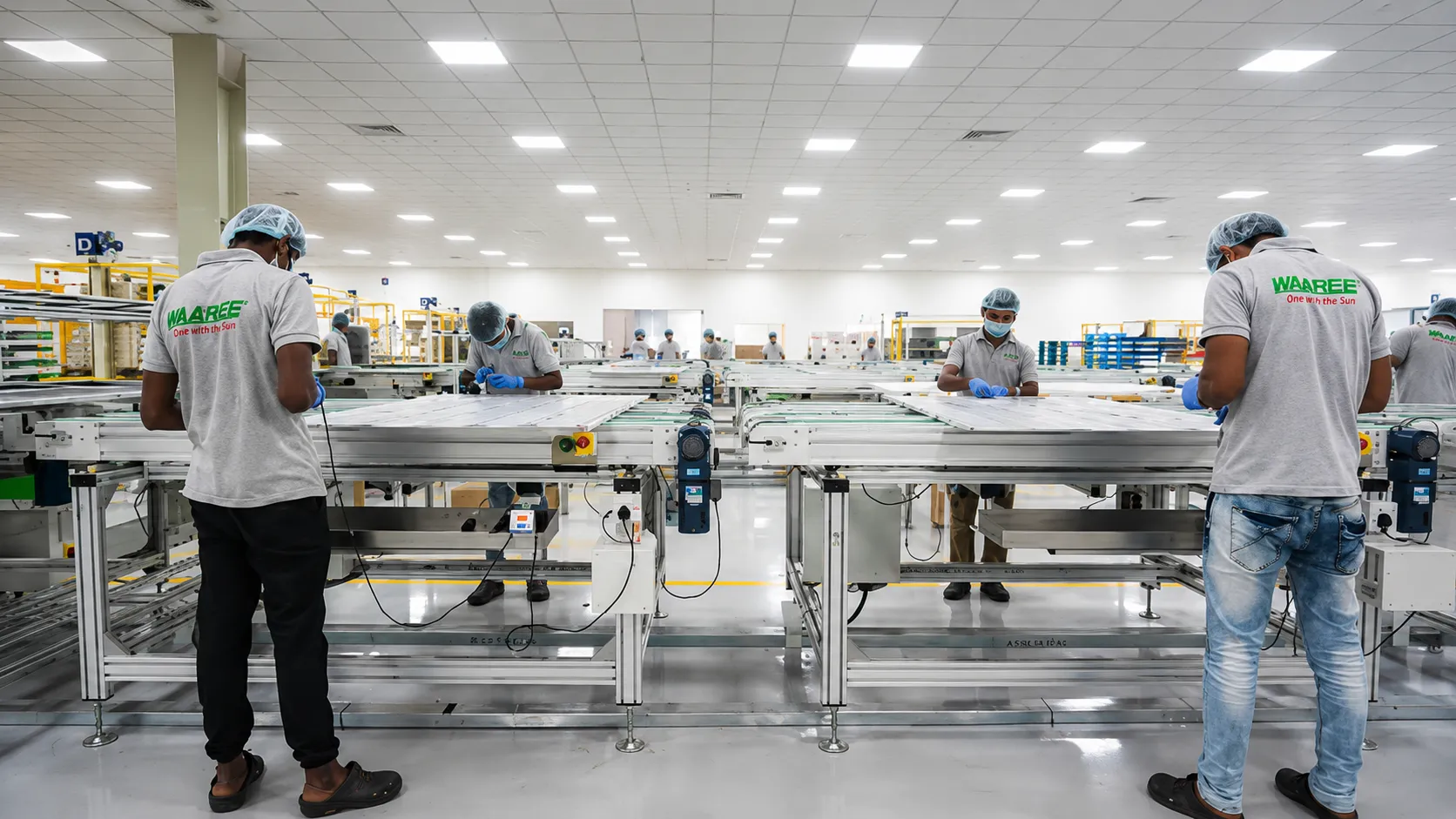
Employment and manufacturing ecosystem impact
Beyond its direct financial results, Waaree's continued capacity expansion carries meaningful implications for skilled manufacturing employment within India's renewable energy sector, a segment the government has repeatedly identified as a strategic priority for job creation alongside its core climate and energy security objectives. Large-scale solar manufacturing facilities require substantial workforces spanning production line operators, quality assurance technicians and specialised engineering roles, and Waaree's continued expansion has, according to industry trade bodies, contributed meaningfully to direct and indirect employment growth within the states hosting its major manufacturing facilities, reinforcing the broader economic case for continued policy support of India's domestic solar manufacturing build-out beyond its pure climate and energy security rationale.
Investors evaluating Waaree alongside other listed renewable energy manufacturing names will likely continue watching quarter-on-quarter margin trends closely as the clearest signal of whether the company's substantial capacity investments are beginning to translate into the kind of operating leverage benefits that typically emerge once new manufacturing lines mature beyond their initial ramp-up phase. Management commentary on this margin trajectory, expected alongside subsequent quarterly disclosures, will likely be scrutinised closely by both equity analysts and credit rating agencies tracking the company's broader capital allocation discipline.