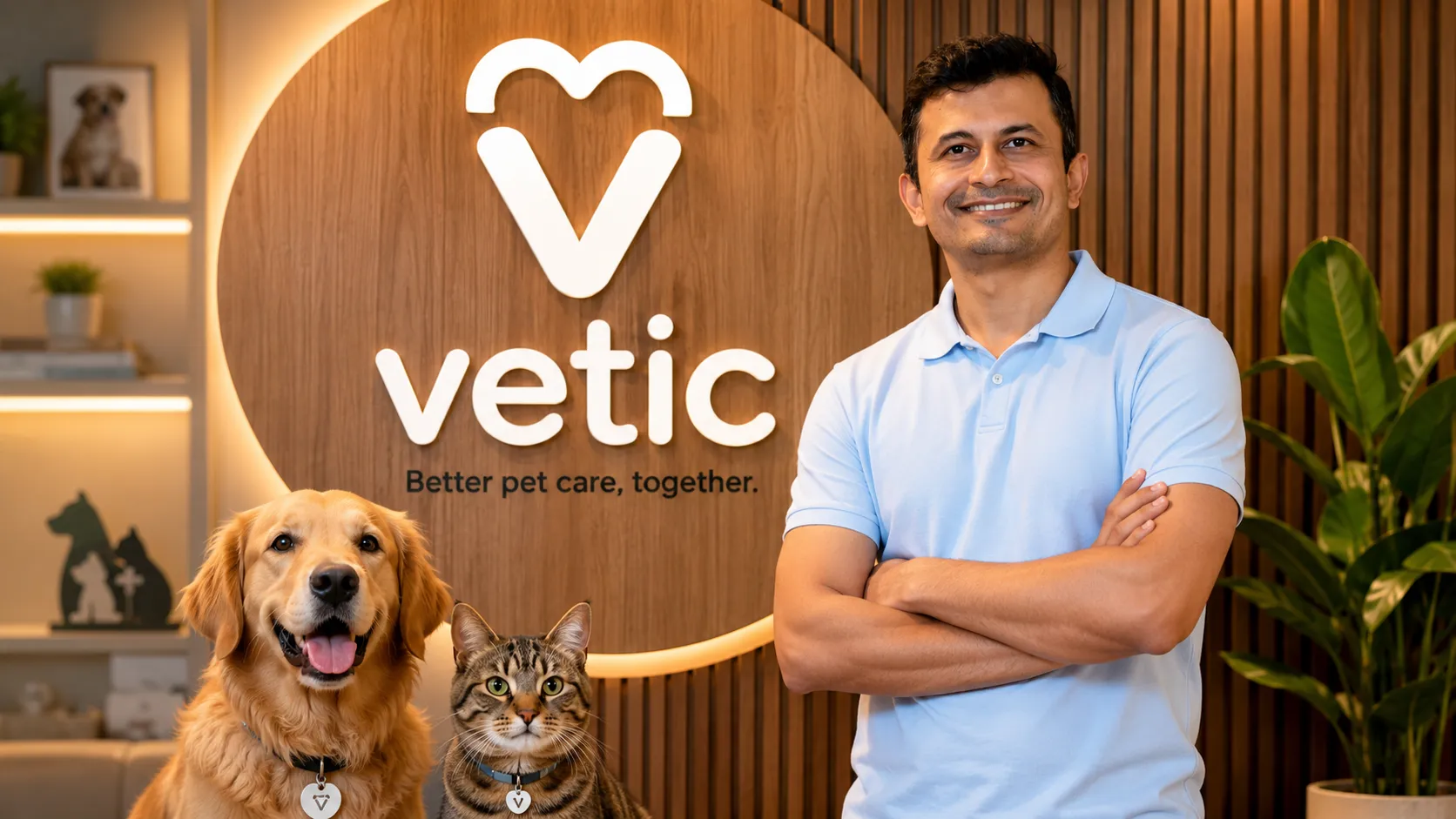
A Cat Named Simba. Twenty-Five Visits. Six Vets. One Founder Who Decided to Fix the Whole System.
This is the kind of founding story that does not require embellishment.
Gaurav Ajmera had a cat named Simba. When Simba got sick, Ajmera did what every pet parent in India does: he took him to a vet. Then to another one. Then to another. Twenty-five to thirty visits across five or six different veterinarians before Simba received a correct diagnosis. No longitudinal health record that travelled with him. No connected system that one clinic could use to see what another had already tried. No consistent care standard that told him whether the next doctor he saw was operating at the same level as the last.
Just fragmentation. Just the particular helplessness of watching something you love suffer while the system that should be helping you fails to do its job.
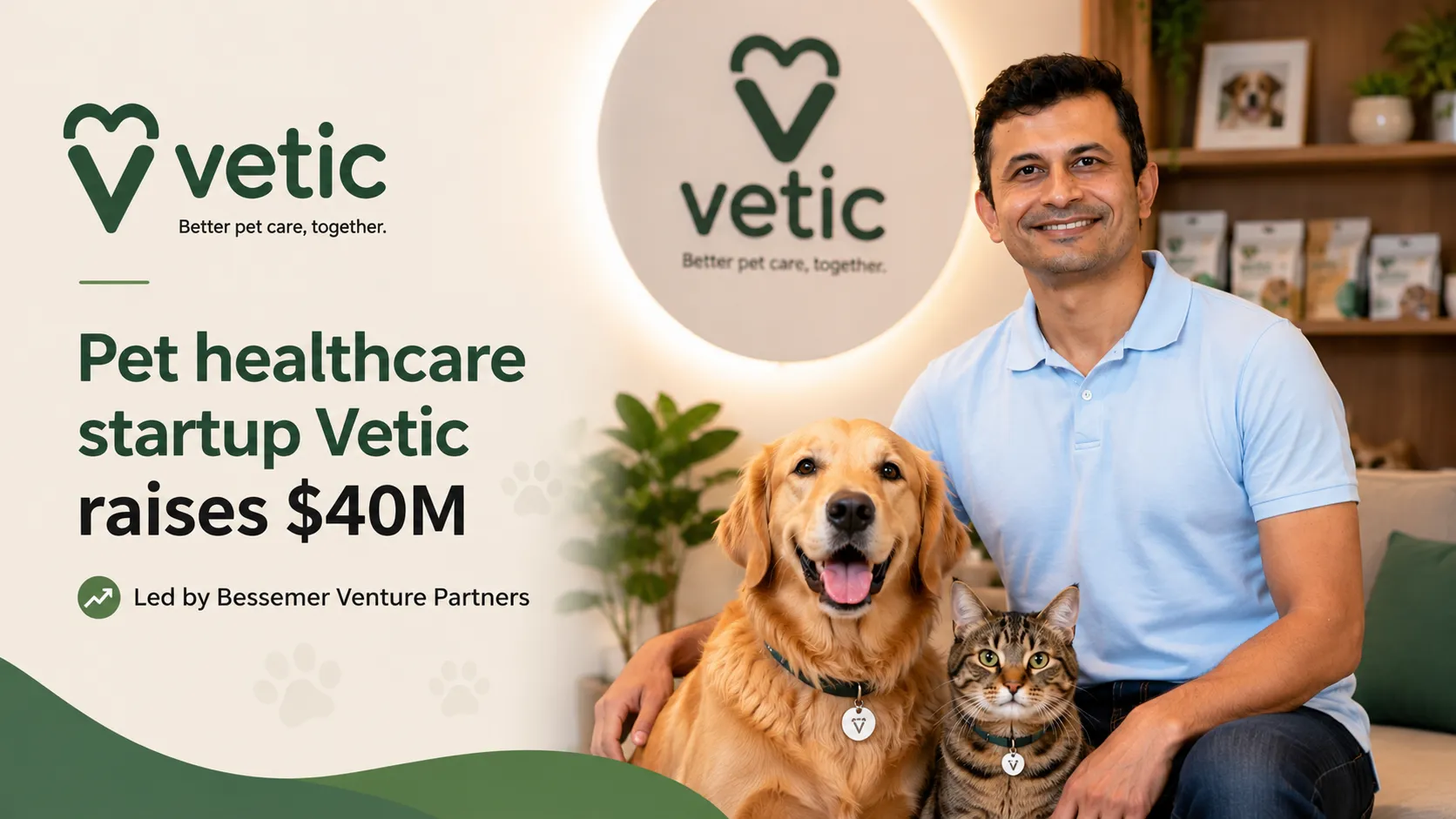
On June 18, 2026, Vetic — the company Ajmera founded in 2022 to solve exactly what Simba's experience exposed — announced a $40 million funding round led by Bessemer Venture Partners, with participation from existing investors Greenoaks Capital, Lachy Groom, and JSW Family Office.
This is the story of why that round happened, what Vetic has built to deserve it, and what it says about one of India's most overlooked and fastest-growing healthcare markets.
What Vetic Actually Built in Four Years
Vetic launched in 2022 with a thesis simple enough to fit in a sentence: India's pet healthcare system is fragmented, unorganised, and medically inconsistent, and the country's growing cohort of pet parents — who have begun treating their animals as family members, not livestock — deserve something better.
The thesis was easy to state. Building the infrastructure to deliver on it was not.
In four years, Vetic has built what it now describes as India's most comprehensive pet healthcare ecosystem. The network currently runs 65-plus clinics across 11 cities, with 15 round-the-clock emergency facilities for the cases that cannot wait until morning. It has a team of more than 250 veterinarians delivering care across in-clinic OPD, advanced diagnostics, and complex surgeries. It has 60,000-plus subscribed members — pet parents who have enrolled in Vetic's wellness plans and use the platform as their primary pet healthcare provider.
The product stack goes well beyond clinic visits. Vetic operates an e-pharmacy that delivers more than 300 medicines across 700-plus pincodes in 60 minutes — a logistics capability that most human pharmacies in India cannot match in speed or geographic breadth. It runs quick commerce for 600-plus pet products. It has launched pet insurance and wellness plan offerings. It is preparing to roll out Vet at Home services nationally within two fiscal quarters.
And underneath all of it is the technology layer that makes the clinical network more than the sum of its parts: a proprietary operating system that captures longitudinal health records for every pet from its very first Vetic visit, standardising care protocols across the entire network. When Simba moves from one Vetic clinic to another, or when a specialist needs to review what the general practitioner already ruled out, the record is there — exactly what was missing in the experience that caused Vetic to exist.
The AI layer extends this further. Vetic has deployed AI across multiple touchpoints: triaging pet parents from the first sign of a symptom before they even book an appointment, supporting veterinarians with diagnostic intelligence during consultations, and delivering proactive, personalised guidance through the Vetic app across a pet's entire life journey. The stated ambition is to move Indian pet healthcare from reactive crisis management — the Simba model, where you only interact with the system when something is already wrong — to continuous, always-on care that identifies problems before they become crises.
Why Bessemer Keeps Writing Cheques
Bessemer Venture Partners is not a new investor in Vetic. This $40 million round is the latest in a sequence of investments across multiple prior rounds. That continuity — a lead investor choosing to keep leading — is one of the most credible conviction signals that exists in venture capital.
Vishal Gupta, Partner at Bessemer Venture Partners, explained the position in terms that go beyond the usual investor boilerplate:
"The unglamorous work of building high quality supply which scales with consistency." That phrase — specifically the word unglamorous — is worth sitting with. It is Bessemer signalling that what they are backing is not a narrative or a market thesis. It is operational execution, clinic by clinic, vet by vet, health record by health record. The kind of work that does not generate headlines but does generate the unit economics that sustain a category-defining business.
"Category leaders compound" is the investment logic in three words. In a market that is fragmented and unorganised — as Vetic's own documentation describes the Indian pet care sector — the first operator that builds genuine quality supply at genuine scale acquires a compounding advantage that becomes progressively harder for any follower to close. The 60,000 member base generates health data. The health data improves the AI models. The AI models improve clinical decisions. The better clinical decisions attract more pet parents. The more pet parents generate more data. This is the flywheel that Bessemer is continuing to fund.
The Market Vetic Is Betting On
To understand why $40 million is going into a pet healthcare company in India, you need to understand how the Indian pet market has changed — and how fast.
India's pet care market is expected to reach ₹2.1 lakh crore by 2032, according to industry estimates cited by multiple analysts. The driver is not a rise in pet ownership among people who have always had pets. It is a structural shift in what the relationship between Indian households and their pets has become.
Urbanisation, nuclear family structures, delayed marriage and parenthood, and the emotional demands of post-pandemic life have all contributed to a generation of Indian pet owners — disproportionately urban, disproportionately millennial and Gen Z — who relate to their animals as family members rather than household accessories. This is not sentiment. It is a spending behaviour. Pet parents in this category make purchasing decisions about their animals that are structurally similar to the decisions they make about their own healthcare: willingness to pay for quality, preference for trusted providers, demand for continuity of care.
The market that existed to serve the previous generation of Indian pet owners — local veterinary clinics operating independently, without standardised protocols, without connected records, without consistent pricing — is not built for this customer. It is built for a customer who wants the cheapest visit, not the best one. That gap between what the market has and what the new pet parent wants is the entire business case for Vetic.
The recent funding environment confirms the investor community has reached the same conclusion. Supertails raised $30 million in its Series C in February 2026. Dr. Shivas — another pet healthcare player — has attracted capital. The space is being funded, and Vetic's current round is a signal that, within it, the platform that has built the most comprehensive, connected, and clinically consistent system is the one that serious investors are choosing to back with serious capital.
What the $40 Million Is For
The capital allocation is specific and sequenced. Vetic will use the funding to double its veterinary team from 250 to 500 vets — covering in-clinic, home, and virtual care across an expanded network. The clinic count, currently 65-plus across 11 cities, will scale to significantly more as the company builds toward the density required to serve pet parents in every major urban centre.
Vet at Home services will be rolled out nationally within two fiscal quarters — a capability that opens up the majority of pet health interactions that do not require a clinic visit but still require a qualified professional: routine check-ups, vaccination follow-ups, medication guidance, post-surgical recovery monitoring. Pet insurance and wellness plan offerings will be deepened, building a recurring revenue layer that provides the financial predictability that enables continued investment in clinical quality.
And the technology and AI investment will continue — building out the predictive capabilities that turn Vetic's longitudinal health record infrastructure into something that actively improves clinical outcomes rather than merely recording them.
The trajectory Ajmera has described is a connected system where every layer of a pet's health journey — consultation, clinic, medicine, diagnostics, insurance, recovery, wellness — operates as a single coherent platform rather than a series of disconnected transactions. That vision is what the $40 million is buying the time and team to build.
The Simba Standard
There is a standard implicit in Gaurav Ajmera's founding story that applies well beyond the pet healthcare sector.
He did not build Vetic to fill a market gap identified in a consultant's report. He built it because something he loved received care that was beneath what it deserved, and the system responsible for providing that care was too fragmented, too inconsistent, and too indifferent to its own inadequacy to fix itself.
"Human-grade care" is the standard. It is also the business strategy. In every healthcare market — human or animal — the provider that builds the infrastructure to deliver consistent, high-quality, connected care at scale becomes the category default. Not because it markets itself most aggressively, but because it is the only provider whose quality the patient's next family member or friend was willing to recommend without qualification.
Simba had to visit 25 times before he got a correct diagnosis. The 60,000 members who have enrolled in Vetic's wellness platform are betting that their pets will not have to. If the $40 million does what Bessemer expects it to do — double the vet team, expand the clinic network, build out the AI layer, roll out national at-home services — they may well be right.
The category is being built. The capital is following. And the standard it is being held to has a name: Simba.