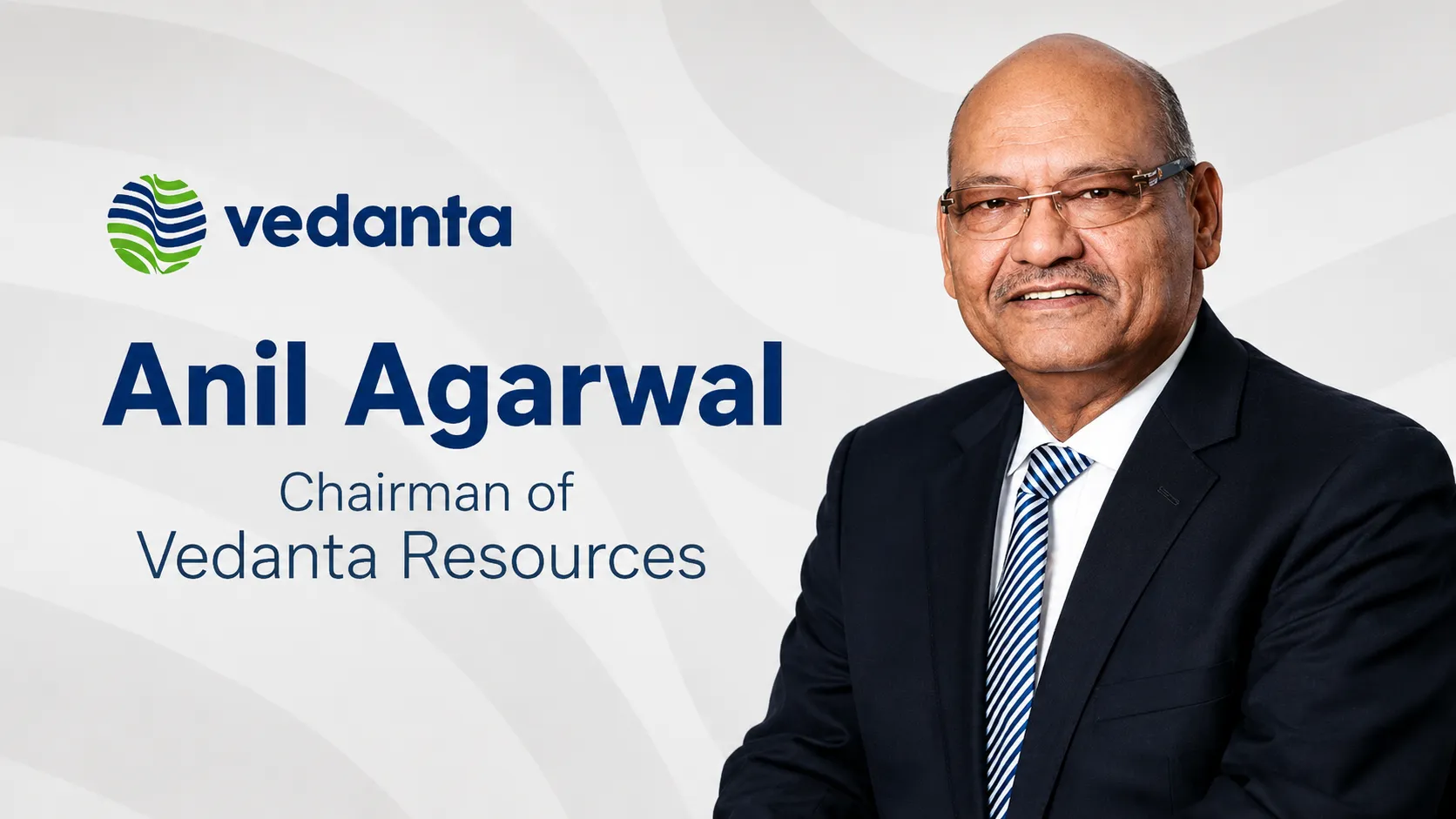
Mumbai: Nearly three years after first announcing plans to break itself apart, Vedanta Group has finally cleared the last of the regulatory hurdles standing between it and one of the more ambitious corporate restructurings in recent Indian business history. With the National Company Law Tribunal's approval secured and four newly independent entities set to list on Indian exchanges within a month, group chairman Anil Agarwal has used the moment to unveil what comes next: a $20 billion investment programme spread across the group's core businesses over the coming three to five years, funded, he says, largely through internal cash generation rather than fresh external borrowing.
The scale of the restructuring itself is worth dwelling on. Vedanta Limited, previously a sprawling conglomerate spanning aluminium, oil and gas, power, iron and steel, and base metals under a single corporate umbrella, has now been split into five distinct listed entities. The residual Vedanta Limited retains the group's zinc and critical metals businesses, including its roughly 65 per cent stake in Hindustan Zinc and the Gamsberg zinc operation in South Africa. Standing alongside it as newly independent, separately listed companies are Vedanta Aluminium, an oil and gas entity housed under Malco Energy, a power business built around Talwandi Sabo Power, and a steel and iron ore entity — each now free to pursue its own capital allocation, growth strategy and investor base without being bundled into a single consolidated group valuation.
Speaking to CNBC-TV18, Agarwal confirmed that all four demerged entities would be listed independently within the month, describing the restructuring as creating focused, standalone businesses each capable of pursuing ambitious growth targets on their own terms. It is a striking level of ambition for what were, until recently, divisions within a single company: Agarwal told Business Today that each of the newly independent entities has the potential to reach $100 billion in revenue over time — a target that, if realised even partially, would represent a transformation in scale for businesses that currently generate a small fraction of that figure collectively.
Vedanta Aluminium, the first of the demerged companies expected to list, illustrates the scale of ambition most concretely. The business currently produces around 3 million tonnes of aluminium annually, and Agarwal has set a target of doubling that output to 6 million tonnes within three years — a target that would, according to the company, position Vedanta Aluminium as the world's largest private-sector aluminium producer. Beyond the headline production target, the company plans to build out an entire ecosystem of downstream industries around its aluminium operations, with reports pointing to plans for as many as 1,000 downstream industrial units developed through an industrial park model designed to capture more value from the metal locally rather than exporting semi-finished aluminium for processing elsewhere.
The oil and gas business, which Agarwal has described in interviews as his personal 'heart and soul,' is earmarked for roughly $5 billion of the overall $20 billion investment programme over the same three-to-five-year window, with the explicit goal of ramping up production to 500,000 barrels of oil equivalent per day — a substantial increase from current output levels that would meaningfully deepen India's domestic oil and gas production base at a moment when the country remains heavily reliant on imported crude, a dependence that has been thrown into sharp relief by the recent volatility in global crude prices tied to escalating tensions in West Asia.
The power business, built around the Talwandi Sabo Power platform, currently generates approximately 4,000 megawatts of capacity and has been targeted for expansion to 20,000 megawatts through brownfield capacity additions at existing sites. Agarwal has been notably unapologetic about the role coal continues to play in this expansion plan, pointing to the company's existing coal linkages and describing coal as what he termed an enduring energy source — a position that runs somewhat counter to the broader global narrative around energy transition, but one that reflects the immediate, practical reality of India's continued dependence on coal-fired power to meet a rapidly growing base load electricity demand even as the country simultaneously builds out renewable capacity at record pace.
The fourth entity, focused on iron and steel, currently produces around 4 million tonnes annually and has been set a considerably more ambitious target of reaching 15 million tonnes of what the company describes as green, electrical or special steel — a product mix oriented toward higher-value, more specialised steel grades rather than commodity-grade output, reflecting a broader strategic bet that value-added, differentiated steel products will command better margins and more durable demand than undifferentiated bulk steel as India's manufacturing and infrastructure sectors continue to mature.
Underpinning the entire $20 billion programme is a financing philosophy that Agarwal has repeatedly emphasised in public remarks: that the investment will be funded largely through internal cash generation rather than a fresh wave of external debt. This emphasis carries particular weight given Vedanta Resources' own debt history — according to Rakesh Arora, Managing Partner at Go India Advisors and a long-time industry tracker, Vedanta Resources' debt has been reduced from $8.9 billion in FY22 to $4.7 billion by the end of FY26, a deleveraging trajectory that both reflects and enables the group's ability to fund an ambitious capex programme without leaning as heavily on debt markets as it has in past investment cycles.
The demerger itself is also explicitly framed by group leadership as part of that same debt and value-unlocking strategy. A simpler corporate structure, with each business standing on its own balance sheet and pursuing its own strategy, is expected to make it easier for both the market and the companies themselves to allocate capital efficiently, reduce structural complexity, and allow each entity's true underlying value to be reflected in its own separate share price rather than being embedded within — and potentially obscured by — a single, diversified conglomerate valuation.
Agarwal has also used recent public remarks to reaffirm the group's commitment to shareholder returns even as it pursues this ambitious capex programme, telling PTI in an earlier interview that 'dividend is in my blood,' and stating unequivocally that there will always be a dividend payout from the group's companies regardless of broader market conditions — a commitment that positions the group's investment case as one aimed at simultaneously funding growth and rewarding existing shareholders, rather than asking investors to forgo near-term returns entirely in exchange for a longer-term growth story.
Not every ambitious bet in Vedanta's recent history has gone according to plan, a fact that adds an important note of caution to the group's latest set of pronouncements. In September 2022, Vedanta announced a $19.5 billion semiconductor joint venture with Taiwan's Foxconn, intended to build a chip fabrication plant in Gujarat with production targeted to begin within two years. Less than a year later, Foxconn withdrew from the joint venture entirely, stating simply that it would not move forward with the partnership, without offering detailed reasons. The episode remains a useful reminder that even well-capitalised, well-publicised growth ambitions from major Indian conglomerates do not always translate cleanly into completed projects, and that the eventual success of the current $20 billion programme will depend heavily on execution discipline across four newly independent management teams rather than on the scale of the headline commitment alone.
For investors navigating the newly demerged structure, the transition period carries its own set of practical complications. Centrum's Nilesh Jain, addressing investor questions about how to handle Vedanta shares acquired before the split and the subsequent shares received across the various demerged entities, has emphasised that while the underlying Vedanta counter shows strong momentum, the newly separated businesses will likely need time to build independent trading histories and demonstrate standalone performance before their true value can be fully and confidently priced in by the market — advice that echoes the broader pattern seen in most major corporate demergers, where value discovery across newly separated entities tends to be a multi-quarter, rather than immediate, process.
Agarwal has also used the platform of the group's restructuring to press a broader policy argument concerning India's natural resources sector: a call for longer mining lease tenures, arguing that the current fifty-year cap on mining leases discourages the kind of large, multi-decade capital investment that natural resources businesses of Vedanta's scale require to justify their most ambitious expansion plans. Whether this argument gains traction with policymakers could have implications not just for Vedanta's own future investment decisions, but for the broader trajectory of capital investment across India's mining and natural resources sector more generally.
With four of the five demerged entities now approaching their independent stock market debuts, the coming weeks will offer the first real test of how public market investors price standalone aluminium, oil and gas, power, and steel businesses that were, until recently, simply divisions within a single, far larger conglomerate — and whether Agarwal's $20 billion investment programme, and the ambitious production targets underpinning it, can translate from stated ambition into the kind of delivered execution that ultimately determines whether his latest and largest bet on India's natural resources sector pays off.
The broader macroeconomic case Agarwal has made for the investment programme rests heavily on India's structural import dependence across minerals and metals. In public remarks, Agarwal has pointed out that roughly 50 per cent of India's imports, worth more than $350 billion, consist of minerals and metals, including oil and gas — a dependence he has argued will only double or triple as the Indian economy continues its rapid growth trajectory, framing the sector as representing what he has described as a $1-trillion opportunity for companies positioned to displace a meaningful share of that import bill with domestic production capacity.
Analysts covering the natural resources sector note that Vedanta's post-demerger structure will also make it considerably easier for investors to take differentiated views across the group's various businesses, rather than being forced to buy or sell exposure to the entire diversified conglomerate as a single bundled position. A pure-play aluminium investor, for instance, will now be able to gain exposure specifically to Vedanta Aluminium's expansion story without simultaneously taking on exposure to the group's oil and gas or power businesses — a structural shift that many equity analysts view as a net positive for price discovery and valuation efficiency across each of the underlying businesses, even if it introduces near-term complexity as investors adjust to tracking five separate listed entities rather than one.
The timing of the group's expansion push also coincides with a broader national push around critical minerals security, an area where Agarwal has positioned Vedanta as a natural domestic champion given its existing scale across zinc, aluminium and other strategically important metals. As India's manufacturing and electronics sectors continue to expand, and as the country pursues greater self-sufficiency across critical mineral supply chains that have historically been dominated by China and a handful of other producing nations, Vedanta's various demerged businesses are, in the company's own framing, well positioned to capture a growing share of what promises to be a structurally expanding domestic market for the metals and minerals the group produces.
For now, though, the story remains one of ambition awaiting execution. Four demerged companies preparing to list, a $20 billion capex programme spread across a three-to-five-year horizon, and a chairman known for setting bold, headline-grabbing targets — the coming quarters will show whether this latest chapter in Vedanta's decades-long history under Agarwal's leadership proves to be the transformative growth story he has promised, or whether it joins the semiconductor joint venture as another ambitious plan that ultimately falls short of its stated scale.
Credit rating agencies tracking the group's various entities will also be watching closely to see how the post-demerger capital structure holds up under the weight of the planned capex programme, particularly given that each of the four newly independent businesses will now need to fund its own growth ambitions from its own standalone balance sheet rather than drawing on the pooled financial resources and cross-guarantees that were previously available within the unified Vedanta Limited structure — a change that, while intended to sharpen accountability and capital discipline at each individual business, also removes a layer of financial flexibility that the combined entity previously enjoyed.