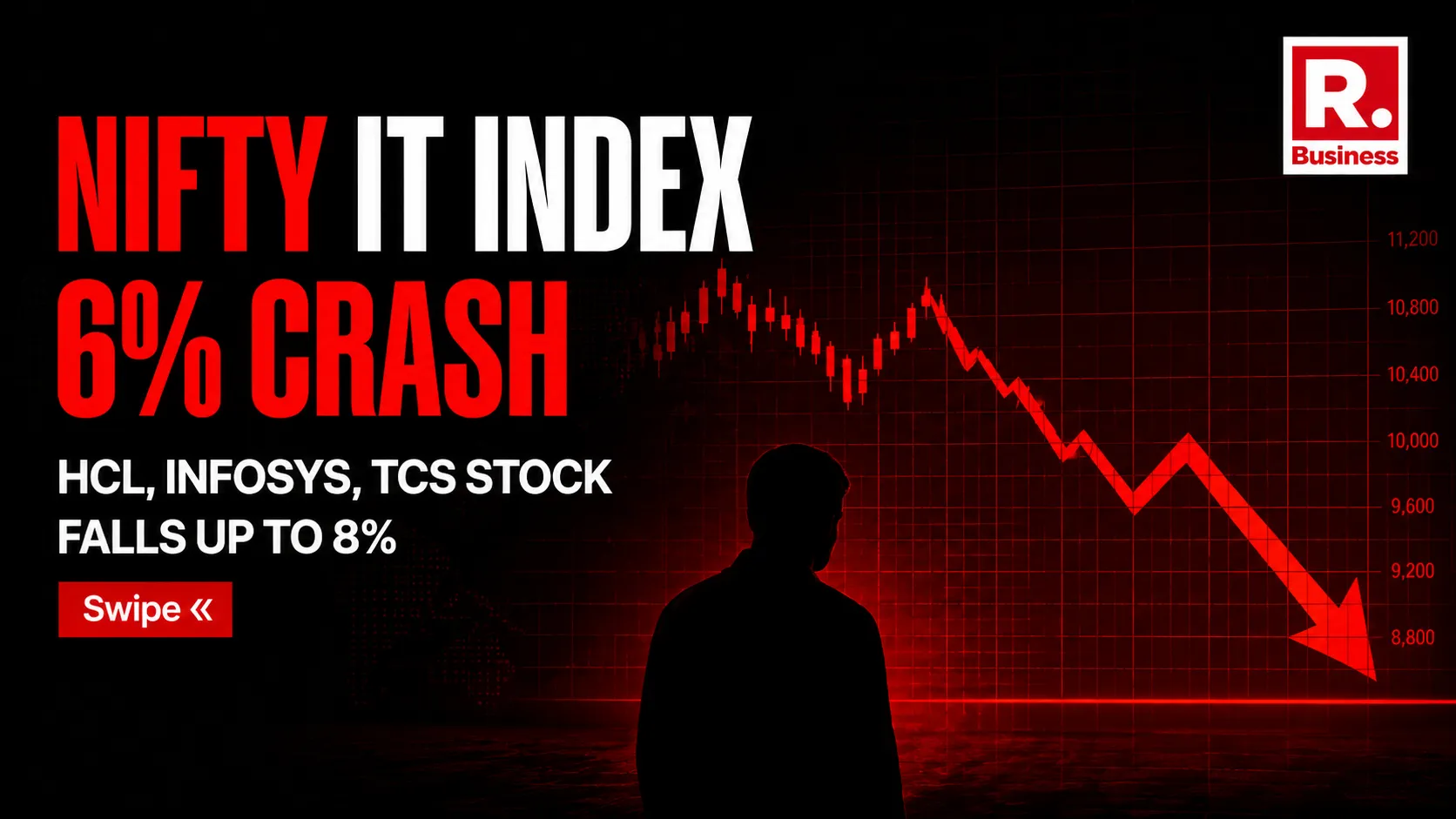
There's an old adage on Dalal Street that markets don't reward the present, they price in the future — and this week, HCL Technologies became the latest illustration of just how unforgiving that principle can be. On Monday, July 13, 2026, HCL Tech reported its first-quarter results for the 2026-27 financial year, numbers that, by most conventional measures, beat analyst expectations. And yet, when trading resumed, the stock fell sharply — dropping around 4.4% and emerging as the single biggest laggard on the Sensex the following session — because the headline that mattered most to investors wasn't the quarter that had just ended, but the guidance for the year still ahead.
Setting the stage: what analysts expected
Heading into the results, expectations had been building steadily. HCL Tech's share price had surged more than 1% on the Monday of results day itself, part of a broader rally across India's technology sector that saw rival stocks including Tata Consultancy Services, Infosys, Wipro, and Tech Mahindra all trading higher in anticipation. Analysts had forecast that HCL's revenue would grow between 13% and 15% year-on-year, landing somewhere in the range of ₹34,250 crore to ₹34,550 crore, building on the ₹33,981 crore reported in the previous quarter (Q4 FY26) and a meaningfully lower ₹30,349 crore in the year-ago June quarter. Analysts also projected net profit growth of 15% to 17% year-on-year, putting expected profit in a range of ₹4,450 crore to ₹4,570 crore — though most expected profit to remain roughly flat on a sequential basis compared to the ₹4,488 crore reported in Q4 FY26.
There was also a widely anticipated margin story: analysts expected HCL's EBIT margin to improve by 10 to 30 basis points during the quarter, landing somewhere between 16.5% and 16.9%, with rupee depreciation against the dollar cited as a meaningful tailwind — a dynamic that had taken on added significance given the rupee's own volatile run through mid-2026, when the currency slid past the psychologically important 96-per-dollar mark amid a broader oil-driven risk-off environment. For an IT services exporter like HCL, which earns the overwhelming majority of its revenue in foreign currencies (chiefly US dollars) while incurring most of its costs in rupees, currency depreciation mechanically boosts reported margins even without any change in underlying operational performance — a nuance that analysts and investors typically try to strip out when assessing the "quality" of a quarter's results.
The results themselves — and where the beat came from
When the numbers landed, HCL Tech's quarterly performance came in ahead of expectations on the profitability front, even as the company maintained its full-year guidance for FY27 rather than raising it — a decision that turned out to be the crux of the market's negative reaction. Sector analysts noted that HCL Tech's results "topped expectations," a characterization consistent with the pattern of the company delivering margin performance and profitability that exceeded what the Street had modeled. The company's board also used the results announcement as an opportunity to consider its second interim dividend for the financial year, following an eye-catching first interim dividend of ₹24 per share — described in market commentary as a 2,400% payout relative to the stock's face value — with a record date of April 5, 2026, and payment completed by May 5, 2026.
This dividend track record is itself a notable part of HCL Tech's investment story. Across the 2025-26 financial year, the company paid out five separate interim dividends totalling ₹60 per share — starting with ₹6 per share in January 2025, followed by ₹18 per share in April 2025, and then three further dividends of ₹12 per share each in July 2025, October 2025, and January 2026. That consistency has made HCL Tech one of the more reliable dividend-paying stocks within India's large-cap IT sector, a characteristic that tends to appeal particularly to income-focused institutional investors, including domestic mutual funds and insurance companies that value predictable cash returns alongside capital appreciation.
So why did the stock fall despite the beat?
The disconnect between HCL's better-than-expected quarterly profitability and its stock's sharp decline comes down to a single word that dominates every earnings season in the IT services sector: guidance. Investors in IT services stocks are notoriously forward-looking, because the sector's revenue visibility depends heavily on multi-year outsourcing contracts, deal pipelines, and — crucially — corporate technology budgets that can shift meaningfully based on macroeconomic conditions in HCL's key markets, chiefly the United States and Europe. When a company like HCL delivers a strong quarter but declines to raise its full-year guidance, the market interprets that as a signal that management itself isn't confident the current quarter's strength is sustainable or indicative of accelerating demand — rather, it may reflect one-off factors (like currency tailwinds) that won't necessarily repeat.
In HCL's case, market commentary specifically noted that the company's "unchanged FY27 guidance overshadowed stronger-than-expected quarterly results" — language that captures precisely this dynamic. Investors had been hoping that a strong quarter, especially one boosted by rupee weakness, might prompt HCL's management to signal growing confidence in the broader demand environment by raising its full-year outlook. When that didn't happen, it read as an implicit acknowledgment from the company that the operating environment for IT services — characterized by continued caution around discretionary technology spending among large enterprise clients, particularly in sectors like banking, financial services, and technology itself, which have historically been among HCL's largest revenue contributors — remains challenging enough that management isn't ready to bank on sustained acceleration.
The broader IT sector context
HCL's results need to be read alongside the performance of its sector peers, all of whom have been reporting their own first-quarter results for FY27 around the same period. Tata Consultancy Services, India's largest IT services company by revenue, reported Q1 FY27 revenue of ₹59,553 crore and net profit of ₹13,642 crore, with an EPS of ₹37.70 — numbers that were generally read as a "decent" quarter that set a reasonably steady baseline heading into the rest of the earnings season, according to market commentary that described investors as "looking forward to HCL Tech results for a turnaround" after TCS's showing.
Wipro, meanwhile, has faced a more skeptical set of expectations from sell-side analysts. Ahead of its own results, brokerage Jefferies projected that Wipro's Q1 FY27 IT services revenue would actually decline 1.7% quarter-on-quarter, citing the combined impact of wage hikes and costs associated with recent acquisitions — a more cautious read than the one applied to either TCS or HCL, and a reminder that even within India's tightly clustered IT services sector, company-specific execution and cost dynamics can produce meaningfully divergent outcomes from one player to the next.
Taken together, this earnings season has painted a picture of an Indian IT services sector that is, at best, in a state of cautious stabilization rather than robust recovery — companies are managing costs effectively enough to deliver margin beats and maintain healthy profitability, and currency tailwinds from rupee depreciation are providing a genuine, if somewhat artificial, boost to reported numbers. But the reluctance across the sector to raise full-year guidance suggests that management teams, who have far more granular visibility into their deal pipelines and client conversations than external analysts, remain unconvinced that global enterprise technology spending is entering a genuinely stronger growth phase, particularly for discretionary, non-essential technology projects that tend to be the first casualties when corporate clients in the US and Europe tighten their own budgets amid economic uncertainty.
What analysts will be watching next
Beyond the headline revenue and profit numbers, several other metrics from HCL's results are likely to attract close analyst scrutiny in the days following the announcement. Deal bookings and new contract wins during the June quarter will be a key indicator of the underlying health of HCL's sales pipeline — a metric that often provides a better forward-looking signal than the reported financials for the quarter that has already closed, since large IT services deals typically have long lead times between signing and revenue recognition. Management commentary on discretionary spending trends among clients — particularly whether companies are becoming more willing to greenlight new, non-essential technology initiatives, as opposed to simply maintaining existing systems and contracts — will also be closely parsed for clues about the trajectory of the broader sector heading into the back half of the calendar year.
Currency dynamics will remain a live variable to watch as well. With the rupee having weakened meaningfully through mid-2026 amid the combination of elevated crude oil prices and broader geopolitical uncertainty tied to the ongoing Middle East conflict, IT services companies with substantial dollar-denominated revenue streams are likely to continue seeing some degree of currency-driven margin support in the coming quarters — though how much of that benefit management chooses to reinvest into wage increases, talent retention, or pricing competitiveness, versus flowing straight through to reported profitability, will vary company by company and will factor into how analysts assess the "quality" of earnings across the sector.
The bigger picture for Indian IT investors
For investors in India's technology sector more broadly, this earnings season is reinforcing a familiar but important lesson: in a sector where valuations are heavily influenced by growth expectations and forward guidance, even genuinely strong quarterly execution can be insufficient to satisfy the market if it isn't accompanied by clear signals of improving future demand. HCL Tech's ability to deliver margin beats, maintain a strong dividend payout track record, and navigate a challenging global demand environment reasonably well are all points in the company's favor from an operational standpoint. But until management teams across the sector — HCL included — feel confident enough in their order pipelines to raise, rather than simply reiterate, full-year guidance, India's IT services stocks are likely to remain caught in the kind of "beat the quarter, miss the narrative" pattern that defined HCL's results this week: a company executing well in a sector still waiting for its next real growth catalyst.