For Nearly A Decade, Venture Capital Rewarded Consumer Startups For Growing Fast. In 2026, Investors Are Sending A Different Message: Growth Matters, But Only If The Business Can Survive Without Constant Funding.
A few years ago, building a consumer startup in India seemed almost straightforward.
Raise venture capital, spend aggressively on customer acquisition, offer discounts, expand into multiple categories and prioritize growth above everything else. Investors encouraged founders to capture market share quickly because capital was abundant and public markets rewarded scale. The objective was rarely profitability. The objective was dominance. As long as user numbers kept rising and revenue growth remained impressive, losses were often viewed as a temporary problem that future scale would eventually solve.
That playbook created some of India's most recognizable consumer brands.
The direct-to-consumer boom produced companies across beauty, personal care, food, fashion, wellness and household products. Consumers embraced digitally native brands that promised better products, stronger storytelling and closer relationships than traditional FMCG giants. Venture capital flowed freely into the sector because investors believed India was entering a golden era of consumer entrepreneurship. Every large category seemed capable of producing multiple unicorns, and founders raced to build businesses before competitors could establish meaningful positions.
The environment in 2026 looks dramatically different.
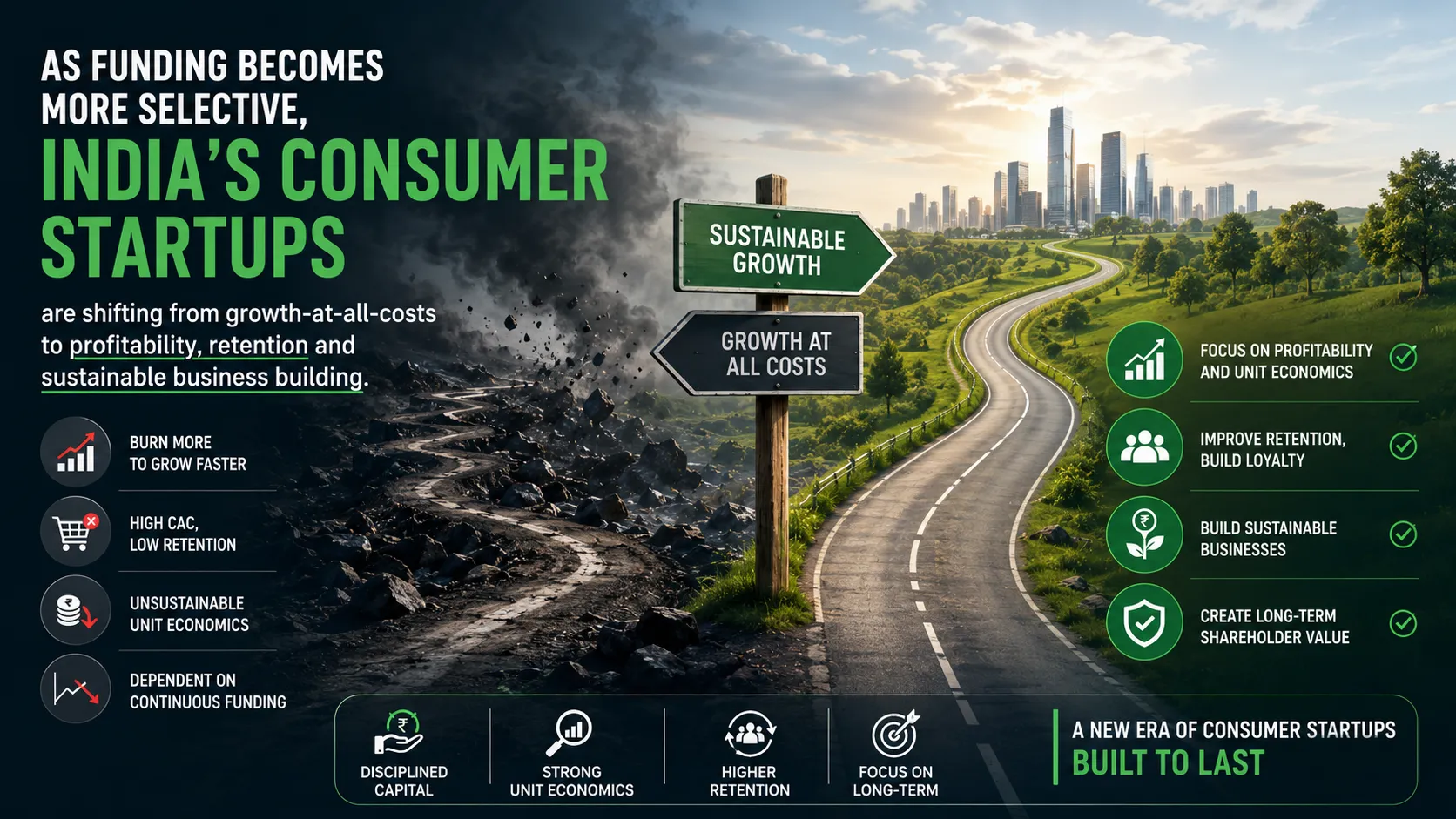
Funding has not disappeared, but the questions investors ask have changed. Instead of focusing exclusively on growth rates, they are examining contribution margins, customer retention, cash flow and operational efficiency. Startups that once celebrated aggressive spending are now discussing profitability roadmaps. Investors are no longer impressed simply because a company can acquire customers. They want to know whether those customers generate sustainable economics. The era of growth at any cost is being replaced by an era of disciplined expansion.
Investors Are Funding Quality Instead Of Hype
One of the biggest changes in the consumer startup ecosystem is the shift in investor behavior.
During the peak funding years, venture capital often rewarded narratives. Founders who could describe large market opportunities and ambitious expansion plans frequently attracted capital even when business fundamentals remained uncertain. Growth itself became the primary metric. If revenues doubled every year, many investors were willing to overlook operational inefficiencies in anticipation of future scale.
Today's investors are behaving differently.
Consumer businesses now face far more rigorous scrutiny. Investors want evidence that customers return repeatedly without excessive promotional spending. They want proof that brands can maintain margins while expanding distribution. They want clarity regarding supply chains, inventory management and unit economics. In many cases, startups growing more slowly but more sustainably are attracting greater interest than companies pursuing unsustainable expansion.
This change reflects a broader maturation of India's startup ecosystem.
Investors are no longer funding consumer businesses because the category is fashionable. They are funding businesses because they believe the underlying economics justify long-term confidence.
The Customer Has Become More Selective
Part of the reset is being driven by consumers themselves.
During the initial D2C boom, novelty often helped brands attract attention. Consumers were excited to discover alternatives to established incumbents and frequently experimented with new products. Digital advertising platforms made discovery easier while pandemic-era online shopping accelerated adoption. Many startups benefited from a period when consumers were actively seeking new experiences.
That environment has become far more competitive.
Today's consumers have access to hundreds of brands across virtually every category. They compare products more carefully, evaluate reviews more thoroughly and switch brands more readily when expectations are not met. Customer loyalty is harder to earn and easier to lose. As a result, businesses can no longer depend solely on marketing to sustain growth. Product quality, customer experience and brand trust have become increasingly important competitive advantages.
This shift is forcing founders to think differently.
Instead of asking how quickly they can acquire customers, many are asking how effectively they can retain them. The distinction may seem subtle, but it fundamentally changes how businesses operate.
The New Winners Are Building Supply Chains, Not Just Brands
One of the most important lessons emerging from the D2C reset is that brands alone are not enough.
The first generation of consumer startups focused heavily on storytelling, design and customer acquisition. While these elements remain important, investors increasingly recognize that long-term success depends on operational excellence. Manufacturing capabilities, sourcing relationships, inventory management and logistics networks often determine whether a company can scale profitably.
This realization is changing how founders allocate resources.
Rather than spending disproportionate amounts on advertising, many startups are investing in supply-chain resilience and operational infrastructure. The objective is to create businesses capable of generating sustainable margins while maintaining product quality. Investors view these capabilities as increasingly valuable because they create advantages that competitors cannot easily replicate.
The result is a consumer ecosystem becoming more sophisticated.
Companies are evolving from marketing-driven startups into operationally disciplined businesses with stronger foundations for long-term growth.
Consolidation Is Becoming Part Of The Strategy
Another consequence of the reset is the growing importance of acquisitions and consolidation.
The funding boom produced hundreds of consumer brands across multiple categories. Not all of them will survive independently. As capital becomes more selective, larger companies are increasingly acquiring smaller brands to expand portfolios, strengthen capabilities and accelerate growth. The trend is creating a consumer landscape where scale matters more than ever before.
This dynamic benefits businesses with strong balance sheets and disciplined operations.
Companies capable of generating healthy cash flows often have greater flexibility to pursue acquisitions and strategic expansion. Instead of competing purely through customer acquisition, they can grow by integrating complementary brands and building broader ecosystems.
Investors increasingly favor this approach.
It creates pathways to scale that rely less on continuous fundraising and more on operational execution.
Funding Is Still Available—But The Rules Have Changed
The most important takeaway from 2026 is that consumer investing remains very much alive.
Despite concerns about funding slowdowns, investors continue deploying substantial capital into promising brands. The difference is that capital is flowing toward businesses demonstrating discipline rather than simply ambition. Startups capable of balancing growth with strong fundamentals are still attracting significant interest.
Recent funding rounds across wellness, food, beauty and lifestyle categories illustrate this point.
Investors remain enthusiastic about India's consumer opportunity because the underlying market continues expanding. Rising incomes, digital adoption and evolving consumption patterns all support long-term growth. What has changed is the threshold for investment. Businesses must now prove they can translate demand into durable economics.
For founders, this shift may ultimately prove beneficial.
Companies built on strong foundations often emerge more resilient than those dependent on continuous external capital.
The Bigger Story Is About Maturity
Viewed narrowly, the D2C reset appears to be a funding story.
Viewed more broadly, it represents the maturation of India's consumer startup ecosystem. The first phase was defined by experimentation and rapid expansion. The second phase is being defined by discipline, operational excellence and sustainable growth. The transition is not a sign of weakness. It is a sign that the market is evolving beyond its earliest stage of development.
The strongest brands are likely to emerge stronger than ever.
They have already proven consumers want their products. The challenge now is proving they can build enduring businesses around that demand. Investors increasingly believe those companies exist. They are simply becoming more selective about identifying them.
That is why 2026 may ultimately be remembered as a turning point.
Not because consumer startups stopped growing, but because they finally learned that growth is only valuable when it rests on a foundation strong enough to support it.