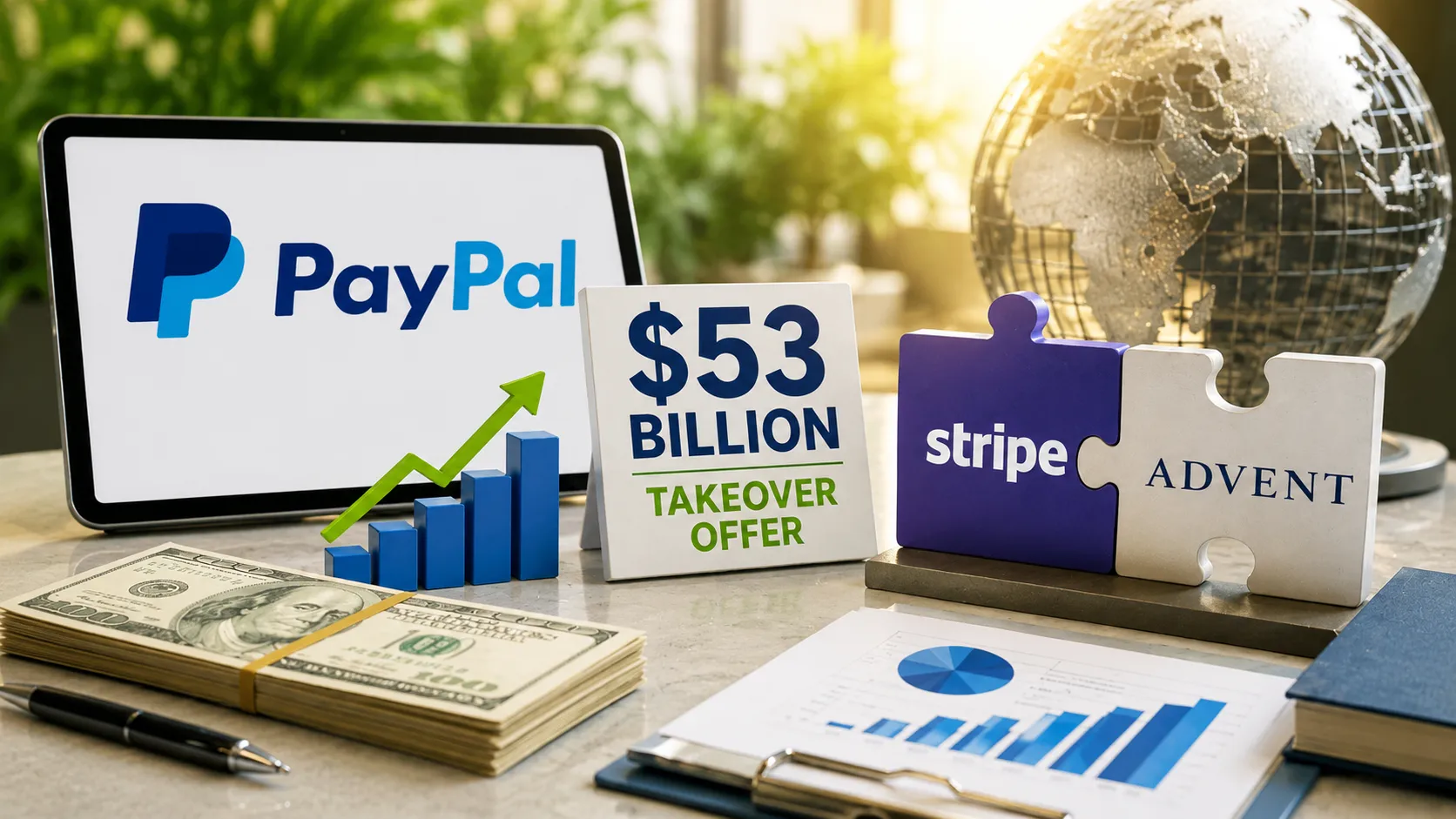
Payments giant Stripe, still privately held but valued at roughly $159 billion, has joined forces with private equity firm Advent International to make a joint takeover offer for PayPal Holdings — a bid that, if accepted, would combine two of the most widely used payment platforms for internet merchants anywhere in the world. The offer, confirmed by multiple sources and reported first by Reuters, values PayPal at more than $53 billion, with Stripe and Advent proposing $60.50 in cash for each PayPal share, a roughly 28 per cent premium over the stock's closing price the day before the offer became public, a bid structure designed to give PayPal's board a compelling enough case to seriously engage despite the company's own ongoing independent turnaround efforts.
The scale of the proposed transaction places it among the largest potential deals anywhere in the global payments sector in recent years, and the news sent PayPal shares surging as much as 17 per cent in after-hours and subsequent trading — a reaction that itself speaks volumes about how far investor expectations for PayPal's standalone prospects had fallen before this week's offer emerged, and about how much relative upside the market believes even a modestly discounted takeover represents compared to the company's recent, difficult independent trading history over the preceding several years.
The Terms of the Deal
According to people familiar with the matter, the offer was submitted earlier this month and is backed by approximately $50 billion in committed financing from banks — an enormous debt package that underscores just how seriously Stripe and Advent are pursuing the acquisition. Stripe, Advent, and payments company Block are reportedly contributing a combined $17 billion in equity toward the offer, a substantial equity commitment that reflects genuine conviction from all three parties in the long-term strategic value of the combination, rather than a purely debt-financed opportunistic bid. If the deal proceeds as structured, Stripe and Advent would jointly own the combined company, each holding an equal stake, a governance arrangement that would itself require careful structuring to avoid the kind of joint-control disputes that have complicated other large private equity co-investments in the past.
PayPal's board is expected to meet as soon as July 20 to formally discuss the offer. Notably, sources indicate that PayPal has so far been reluctant to engage substantively with the proposal, a posture that follows an earlier, less formal expression of interest from Stripe reported back in February, when the two companies were said to be in early, exploratory discussions about a potential combination that ultimately went nowhere at the time.
PayPal's Long Fall From Its Peak
To understand why this offer has generated such intense market interest, it helps to appreciate just how dramatically PayPal's fortunes have shifted since the company's pandemic-era highs. At its peak in 2021, PayPal commanded a market capitalization of roughly $360 billion, a valuation that reflected investor enthusiasm for the explosive growth in digital payments and e-commerce during the pandemic years. Since then, the company's market value has collapsed to as low as approximately $36 billion at points this year — a decline of nearly 90 per cent from its high-water mark, driven by a combination of slowing growth, intensifying competition from rivals including Apple Pay and Google Pay, and a broader loss of investor confidence in the company's ability to defend its position as digital commerce has continued evolving.
PayPal's stock has lost more than 40 per cent of its value over just the past twelve months alone, a decline that has coincided with a series of difficult strategic decisions by the company's leadership. PayPal announced plans earlier this year to cut roughly 20 per cent of its workforce — approximately 4,760 roles — over the coming two to three years, part of a broader restructuring effort the company says is designed to generate at least $1.5 billion in gross run-rate cost savings. The company also replaced its previous chief executive, Alex Chriss, who had originally been brought in specifically to engineer a turnaround, with the board instead naming former HP executive Enrique Lores as its new president and chief executive.
Signs of Operational Improvement Amid the Turmoil
Despite the dramatic decline in market value and leadership upheaval, PayPal's underlying operating metrics have shown some genuine signs of stabilization in recent quarters. In its most recent reported first quarter, PayPal generated $8.35 billion in revenue, a 7 per cent year-on-year increase that exceeded analyst expectations, while total payment volume processed across the platform reached approximately $464 billion, up 8 per cent year-on-year on a constant-currency basis. Management has also outlined ambitions to use artificial intelligence to streamline internal operations and reduce organizational complexity, targeting roughly $1.5 billion in savings over the next two to three years that the company says it plans to reinvest into future growth initiatives.
Even so, Citi analysts noted in a research note published just days before this week's takeover bid emerged that while PayPal is investing heavily to revive its growth trajectory, investor skepticism remains genuinely elevated given the company's history of previously announced — and ultimately underwhelming — turnaround efforts.
Why Stripe Wants PayPal
For Stripe, acquiring PayPal would represent a transformative strategic move, instantly combining two of the internet's largest payment processing platforms and creating what would likely become one of the single largest players in global online payments infrastructure. PayPal brings an enormous, established base of hundreds of millions of consumer and merchant accounts — some reports have cited a user base approaching 439 million — along with deep penetration into e-commerce checkout flows that have become deeply embedded in how consumers transact online across much of the world.
The deal would also give Stripe direct access to PayPal's stablecoin initiatives and broader digital asset infrastructure, an area where both companies have been investing as stablecoins — digital tokens pegged to traditional currencies — have moved increasingly into mainstream financial infrastructure. PayPal's own stablecoin, PYUSD, ranks as the eighth-largest in the sector, while Stripe has separately built out its own blockchain-based payments infrastructure, including a proprietary mainnet called Tempo, alongside its historical integration of Circle's USDC stablecoin into its payments ecosystem.
A Broader Wave of Payments Sector Consolidation
This week's offer for PayPal adds to what has already been a notably active period of consolidation across the global payments industry. A prominent recent example came in 2025, when Global Payments agreed to acquire Worldpay from FIS and private equity firm GTCR in a transaction valued at $24.25 billion — itself one of the largest payments sector deals in recent memory before this week's PayPal offer emerged to potentially eclipse it. That broader consolidation wave reflects an industry increasingly convinced that scale, breadth of merchant relationships, and integrated technology stacks spanning payments, banking infrastructure, and increasingly artificial intelligence and stablecoin capabilities, will prove decisive in determining which payment companies thrive over the coming decade.
What Happens Next
With PayPal's board expected to formally take up the offer as soon as July 20, the coming weeks will be critical in determining whether the company's leadership views this week's bid as a credible path forward, or whether PayPal instead continues pursuing its own independent turnaround strategy under new chief executive Enrique Lores. Sources familiar with the matter indicate that Stripe and Advent have not yet received any formal response from PayPal, but are hoping to advance substantive discussions in the coming weeks — suggesting that even a formal board meeting on July 20 may represent only the opening stage of what could become a protracted negotiation, or potentially a contested takeover process, depending on how PayPal's board ultimately chooses to respond to a bid that many analysts view as attractively priced relative to the company's recent, difficult trading history.
The Consumer Impact of a Potential Combination
For the hundreds of millions of consumers and merchants who rely on Stripe and PayPal for everyday online transactions, a combination of this scale would inevitably raise questions about long-term pricing power, given how dramatically it would reduce the number of large-scale, full-service payment processing alternatives available to businesses of all sizes. Merchant advocacy groups and smaller fintech competitors alike are likely to scrutinize any formal transaction closely for exactly this reason, adding yet another layer of stakeholder interest to a deal that already faces genuine uncertainty simply in getting PayPal's board to the negotiating table in the first place.
What a Combined Stripe-PayPal Would Actually Look Like
Beyond the headline financial terms, the strategic logic of combining Stripe and PayPal centers on the genuinely complementary nature of their respective strengths. Stripe has built its reputation primarily around serving software-native, often younger and faster-growing businesses with highly flexible, developer-friendly payment infrastructure, while PayPal's core strength has historically rested in its enormous, deeply entrenched consumer-facing checkout brand recognition and its long-standing relationships with larger, more established e-commerce merchants. A combination would, in theory, give the merged entity a genuinely rare combination of both cutting-edge developer infrastructure and mass-market consumer trust — two capabilities that few, if any, other standalone payments companies currently possess simultaneously at comparable scale.
The Regulatory Road Ahead
Even if PayPal's board were to engage constructively with this week's offer, any eventual transaction of this scale would almost certainly face extensive antitrust and regulatory scrutiny given the sheer combined market share Stripe and PayPal would command across global online payment processing. Regulators in the United States, European Union, and other major jurisdictions have grown increasingly attentive to consolidation within financial technology and payments infrastructure specifically, given how central these platforms have become to the functioning of global e-commerce — meaning that even a fully agreed transaction would likely require many months, if not longer, of regulatory review before any closing could realistically occur.
The Leadership Question at the Center of It All
PayPal's response to this week's offer will inevitably be shaped by the strategic vision of its recently installed chief executive, Enrique Lores, who joined from HP with an explicit mandate to engineer the kind of durable turnaround that his predecessor, Alex Chriss, was ultimately unable to deliver. Lores now faces an unusually consequential early test of his leadership: deciding whether to engage seriously with a takeover offer that values the company at a fraction of its historical peak, or to make the case to PayPal's board and shareholders that the company's own independent restructuring plan offers a more compelling path to long-term value creation than an immediate, if substantially discounted, cash exit.
Why This Matters for Global Digital Payments
For readers tracking the global evolution of digital commerce and financial infrastructure, this week's offer carries significance that extends well beyond the fate of two individual American companies. Both Stripe and PayPal maintain substantial international operations and merchant relationships spanning markets including India, where digital payments adoption has expanded dramatically over the past decade alongside the broader growth of e-commerce and the country's own homegrown Unified Payments Interface ecosystem. A combined Stripe-PayPal entity would represent an even more formidable global payments infrastructure provider, with implications for how international merchants, including a growing number of Indian businesses selling into global markets, access and price cross-border payment processing services in the years ahead.
The deal also offers a pointed illustration of a broader dynamic reshaping global technology and financial services: even well-established, historically dominant platforms like PayPal are not immune to genuine competitive and valuation pressure when growth slows and more agile, technologically ambitious rivals like Stripe continue expanding aggressively — a lesson with resonance for technology and financial services companies operating in fast-evolving digital markets everywhere, India included.