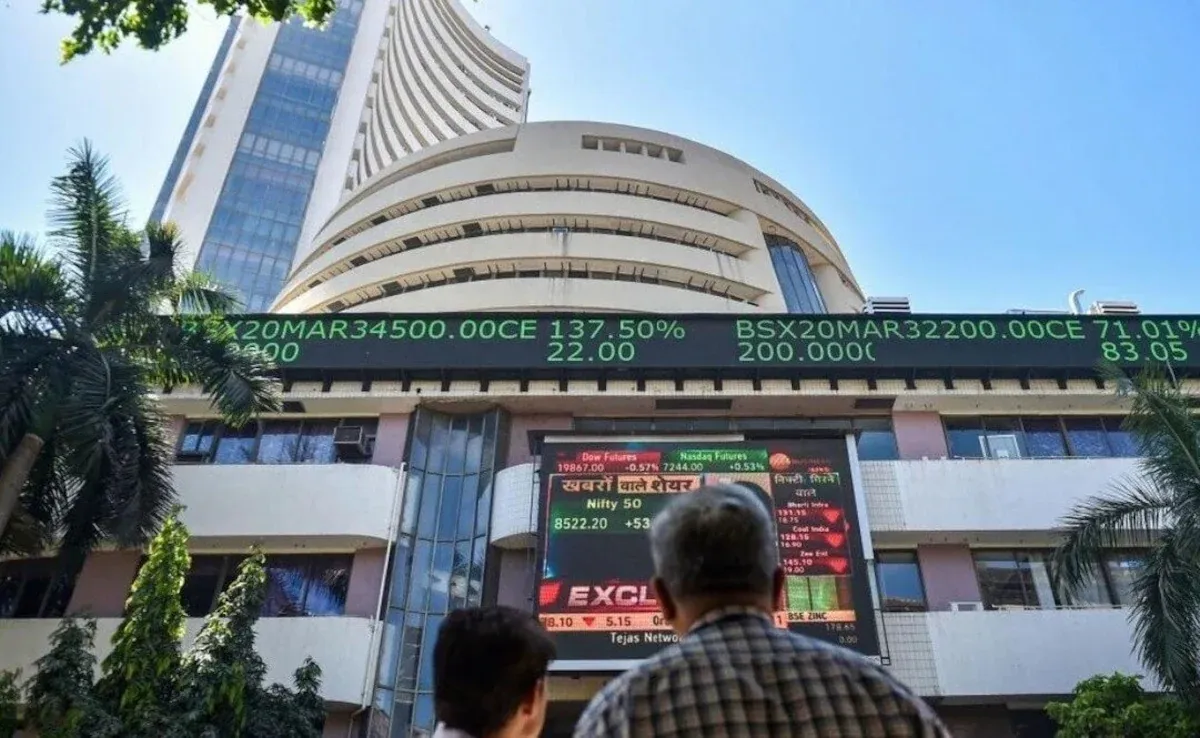
Dalal Street closed out July 29, 2026, with the kind of session traders describe, without much exaggeration, as a "risk-on" day — the sort where nearly every sector chart turns green, institutional flows swing positive, and the fear gauge quietly slides lower in the background. The BSE Sensex surged 888.68 points, or 1.16 percent, to settle at 77,654.60, while the NSE Nifty 50 climbed 264.85 points, or 1.10 percent, to close at 24,250.20 — the benchmark index's strongest single-session performance in several weeks, and one that pulled the broader market decisively out of the range-bound drift it had been stuck in through much of mid-July.
The engine behind the rally was unambiguous: technology. The Nifty IT index surged 2.32 percent, comfortably the best-performing sector gauge of the day, as investors piled into India's largest IT services exporters following a run of quarterly earnings that, while not universally spectacular, offered enough reassurance on margins and deal pipelines to justify a re-rating. Infosys was the standout within the pack, jumping 4.51 percent to close at ₹1,155.60 on the back of continued digestion of its Q1 FY27 results — a quarter that had shown resilient operating margins, a narrowed but still positive revenue growth outlook, and, notably, AI-linked revenue crossing 8 percent of the company's total topline for the first time. TCS and HCL Technologies both added more than 1.5 percent in sympathy, while banking heavyweights joined the advance too, with the Bank Nifty index climbing 0.79 percent to settle at 57,205.90.
Financials more broadly had a strong session, a detail that matters because it signals the rally was not confined to the technology complex alone. Hindustan Unilever climbed nearly 5 percent, continuing a recovery in consumer staples names that had lagged the broader market for much of the year, while engineering and construction major Larsen & Toubro added 2.6 percent after posting quarterly earnings that beat market expectations on order-book growth. Even Tata Steel, a name more sensitive to global commodity cycles than domestic sentiment, participated in the advance, climbing over 2.5 percent as investors read through to improving realisations across the metals complex.
What distinguished July 29's rally from some of the narrower, index-heavy moves the market had seen earlier in the month was the breadth of participation. Market technicians tracking the NSE's advance-decline ratio — a simple but closely watched measure of how many stocks rose versus how many fell on a given day — noted the ratio was broadly positive through the session, a detail that matters because it signals genuinely wide participation across the market rather than a handful of large-cap names dragging the headline index higher while the broader market languishes. That distinction is not a technicality: rallies driven by broad participation have historically proven more durable than those propped up by one or two heavyweight stocks, precisely because they reflect a genuine, market-wide shift in risk appetite rather than a mechanical index effect from a single name's outsized weighting.
Underpinning the equity rally was a meaningfully calmer volatility backdrop. India VIX, the market's primary gauge of expected near-term volatility, eased 4.4 percent to settle around 12.0 — comfortably within the range associated with low anticipated turbulence, and a sharp contrast to the elevated readings the index had touched earlier in July amid tariff-related uncertainty. A falling VIX alongside a rising index is generally read by derivatives desks as confirmation that the rally reflects genuine investor conviction rather than a short-covering bounce, since option markets were simultaneously pricing in less, not more, expected turbulence even as the index climbed.
Institutional flow data added further support to the constructive reading of the session. Foreign institutional investors turned meaningful net buyers in the cash segment, purchasing close to ₹2,981.90 crore worth of Indian equities — their largest single-day net buy in several weeks — while domestic institutional investors added a further ₹998 crore, extending a buying streak that has now persisted for the better part of two months. The combination of returning foreign capital and persistent domestic buying gave the July 29 rally a two-sided support structure that had been notably absent through much of the preceding fortnight, when domestic institutions had been doing almost all of the market's heavy lifting while foreign investors sold into nearly every bounce.
Global cues offered a broadly supportive, if not uniformly positive, backdrop. Asian markets traded higher through the session, with sentiment lifted by continued strength in technology names globally and a sense that the worst of the tariff-related uncertainty that had weighed on emerging-market sentiment through much of 2026 might be beginning to ease. European markets, by contrast, were more mixed, with the FTSE 100 holding in positive territory even as the DAX, CAC 40 and STOXX 50 slipped modestly — a divergence that traders attributed to sector composition differences rather than any single unifying macro catalyst, given how heavily the FTSE's gains were concentrated in financial and energy names that had their own company-specific catalysts that week.
Sector rotation was a notable undercurrent within the broader rally. While IT and financials led the charge, more defensive, rate-sensitive sectors like FMCG and pharmaceuticals posted more muted gains, consistent with a market that was, at least for one session, favouring growth and cyclical exposure over defensive positioning — itself a signal of improving risk appetite. Energy stocks were a partial exception to the broad-based cheer, trading with a more mixed tone as crude oil prices firmed on the back of shipping disruptions linked to tensions in the Strait of Hormuz, a dynamic that has kept oil-import-sensitive sectors and India's broader current account calculus under periodic pressure through the second half of 2026.
Options market positioning offered a more nuanced picture beneath the headline enthusiasm. Even as foreign investors bought aggressively in the cash segment, data on index futures positioning showed FIIs maintaining a substantial net short position of roughly 194,818 contracts — a combination market strategists typically interpret as constructive but hedged: genuine cash-market accumulation, protected by downside insurance in the derivatives segment, rather than an unconditionally bullish, all-in bet on further near-term gains. That nuance matters for anyone reading the day's rally as an unambiguous "all clear" signal — professional money was buying, but buying carefully, with one eye still on the tariff headlines and global rate decisions that have repeatedly wrong-footed the market through 2026.
For retail investors and market-watchers trying to place July 29 in a broader context, the session capped what had otherwise been a choppy month for Indian equities, with the Nifty spending much of mid-July grinding through a range as investors weighed uneven Q1 corporate earnings against persistent trade-policy uncertainty emanating from Washington. A single strong session does not, on its own, confirm a durable trend reversal — market veterans are quick to caution against reading too much into any one day's price action, however impressive — but the combination of broad sectoral participation, falling volatility, and a genuine (if hedged) return of foreign buying gave July 29 a more convincing character than many of the narrower, single-catalyst rallies the market had produced earlier in the year.
Looking ahead, the market's next major tests are already on the calendar. A significant tranche of India Inc's first-quarter results remain to be reported through the first half of August, spanning banking, auto and consumer names that will offer a fuller picture of corporate India's health beyond the IT-sector-led narrative that dominated July. Globally, investors are also watching for the US Federal Reserve's next policy signals and a fresh round of earnings from major US technology companies, both of which carry meaningful read-through for how global capital continues to price risk appetite toward technology-heavy emerging markets like India. And domestically, the trajectory of the fresh 10 percent Section 301 tariff the US imposed on a majority of Indian exports just days before this rally — a policy shift still being digested by exporters and analysts alike — remains the single largest wildcard that could either extend July 29's momentum into August or interrupt it entirely.
For now, though, Dalal Street closed the week on a genuinely encouraging note: a broad, well-supported rally, a calmer volatility backdrop, and the first meaningful sign in weeks that foreign capital may be willing to look past the year's trade-policy noise and re-engage with Indian equities in size.
Zooming out from the single session, July 29's rally arrived at the tail end of a month that had tested investor patience more than it had rewarded conviction. The Nifty had spent much of the first three weeks of July grinding sideways in a roughly 500-point band, whipsawed between encouraging domestic corporate earnings on one hand and persistent anxiety over the trajectory of US tariff policy on the other — anxiety that proved well-founded when Washington added a fresh 10 percent Section 301 duty on more than half of India's exports on July 24, just days before this rally. That the market managed to shrug off a genuinely negative trade-policy headline and rally sharply within days is itself a data point worth weighing: either investors had already substantially priced in the tariff risk ahead of the announcement, or the earnings-driven optimism around technology and financials proved simply strong enough to override the trade overhang, at least for one week.
Retail investor participation added a further layer of support beneath the institutional flows. India's mutual fund industry, powered by a now well-established systematic investment plan culture among retail savers, has continued channelling steady monthly inflows into equities largely irrespective of short-term sentiment swings — a structural feature of the Indian market that has increasingly insulated the broader index from the kind of sharp, foreign-outflow-driven corrections that characterised earlier decades of Indian market history. That domestic buying base, several fund managers have noted in commentary around the July rally, gives the market a genuine floor that allows sessions like July 29 — where foreign capital returns alongside already-present domestic conviction — to translate into outsized single-day gains rather than more muted, foreign-flow-constrained moves.
Sector-specific stock stories beneath the index-level numbers offered additional texture to the rally. Beyond the marquee names already discussed, mid-cap IT services companies and select engineering names posted even sharper percentage gains than their large-cap counterparts, a pattern market technicians often read as a sign of genuine, broad conviction rather than large-cap-driven index mechanics — since mid-cap rallies typically require active stock-picking demand rather than passive index-fund flows, which concentrate almost entirely in the largest constituent names. Options market activity around the Nifty's weekly expiry also reflected the shift in sentiment, with open interest data showing a meaningful build-up in call options at strikes above the index's prevailing level — traders positioning for further upside into the first week of August, even as the same data showed enough put-option activity at lower strikes to suggest the market was hedging rather than making an entirely one-directional bet on continued gains.
For long-term investors rather than short-term traders, the more interesting question raised by July 29's rally is what it implies about earnings quality heading into the remainder of the FY27 corporate results season. A rally built substantially on IT sector earnings beats, rather than on macro sentiment or central bank policy alone, tends to be viewed by fundamental analysts as a healthier, more sustainable kind of market move — one grounded in improving corporate profitability rather than purely in liquidity or sentiment swings that can reverse just as quickly as they arrive. Whether that earnings-driven character persists as the remaining large banking, auto and consumer-sector results roll in through the first half of August will go a long way toward determining whether July 29 marks the beginning of a genuine, durable re-rating for Indian equities, or simply the strongest single session within what remains, on balance, a genuinely choppy and headline-sensitive year for the market. Traders heading into the first week of August will be watching the same triad of signals that has governed sentiment for much of 2026: institutional flow data, the trajectory of the fresh US tariff measures, and the steady drip of remaining Q1 corporate results still to come. Each of those three threads, individually, has the power to either extend July 29's momentum or interrupt it — and how they interact over the coming fortnight will likely determine whether this week is remembered as the start of a genuine August rally or simply a well-earned pause within a longer, more uncertain year for Indian equities.


