FundingMarket Data Women4 MIN READ

Sensex, Nifty Open Sharply Higher as Iran War Fears Ease and Oil Prices Tumble

GIFT Nifty futures surge past 24,600 after Trump signals a pause on Iran strikes, extending India's benchmark indices' third straight winning session into a fourth

By Aravind Kumar · Author3 August 2026
Sensex, Nifty Open Sharply Higher as Iran War Fears Ease and Oil Prices Tumble

MUMBAI — Indian equity benchmarks opened sharply higher on Monday, August 3, extending a rally that has now stretched into a fourth consecutive session, as a sudden de-escalation in geopolitical tensions between the United States and Iran sent crude oil prices tumbling and lifted risk appetite across Asian and domestic markets. At pre-open, both the Sensex and the Nifty50 advanced, building directly on the momentum from GIFT Nifty futures at Gandhinagar's International Financial Services Centre, which surged 180 points, or 0.74%, to 24,628 in early trade.

The trigger was unmistakable: reports that U.S. President Donald Trump had cancelled planned military strikes on Iran, with negotiations between Washington and Tehran expected to begin Monday and a broader deal over the Strait of Hormuz described as imminent. For a market that had spent the preceding days pricing in the risk of a wider West Asia conflict — and the associated threat of disrupted crude flows through one of the world's most critical energy chokepoints — the news arrived as immediate, tangible relief. Brent crude fell as much as 7% in the wake of the announcement, sliding to $81.93 per barrel, tracking the broader easing of hostilities after Trump said he had agreed to halt strikes following requests from West Asian allies to give diplomacy a chance.

For India, a country that imports roughly 85% of its crude oil requirements and remains acutely sensitive to swings in global energy prices, the drop in crude carries outsized significance beyond sentiment alone. Lower oil prices ease pressure on the current account deficit, moderate inflationary risk, and reduce the fiscal burden associated with fuel subsidies and under-recoveries at state-run oil marketing companies — a combination that markets have historically rewarded with broad-based buying across sectors, and Monday's early trade showed exactly that pattern playing out.

Monday's gap-up open followed a strong finish to the previous week. The Sensex closed Friday at 78,095, up 166 points or 0.21%, while the Nifty50 advanced 66 points to settle at 24,384 — the index's third straight session of gains, led by index heavyweights Bajaj Finance, Mahindra & Mahindra, Reliance Industries, Bajaj Finserv, Bharti Airtel, Adani Ports and Tata Steel. That the rally has now carried through into Monday's opening bell, against a backdrop of otherwise mixed regional cues, underscores just how directly Indian market sentiment on this occasion was being driven by the West Asia de-escalation rather than by domestic factors alone.

The broader Asian market picture on Monday was notably less enthusiastic than India's, a divergence worth noting. Japan's Nikkei fell 1.5%, China's Shanghai Composite declined 0.64%, Hong Kong's Hang Seng slipped 0.1%, and South Korea's KOSPI dropped a sharp 4%, with investor sentiment across the region remaining subdued on the back of a broader selloff in artificial-intelligence-related shares globally. That Indian benchmarks were poised to buck this regional weakness reflects both the outsized domestic sensitivity to oil prices and continued relative resilience in foreign institutional flows, with FIIs having bought shares worth ₹277 crore on Friday — a modest but directionally positive signal after periods of sustained foreign outflows earlier in the year.
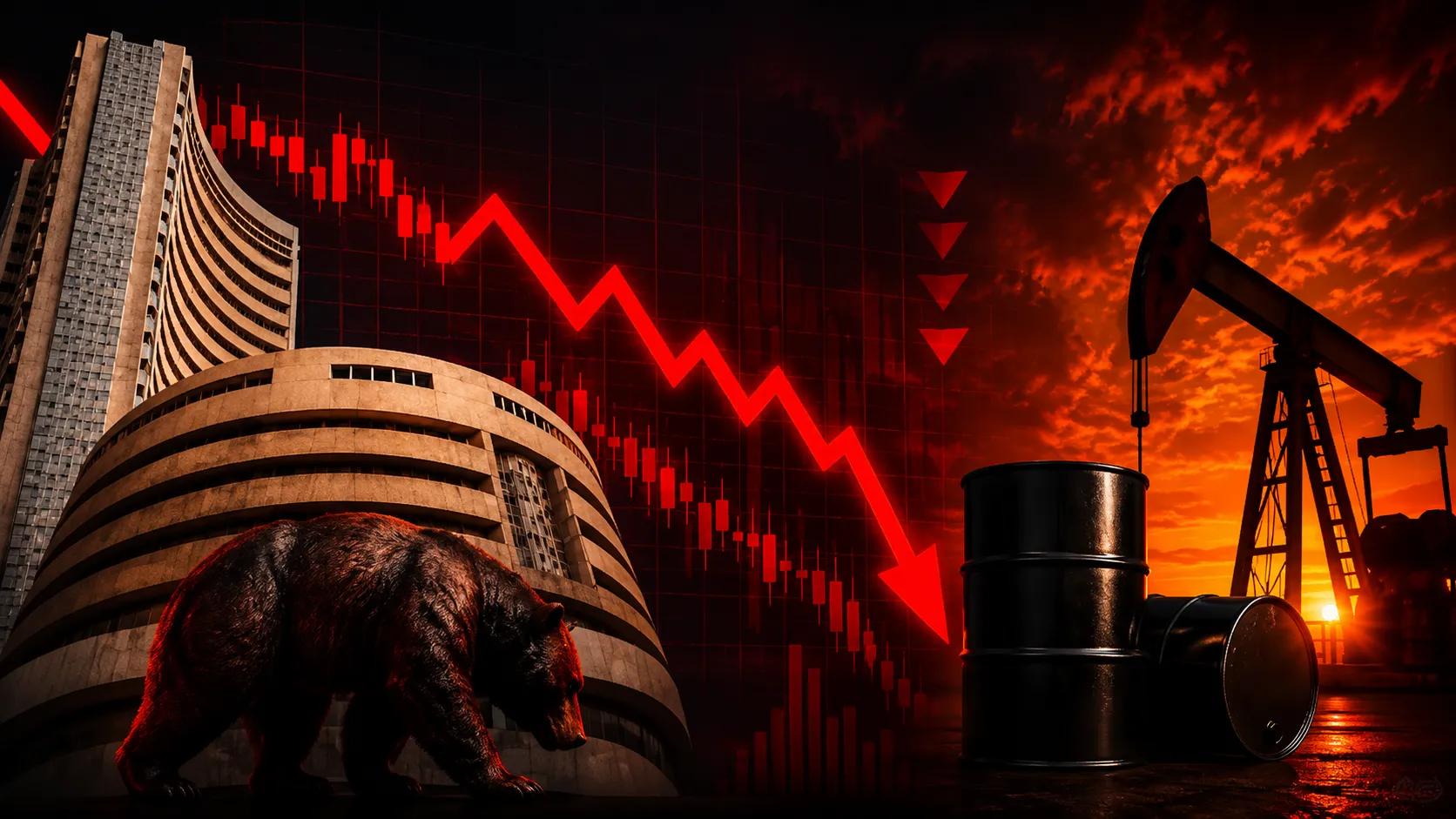

GIFT Nifty futures surged 180 points, or 0.74%, to 24,628 as crude oil prices dropped after reports suggested US President Donald Trump had cancelled planned strikes on Iran, with negotiations set to begin Monday.
Business Standard / Upstox market report

image.png

U.S. markets, for their part, provided a supportive overnight backdrop, with the Dow Jones Industrial Average ending Friday's session higher, reinforcing the generally constructive global risk mood that Indian traders woke up to on Monday morning. Wall Street's gains, combined with the oil price collapse and the specific de-escalation headlines out of the Iran-U.S. talks, created what market participants describe as a near-ideal confluence of factors for a gap-up opening — the kind of session where index futures markets in Gandhinagar's GIFT City accurately foreshadow a broadly positive cash market session hours before the Bombay Stock Exchange and National Stock Exchange formally open for trade.

Sectorally, early indications pointed to broad participation in the rally, though metal stocks were flagged as a particular area of strength, with the Nifty Metal index rising over 1% in early trade — a move consistent with the risk-on mood extending beyond the most obvious oil-sensitive sectors like aviation, paints, and tyre manufacturers into cyclical, globally-linked segments of the market as well. Banking and financial stocks, which had anchored much of Friday's gains through Bajaj Finance and Bajaj Finserv, were also expected to remain in focus as the session progressed.

Monday's trading session arrives at a particularly consequential moment for Indian markets more broadly: the first full week of what is shaping up to be one of the busiest phases of the Q1 FY27 corporate earnings season, with more than 350 to nearly 600 companies scheduled to report their April-June quarter results between August 3 and August 8. That combination — a geopolitically-driven market rally colliding directly with a dense earnings calendar — sets up a session, and likely a week, in which macro sentiment and micro, company-specific fundamentals will be competing for investor attention in near-equal measure.

Market strategists caution that the durability of Monday's rally will depend heavily on how the actual U.S.-Iran negotiations unfold over the coming days. A geopolitically-driven rally built on the expectation of a deal carries obvious downside risk should talks stall or collapse, a dynamic that has played out repeatedly across global oil-sensitive markets over the past year of intermittent West Asia tensions. For now, however, Monday's price action reflected a market willing to price in the optimistic scenario, sending Indian benchmarks decisively higher at the open and setting a constructive tone for a week that domestic investors will be watching closely on two fronts simultaneously: geopolitics abroad, and corporate earnings at home.

As the session progresses through the day, all eyes will remain on whether the early gains hold through the close, whether foreign institutional buying accelerates further on the back of the improved risk sentiment, and how effectively the nearly 600 companies reporting Q1 FY27 results this week are able to keep the market's attention on fundamentals even as the geopolitical backdrop continues to dominate the opening-bell narrative.

TagsSensexNifty50Stock Market TodayGIFT NiftyIndian EquitiesCrude OilUS Iran TalksMarket RallyBSEImpactful Global Indian

Reader reviews

Sign in to rate and review this article.
Loading reviews…