A single Accenture warning wiped out ₹2 lakh crore in market value on June 19, as Infosys plunged 8% and the Nifty IT index hit a fresh 52-week low. The five-day bull run that had lifted markets nearly 5% came to a screeching halt — and investors are bracing for more pain.
The party on Dalal Street ended with a bang — and it wasn't a good one.
Just a day after the Sensex closed above 77,000 for the first time and the Nifty settled at 24,168, Indian equity benchmarks came crashing down on June 19. The trigger? A single earnings report from a global consulting giant based 8,000 miles away in Dublin.
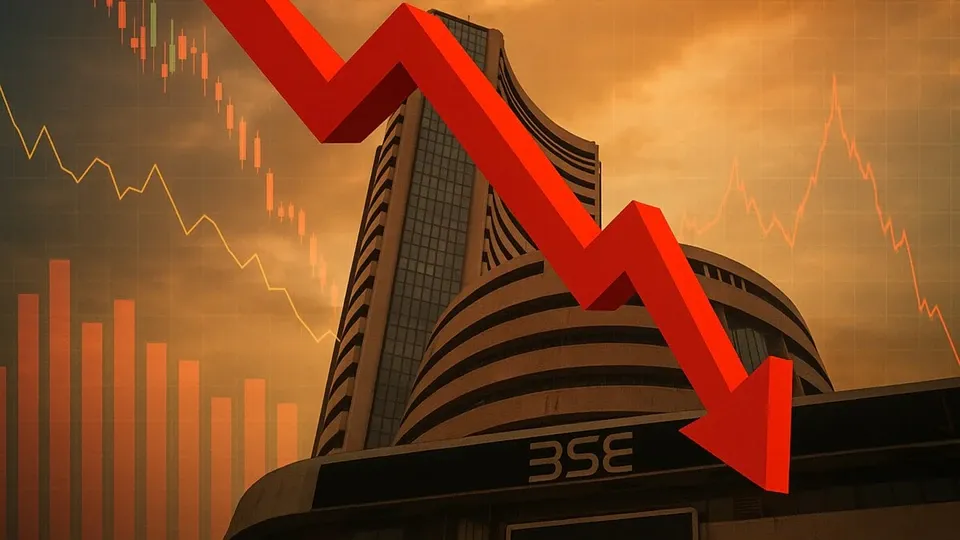
The BSE Sensex plunged as much as 870 points during the session to hit an intraday low of 76,539, while the Nifty 50 sank below the crucial 24,000 mark to 23,920. By the closing bell, the Sensex had fallen 732.19 points, or 0.95%, to settle at 76,677.79, while the Nifty declined 200.10 points, or 0.83%, to close at 23,967.90. Nearly ₹2 lakh crore in market capitalisation was wiped out within hours of trading.
The five-day winning streak — which had seen the Nifty rally 4.3% and the Sensex gain 4.8% — was over. And the culprit was a familiar one: information technology.
The Accenture Shock: What Triggered the Bloodbath
The selloff began when Accenture, the world's largest technology services firm, lowered its full-year revenue growth forecast to 3-4% in constant currency terms, down from its earlier projection of 3-5%. Excluding its US federal business, the company now expects growth of 4-5%, compared with its previous estimate of 4-6%.
While Accenture reported third-quarter revenue of $18.72 billion, up 6% from a year earlier, new bookings stood at just $19.3 billion — lower than the year-ago period. The company also projected fourth-quarter revenue in the range of $17.75 billion to $18.4 billion, below Wall Street expectations.
Julie Sweet, Accenture's Chair and CEO, said clients are continuing to spend on large business transformation projects, including those involving artificial intelligence. But investors focused on the negatives: management disclosed that conflict-related disruptions in the Middle East had affected regional operations during the quarter, with the possibility of additional impact in the coming months. The company flagged a $400 million hit to its Middle East business from the Iran conflict.
The market's reaction was swift and brutal. Accenture shares tumbled nearly 18% in US trading. Indian IT ADRs also came under pressure, with Infosys ADRs sliding close to 10% and Wipro ADRs ending lower.
The IT Bloodbath: Every Stock Bleeds
The Nifty IT index crashed nearly 6% in early trade, hitting a fresh 52-week low of 26,634 — its lowest level in three years. All 10 constituents of the index traded in the red.
Infosys emerged as the biggest loser, tumbling over 8% to hit a 52-week low of ₹1,033.90. Tata Consultancy Services (TCS) fell more than 6%. Tech Mahindra dropped around 5-6%. HCL Technologies lost over 5%. Wipro declined nearly 4%.
The selling pressure extended beyond frontline names. Mphasis, Persistent Systems, Coforge, KPIT Technologies, Tata Elxsi, LTIMindtree, and L&T Technology Services all recorded steep declines between 4% and 6%. Seven IT companies featured among the ten biggest losers on the BSE Midcap index.
All five top laggards on the Nifty 50 were IT companies. The Nifty IT index ended the day down 5.83%, making it the worst-performing sectoral index by a wide margin.
Why Accenture's Warning Matters for Indian IT
For Indian IT companies, one metric stood out above all others: outsourcing bookings fell 15% from a year earlier at Accenture.
That is significant because outsourcing remains the backbone of India's software services industry. The decline suggests that global enterprises are still cautious about committing to large technology contracts. Consulting demand remains weak, while discretionary spending — often the first area to be cut during uncertain times — has yet to recover.
Brokerages interpreted the guidance cut as a reflection of weak demand conditions rather than concerns around artificial intelligence adoption. CLSA noted that managed-services demand remained healthy and rising headcount was an encouraging sign, but the company's order book contracted 14.7% year-on-year. HSBC said Accenture's revised outlook indicated that demand conditions remain subdued. Nomura warned that geopolitical disruptions in West Asia could continue to weigh on deal activity and revenue growth in the near term.
"Guidance cuts by Accenture have triggered sell-off in Indian IT majors' ADRs. This can cause correction in IT stocks in the domestic market too," said VK Vijayakumar, Chief Investment Strategist at Geojit Investments. However, he offered a contrarian view: "Buying can emerge at lower levels in IT since valuations are becoming attractive".
The Broader Market: Pharma Shines While Others Bleed
The selloff was not confined to IT, though technology stocks bore the brunt. The Nifty Realty index declined 0.84%, while Bank Nifty, Financial Services, and Metal indices fell around 0.5% each.
The advance-decline ratio reflected broad-based weakness, with 956 shares advancing against 1,324 declines on the NSE. Around 1,474 stocks declined overall, while 1,039 advanced and 110 remained unchanged.
The India VIX, which measures volatility in the stock market, jumped nearly 5% to 13.30.
However, there were silver linings. Defensive sectors outperformed amid the risk-off sentiment. The Nifty Pharma and Nifty Healthcare indices traded in the green. Sun Pharma and NTPC gained nearly 1% each to emerge as the top gainers.
Among Nifty constituents, Adani Enterprises, Cipla, Bajaj Auto, ICICI Bank, and Max Healthcare were among the top gainers. Bharti Airtel rose 1.34%, while NTPC gained 1.13%.
FIIs and DIIs: Who's Buying, Who's Selling?
Foreign institutional investors sold Indian equities worth ₹1,025 crore on Thursday, June 18, while domestic institutional investors remained net buyers at ₹3,517 crore.
The broader trend for FIIs has been one of consistent selling. Foreign investors have sold shares worth ₹47,903 crore so far in June (till June 18), following cash sales of ₹55,963 crore in May, ₹70,135 crore in April, and ₹122,540 crore in March.
Despite this sustained outflow, strong DII buying continues to provide a cushion to the market. As one analyst noted, "The significant near-term trends in the market are the underlying strength emanating from improving macros helped by the sharp correction in crude prices and short covering by FIIs supporting recovery in banking stocks".
The Crude Oil Factor: A Silver Lining
The market decline came despite a favourable backdrop for oil-importing economies such as India. Brent crude slipped below $79 per barrel and is set for a second consecutive weekly decline, falling more than 9% during the week.
The drop followed progress on the US-Iran interim peace agreement, which helped restore shipping through the Strait of Hormuz and eased concerns over supply disruptions. Kuwait also indicated plans to increase production, adding further pressure on oil prices.
Lower crude prices are positive for India as they help reduce inflationary pressures, support the rupee, and improve the current account balance. The rupee strengthened to 94.31 against the US dollar in early trade, extending its recent recovery.
Global Markets: Mixed but Resilient
Asian markets remained largely positive despite the Indian selloff. South Korea's Kospi rose 2.82% and Japan's Nikkei 225 gained 0.79%, extending their record runs. Australia's ASX 200 declined 0.89%, while markets in China, Hong Kong, and Taiwan remained closed for a holiday.
US markets had closed higher overnight, with the Dow Jones up 0.14% to 51,565, the Nasdaq climbing 1.91% to 26,518, and the S&P 500 rising 1.08% to 7,501.
The Bottom Line
June 19, 2026, will be remembered as the day Accenture's warning ended the five-day bull run on Dalal Street. Nearly ₹2 lakh crore was wiped out. The Nifty IT index crashed to a three-year low. Infosys fell 8%. TCS dropped 6%.
But the story is not just about one day. It is about a sector at a crossroads, facing structural challenges from AI disruption, geopolitical uncertainty, and a slow recovery in global tech spending. The Accenture commentary suggests that AI is not expanding the technology spending pie — at least not yet. It is reshuffling existing budgets.
For Indian IT companies that have built their businesses on outsourcing and cost arbitrage, the message is clear: the old model is under pressure, and the new model has not yet arrived. The question for investors is not whether IT stocks will recover — they will. The question is how long the recovery will take, and which companies will emerge stronger.
For now, the bulls are licking their wounds. The Sensex has fallen below 77,000. The Nifty is trading below 24,000. And investors are watching Accenture's next move — because if the global bellwether sneezes, Indian IT catches a cold. Today, it caught a very bad one.