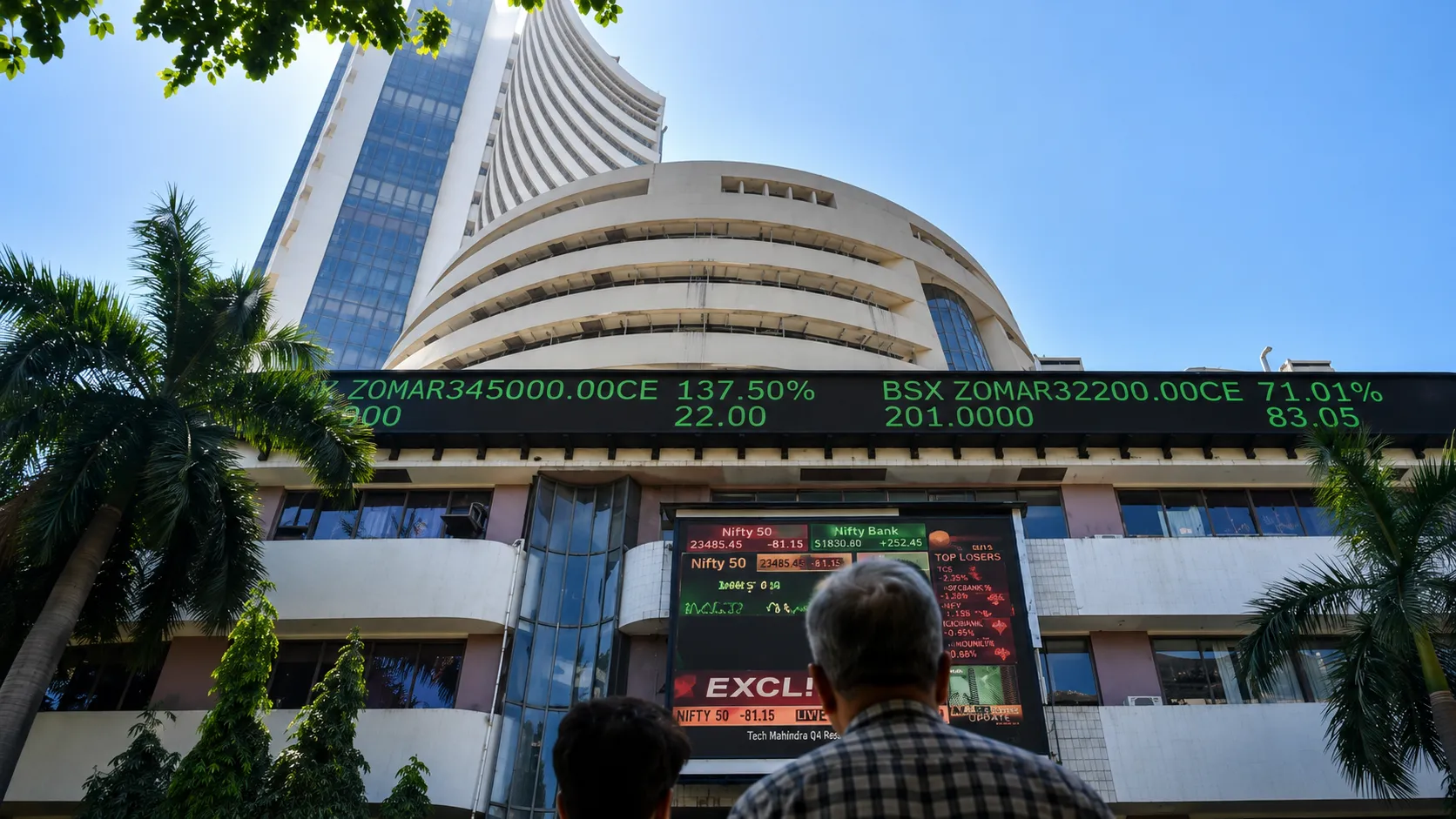
By the time Indian markets reached the midpoint of Wednesday's trading session on July 29, 2026, what had begun as a strong but fairly typical opening rally had evolved into something considerably more emphatic. The BSE Sensex, which had opened the day up 657.85 points, extended its gains through the morning to trade more than 800 points higher by noon, touching 77,569.08 — a rise of 1.05 per cent — while the NSE Nifty 50 climbed 241.10 points, or 1.01 per cent, to 24,226.45. For a market that had spent much of the previous several sessions locked in a cautious, narrow trading range, the persistence of Wednesday's rally through the full morning session offered a meaningfully different signal than a rally that fades by mid-morning typically provides.
The composition of Wednesday's midday leaderboard tells its own story about where investor conviction was concentrated. Hindustan Unilever, Infosys, and Tata Steel emerged as the standout performers within the Nifty 50 index by midday, a grouping that, on the surface, spans three quite different corners of the Indian economy — consumer goods, information technology, and metals and mining — but which collectively points to a broadening of the rally beyond the narrow, IT-led move that had characterised the opening hour of trade.
Hindustan Unilever's inclusion among the day's top gainers carries particular significance given the context surrounding the stock heading into Wednesday's session. The FMCG major had reported Q1 FY27 results a day earlier that several brokerages initially characterised as a headline miss on profit growth, a result of a tax-credit base effect from the prior year rather than any genuine weakness in the underlying business. By midday Wednesday, HUL shares had climbed roughly 4 per cent, with brokerages projecting further upside as the market continued to digest the more encouraging underlying story of 10 per cent net sales growth and 5 per cent volume growth that lay beneath the headline profit number. The stock's continued strength through the midday session suggests the market's initially measured reaction to Tuesday's results has, if anything, gained conviction as more analysts have had time to complete their full review of the numbers.
Infosys's continued leadership through the midday session builds on the momentum that defined the market's opening hour, when the IT bellwether led the Sensex pack with gains approaching four per cent. That the stock maintained, rather than surrendered, its early lead through the middle of the trading day suggests genuine, sustained buying interest rather than a brief, opening-hour spike driven by early momentum traders. Given that the broader Nifty IT index has now rallied approximately 15 per cent through the month of July, Infosys's continued strength adds further weight to the narrative that India's technology services sector is experiencing a genuine, multi-week re-rating rather than a single-session anomaly.

Tata Steel's appearance among the day's leaders introduces a distinctly different narrative thread into Wednesday's rally, one tied to global commodity and metals market dynamics rather than the crude-oil-and-technology-sector story that has otherwise dominated market commentary through the session. Steel stocks globally have periodically responded to shifts in Chinese production and export policy, global infrastructure spending trends, and commodity price movements, and Tata Steel's strength on a day when broader market sentiment was already buoyant suggests metals investors found additional company- or sector-specific reasons for optimism beyond simply riding the broader market's positive mood.
The breadth of Wednesday's rally deserves particular emphasis, since single-session market gains concentrated in only a handful of stocks or sectors tend to be viewed with more scepticism by technical analysts than gains that extend across a genuinely diverse set of names and sectors. With gains spanning technology, FMCG, and metals by midday, and with the broader Nifty MidCap and Nifty SmallCap indices also trading firmly in positive territory — up 0.59 per cent and 0.87 per cent respectively — Wednesday's rally increasingly appears to fit the pattern of a broad-based market advance rather than a narrow, sector-specific move.
Trading volumes through the morning session will offer analysts an additional data point in assessing the conviction behind Wednesday's rally, since a price advance accompanied by genuinely elevated trading volumes is generally read as more durable and meaningful than a similar-magnitude move on comparatively thin volumes, which can sometimes reflect a smaller number of large trades moving prices more than the breadth of participation would suggest. Given the scale of Wednesday's move — over 800 points on the Sensex by midday, following an already strong opening — market technicians will likely be parsing volume data closely in the days ahead to assess how genuinely broad-based the participation behind this rally has been.
The midday milestone also arrives against the backdrop of a market that had, for an extended stretch, been trading below its long-term 200-day moving average on the Nifty 50, a streak dating back to late February 2026. While a single strong session, even one as emphatic as Wednesday's midday performance, does not by itself reverse a months-long technical pattern, sustained strength of this kind builds the kind of momentum that could eventually put a decisive reclaim of that closely watched trend line within reach, a development that would carry meaningful psychological significance for technically oriented traders and portfolio managers who track such signals closely.
Sector rotation dynamics visible through the midday session also merit attention. With IT stocks having already rallied substantially through July, some market watchers had anticipated a degree of profit-booking or rotation away from the sector as the month progressed. Wednesday's midday data, however, suggests IT names including Infosys have continued to attract fresh buying interest even after their substantial recent run, while simultaneously drawing in previously lagging sectors like FMCG and metals — a pattern more consistent with genuine, broadening market strength than with capital simply rotating from one narrow theme to another.
Global cues through the morning session provided a broadly supportive, if not uniformly positive, backdrop for Wednesday's rally. Crude oil prices, having rebounded somewhat after their sharp fall amid the easing of tensions between the United States and Iran, remained a key variable that traders continued to monitor closely, given the direct relevance of crude prices to India's import bill and broader macroeconomic stability. European markets had traded positively in the prior overnight session, offering some tailwind for India's globally linked and export-oriented sectors, even as the picture across other parts of Asia remained comparatively mixed.
For market participants assessing how the remainder of Wednesday's session, and the trading day that follows, might unfold, the midday data offers several considerations. The session's persistence through the morning increases the likelihood that at least some portion of the day's gains will hold into the close, though Indian markets have periodically shown a tendency for afternoon profit-booking even after strong morning sessions, particularly ahead of significant known catalysts like the imminent US Federal Reserve policy decision that continued to loom over broader risk sentiment through the week. Traders positioning into the afternoon session were likely to remain attentive to any incremental newsflow, whether related to the ongoing wave of Q1 FY27 corporate earnings still being reported through the day or to any fresh developments on the geopolitical or global monetary policy front.
The Reserve Bank of India's own policy stance, while not a direct catalyst for Wednesday's specific rally, forms part of the broader backdrop against which domestic equity investors have been operating in recent months, with market participants generally anticipating a continued accommodative tilt from the central bank as inflationary pressures have moderated. This broader domestic monetary policy backdrop, combined with the more immediate, session-specific catalysts of crude oil relief and strong Q1 FY27 earnings from bellwether names, has created a reasonably supportive environment for the kind of sustained, broad-based rally that characterised Wednesday's midday session.
As markets moved from the midday mark toward the afternoon session, the key question for traders and investors alike centred on whether Wednesday's rally could sustain its momentum through the close, or whether the day's considerable gains would prove vulnerable to profit-booking as the session progressed. Either way, the strength and breadth on display by midday had already accomplished something meaningful: shifting the market's underlying tone, at least for this session, from the cautious, range-bound posture that had characterised recent weeks to a considerably more constructive, risk-on mood spanning technology, consumer goods, and metals alike.
Banking and financial services stocks, while not featured among the very top gainers by midday, nonetheless traded broadly in line with or slightly ahead of the overall market, offering further confirmation of the rally's breadth. Given that banking and financial stocks typically carry substantial weight within both the Sensex and Nifty 50 indices due to their large market capitalisations, a scenario where financials merely track the broader market rather than either leading or dragging it suggests the day's gains were not being artificially inflated by outsized moves in a small number of heavily weighted index constituents, but instead reflected a more genuinely distributed pattern of buying across the market's various major sectoral components.
The derivatives market added its own layer of signal to Wednesday's midday session, with Wednesday marking the start of a fresh monthly futures and options series on the National Stock Exchange following Tuesday's expiry. Fresh series openings can sometimes amplify intraday volatility as traders establish new positions, and the scale of Wednesday's rally through the midday mark suggests that the balance of fresh positioning, at least through the morning session, tilted meaningfully toward bullish rather than bearish conviction among both institutional and retail derivatives participants.
Retail investor participation, increasingly a significant driver of Indian equity market dynamics given the sustained multi-year growth in domestic retail trading and systematic investment plan flows, likely contributed to the sustained buying pressure visible through the midday session as well. India's retail investor base has, over recent years, grown considerably more sophisticated and active in reacting to intraday market developments, a dynamic that market technicians increasingly factor into their assessment of how durable a given session's rally is likely to prove, since broad retail participation alongside institutional buying tends to produce more resilient price action than institutional buying alone.
Sector-specific news flow beyond the day's earnings announcements also likely played a supporting role in shaping which stocks led Wednesday's midday gains. Tata Steel's strength, for instance, arrived amid a broader period of relative stability in global steel and iron ore pricing, providing a more favourable backdrop for domestic steel producers than had been the case during some of the more volatile stretches of the past year, when Chinese export dynamics and global demand uncertainty had periodically weighed on sentiment toward Indian metals stocks.
For portfolio managers and institutional investors tracking Wednesday's session in real time, the midday data offered an important input into ongoing decisions about sector allocation and risk positioning heading into the remainder of the week, particularly given the proximity of the US Federal Reserve's policy announcement and the continued flow of Q1 FY27 corporate results still to be reported. A market capable of sustaining an 800-plus point Sensex rally through the full morning session, across a genuinely broad set of sectors, offers meaningfully different signals for near-term positioning than a market that shows the same opening strength but fades by mid-morning — and Wednesday, through its midday mark, had firmly delivered the former.
Foreign portfolio investor activity through the morning session, while not immediately quantifiable in real time, will likely feature in end-of-day provisional data that market participants use to gauge whether Wednesday's rally was predominantly domestically driven or whether it also reflected renewed overseas buying interest. Given that foreign flows have, at various points over the past year, swung between periods of aggressive selling and buying in Indian equities, a session as strong as Wednesday's midday performance would typically be read more favourably by the market if accompanied by confirmed net foreign buying, since that would suggest the rally's underlying support extends beyond domestic mutual fund and retail participation alone.
Media and financial commentary coverage of Wednesday's midday session has generally framed the rally in cautiously optimistic terms, with several market strategists quoted across financial news outlets noting that the day's breadth was as encouraging as its magnitude. This kind of qualitative market commentary, while inherently less precise than the underlying price and volume data, nonetheless plays a meaningful role in shaping broader investor sentiment and confidence heading into the remainder of the trading week, particularly for retail investors who may rely more heavily on summarised market narratives than on granular technical analysis of index-level breadth and volume statistics.