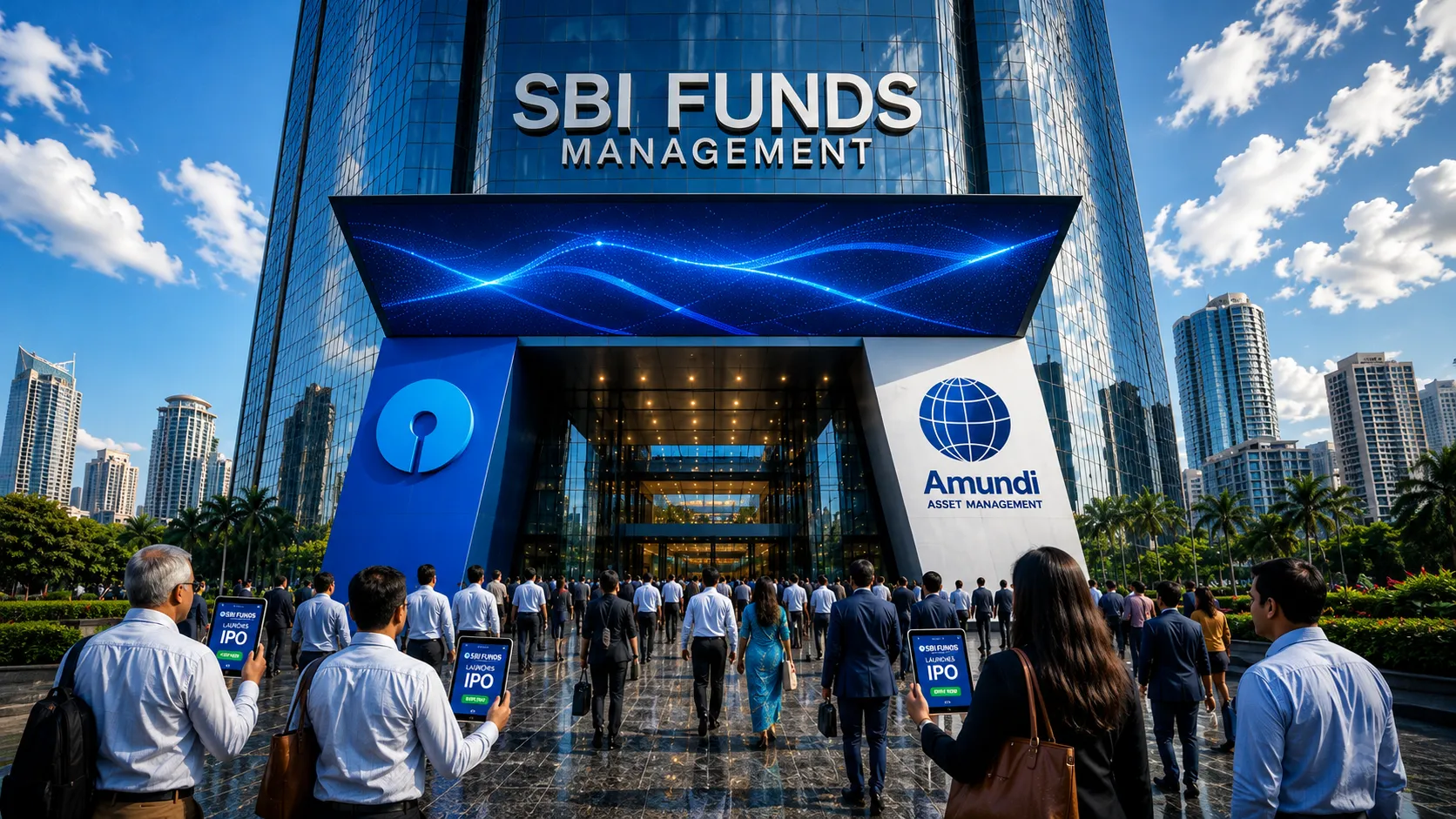
Mumbai: When SBI Funds Management Limited opened its initial public offering for subscription on July 14, it did so as the investment manager behind India's largest mutual fund house — a pedigree that translated almost immediately into some of the most intense grey market chatter and investor interest seen in the Indian primary market so far in 2026. By the time the issue closed and the stock made its formal trading debut a week later, the IPO had told a story with two distinct chapters: a subscription period marked by exceptional, at times almost frenzied, demand and a steadily elevated grey market premium, followed by a listing-day performance that, while comfortably positive, came in noticeably below what the grey market's most bullish signals had implied.
SBI Funds Management is not a conventional operating company going public; it is the asset management arm of SBI Mutual Fund, jointly promoted by State Bank of India and global asset management giant Amundi, and by virtually every relevant metric, it is India's largest player in its category. As of the IPO period, the company managed mutual fund quarterly average assets under management of ₹12.51 lakh crore, translating into a market share of roughly 15.3 per cent of the entire domestic mutual fund industry — a scale advantage built over more than three decades since the fund house's establishment in 1992, and one that gave the IPO an unusually well-understood, low-controversy investment thesis relative to many first-time issuers in the primary market.
The offering itself was structured as an entirely secondary sale. The IPO comprised 17,09,56,631 equity shares offered purely as an Offer for Sale by promoters State Bank of India and Amundi India Holding, meaning SBI Funds Management itself would not receive any proceeds from the transaction — the entire ₹9,795.32 crore raised would flow to the selling shareholders rather than into the company's own balance sheet. The price band was fixed at ₹545 to ₹574 per share, with a minimum market lot of 26 shares, and eligible employees were extended a discount of ₹54 per share, alongside a dedicated shareholder reservation portion of 1,30,55,629 shares carved out of the overall offer.
The subscription window ran from July 14 to July 16, and the demand that materialised over those three days was, by most measures, exceptional. Reuters reported that the offering, worth roughly 98.12 billion rupees, received bids worth more than 4 trillion rupees in aggregate — implying an overall subscription level running into several multiples of the shares on offer. More granular subscription data put the overall figure at around 41.66 times subscribed by the close of bidding, with particularly intense demand from Qualified Institutional Buyers, whose portion was subscribed roughly 140 times over, alongside strong retail participation running at approximately 3.6 times the retail portion on offer.
For prospective retail applicants navigating the process, the mechanics were straightforward and consistent with standard mainboard IPO procedures: eligible investors could apply through the ASBA facility offered by their banks, or via UPI-supported applications made available through registered brokers, with funds blocked in the applicant's bank account rather than debited upfront, and released back automatically for any shares not ultimately allotted. The basis of allotment was finalised on July 17, refunds to unsuccessful applicants and share credits to successful applicants' demat accounts were completed by July 20, and the stock made its formal listing debut on both the BSE and NSE on July 21.
Throughout the subscription window and the days immediately surrounding it, the grey market premium — an unofficial, informal indicator of how unlisted shares are trading ahead of formal listing — proved to be one of the most closely tracked data points among prospective investors. The GMP touched a high of around ₹143 in the days before formal bidding opened, moderated to a low near ₹70 shortly after, and then settled into a broadly resilient range through the subscription period itself: ₹110 on July 10, easing to ₹88 by the close of Day 1 of bidding on July 14, recovering to ₹93 on Day 2, and running at ₹90 to ₹92 through the final day of bidding on July 16. As of July 20, just ahead of listing, the GMP stood at ₹101, implying an estimated listing price of roughly ₹675 against the ₹574 issue price — a potential gain of approximately 17.6 per cent, at the upper end of the 15 to 19 per cent range implied by GMP readings through much of the subscription window.
Market commentary throughout this period consistently emphasised an important caveat that bears repeating: grey market premiums, however closely watched, represent only an unofficial and informal indicator of prevailing sentiment among a relatively narrow set of grey market participants, rather than any kind of guarantee of actual listing-day performance. That caveat proved genuinely prescient once the stock actually began trading.

When SBI Funds Management shares finally listed on Tuesday, July 21, the debut was unambiguously positive, but came in meaningfully below the grey market's most bullish implied expectations. The stock opened at ₹613.30 on the NSE, a premium of ₹39.30, or 6.85 per cent, over the ₹574 issue price, while on the BSE it debuted at ₹610, up ₹36, or 6.27 per cent. Both figures represented a solid, comfortably positive listing by conventional standards — but sat well below the roughly 17 per cent listing pop that grey market trends in the days immediately preceding listing had appeared to signal, illustrating precisely the gap between informal grey market sentiment and actual, formal market-clearing prices that analysts had cautioned about throughout the subscription period.
The stock's first trading day saw further, if modest, upward movement intraday, touching a high of ₹625 on both the BSE and NSE before settling to close at ₹610.10 on the NSE. Trading volumes were substantial for a listing-day session: total quantity traded on the NSE stood at roughly 848.49 lakh shares, with a further 91.2 lakh shares changing hands on the BSE, for a combined turnover across both exchanges of approximately ₹5,794.7 crore on the day. Following its debut, the company's total market capitalisation stood at approximately ₹1.24 lakh crore to ₹1.25 lakh crore, according to figures reported by both exchanges.
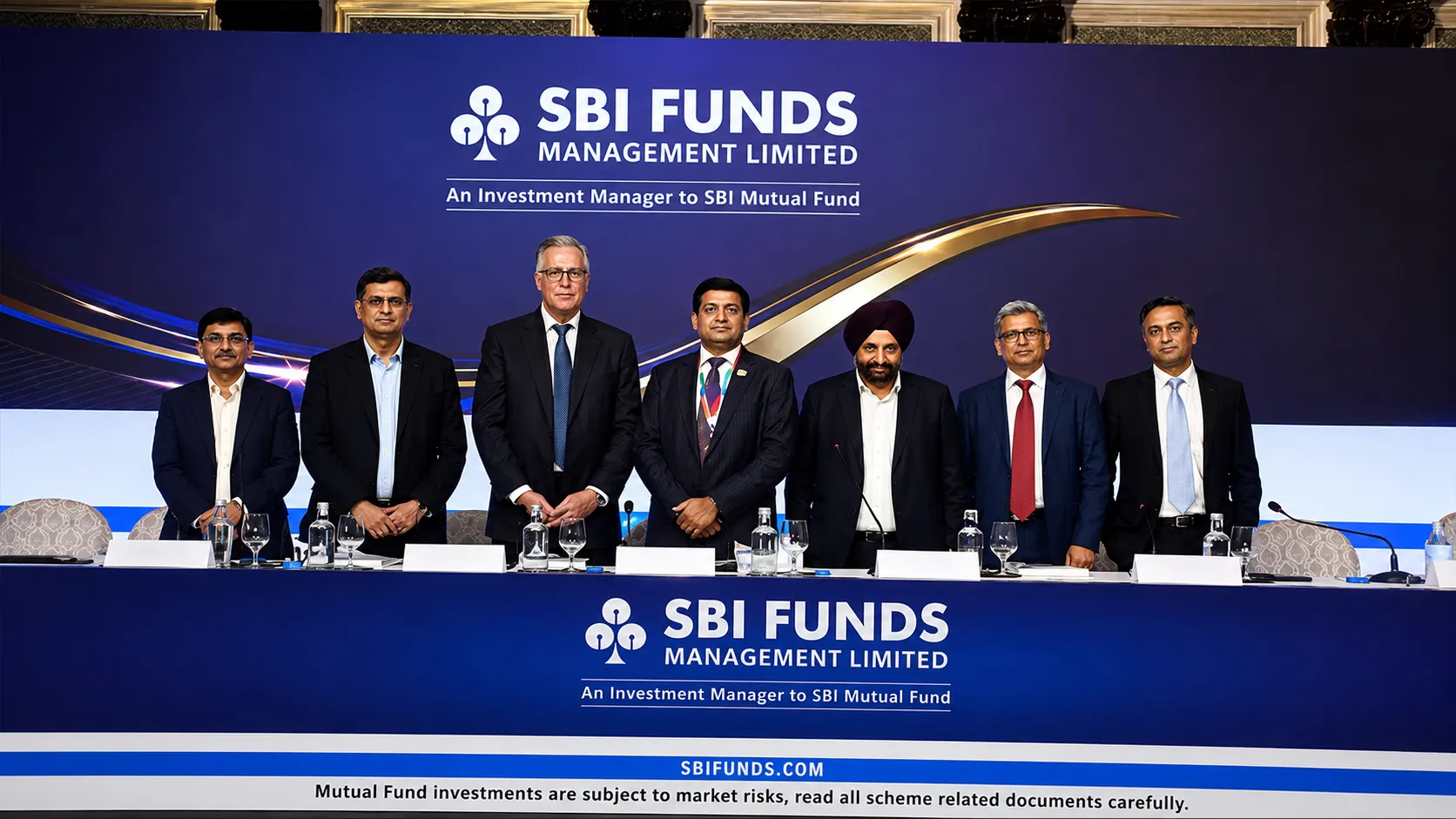
Speaking at the formal listing ceremony, SBI Chairman Challa Sreenivasulu Setty described the offering as the largest issue in India's primary market so far in 2026, framing the milestone as more than simply a successful stock market debut. Setty pointed to the broader institution-building journey behind the listing, noting that the Indian mutual fund industry as a whole — which managed assets of roughly ₹6,700 crore in 1988 — has since grown to more than ₹80 lakh crore, with SBI Funds Management alone now managing close to 15 per cent of that vastly expanded industry pool. He attributed the company's sustained leadership position to a combination of investment resilience, prudent risk management, strong governance and continuous innovation, underpinned by what he described as the confidence of millions of individual investors across the country.
Beyond its headline mutual fund business, SBI Funds Management's broader scale becomes even more apparent when its full range of activities is accounted for. Including its Portfolio Management Services and other advisory mandates, the company's total quarterly average assets under management reached ₹29,461.05 billion — nearly ₹29.5 lakh crore — as of March 31, 2026. The company additionally commands a 27.9 per cent share of India's passive funds and exchange-traded funds segment, and an even more dominant 39.7 per cent share of the domestic Portfolio Management Services market, underlining a diversification well beyond its core actively managed mutual fund franchise.
The company's distribution reach forms perhaps its most formidable competitive moat. Backed by parent State Bank of India's nationwide branch and digital footprint, SBI Funds Management's products are made available through more than 132,000 mutual fund distributors, 95 banking partnerships, and digital platforms including InvesTap and SBI's flagship YONO app, collectively serving approximately 18 million unique investors across the country — a distribution scale that few, if any, domestic asset management competitors can realistically match. The company's joint venture structure with Amundi additionally provides access to an international investor network and offshore investment mandates spanning Japan, Australia, South Korea, Europe and the Middle East.
For India's broader primary market, industry observers have framed the SBI Funds Management listing as a potentially significant confidence booster following what had, by several accounts, been a somewhat subdued start to the IPO calendar earlier in 2026. A large, well-subscribed, positively-listed offering from a household financial services name is widely expected to help set a constructive tone for the slate of additional large-cap IPOs reportedly waiting in the wings for later in the year, even as the listing itself served as a useful, real-world reminder to retail investors that grey market signals, however closely followed, should be treated as directional sentiment indicators rather than reliable predictors of actual listing-day price action.
With the stock now trading on both exchanges and early institutional research coverage beginning to emerge, the coming quarters will offer the first real test of how SBI Funds Management performs as a newly listed, publicly accountable entity — subject for the first time to quarterly earnings scrutiny, analyst price targets and the full range of governance and disclosure expectations that come with a public listing, rather than operating purely as a wholly owned subsidiary within the broader SBI Group structure.
The IPO's Offer for Sale structure also carries specific implications worth understanding for prospective long-term shareholders. Because the entire issue comprised shares sold by existing promoters State Bank of India and Amundi India Holding rather than newly issued shares, the listing did not inject any fresh capital directly into SBI Funds Management's own balance sheet — the company's operations, capital base and growth funding requirements remain entirely unaffected by the transaction itself, which functioned purely as a mechanism for the promoters to partially monetise their existing holdings while retaining majority ownership and control of the business going forward.
Analysts covering the asset management sector have generally framed SBI Funds Management's listing as a welcome addition to a still relatively thin roster of publicly listed, pure-play asset management companies on Indian exchanges, offering both retail and institutional investors a direct, liquid avenue to gain exposure to the structural growth story of India's mutual fund and broader asset management industry — a sector that has, as Chairman Setty's remarks at the listing ceremony underscored, expanded roughly twelve-fold in aggregate industry assets under management over less than four decades, and which most industry participants expect to continue growing meaningfully faster than India's broader nominal GDP growth rate as financial savings continue migrating from traditional bank deposits toward market-linked investment products across an expanding base of first-time retail investors.
The listing also arrives at a moment when India's broader primary market has been navigating a somewhat uneven start to the calendar year, with grey market premiums across a number of other issues in the pipeline running comparatively subdued relative to the standards seen in some previous IPO cycles. Against that backdrop, the combination of SBI Funds Management's exceptional subscription demand, sustained double-digit grey market premium through virtually the entire bidding window, and a comfortably positive, if not blow-out, listing-day debut has been read by several market participants as a genuinely constructive signal for investor risk appetite ahead of the additional large-cap issuances reportedly queued for later in the year.
For retail investors specifically, the SBI Funds Management episode offers a useful and fairly instructive case study in how to interpret grey market signals responsibly. The GMP's own trajectory through the subscription window — swinging from a high of ₹143 well before formal bidding even opened, down to a low of ₹70 shortly thereafter, before eventually settling into the ₹84 to ₹110 range that persisted through most of the actual bidding period — illustrates just how much grey market sentiment itself can fluctuate even for a single, well-understood issue with minimal fundamental uncertainty, reinforcing the standard caution that GMP figures should be treated as one directional input among several, rather than as a reliable, precise forecast of eventual listing-day pricing.