FundingLatest Deals6 MIN READ

Samsung Is Offering Startup Grants Without Taking Equity

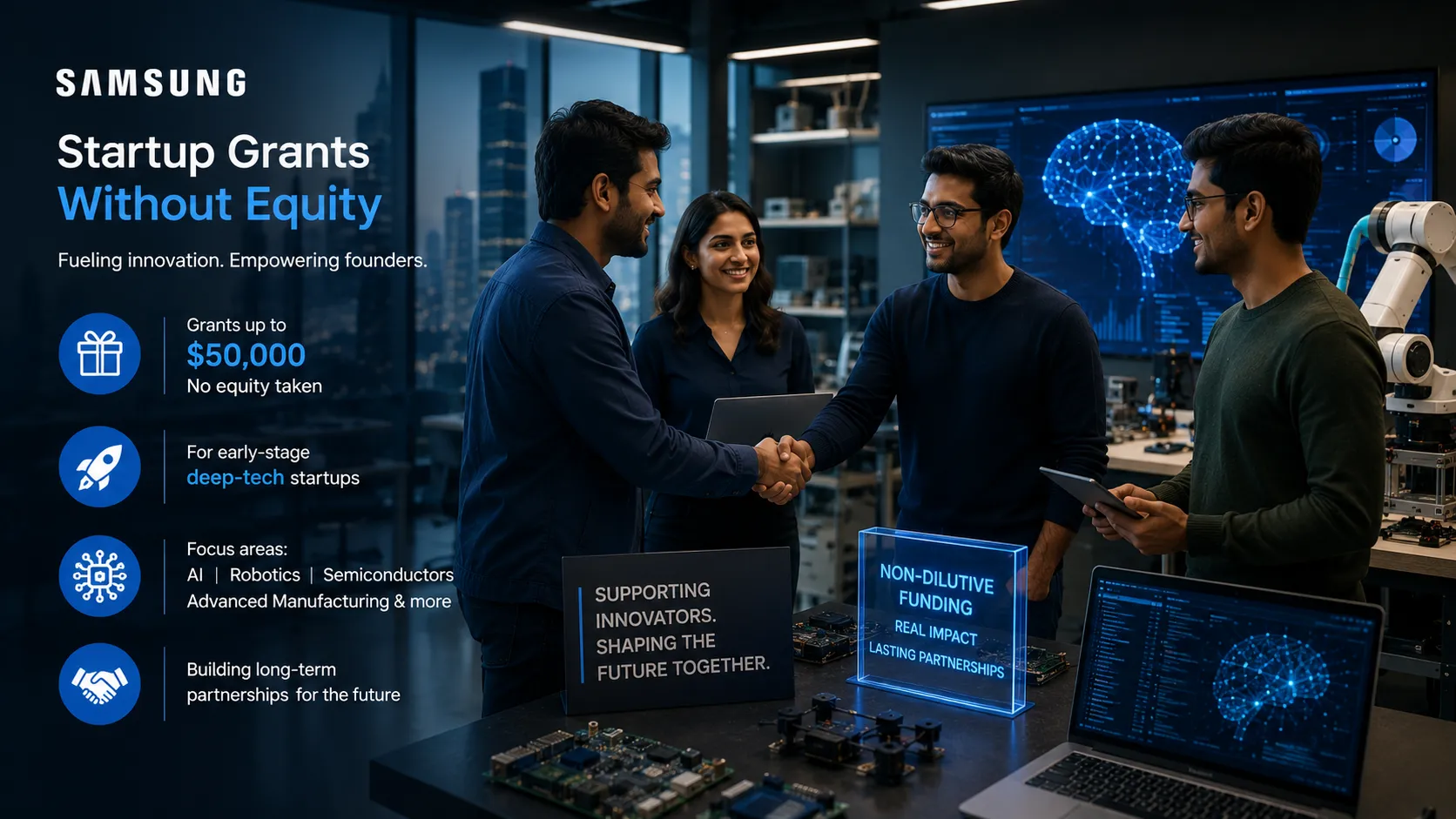
Samsung’s 2026 startup incubation program is offering grants of up to $50,000 without taking equity, highlighting growing interest in non-dilutive funding for deep-tech founders.

By Nisha Omkumar · Author29 May 2026New
Samsung Is Offering Startup Grants Without Taking Equity

The Tech Giant’s Latest Incubation Initiative Highlights A Growing Trend Where Strategic Support, Not Ownership, Is Becoming The Biggest Attraction For Early-Stage Founders

For years, startup funding followed a relatively simple formula.

Founders needed capital to build products, hire teams and enter markets, while investors provided funding in exchange for equity ownership. This relationship became the foundation of modern startup ecosystems because capital was often the scarcest resource available to young companies. Whether through angel investors, venture capital firms or accelerators, most startup support eventually involved giving away a portion of ownership in return for growth opportunities.

That model is no longer the only path available.

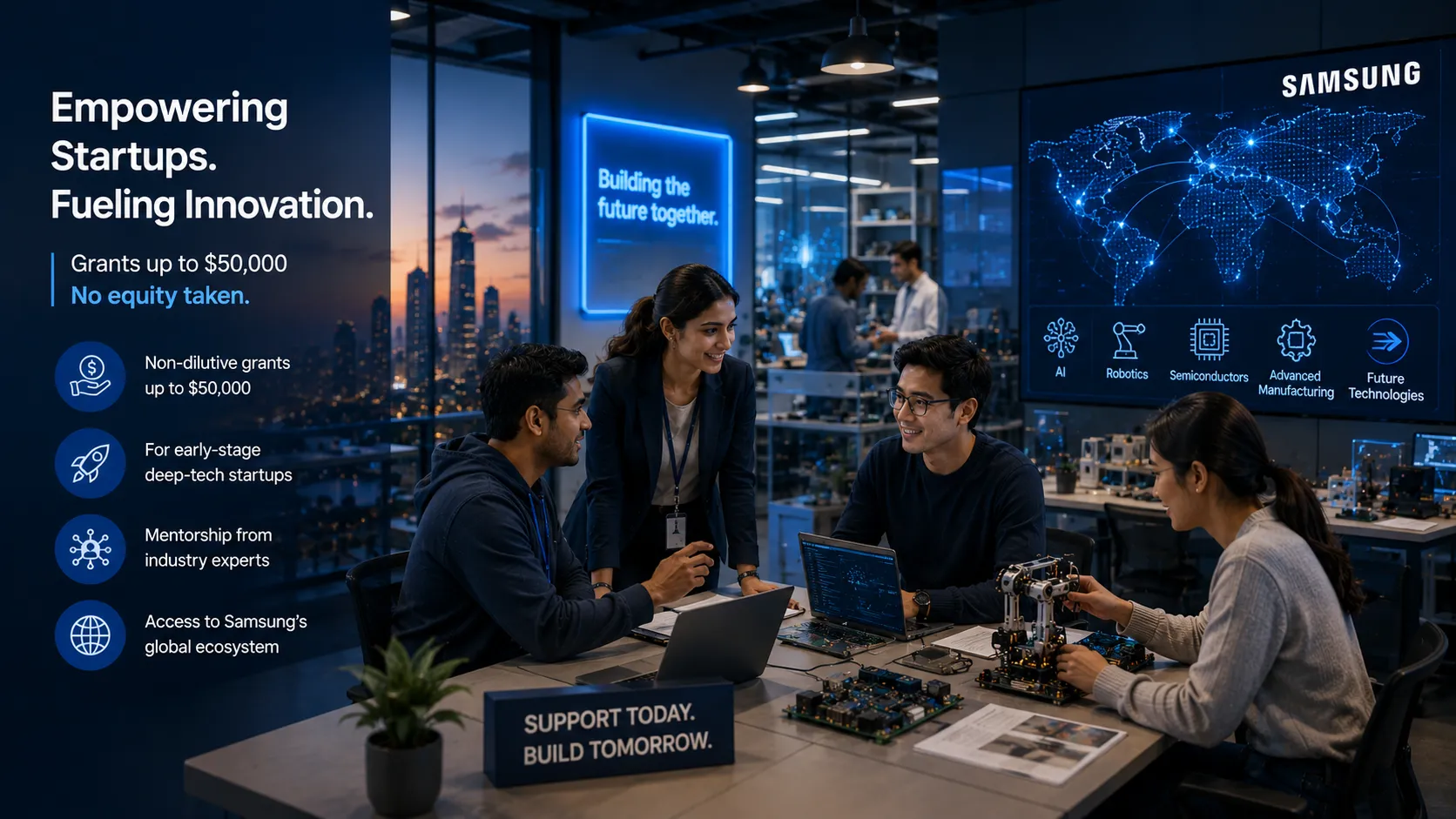
Samsung’s 2026 startup incubation program is attracting attention because it offers grants of up to $50,000 to selected startups without taking equity in return. For many early-stage founders, especially those building deep-tech products, the program represents something increasingly valuable in today’s funding environment: access to capital without dilution. The initiative reflects a broader shift where large corporations are exploring new ways to support innovation while building long-term relationships with emerging startups.

The timing is particularly significant for deep-tech founders.

Unlike many software startups, deep-tech companies often require longer development cycles because they operate in areas such as artificial intelligence, robotics, semiconductors, advanced manufacturing and scientific research. These businesses frequently spend years developing technology before generating meaningful revenue. As a result, founders often face pressure to raise multiple rounds of funding at early stages, gradually giving away larger portions of ownership before products fully mature.

Non-dilutive capital changes that equation.

When startups receive grants instead of equity investments, founders retain complete ownership of the capital provided because they are not required to surrender shares in exchange for support. This gives entrepreneurs greater flexibility in shaping long-term company strategy while preserving future fundraising options. For highly technical founders building ambitious technologies, maintaining ownership can become especially important because significant value creation often occurs later in the development cycle.

Corporate-backed startup programs are increasingly evolving beyond traditional accelerators.
ChatGPT Image May 29, 2026, 08_51_12 PM.png

Earlier incubation initiatives often focused primarily on mentorship, networking and limited seed support because large corporations viewed startup engagement mainly as an innovation exercise. Today many global technology companies see startups as potential future partners, customers or ecosystem contributors. Providing grants without immediate ownership demands allows corporations to encourage innovation while creating goodwill among founders who may later build influential businesses.

Samsung’s approach also reflects growing competition for startup talent.

“Not all startup capital needs to come at the cost of ownership. Sometimes the most valuable funding is the funding that lets founders keep more of what they build.”

Artificial intelligence, semiconductors, robotics and other deep-tech sectors are attracting some of the world’s most ambitious entrepreneurs because these industries are expected to shape future economies. Large corporations increasingly recognize that engaging with early-stage innovators can provide strategic advantages. Programs offering non-dilutive funding therefore become a way to attract promising founders without creating the transactional dynamics often associated with traditional venture capital.

The initiative highlights another important trend as well.

Many founders today are becoming more selective about fundraising because venture capital is no longer the only source of startup support. Government grants, corporate innovation programs, research partnerships and non-dilutive funding mechanisms are expanding across technology ecosystems globally. Entrepreneurs increasingly evaluate capital not only by size but by its long-term impact on ownership, control and strategic flexibility.

India’s startup ecosystem is particularly relevant to this conversation.

The country has produced a growing number of deep-tech startups working across AI, aerospace, climate technology, manufacturing and semiconductor design because founders are increasingly moving beyond consumer internet categories. These businesses often require patient capital and technical support rather than rapid growth-focused funding models. Non-equity grants therefore provide meaningful value by helping founders cross early development milestones without compromising ownership structures.

For Samsung, the benefits extend beyond philanthropy.

Supporting startups allows the company to remain closely connected to emerging technologies, entrepreneurial talent and future innovation trends. While the grants themselves may not involve equity, the relationships created through incubation programs can generate long-term strategic opportunities across research, partnerships and ecosystem development. In many cases, access and influence can be as valuable as ownership.

Of course, grants alone do not solve every startup challenge.

Building successful companies still requires product-market fit, execution capability, customer adoption and long-term financial sustainability. Yet for founders operating in capital-intensive sectors, even relatively modest non-dilutive funding can provide critical breathing room during early development stages. That support often arrives when entrepreneurs need it most.

What makes Samsung’s program noteworthy is the message it sends about startup support itself.

The traditional assumption has been that every dollar of startup funding must eventually translate into ownership. Increasingly, corporations and institutions are demonstrating that ecosystem development can take other forms as well.

And as deep-tech entrepreneurship continues expanding globally, founders may find that the most attractive capital is not always the capital that comes with the biggest valuation.

Sometimes it is the capital that lets them keep building without giving anything away.

TagsSamsung startup programstartup grantsnon dilutive fundingdeeptech startupsSamsung incubationstartup funding IndiaAI startupsfounder ownershiptechnology innovationstartup ecosystemcorporate acceleratorsdeeptech fundingentrepreneurship Indiastartup grants 2026innovation programs

Reader reviews

Sign in to rate and review this article.
Loading reviews…