
Indian equity benchmarks staged one of their sharper rallies of the month ahead of Reliance Industries' June-quarter results, with the BSE Sensex jumping 964.58 points, or 1.25 per cent, to close at 78,151.45, while the Nifty 50 advanced 261.55 points, or 1.09 per cent. Strong buying across private banking, information technology and auto stocks provided the broader backdrop for the rally, but it was gains in Reliance Industries specifically, ahead of its keenly awaited June-quarter earnings, that market participants credited with providing the final, decisive lift to overall index sentiment.
As India's largest listed company by market capitalisation and a stock that carries substantial weight in both the Sensex and the Nifty, Reliance Industries' pre-results positioning tends to have an outsized influence on overall index direction, a dynamic that was on clear display in this session as investors moved to build positions ahead of what many expect to be one of the more closely scrutinised earnings reports of the current Q1 FY27 season.
The rally also arrived at a psychologically important moment for a broader market that had spent much of the preceding fortnight in a more defensive, macro-driven posture, dominated by headlines around crude oil prices and the escalating US-Iran conflict rather than company-specific catalysts. A session driven substantially by positive positioning ahead of a single, closely watched earnings report offered a notable change of pace for a market otherwise searching for reasons to look past the prevailing geopolitical and currency-driven caution.
Trading desks noted that volumes in Reliance shares picked up notably in the sessions immediately preceding the results, consistent with the kind of pre-earnings positioning typically seen ahead of high-profile corporate results, as both institutional and retail investors sought to establish or add to positions before the numbers were formally announced.
Why The Market Is Optimistic Ahead Of Results
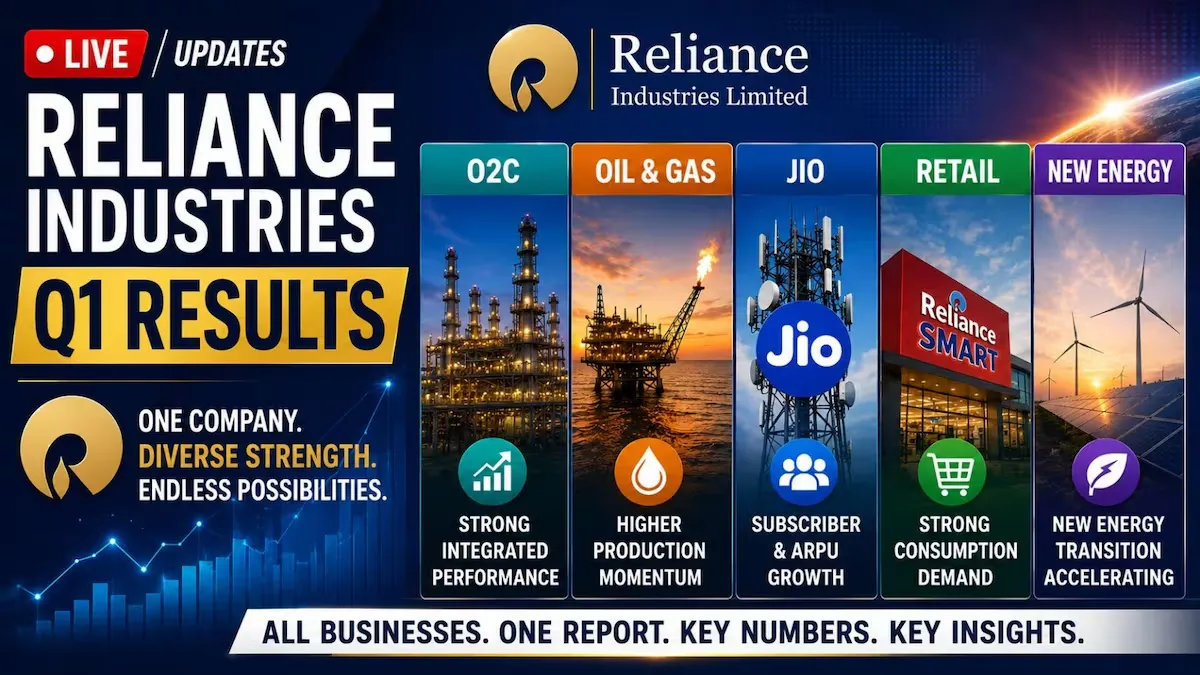
Reliance Industries' investment case has, over the past several years, evolved considerably beyond its traditional refining and petrochemicals roots, with the conglomerate's retail and telecommunications arms now representing an increasingly significant share of both revenue and, more importantly for valuation purposes, overall enterprise value. Reliance Jio, the group's telecom arm, has continued to add subscribers and has been progressively rolling out tariff increases across its user base over recent quarters, a trend analysts expect to continue supporting average revenue per user growth and, by extension, overall segment profitability in the June quarter results.
Reliance Retail, the group's consumer-facing retail arm and one of India's largest retail operators by both store count and revenue, has similarly been a focus of investor attention, with analysts watching closely for signs of continued same-store sales growth and margin improvement following a period of more measured expansion after the retail business's earlier phase of aggressive store rollout. Meanwhile, the group's core oil-to-chemicals business, while more directly exposed to volatile global refining margins and petrochemical spreads, has benefited in recent quarters from generally supportive refining margin conditions, even as the current bout of crude oil price volatility tied to the escalating US-Iran conflict introduces a fresh layer of near-term uncertainty into that segment's outlook.
Taken together, this three-way segment mix — telecom, retail and energy — is precisely what analysts point to when describing Reliance as a genuinely diversified proxy for the Indian economy, since strength in any single segment can help offset temporary softness in another, a structural characteristic that has become an increasingly important part of the bull case for the stock during periods of broader macro uncertainty.
The Jio Financial And New Energy Wildcards
Beyond the three established core segments, investors have increasingly been factoring in the potential contribution from Reliance's newer growth initiatives, particularly Jio Financial Services, the group's financial services arm that was demerged and separately listed in 2023, and the group's substantial, multi-year investment programme in new energy and green hydrogen infrastructure, both of which represent longer-duration growth options that, while not yet major contributors to current-quarter profitability, continue to feature prominently in how analysts frame the company's multi-year growth narrative.
Jio Financial Services, in particular, has been gradually building out its lending, insurance distribution and asset management capabilities, leveraging Reliance's vast existing customer base across its telecom and retail operations to cross-sell financial products at a scale few competitors can match, a strategy that analysts say could, over time, position the business as a meaningful fourth pillar of the broader Reliance growth story, even as its near-term financial contribution remains comparatively modest relative to the group's established core businesses.
Historical Earnings Pattern And What It Suggests
Reliance Industries has, over recent quarters, developed a fairly consistent pattern of delivering steady, if not always spectacular, sequential and year-on-year growth across its diversified segment portfolio, a pattern that analysts say has helped build a degree of market confidence in the company's ability to deliver predictable execution even amid a broader macro environment that has, at various points over the past year, featured meaningful volatility in crude oil prices, currency markets and consumer demand trends.
This track record of consistent execution is part of what analysts point to in explaining the pre-results rally in the stock, arguing that investors have increasingly come to treat Reliance as a relatively lower-volatility, diversified proxy for broad Indian economic growth, spanning energy, retail, telecom and financial services simultaneously — a positioning that has, at least in this instance, translated into investors bidding the stock up in anticipation of results rather than waiting cautiously on the sidelines as they have with several other large-cap names this earnings season.

What Analysts Are Watching For In The Results
Ahead of the formal results announcement, sell-side analysts had converged on a handful of specific metrics as the key swing factors likely to determine the market's ultimate reaction to Reliance's June-quarter numbers: Jio's average revenue per user trajectory following recent tariff actions, Reliance Retail's same-store sales growth and margin trends following its post-expansion consolidation phase, and the oil-to-chemicals segment's ability to navigate the current volatile global crude and refining margin environment without a significant sequential profitability decline.
Consensus estimates heading into the results broadly pointed toward continued, if moderate, year-on-year profit growth for the group as a whole, with the specific segment-level performance mix likely to be scrutinised at least as closely by analysts as the headline consolidated profit figure, given how directly that segment mix informs the market's evolving view of which parts of Reliance's sprawling business portfolio are currently driving incremental value creation.
The Broader Market Impact
Given Reliance Industries' substantial index weighting, the stock's pre-results rally had a direct, mechanical impact on overall Sensex and Nifty performance during the session, a dynamic that market technicians say is worth bearing in mind when interpreting the broader index-level rally — a meaningful portion of the day's gains were attributable to strength in this single stock, even as buying across banking, IT and auto stocks also contributed to the overall positive tone.
This concentration effect is a recurring feature of Indian index dynamics given the substantial weight several large-cap stocks, Reliance chief among them, carry within the benchmark indices, meaning that stock-specific catalysts for these mega-cap names can, on occasion, meaningfully influence overall market sentiment and headline index performance independent of the broader market's underlying breadth.
Sector-Wide Read-Through
Reliance's results, once announced, are also likely to be read closely by investors and analysts as a broader signal for how India's energy, retail and telecommunications sectors are collectively navigating the current environment of crude oil price volatility and currency pressure, given the company's substantial footprint across all three of these sectors simultaneously. A strong set of results, particularly if driven by continued strength in the retail and telecom segments, could help offset some of the broader macro-driven caution that has characterised market sentiment through much of the current earnings season.
Conversely, any signs of unexpected weakness, particularly in the oil-to-chemicals segment given the current volatile crude price environment, could reinforce the broader narrative of macro headwinds weighing on corporate India's near-term earnings trajectory that has featured prominently in recent brokerage commentary on the overall market outlook.
How Global Peers Are Positioned Ahead Of Reliance's Results
Global energy and conglomerate comparisons have become an increasingly common lens through which analysts evaluate Reliance's diversified business model, with several sell-side research notes drawing comparisons to global integrated energy majors that have similarly diversified into adjacent consumer-facing and technology-linked businesses over recent years. These comparisons generally note that Reliance's specific combination of scale, diversification and continued reinvestment capacity gives it a distinctive positioning even relative to these global peers, many of which have pursued diversification strategies with less overall success than Reliance's retail and telecom expansion has achieved to date.
This global positioning context matters for how foreign institutional investors, who hold a meaningful share of Reliance's free float, evaluate the stock relative to alternative global energy and diversified conglomerate investment opportunities, a dynamic that adds an additional layer of significance to how the market interprets this quarter's results beyond their purely domestic Indian market implications.
The Capital Expenditure Question
Beyond the immediate quarterly results, investors and analysts have increasingly focused attention on Reliance's broader capital expenditure trajectory, particularly the pace and scale of continued investment in its new energy and green hydrogen initiatives, telecom network expansion, and retail footprint growth. The company's substantial ongoing capital expenditure programme across these multiple fronts has, at various points, drawn both praise for its ambition and scrutiny regarding the timeline over which these investments are expected to generate meaningful returns for shareholders.
Analysts covering the stock will be watching this quarter's results not just for near-term profitability trends but for any updated management commentary on capital expenditure priorities and timelines across these various growth initiatives, given how directly these forward-looking capital allocation decisions shape the market's longer-term view of Reliance's overall growth trajectory and eventual free cash flow generation potential.
Retail Investor Interest In Reliance
Reliance Industries remains one of the most widely held stocks among India's retail investor base, a status built over decades as the company has grown from its origins as a textile and petrochemicals manufacturer into India's largest private sector conglomerate. This broad retail ownership means that results days for Reliance tend to generate outsized attention across financial media and retail trading platforms alike, with trading volumes in the stock typically spiking meaningfully around quarterly results compared to more routine trading sessions.
This deep retail engagement also means that Reliance's stock price movements around results carry a degree of broader market sentiment significance beyond the company's direct index weighting, given how closely millions of individual Indian investors track the stock's performance as a bellwether for both their own portfolios and the broader health of Indian equity markets.
The Demerger Precedent And Future Corporate Actions
Reliance's 2023 demerger of Jio Financial Services into a separately listed entity established a precedent that continues to inform market speculation about the group's longer-term corporate structure, with some analysts periodically raising the possibility of further business unit separations, including potential future listings of the retail or new energy businesses, as a means of allowing the market to value each segment more precisely on a standalone basis rather than within the group's current, more complex consolidated structure.
Management has not confirmed any specific near-term plans for further corporate restructuring, and analysts generally caution against treating such speculation as more than a longer-term possibility rather than an imminent development, even as the topic continues to feature periodically in investor discussions about how Reliance might further unlock shareholder value from its diversified business portfolio over time.
What Comes Next
With the results now the most closely watched near-term catalyst for both the stock specifically and, given its index weighting, the broader market, investors and analysts alike are bracing for what is likely to be a high-scrutiny reaction to the numbers, particularly given how much of the recent stock price strength appears to already reflect an expectation of a solid quarter.
Should the results meet or exceed these elevated expectations, market participants expect the positive read-through to extend beyond Reliance itself, potentially providing a broader sentiment boost for Indian equities at a moment when the market has otherwise been searching for a durable, company-specific catalyst to offset the persistent macro-driven caution tied to elevated crude prices and global geopolitical uncertainty that has dominated headlines through much of the current stretch of trading.
Either way, Reliance's results are set to serve as an important early read on how India's most diversified large-cap conglomerate is navigating a genuinely complex operating environment, offering lessons that are likely to inform how the broader market approaches the remainder of this earnings season's most closely watched large-cap results.