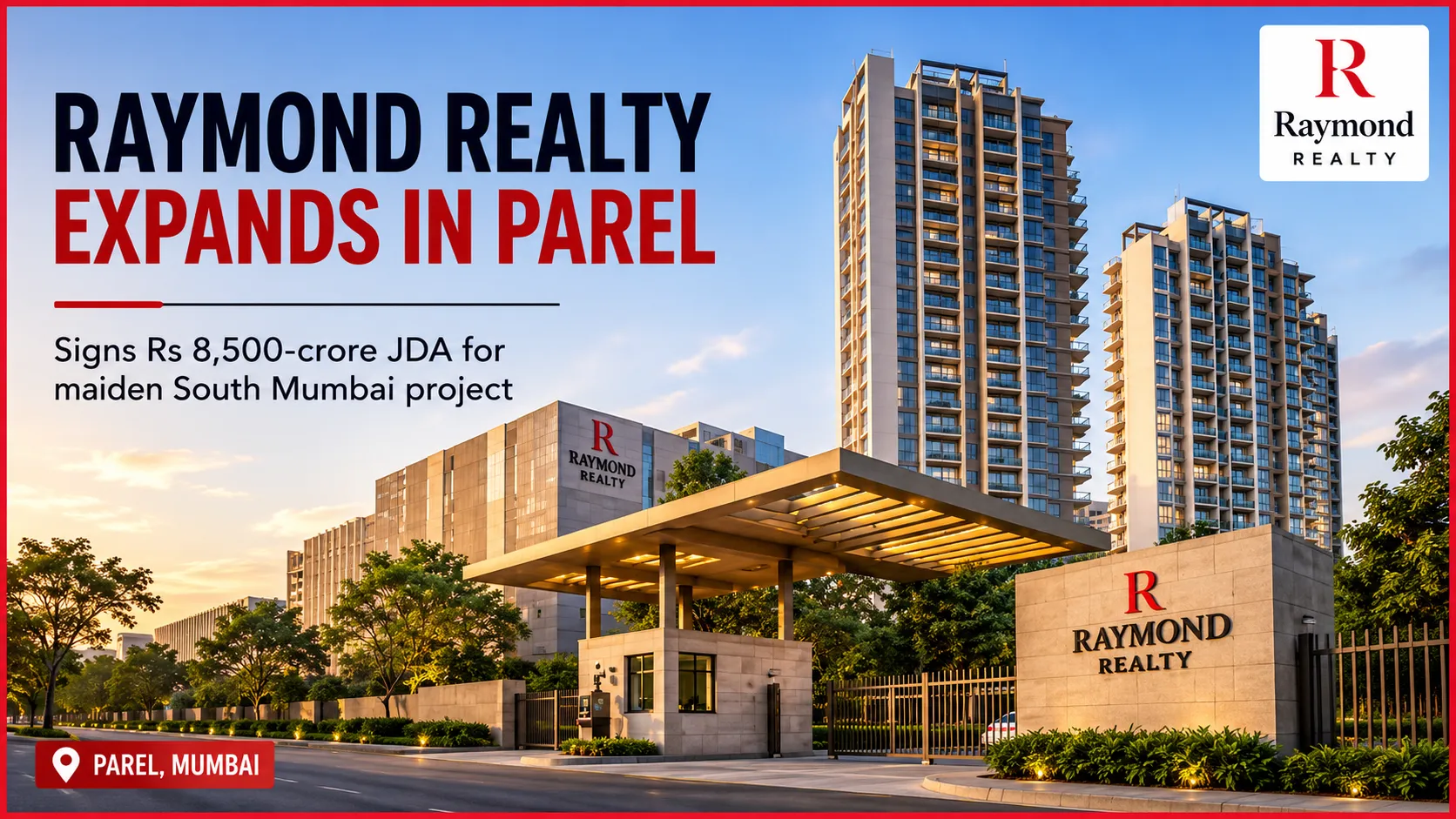
Raymond Realty has made its long-anticipated entry into South Mumbai's premium residential market, announcing a joint development agreement for a landmark project in Parel with an estimated gross development value of approximately ₹8,500 crore — a transaction that instantly becomes the developer's largest project outside its flagship Thane land parcel and pushes its total real estate portfolio to a cumulative GDV of nearly ₹52,000 crore.
**The deal at a glance**
Under the terms of the joint development agreement, signed and disclosed to stock exchanges on Wednesday, July 15, 2026, Raymond Realty will partner with an undisclosed landowner to develop a premium residential project in Parel, one of Mumbai's most storied and rapidly transforming residential and commercial micro-markets. The structure of the deal is characteristically asset-light: Raymond Realty expects to invest around ₹700 crore at the project's peak development phase, while the landowner will bear the costs associated with tenant rehabilitation and regulatory approvals — a revenue-sharing arrangement under which the development partner will receive approximately 40 percent of the project's overall revenue, according to Raymond Realty Managing Director and CEO Harmohan Sahni, who confirmed the specific terms in comments to the business press. This structure, common in Mumbai's redevelopment-heavy real estate market, allows Raymond Realty to secure prime, difficult-to-acquire urban land parcels without the capital intensity of outright land purchase, instead leveraging its brand strength, execution track record, and access to capital to unlock value on land that existing owners are otherwise unable to develop independently.
**Why Parel, and why now**
The choice of Parel as Raymond Realty's entry point into South Mumbai is far from incidental. The neighbourhood, once dominated by Mumbai's historic textile mill industry, has undergone a dramatic transformation over the past two decades into one of the city's most sought-after residential and commercial corridors, and it stands to benefit from a wave of infrastructure upgrades currently underway or planned across the broader South and Central Mumbai region. The site benefits from immediate access to the Atal Setu, the recently commissioned sea link connecting the area to Navi Mumbai International Airport, dramatically cutting travel times to the city's newest aviation gateway. Commute times to key business districts including Worli, the Bandra-Kurla Complex, and Lower Parel are expected to shrink further once the Sewri-Worli Elevated Connector opens later in 2026, while an upcoming underground tunnel project is slated to link the area directly to Marine Drive and Nariman Point by 2028. The upcoming Metro Line 11, running from Bandra to Colaba via Parel, adds yet another layer of connectivity infrastructure set to boost the area's residential desirability in the coming years. Raymond Group Chairman Gautam Hari Singhania, commenting on the announcement, described Parel as having "always been at the heart of Mumbai's evolution," framing the new project as another landmark addition to the company's growing real estate portfolio.
**Raymond Realty's broader Mumbai footprint**
This Parel transaction marks Raymond Realty's eighth joint development project within Mumbai city limits, reflecting a deliberate and increasingly well-established strategy of expanding its footprint through partnership-led, asset-light development rather than pursuing outright land acquisition across the city. The company's rapid recent expansion trajectory is worth tracing in some detail to appreciate the pace at which its overall portfolio GDV has been climbing: as recently as early 2025, Raymond's real estate portfolio GDV stood at levels closer to ₹35,000 crore, following a joint development agreement for a residential project in Mahim West with an estimated revenue potential of around ₹1,800 crore. By later in 2025, following an additional joint venture for a large-scale residential project in Wadala carrying an estimated GDV of approximately ₹5,000 crore, the company's overall portfolio value had climbed toward the ₹40,000 crore mark. The addition of this latest ₹8,500 crore Parel project now takes that cumulative figure to approximately ₹52,000 crore — a trajectory that illustrates just how aggressively Raymond Realty has been scaling its real estate ambitions over a relatively compressed timeframe of roughly 18 months.
**Strong operational momentum underpinning the expansion**
The Parel announcement arrives against the backdrop of genuinely strong underlying operational performance at Raymond Realty. The company's provisional Q1 FY27 operational highlights showed pre-sales surging 129 percent year-on-year to ₹700 crore for the quarter ended June 30, 2026 — a particularly notable achievement given that this growth was achieved without the company launching any new residential projects during the quarter, reflecting instead robust sales velocity across its existing "Address by GS" portfolio of residential offerings across the Mumbai Metropolitan Region. Collections, a critical metric for real estate developers reflecting actual cash generation from committed sales, rose 47 percent year-on-year to ₹550 crore, up from ₹374 crore in the same quarter of the prior fiscal year — underscoring genuinely robust liquidity generation from the company's operational activities rather than growth built primarily on paper bookings that may take years to convert into actual cash collection. The company reportedly deployed approximately ₹198 crore in incremental borrowings during the quarter to help fund continued project construction and expansion activity, a manageable increase in leverage given the scale of collections growth reported over the same period.
**Market reaction and analyst sentiment**
Investors responded positively to the Parel announcement, with Raymond Realty shares gaining roughly 2 percent in the sessions following the disclosure, trading at levels around ₹716 per share amid broader strength in Indian equity benchmarks that day. Market commentary accompanying the announcement has generally framed the development as further evidence that organised, branded real estate developers with demonstrated execution track records are capturing an increasingly disproportionate share of Mumbai's complex and often fragmented redevelopment market — a dynamic that has played out repeatedly across India's major metro real estate markets over the past several years, as buyers increasingly favour established, publicly listed developers with strong balance sheets and proven delivery histories over smaller, less capitalised local builders, particularly for large-scale, multi-year redevelopment projects of the kind Raymond Realty specialises in. Sector analysts have maintained a broadly constructive, "overweight" stance on real estate, residential construction, and infrastructure-linked stocks in the wake of the announcement, citing the combination of the substantial GDV addition alongside the company's already strong operational momentum evidenced by the sharp jump in Q1 pre-sales.
**The bigger picture: Mumbai's redevelopment supercycle**
Raymond Realty's Parel move is best understood as one prominent data point within a much broader structural transformation reshaping Mumbai's real estate landscape. The city's chronic shortage of vacant, developable land — combined with an enormous stock of ageing, often dilapidated housing stock across its older mill-land and inner-city neighbourhoods — has created what many industry participants describe as a multi-decade redevelopment supercycle, in which organised developers with the balance sheet strength and regulatory expertise to navigate Mumbai's notoriously complex redevelopment approval processes stand to capture outsized value. Improving transit infrastructure across the city, including the Metro network expansion, new sea links, and elevated connector projects, has been a critical enabling factor in this cycle, unlocking previously underappreciated value in central and inner-city micro-markets like Parel that were historically overshadowed by newer, more peripheral growth corridors such as Thane and the extended suburbs.
**What comes next**
For Raymond Realty, the immediate priorities following this announcement will centre on the formal launch of the Parel project and the pace of initial booking response — a critical early indicator that will help validate whether the ambitious ₹8,500 crore GDV estimate for the site is achievable given prevailing market conditions in the South Mumbai luxury residential segment. The company's stated positioning of the project as an "iconic, large-scale residential development" integrating luxury, contemporary design, and wellness-focused amenities suggests Raymond Realty is targeting the upper end of Mumbai's residential market, a segment that has generally proven more resilient to broader macroeconomic headwinds — including the currency volatility and elevated interest rate environment currently affecting other parts of the Indian economy — given its concentration among high-net-worth buyers less sensitive to near-term borrowing costs. Investors and market watchers will likely be monitoring both the formal project launch timeline and subsequent quarterly pre-sales figures closely, as continued execution on this scale of ambition will be central to validating Raymond Realty's broader strategic bet on asset-light, partnership-led growth across Mumbai's most valuable urban real estate corridors.
**The economics of the JDA model explained**
For readers less familiar with how joint development agreements function in Indian real estate, it is worth unpacking why this structure has become the preferred vehicle for developers like Raymond Realty operating in land-constrained, redevelopment-heavy markets like Mumbai. Under a typical JDA, the landowner — who may be an original mill owner, a housing society undergoing redevelopment, or in some cases even a government or quasi-government entity — contributes the land itself, along with responsibility for securing tenant consent and navigating the various municipal and state-level regulatory approvals required before construction can begin. The developer, in turn, contributes construction capital, project management expertise, architectural and design capability, sales and marketing infrastructure, and crucially, brand credibility that can command premium pricing and faster sales velocity than an unbranded or lesser-known developer might achieve on an identical physical asset. Revenue or, in some structures, constructed area is then split between the two parties according to a pre-negotiated ratio — in this case, roughly 40 percent to the landowner and the remainder retained by Raymond Realty — allowing the developer to access prime urban land without the enormous capital outlay that outright acquisition would require, while the landowner benefits from professional development expertise and market access that would otherwise be difficult to secure independently.
**How this fits into Raymond Group's broader corporate transformation**
The Parel announcement also carries symbolic weight within the context of the broader Raymond Group's multi-year corporate transformation journey. Once known almost exclusively as India's preeminent textile and branded apparel conglomerate, the Raymond Group has, over the past several years, undergone a deliberate strategic pivot toward real estate as a core growth pillar, culminating in the demerger and separate listing of Raymond Realty as a standalone entity distinct from the group's original textile and lifestyle businesses. This transformation reflects a broader recognition within the group's leadership that its substantial legacy land holdings — accumulated over decades of textile manufacturing operations, particularly at its flagship Thane facility — represented a significantly underutilised asset base relative to the value that could be unlocked through active real estate development. The Parel JDA, representing the company's first major move beyond its traditional Thane stronghold and into the considerably more competitive but also more lucrative South Mumbai market, marks an important test of whether Raymond Realty's execution capabilities and brand equity can translate successfully beyond the geography where the company built its initial real estate track record.
**Comparing Raymond Realty's pace to sector peers**
Within the broader landscape of Mumbai-focused real estate developers, Raymond Realty's rapid GDV expansion — from roughly ₹35,000 crore in early 2025 to nearly ₹52,000 crore just over a year later — places it among the more aggressively expanding portfolios in the sector, though it continues to compete against several considerably larger and more established Mumbai-focused developers with correspondingly larger existing land banks and project pipelines. What differentiates Raymond Realty's approach, according to sector analysts, is less the absolute scale of its portfolio relative to the largest incumbents and more the consistency and pace of its JDA signing activity, having now completed eight such agreements within Mumbai in a relatively compressed multi-year window — a cadence that speaks to a well-oiled business development function capable of consistently identifying, negotiating, and closing complex redevelopment transactions in one of India's most competitive and legally intricate real estate markets.
**Risks that could complicate the growth trajectory**
Notwithstanding the evidently strong momentum behind Raymond Realty's expansion, sector watchers have flagged a handful of risks worth monitoring as the company works to convert this rapidly expanding GDV pipeline into delivered, cash-generating projects. Mumbai's redevelopment approval processes remain notoriously time-consuming and subject to periodic regulatory or litigation-related delays, meaning the gap between signing a JDA and actually breaking ground, let alone delivering completed units to buyers, can often stretch considerably longer than initial timelines suggest. Additionally, as Raymond Realty's portfolio scales rapidly across an increasing number of simultaneous projects, execution bandwidth and working capital discipline become correspondingly more important considerations — a challenge the company will need to navigate carefully as it moves from an earlier phase focused primarily on signing new development agreements toward a phase increasingly defined by the harder work of construction execution, sales conversion, and timely project delivery across a now considerably larger and more geographically dispersed portfolio of active developments.