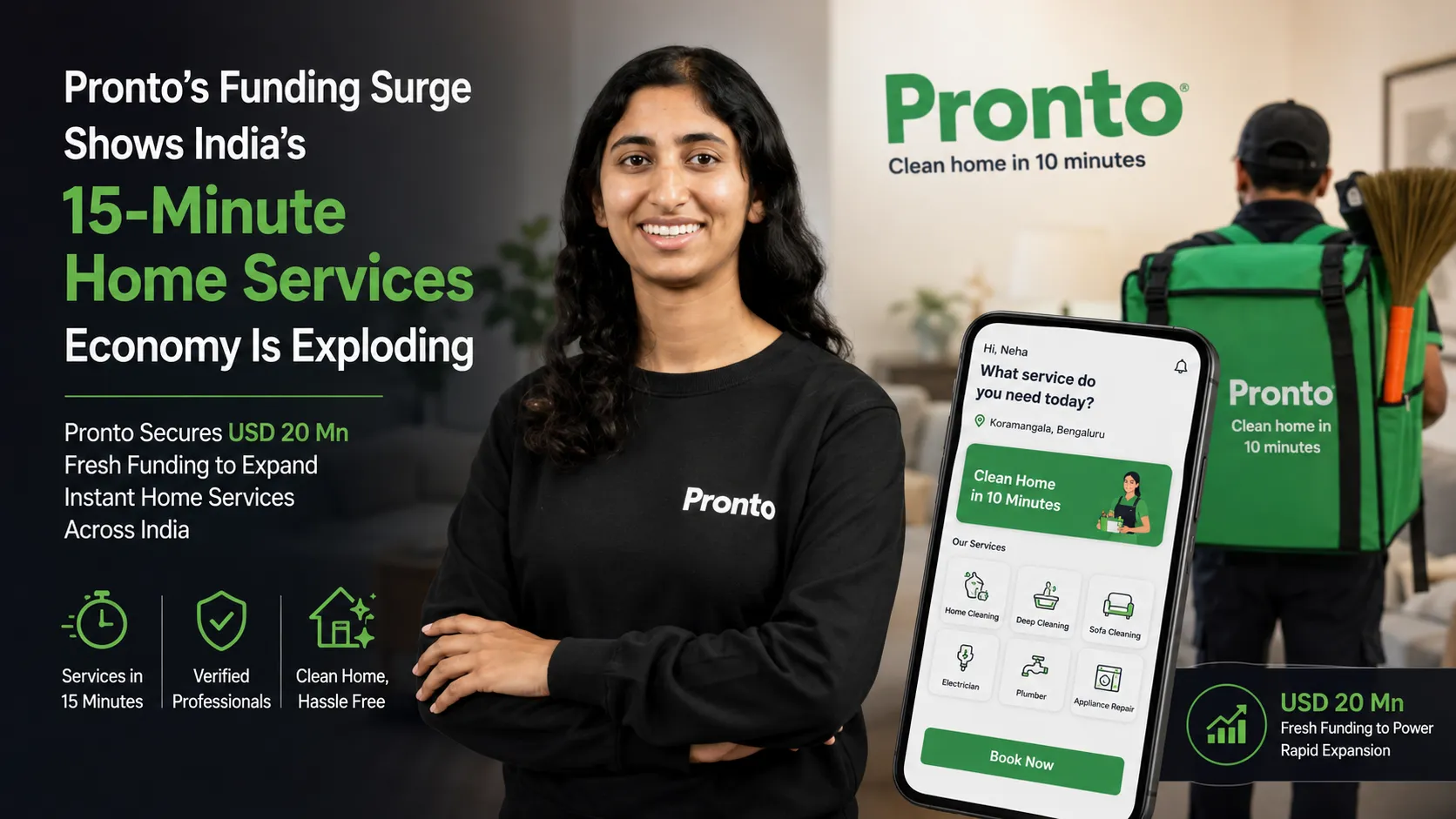
Pronto’s Funding Surge Shows India’s “15-Minute Home Services” Economy Is Exploding
Investors Once Focused Heavily On Food Delivery And Quick Commerce. Now Capital Is Rapidly Moving Toward Instant Home Services As Urban Convenience Culture Expands
India’s startup economy spent the last several years aggressively building around speed. Food delivery platforms promised meals within minutes, grocery startups transformed consumer expectations around convenience and quick-commerce companies raced to shrink delivery timelines because urban users increasingly valued immediacy as part of everyday life. What initially looked like a logistics trend gradually evolved into a much larger behavioral shift where consumers stopped viewing rapid delivery as a luxury and began treating it as a default expectation.
That same mindset is now rapidly entering home services.
Pronto is drawing significant investor attention after its recent funding momentum highlighted the growing demand for ultra-fast household assistance across Indian cities. The startup operates inside an emerging category often described as the “15-minute home services economy,” where users increasingly expect electricians, cleaners, appliance technicians, plumbers and repair professionals to arrive almost as quickly as food deliveries. What once required lengthy scheduling calls or uncertain waiting periods is now being redesigned around speed, app-based convenience and instant fulfillment.
The funding interest matters because it signals how investors are beginning to view home services not merely as fragmented local businesses but as scalable infrastructure opportunities.
For years, India’s home-services sector remained largely unorganized because most consumers relied on neighborhood referrals, independent technicians or informal service networks. Reliability often varied dramatically, arrival times remained unpredictable and pricing transparency was inconsistent. Digital platforms gradually started organizing this ecosystem over the last decade, but the latest evolution goes much further because startups are now competing primarily on response time itself.
That shift reflects changing urban behavior patterns.
Consumers living in large cities increasingly treat time as one of their most valuable resources because modern work culture, traffic congestion and digitally overloaded routines leave little room for operational delays. Younger urban households especially expect services to function seamlessly through apps because convenience-first digital ecosystems already shape how they order food, commute, shop and consume entertainment. Home services are therefore becoming part of the same instant-access expectation cycle.
The rise of companies like Pronto also highlights how quick-commerce infrastructure is influencing entirely new industries.
Many startups realized that dense urban logistics networks, real-time workforce allocation and hyperlocal operations could potentially extend beyond groceries and food delivery into broader service categories. The logic is commercially attractive because home services often carry higher-margin opportunities compared to heavily discounted delivery businesses. Investors therefore increasingly see this space as a potentially scalable extension of India’s broader convenience economy.
Funding activity around the category has accelerated because the market itself is enormous.
India’s urban middle-class expansion is driving rising demand for appliance maintenance, deep cleaning, repairs, beauty services and home support infrastructure because dual-income households and nuclear family structures increasingly depend on outsourced convenience. Consumers are also becoming more comfortable paying premiums for reliability, verified professionals and faster response times because trust itself remains a major pain point inside traditional home-service ecosystems.
This creates an important behavioral shift.

Earlier generations often approached home repairs reactively because arranging professional help felt inconvenient and uncertain. Today younger users increasingly expect app-driven predictability similar to ride-hailing or food delivery experiences. Transparent pricing, live tracking, verified workers and rapid arrival windows are becoming central competitive advantages because digital trust increasingly determines consumer loyalty.
The “15-minute” framing itself also carries symbolic value.
Whether every service literally arrives within fifteen minutes is sometimes less important than the psychological expectation being created around instant responsiveness. Quick-commerce companies transformed consumer patience thresholds dramatically over the last few years because rapid fulfillment became associated with modern urban efficiency. Home-service startups are now adapting that same emotional promise for household infrastructure and daily maintenance.
Investors appear especially interested because the category sits at the intersection of multiple major trends simultaneously.
It combines urban consumption growth, platform economies, workforce digitization, hyperlocal logistics and convenience-driven behavior — all sectors already attracting enormous venture capital attention in India. Unlike purely digital products, home-service platforms also create recurring offline engagement because households regularly require maintenance, repairs and utility support across appliances, cleaning and infrastructure needs.
At the same time, operational complexity remains significant.
Scaling home services is far more difficult than scaling software because workforce quality, training consistency and customer trust directly influence retention. Unlike product delivery, services involve human interaction inside private living spaces, making reliability and professionalism critically important. Startups entering this category therefore need to balance rapid growth with operational credibility — something many platform businesses historically struggled to maintain at scale.
Still, the broader direction appears increasingly clear.
India’s convenience economy is expanding far beyond food and groceries because urban consumers now expect speed across nearly every category of daily life. The same infrastructure logic that transformed commerce is gradually reshaping maintenance, domestic support and household management itself.
And Pronto’s funding momentum suggests investors believe this may become one of the next major battlegrounds inside India’s startup economy.
Because the future of convenience may no longer stop at delivery.
It may increasingly include how quickly someone can fix your air conditioner, clean your apartment or solve a household problem before your next meeting even begins.