FundingMarket Data Women10 MIN READ

Nestlé India Rewrites The Playbook: Profit Soars 48%, Stock Rockets To A Record High

Double-digit growth across every product category, a 40% jump in advertising spend, and surging exports power Nestlé India's strongest quarter in years — sending its shares to an all-time peak even as the broader market wobbles

By Aravind Kumar · Author24 July 2026New
Nestlé India Rewrites The Playbook: Profit Soars 48%, Stock Rockets To A Record High

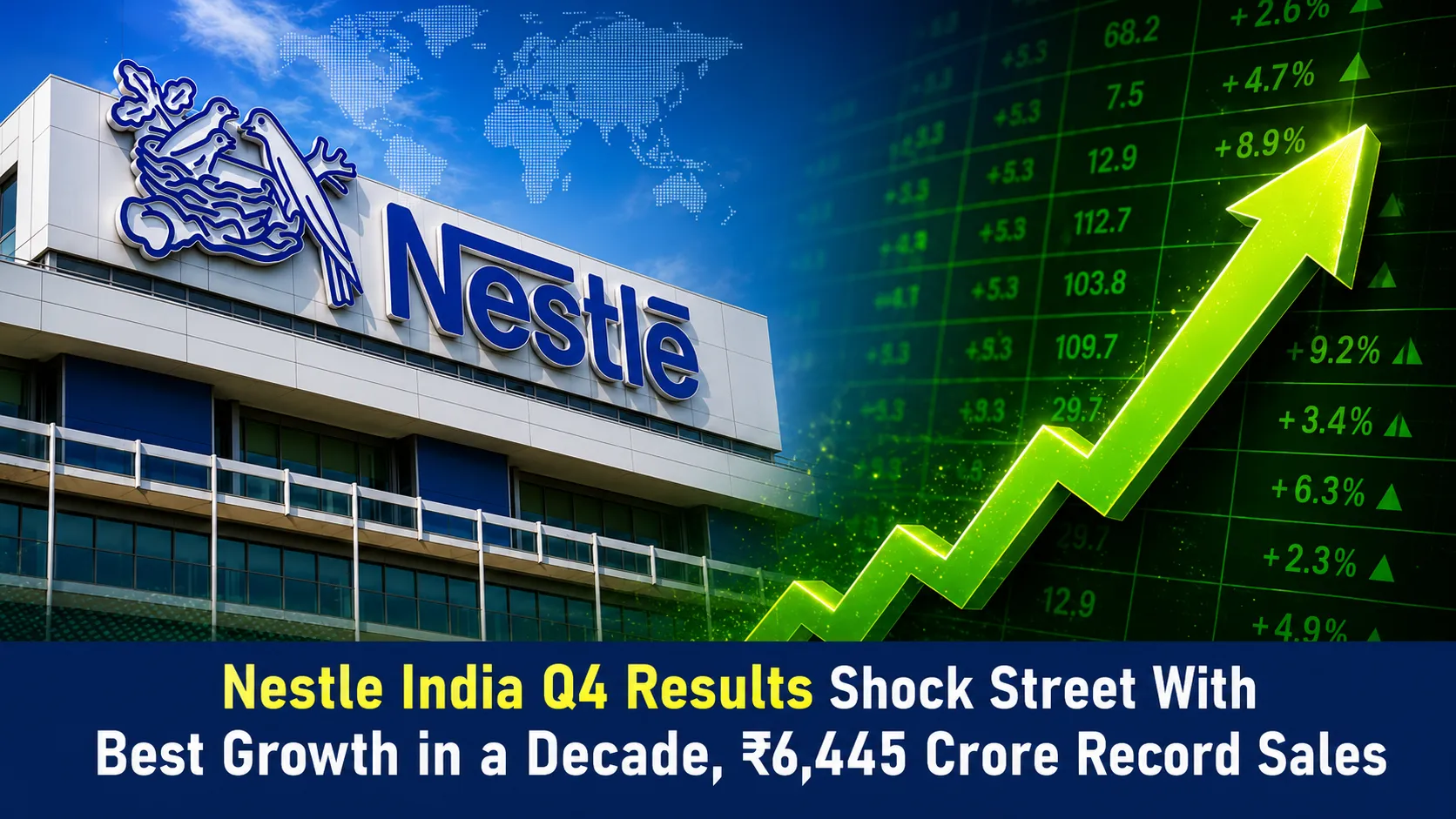
Nestlé India has delivered one of the standout earnings surprises of the ongoing quarterly results season, posting a 48.26 per cent jump in consolidated net profit for the April-June quarter of FY27 and sending its stock soaring to a fresh all-time high even as the broader Indian market battled a bruising four-day losing streak. The FMCG heavyweight reported a consolidated net profit of ₹958.68 crore for the June quarter, up sharply from ₹646.59 crore in the same period a year earlier, according to the company's regulatory filing. On a standalone basis, the numbers were even stronger, with profit after tax climbing 47.9 per cent year-on-year to ₹975.1 crore, comfortably beating what analysts on Dalal Street had been pencilling in ahead of the results.

The scale of the beat is what has caught the market's attention. Going into the results, brokerages had pegged Nestlé India's profit growth in the range of roughly 20-34 per cent, driven by expectations of healthy double-digit volume growth but tempered by worries over margin compression from elevated input and fuel costs. Instead, the company delivered a profit surge nearly 15-25 percentage points ahead of the upper end of Street expectations, a gap large enough to trigger an immediate and emphatic re-rating in the stock. Shares of Nestlé India jumped as much as 4 per cent in early trade on results day, eventually settling at a level that marked a fresh record high on both the BSE and the NSE, decisively breaking out of the trading range the stock had been consolidating in for months.

At the heart of the outperformance was a broad-based, volume-led revenue expansion that touched every single one of the company's four core product groups — Prepared Dishes and Cooking Aids, Milk Products and Nutrition, Confectionery, and Powdered and Liquid Beverages — all of which logged double-digit growth during the quarter. Standalone total sales from the sale of products rose 25.4 per cent year-on-year to ₹6,363.27 crore, an unusually strong showing for a company of Nestlé India's size and maturity, where growth in the low-to-mid teens has typically been considered a good outcome. Domestic sales alone rose 25 per cent to ₹6,073.1 crore, while exports — often the more volatile line item for the company — grew an even sharper 35.6 per cent, a number management flagged as particularly notable given what it described as ongoing geopolitical headwinds affecting international trade flows during the quarter.

Profitability metrics told an equally compelling story. The company's EBITDA for the quarter came in at ₹1,538.1 crore on a standalone basis, up from ₹1,100.1 crore a year earlier, translating into an EBITDA margin of 24.2 per cent. That is a striking outcome in an environment where brokerages had actually been modelling margin contraction — some estimates ahead of the results had projected gross margins to shrink by close to 200 basis points and EBITDA margins to slip modestly, weighed down by elevated commodity and fuel costs alongside sustained investment in advertising. Nestlé India managed to defy that script entirely, expanding margins even while dramatically stepping up brand spending, a combination that speaks to tightening operational discipline running in parallel with aggressive top-line investment.

That is perhaps the most striking data point buried inside the results: advertising and brand-building expenditure jumped by more than 40 per cent during the quarter, even as the company simultaneously accelerated what it described as operational cost savings elsewhere in the business. In consumer-facing businesses, that kind of dual-track execution — cutting cost in the back-end while pouring money into the front-end brand machine — is often held up as the textbook definition of operating leverage done right, and it is exactly the combination that fund managers and equity analysts tend to reward with premium valuations. Basic and diluted earnings per share for the quarter stood at ₹5.06 on a standalone basis and ₹4.97 on a consolidated basis, both unannualised figures for the three-month period.

Within the four product verticals, the Confectionery business appears to have been a standout performer, with the company specifically calling out another quarter of strong volume-led double-digit growth, powered by premiumisation trends and an increasingly important e-commerce channel, alongside what the company described as strong underlying transaction growth across its flagship confectionery brands. That premiumisation narrative fits into a broader pattern being seen across India's packaged foods sector in 2026, where consumers — particularly in urban and semi-urban markets — have continued to trade up toward higher-value, higher-margin variants even amid broader macroeconomic uncertainty, a trend that has disproportionately benefited scaled, brand-rich players like Nestlé India over smaller regional competitors.

The results landed against a backdrop of genuine corporate housekeeping as well. Nestlé India's board had, on July 3, 2026, declared a special dividend of ₹2 per equity share, amounting to roughly ₹385.66 crore, funded out of the residual balance of a reserve reclassification exercise that was carried out under an NCLT-sanctioned scheme. That dividend announcement, coming just weeks ahead of the blockbuster results, had already put a floor under investor sentiment toward the stock; the earnings beat has now added a second, more structural leg to the rally. Year-to-date in calendar 2026, Nestlé India shares have climbed roughly 15.9 per cent even as the benchmark index has slipped by around 7.5 per cent over the same period — a striking act of relative outperformance in a market that has otherwise been characterised by risk-off sentiment, crude-oil-driven volatility, and persistent foreign portfolio outflows.

Commenting on the quarter, the company's Chairman and Managing Director, Manish Tiwary, framed the results as a story of balanced execution rather than a one-off windfall, pointing to the combination of accelerated cost savings and stepped-up brand investment as central to the outcome, while also crediting the strength of the company's distribution network and the resilience of underlying consumer demand. Management's commentary suggests the company sees the current growth trajectory as sustainable rather than a quarter-specific anomaly, a claim the market will get its first opportunity to test when the September-quarter numbers land later in the year, particularly given that festive-season demand typically provides a meaningful tailwind for FMCG majors in the July-to-December stretch.

We accelerated cost efficiencies while stepping up brand investment across every category this quarter — that combination is what is driving both volume and value growth.
Manish Tiwary, Chairman & Managing Director, Nestlé India (paraphrased from company remarks)

For investors and market watchers, the Nestlé India print carries significance well beyond the company's own stock price. As one of the most closely tracked bellwethers for urban and semi-urban consumption in India, a beat of this magnitude — delivered with margin expansion rather than margin sacrifice — is being read by several Dalal Street analysts as tentative evidence that consumption demand may be proving more resilient than the broader macro narrative of a rupee under pressure, elevated crude prices, and cautious foreign investors would suggest. Whether that read-through extends meaningfully to peers across the FMCG space, many of whom are yet to report their own June-quarter numbers, remains to be seen, but for now, Nestlé India has handed the market a rare, unambiguously positive data point in an earnings season that has otherwise delivered as many disappointments — from pharmaceutical majors to private banks — as pleasant surprises.

Looking ahead, the key questions for Nestlé India will centre on the durability of its input-cost management, the sustainability of a 40-per-cent-plus jump in advertising spend without it eroding future margins, and whether the export momentum can hold up given the geopolitical uncertainty the company itself flagged. With the stock now trading at a fresh record high, the market's expectations for the company have unambiguously been reset upward — meaning the bar for future quarters just got considerably higher.

It is also worth placing Nestlé India's performance within the wider competitive landscape of India's packaged foods and beverages industry, a sector that has, over the past several years, seen intensifying competition from a new generation of digitally native, direct-to-consumer food brands alongside the traditional dominance of large multinational players. Nestlé India's ability to post double-digit growth across every single one of its four product categories simultaneously — rather than relying on one or two star performers to carry the overall number — suggests a level of portfolio strength and distribution reach that smaller, category-specific challengers still struggle to replicate at scale. That breadth of performance is precisely the kind of data point that long-only institutional investors and mutual fund managers tend to weigh heavily when assessing the durability of a consumer company's competitive moat, as opposed to a narrower, single-category growth story that might prove more vulnerable to shifting consumer trends or aggressive new entrants.

image.png

The special dividend declared earlier in July, funded through the NCLT-sanctioned reserve reclassification, also deserves closer attention from an investor-relations standpoint. Reserve reclassification exercises of this nature typically involve a company restructuring specific components of its balance sheet — often reserves built up over years of retained earnings or capital transactions — into a form that can be legally distributed to shareholders as dividends, a process that requires approval from the National Company Law Tribunal given the implications for creditor protection and capital-structure integrity. That Nestlé India pursued and secured such approval, and then moved swiftly to distribute a portion of those unlocked reserves to shareholders just weeks before delivering a blockbuster earnings beat, paints a picture of a management team executing a coordinated capital-allocation strategy rather than simply reacting to quarter-to-quarter operational outcomes in isolation.

From a broader macroeconomic lens, Nestlé India's strong quarter also offers an interesting data point for economists and policymakers tracking the health of India's consumption economy at a moment when several other indicators — a weakening rupee, elevated crude-driven inflation risk, and cautious foreign investor sentiment — have painted a more cautious picture. FMCG demand, being relatively less discretionary and less sensitive to short-term financial market volatility than categories like automobiles or real estate, is often viewed as one of the more reliable barometers of underlying household purchasing power and confidence. A result of this magnitude from one of the sector's largest and most closely tracked players lends some tentative support to the view that Indian consumption, particularly in urban and semi-urban pockets, may be proving more resilient through the current bout of macro volatility than headline market sentiment alone would suggest — though most economists would caution against extrapolating too much from a single company's results without corroborating data from peers still due to report.

image.png

Historically, Nestlé India's stock has commanded one of the richest valuation multiples within India's listed FMCG universe, a premium that has periodically drawn criticism from value-oriented investors even as growth-focused fund managers have continued to argue the premium is justified by the company's consistency, brand strength, and best-in-class return ratios relative to peers. This quarter's results are likely to reignite that valuation debate in earnest, with bulls pointing to the demonstrated ability to grow revenue, expand margins, and increase brand investment all simultaneously as vindication of the premium multiple, while more cautious voices will likely note that a record-high stock price leaves considerably less room for error should any of the current quarter's favourable dynamics — input costs, currency movements, or consumer demand trends — shift unfavourably in subsequent quarters. Brokerage price-target revisions, expected in the days following the results, will offer the clearest read on how the sell-side analyst community is recalibrating its own view of fair value for the stock in light of this quarter's performance.

For now, though, Nestlé India has delivered a masterclass in navigating a difficult macro environment, and its shareholders, at least, have every reason to be smiling this week. As the rest of India's FMCG majors line up to report their own June-quarter numbers in the coming days, the bar Nestlé India has just set will inevitably become the reference point against which the entire sector's quarter is judged — for better or worse. Retail investors who have watched the stock from the sidelines during its recent run-up will now face their own decision on whether to chase the momentum at record-high levels or wait for a more attractive entry point, a dilemma that is likely to keep trading volumes in the counter elevated over the sessions ahead as the market digests the full implications of this landmark quarter.

TagsNestleIndiaQ1ResultsFMCGIndiaStockMarketIndiaNSEBSEIndianEconomyConsumerGoodsEarningsSeason2026BusinessNewsIndiaStockToWatch

Reader reviews

Sign in to rate and review this article.
Loading reviews…