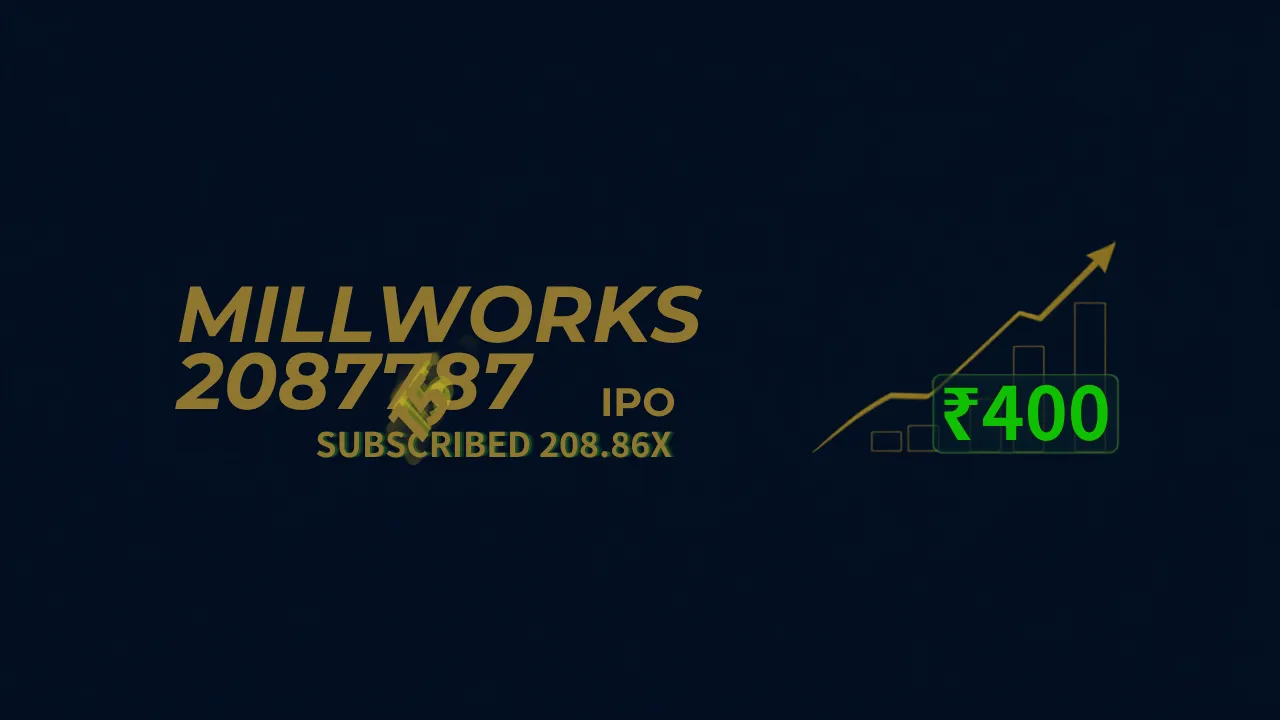
Mumbai: Millworks Technologies, one of several small and medium enterprise companies making its way to India's public markets this week, has emerged as the standout story of the current primary market cycle after its shares began commanding a grey market premium as high as 117 percent ahead of the company's stock exchange listing. The extraordinary premium, representing more than a doubling of the company's issue price in unofficial pre-listing trading, has thrust Millworks Technologies into the spotlight among a broader cohort of companies coming to market this week, even as the episode has reignited a familiar debate among market analysts about how much weight investors should place on grey market signals when making actual investment decisions.
Grey market premium, often abbreviated as GMP, refers to the price at which shares of a company preparing to list on stock exchanges trade in an unofficial, unregulated over-the-counter market that operates in parallel to the formal primary market subscription process. This grey market activity, while carrying no formal legal recognition or regulatory oversight, has nonetheless become an increasingly closely watched indicator among Indian retail investors and market commentators seeking early signals about likely investor demand and probable listing-day price performance for upcoming initial public offerings.

WHAT IS DRIVING THE EXTRAORDINARY PREMIUM
The 117 percent grey market premium commanded by Millworks Technologies places the company's shares among the most sought-after offerings in the current primary market cycle, a cycle that has itself been notably busy, featuring eight separate public issues opening for subscription within a single week spanning both mainboard and SME market segments. Such an elevated premium typically reflects a combination of factors, including strong perceived growth prospects for the underlying business, favourable sector positioning, relatively modest overall issue size that limits available supply relative to demand, and broader positive sentiment toward the SME segment of India's primary market, which has itself experienced a notable surge in both listing activity and investor interest over recent years.
Market commentators tracking the SME primary market segment have noted that grey market premiums for smaller, more thinly floated issues can, at times, become subject to more pronounced speculative dynamics compared to larger, more liquid mainboard offerings, given the comparatively smaller pool of shares available for grey market trading and the correspondingly greater potential for concentrated buying interest to drive premiums to unusually elevated levels. This dynamic makes it particularly important for prospective investors to exercise caution when interpreting extremely high grey market premium figures, recognising that such levels do not automatically or reliably translate into correspondingly strong actual listing-day gains once formal trading begins.
THE BROADER SME IPO PHENOMENON
Millworks Technologies' grey market performance needs to be understood within the context of a broader, multi-year surge in investor interest toward India's SME initial public offering segment, a corner of the primary market that has evolved considerably from its origins as a relatively niche listing avenue for smaller companies into an increasingly closely watched and actively traded segment in its own right. This growth has been driven by several converging factors, including growing retail investor sophistication and risk appetite, the emergence of dedicated financial media coverage and research specifically focused on SME offerings, and a track record of several SME listings having delivered substantial listing-day gains that has, in turn, fuelled further speculative interest in subsequent offerings within the segment.
This self-reinforcing cycle of strong historical returns attracting further speculative capital has, at various points, drawn scrutiny from market regulators and analysts concerned about the potential for excessive speculation within the SME segment, particularly given the generally smaller scale, shorter operating history, and comparatively limited public disclosure requirements that characterise many SME-listed companies relative to their larger mainboard counterparts. The Securities and Exchange Board of India has, in response to these concerns, periodically tightened various aspects of the SME listing framework, including enhanced disclosure requirements and stricter eligibility criteria, aimed at ensuring that the segment's continued growth occurs within an appropriately robust regulatory framework.
ANALYST CAUTION ON GREY MARKET RELIANCE
Despite the eye-catching nature of Millworks Technologies' 117 percent grey market premium, market analysts have consistently urged investors to exercise considerable caution before treating such figures as a reliable basis for investment decisions. Grey market trading, precisely because it operates outside formal regulatory oversight, remains susceptible to a range of distorting influences, including limited trading volumes that can allow relatively small transactions to move quoted premiums significantly, deliberate attempts by certain market participants to influence sentiment ahead of formal listing, and the fundamentally forward-looking and speculative nature of grey market pricing, which reflects traders' expectations about future listing-day demand rather than any fundamentally grounded assessment of the underlying business's intrinsic value.
Historical experience across numerous previous Indian IPO cycles has repeatedly demonstrated that grey market premiums, however elevated, do not guarantee correspondingly strong actual listing-day performance, with numerous instances of highly-anticipated offerings commanding substantial grey market premiums ultimately delivering more modest, or in some cases even negative, returns once formal trading commenced. This historical pattern underscores why financial advisors and experienced market participants consistently counsel a more holistic approach to IPO investment decisions, incorporating fundamental business analysis alongside, rather than instead of, grey market sentiment indicators.
FUNDAMENTAL FACTORS INVESTORS SHOULD WEIGH
Beyond the grey market premium, prospective investors evaluating the Millworks Technologies offering, alongside the broader slate of issues opening this week, would be well advised to examine a range of more fundamental considerations, including the company's historical financial performance and growth trajectory, the competitive dynamics and growth prospects of its specific industry segment, the experience and track record of its management team, and the valuation of the offering relative to comparable listed peers, where such comparisons are available and meaningful given the company's specific business model and sector positioning.
For SME-segment companies specifically, additional considerations around post-listing liquidity become particularly relevant, given that SME-listed stocks generally trade with considerably lower daily trading volumes compared to mainboard-listed companies, a dynamic that can make it more challenging for investors to exit positions at desired prices, particularly during periods of adverse sentiment or broader market volatility, reinforcing the importance of approaching SME IPO investments with an appropriately calibrated risk tolerance and investment time horizon.
THE WEEK'S BROADER PRIMARY MARKET CONTEXT
Millworks Technologies' standout grey market performance arrives amid what has already been described as one of the busiest weeks for India's primary market in 2026, featuring a total of eight separate public offerings across both mainboard and SME segments, alongside several notable stock exchange listings including SBI Funds Management, Alpine Texworld, Caliber Mining, and Sotefin Bharat. This clustering of primary market activity within a single week provides investors with an unusually rich and immediate basis for comparing relative investor demand and sentiment across a diverse range of offerings, spanning different sectors, issue sizes, and market segments, even as the sheer volume of simultaneous activity places additional demands on investors' capacity to conduct appropriately thorough due diligence across each individual opportunity.
WHAT HAPPENS NEXT
As Millworks Technologies approaches its scheduled listing date, market attention will inevitably focus on whether the company's actual listing-day performance validates the extraordinary optimism reflected in its grey market premium, or whether, as has occurred with various previous high-GMP offerings, the eventual outcome proves more measured than pre-listing sentiment might have suggested. Regardless of the specific outcome, the episode offers a valuable, real-time case study in the ongoing dynamics of India's SME primary market segment, illustrating both the genuine enthusiasm that well-positioned smaller companies can generate among investors, and the important caveats that continue to apply when interpreting unofficial, unregulated grey market signals as part of the broader investment decision-making process.
THE MECHANICS OF GREY MARKET TRADING EXPLAINED
For investors less familiar with how grey market trading actually functions, it is worth understanding the basic mechanics that underpin how these unofficial premium quotes are generated. Grey market trading typically involves informal arrangements between buyers and sellers, often facilitated through a network of dealers or brokers operating outside the formal stock exchange infrastructure, wherein parties agree to transact shares of an upcoming IPO at a price determined through this parallel, unregulated market, with settlement of the actual transaction typically occurring only after the shares are formally allotted and credited to investors' demat accounts following the completion of the official subscription process.
This structure means that grey market prices, and by extension the derived premium figures widely reported in financial media, reflect the collective expectations of a relatively small and self-selected group of market participants actively engaged in this informal trading activity, rather than the broader universe of investors who may ultimately participate in the formal, exchange-regulated trading that begins once a stock actually lists. This distinction helps explain why grey market premiums can, at times, diverge meaningfully from actual listing-day performance, particularly for smaller, less liquid offerings where the grey market itself may involve a relatively limited number of active participants whose trading activity may not fully represent the broader market's eventual demand once formal trading commences.
REGULATORY STANCE ON GREY MARKET ACTIVITY
It is worth noting that grey market trading in IPO shares operates in a regulatory grey zone in India, neither explicitly sanctioned nor comprehensively prohibited under current securities market regulations, a status that has periodically prompted debate among policymakers and market participants about whether more formal regulatory oversight of this informal market segment might be warranted, particularly given the increasingly prominent role grey market premium data has come to play in shaping retail investor sentiment and decision-making around IPO participation. For now, however, grey market activity continues largely unregulated, reinforcing the importance of the cautionary guidance that financial advisors and experienced market participants consistently offer regarding the appropriate weight such figures should carry within a broader, fundamentals-based investment decision-making framework.
HISTORICAL EXAMPLES OF GMP DIVERGENCE FROM LISTING PERFORMANCE
India's IPO market has witnessed numerous instances over recent years where offerings commanding substantial grey market premiums ahead of listing ultimately delivered listing-day gains considerably more modest than the grey market data might have suggested, alongside occasional instances of the reverse pattern, where offerings with relatively modest grey market interest nonetheless delivered strong actual listing-day performance once broader market participation began. This historical inconsistency between grey market signals and actual outcomes reinforces why seasoned market participants continue to emphasise a more holistic, fundamentals-oriented approach to evaluating IPO investment opportunities.
BROKER AND RESEARCH HOUSE PERSPECTIVES
Several brokerages and independent research houses covering India's SME primary market segment have begun publishing more structured analysis of grey market trends alongside their formal fundamental research on individual offerings, reflecting a broader industry recognition that retail investors are, in practice, already heavily influenced by grey market data regardless of how strongly professional analysts might caution against over-reliance on such figures. This pragmatic approach, providing context and appropriate caveats around grey market data rather than simply ignoring it, has become increasingly common among research providers seeking to offer genuinely useful guidance to retail investors navigating India's busy and increasingly complex primary market calendar.

RISK FACTORS SPECIFIC TO THE SME SEGMENT
Beyond the grey market premium considerations discussed throughout this analysis, investors evaluating SME offerings like Millworks Technologies should remain mindful of several structural risk factors that distinguish this market segment from mainboard listings, including generally smaller absolute company size that can translate into greater vulnerability to adverse business developments, more limited historical public disclosure given many SME companies' relatively recent transition from private to public company status, and the previously discussed liquidity constraints that can affect investors' ability to exit positions during periods of market stress. These considerations collectively underscore the importance of position sizing and portfolio diversification when allocating capital toward SME segment investments, regardless of how compelling any individual offering's grey market signals might appear.
CONCLUDING PERSPECTIVE FOR PROSPECTIVE SUBSCRIBERS
As Millworks Technologies moves toward its formal listing date, the ultimate test of whether its extraordinary grey market premium was justified will come down to actual trading behaviour once shares begin changing hands on the exchange. Investors who choose to subscribe to the offering, whether drawn primarily by the eye-catching grey market signal or by a more considered assessment of the underlying business fundamentals, would do well to approach their eventual investment decision, including any choice to hold or sell shares immediately upon listing, with a clear-eyed understanding of both the opportunity and the very real risks that continue to characterise India's fast-moving and increasingly closely watched SME primary market segment.


