The ₹10 Lakh Problem That No One Was Solving
In the Indian startup ecosystem, there is no shortage of capital for companies that have already proven themselves. Series A, Series B, and growth-stage funding have become relatively accessible for founders with traction, revenue, and a compelling story. But there is a gap at the very beginning—the stage before the product is built, before the first customer is signed, before the founder can afford to quit their day job.
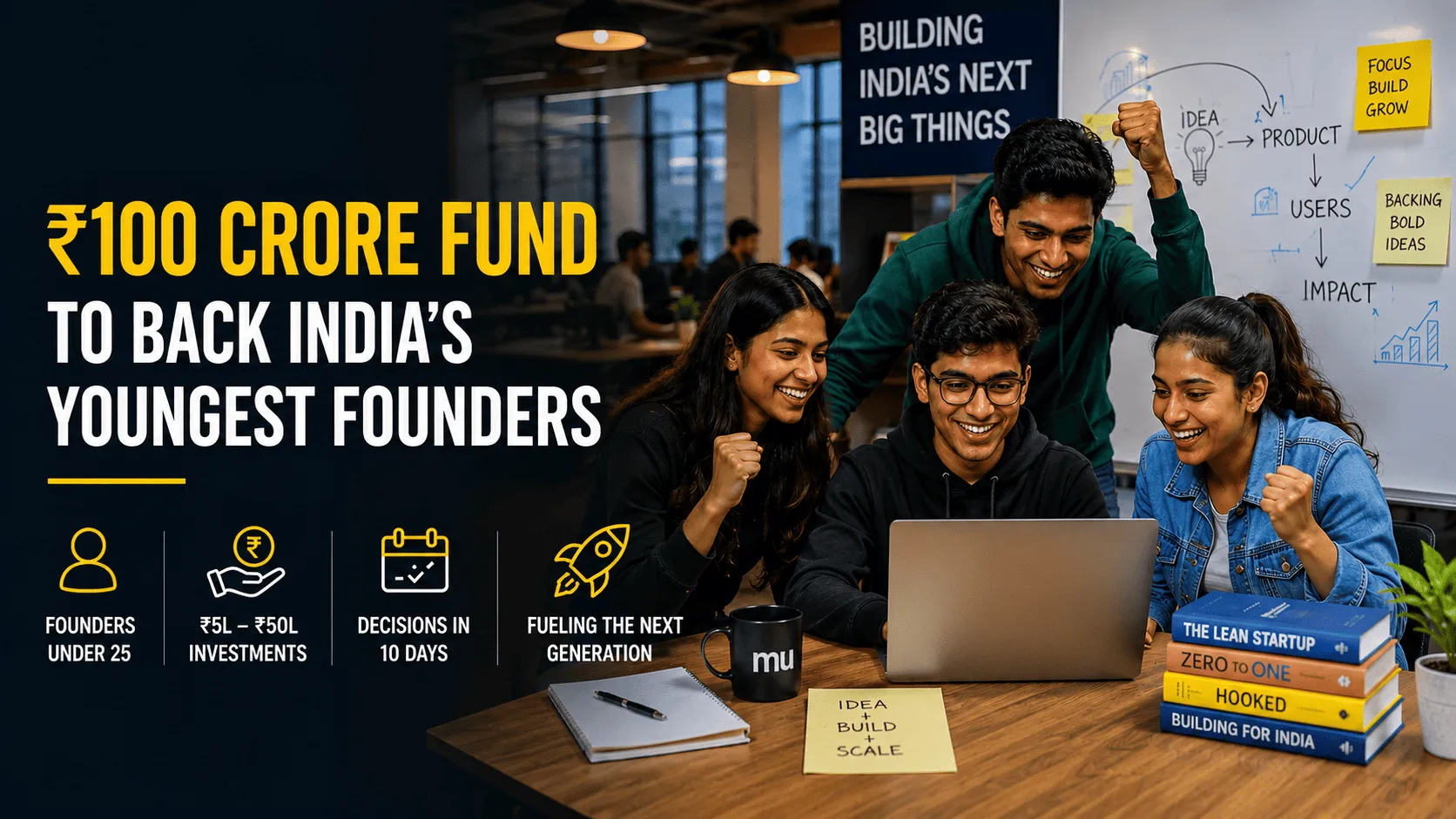
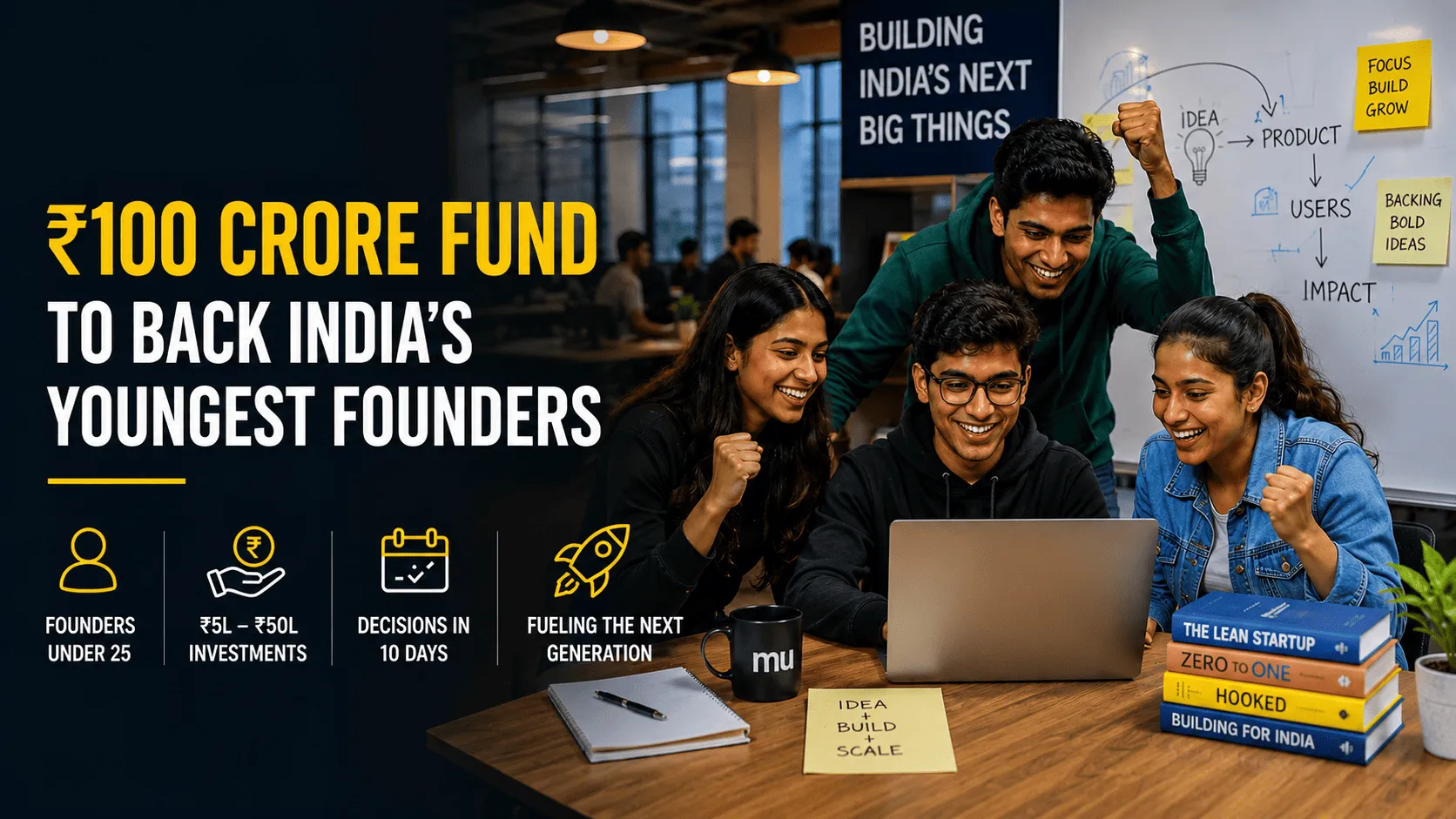
Masters' Union, a Gurugram-based business and technology school, has decided to fill that gap. On April 9, 2026, the institution announced the launch of MU Ventures, a ₹100 crore early-stage investment platform designed specifically for founders under the age of 25 . The platform will write cheques ranging from ₹5 lakh to ₹50 lakh per founder, with an average initial investment of ₹10-20 lakh .
For context, this is the stage that most venture capitalists ignore. Angel investors might write small cheques, but they are scattered and inconsistent. Incubators offer mentorship but rarely meaningful capital. Accelerators take equity but run on fixed cohorts. MU Ventures is attempting something different: a sector-agnostic, rolling-application fund that promises funding decisions within 10 days .
Pratham Mittal, the founder of Masters' Union, put it simply. He told The Economic Times that it is easy to raise $100,000, $1 million, or even $10 million, but the first $10,000 is the hardest. That first cheque gives a founder the confidence to leave their job and validates their idea. That, he said, is what MU Ventures is trying to solve .
Why a Business School Is Running a Venture Fund
The idea of a business school launching a venture fund is unusual, but it fits Masters' Union's broader philosophy. The institution, founded in 2020, has built its reputation on a learn-by-doing model that prioritizes practical experience over traditional lectures . Its faculty includes executives from Amazon, Apple, IBM, McKinsey, and KPMG, and its curriculum is designed to immerse students in real business challenges.
MU Ventures extends that philosophy beyond the classroom. The fund is not a separate entity run by professional investors. It is an integrated part of the Masters' Union ecosystem, drawing on the institution's network of industry partners, global faculty, and alumni founders.
The fund is led by Saksham Kotiya as managing partner . The advisory board includes Shishir Maheshwari, managing director at Eversource Capital and a former Blackstone executive; Arjun Vaidya, co-founder of V3 Ventures and founder of Dr. Vaidya's; and Swapna Gupta, former partner at Avaana Capital and previously director at Qualcomm Ventures . A network of prominent angel investors, including Dravya Dholakia, Amit Singhal, and Naveen Tiwari, also supports the platform .
The broader support ecosystem includes partnerships with Amazon Web Services, Google, Razorpay, Webflow, and Airtable, which will provide technology credits and other resources to funded founders . Selected startups will also be flown to San Francisco for a dedicated Demo Day, where they can pitch to global venture capitalists and established founders .
Four Funds for Four Kinds of Founders
MU Ventures is structured as four distinct tracks, each designed for a different founder profile .
The Dropout Fund is perhaps the most unconventional. It is designed to back school, undergraduate, and postgraduate dropouts who have left formal education to build something. In India, where educational credentials remain deeply valued, dropout founders often face additional skepticism from investors. This fund is a direct counter to that bias.
The Founders' Union Fund deploys founder-first capital backed by marquee entrepreneurs, including Aman Gupta, the co-founder of boAt . The idea is that capital from successful founders carries both money and credibility, and the network effects of being backed by established entrepreneurs can open doors that a standard cheque cannot.
The Bharat Capital Fund focuses on technology startups building India-first products for Tier 2, Tier 3, and Tier 4 markets . This track acknowledges that the next wave of Indian innovation will not come from solving problems for affluent urban consumers but from addressing the needs of the hundreds of millions of Indians in smaller cities and rural areas.
The Content Creator Fund backs businesses built by creators with existing distribution on platforms such as YouTube and Instagram . Many creators have built loyal audiences but lack the capital and operational expertise to launch products or scale their businesses. This fund is designed to bridge that gap.
The Gap in India's Startup Ecosystem
The launch of MU Ventures comes at a time when India's startup ecosystem is facing a specific challenge: a paucity of early-stage capital, particularly at the idea stage where institutional support remains limited . Over the past year, many funds have attempted to address this through venture studios, incubators, and founder cohorts, but the gap persists.
Saksham Kotiya, managing partner of MU Ventures, highlighted the broader economic context. He noted that nearly 12 million people enter the Indian workforce annually, far exceeding the capacity of traditional job creation. Startups contribute nearly 30 percent to India's GDP and around 45 percent of exports, underscoring the need to support entrepreneurship from an early stage .
Swapna Gupta, an advisory board member, emphasized the importance of supporting deep-tech startups to build long-term technological capability and economic growth in India. She added that MU Ventures will provide not just capital but also guidance, infrastructure, and market access .
Several early-stage startups have already emerged from the Masters' Union ecosystem, including Sanyark Space, Cryptique, Flourish Foods, Bambaii, Guardex, Bana Roma, and Mom's Mixes . With MU Ventures, the institution is formalizing its support through a dedicated capital platform rather than relying on ad-hoc investments and alumni networks.
The Y Combinator Comparison
Kotiya explicitly compared MU Ventures to Y Combinator, the legendary Silicon Valley accelerator that has backed companies including Airbnb, Dropbox, and Stripe. He told The Economic Times that MU Ventures is building a differentiated but comparable model to something like Y Combinator in the United States, adapted for India .
The comparison is ambitious but not entirely unfounded. Like Y Combinator, MU Ventures is sector-agnostic, operates on a rolling application basis, and provides a combination of capital, mentorship, and network access. Unlike Y Combinator, which runs fixed cohorts twice a year, MU Ventures accepts applications year-round and promises faster funding decisions.
The differences are also significant. Y Combinator invests $500,000 in standard deals and has a network of thousands of alumni founders worldwide. MU Ventures is starting smaller, with an average cheque of ₹10-20 lakh (roughly $12,000-24,000) and a target of 10-20 investments per year . The fund is also explicitly age-restricted to founders under 25, a limitation that Y Combinator does not have.
Kotiya noted that early backing is essential for a young nation where entrepreneurship is a critical economic driver . The fund is targeting about 10 to 20 investments per year, a pace that allows for hands-on support while maintaining portfolio diversity .
What the Funding Will Do
Selected founders will receive more than just capital. The MU Ventures support stack includes mentorship from the advisory board and global faculty, co-working space at the Masters' Union campus in Gurugram, technology credits from partners including Google and Amazon Web Services, access to CXO networks and curated introductions to customers and investors, and ongoing support for investor readiness and business model development .
A major component of the programme is its focus on global exposure. Selected startups will be flown to San Francisco for a dedicated Demo Day, where they will present their businesses to international venture capitalists and established founders . This is designed to address a common criticism of Indian startups: that they lack the global perspective and network to scale beyond domestic markets.
The fund is sector-agnostic and will run on a rolling application basis . Founders who are not selected initially can reapply after six months with further progress, ensuring that a rejection is not a permanent barrier .
The Institutional Context
Masters' Union is not new to the world of investment. The institution already runs a ₹5 crore student-managed investment fund that invests in crypto, equities, debt, real estate, and startups as part of its curriculum . That fund has generated returns including a 60-70 percent surge on an investment in Nisus Finance .
MU Ventures is different. It is not a pedagogical tool. It is a dedicated investment platform with its own capital, its own management team, and its own return expectations. The fund does not solicit or manage outside capital; it is a college-owned initiative that stands alone in Indian higher education .
The institution's alumni data suggests a growing appetite for entrepreneurship. From the 2025 cohort, 74 percent took placements through the institute, 17 percent went directly into entrepreneurship, and the remaining joined family businesses or placed independently . More than 80 graduates have launched ventures post-Masters' Union, many after spending one to three years in jobs building savings, skills, and networks .
The Bottom Line
MU Ventures is not trying to replace Sequoia or Accel. It is trying to do something that those firms are structurally unable to do: write small cheques to very young founders with no traction, no revenue, and often no team. It is a bet that the best founders are not always the ones who can afford to wait for traditional venture capital.
For Masters' Union, the fund also serves a strategic purpose. It creates a pipeline of startup founders who are deeply connected to the institution, its network, and its alumni. Those founders, if successful, become future mentors, investors, and brand ambassadors. The ₹100 crore fund is not just an investment vehicle. It is a flywheel for the entire Masters' Union ecosystem.
Pratham Mittal captured the ambition when he said that the fund seeks to act as an early believer in under-25 founders, helping them transition from ideas to execution with confidence . In a startup ecosystem that often values traction over vision, that is a bet worth watching.