Maruti Suzuki India, the country's largest carmaker by volume, has just delivered one of the more counterintuitive earnings reports of this results season: record-breaking revenue growth alongside a year-on-year decline in profit — a combination that has drawn close attention from analysts trying to read exactly what it says about the health of India's automobile industry heading into the second half of 2026.
The Headline Numbers
For the quarter ended June 30, 2026 — the first quarter of the company's FY27 fiscal year — Maruti Suzuki reported consolidated net profit of approximately Rs 3,447 crore, a decline of roughly 9.1 percent compared to Rs 3,792 crore in the same quarter a year earlier. On a sequential basis, profit was also down, falling from the roughly Rs 3,659 crore reported in the preceding March quarter. On a standalone basis, the numbers tell a similar story with slightly sharper edges: standalone net profit came in at around Rs 3,352 crore, a decline of nearly 9.7 percent year-on-year.
The profit decline stands in sharp contrast to the company's topline performance, which was genuinely exceptional. Consolidated revenue from operations surged roughly 36 percent year-on-year to approximately Rs 52,470 crore, up from about Rs 38,605 crore in the year-ago quarter — among the strongest revenue growth numbers the company has posted in recent memory. Standalone revenue told the same story, climbing to roughly Rs 52,456 crore, also up more than 36 percent year-on-year. The company's board of directors, which approved the results at a meeting on July 31, 2026, also confirmed that its total sales volume rose 29.3 percent during the quarter compared with the same period last year, driven by particularly strong momentum across specific vehicle categories: domestic small-car sales grew 34.1 percent, SUV sales climbed 44.6 percent, and exports rose 28.6 percent.
Why Revenue and Profit Diverged So Sharply
The gap between Maruti's blistering revenue growth and its profit decline comes down almost entirely to margin compression. Standalone operating EBITDA margin contracted by roughly 218 basis points year-on-year, falling to about 8.22 percent from 10.4 percent in the same quarter last year — even though standalone EBITDA in absolute terms actually rose nearly 8 percent, to approximately Rs 4,311 crore, reflecting the sheer scale of volume growth even as profitability per vehicle came under pressure.
Several factors converged to squeeze margins even as sales boomed. Persistently elevated commodity costs — particularly steel, aluminium and copper, the core raw material inputs for vehicle manufacturing — continued to weigh on gross margins throughout the quarter. At the same time, the company faced an inability to fully pass these rising input costs on to retail consumers amid heavy competitive discounting across India's passenger-vehicle market, where rival manufacturers have been offering aggressive promotional pricing to defend or grow market share. Higher operating expenses and, according to some reports, adverse foreign exchange movements added further pressure on the bottom line, and Maruti's export segment — while a genuine growth bright spot in volume terms — also carries exposure to geopolitical and supply-chain disruptions that can compress realised margins even when unit volumes are rising.
The company had already responded to some of this cost pressure before the quarter closed: in June 2026, Maruti announced portfolio-wide price hikes of up to Rs 30,000 across its model range, an attempt to offset rising input costs without ceding too much ground on competitiveness. That the hikes were only partially able to protect margins — even as they were implemented — underscores just how intense competitive pricing pressure has become across the Indian passenger-vehicle market this year.
A Quieter Structural Story: The SMGPL Amalgamation
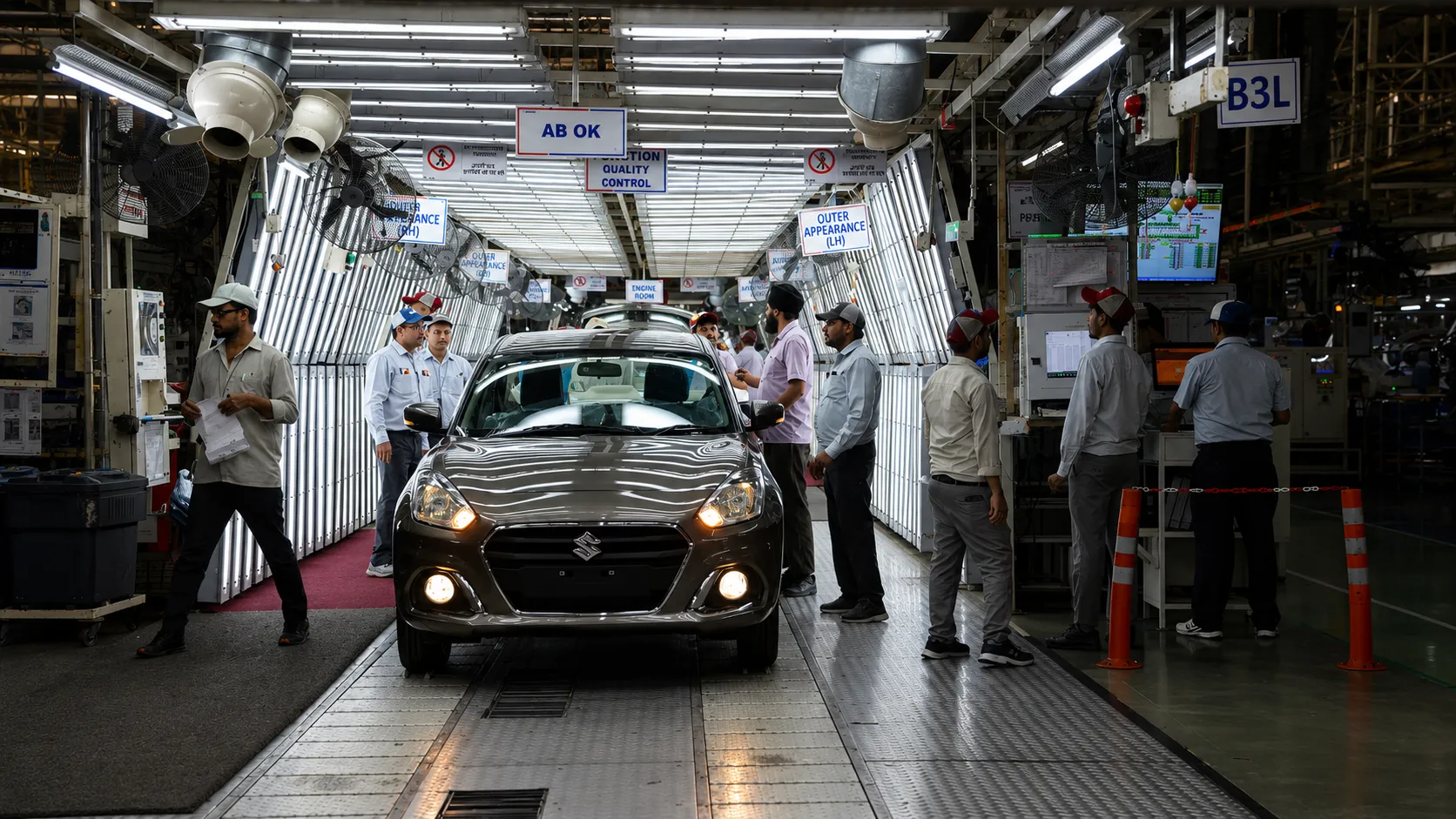
Behind the headline profit-and-revenue numbers sits a significant corporate restructuring that complicates straightforward year-on-year comparisons. Maruti Suzuki completed the amalgamation of Suzuki Motor Gujarat Private Limited, its wholly owned manufacturing subsidiary, into the parent company during the quarter — a scheme that had been approved by the National Company Law Tribunal in New Delhi on November 6, 2025, and became effective from December 1, 2025, with the accounting impact applied retroactively from an appointed date of April 1, 2025. Because prior-period figures have been restated to reflect this amalgamation, comparisons between this quarter's results and the year-ago period are not entirely apples-to-apples in the traditional sense — though the broad direction of the story, rising revenue alongside margin compression, holds across multiple restated and as-reported figures published by different financial news outlets covering the results. With the amalgamation now complete, Maruti Suzuki has effectively consolidated its manufacturing capabilities under a single corporate structure, a move the company has indicated should support future operational synergies, even if the immediate quarter's results were dominated by cost pressures rather than efficiency gains.
A Bet on Alternative Fuels
Amid the margin pressure, Maruti's board used the same July 31 meeting to approve a fresh capital commitment aimed squarely at the company's longer-term strategy around alternative fuels: roughly Rs 561 crore in capital expenditure to establish four compressed biogas projects in the initial phase of a new green-energy initiative. The move follows closely on the company's June 2026 launch of the Wagon R Flex Fuel variant, a vehicle compatible with ethanol-petrol blends ranging from E20 to E100 — positioning Maruti at the front edge of India's push toward flexible-fuel and biofuel-compatible vehicles as an alternative decarbonisation pathway that runs alongside, rather than in direct competition with, the electric-vehicle transition being pursued by several of its domestic rivals.
The compressed biogas investment, while modest relative to the company's overall capital base, signals that Maruti sees near-term commercial opportunity in alternative fuels that can be deployed within India's existing vehicle architecture and fuel-distribution infrastructure, rather than requiring the kind of large-scale charging-infrastructure buildout that full battery-electric adoption demands. It is also a notably different strategic emphasis from several competitors who have concentrated their alternative-powertrain investment almost exclusively on battery-electric vehicles, suggesting Maruti is deliberately hedging across multiple decarbonisation pathways rather than betting the company's future on a single technology.
What Analysts and the Market Are Watching
Maruti Suzuki's results landed in the middle of a broader Q1 earnings season across Indian industry, with a wide range of companies — from Dixon Technologies, which posted a strong 21 percent revenue rise, to Indian Oil Corporation, which reported a substantial quarterly loss as margins shrank — reporting results in the same window. Against that backdrop, Maruti's combination of record revenue and declining profit reads as broadly consistent with a wider theme running through this earnings season: Indian companies with strong consumer demand are generally managing to grow volumes and top-line revenue, but input-cost inflation, competitive discounting and currency volatility are proving difficult to fully offset, compressing margins even for market leaders with substantial pricing power.
For Maruti specifically, the SUV segment's 44.6 percent growth is likely to draw particular analyst attention, given that SUVs typically carry richer margins than small cars, and the category's outperformance suggests the company's ongoing push to expand its SUV portfolio — long considered a relative weak point compared with some rivals — is beginning to pay dividends in volume terms, even if that has not yet been sufficient to offset broader cost pressures across the rest of the portfolio. Export growth of 28.6 percent will also be closely tracked, both as a signal of overseas demand for Maruti's product range and as an indicator of the company's ability to diversify revenue beyond an Indian market where competitive discounting shows no signs of easing.
The Bigger Picture for India's Auto Sector
Maruti Suzuki's results arrive at a moment when India's passenger-vehicle market is characterised by a somewhat unusual combination: genuinely strong underlying demand, reflected in double-digit volume growth across most categories, coexisting with intense margin pressure driven by commodity costs and competitive dynamics that show no sign of easing in the near term. For a company that commands the largest share of India's passenger-vehicle market, that combination is instructive well beyond Maruti's own balance sheet — it offers one of the clearest available signals of where the broader Indian auto industry currently sits: growing convincingly in volume terms, but working hard, and not always successfully, to convert that volume growth into proportionate profit growth.
Whether Maruti Suzuki can translate its SUV momentum, its export growth and its early alternative-fuel investments into a genuine margin recovery over the coming quarters — rather than simply posting ever-larger revenue numbers on a thinner profit base — will be one of the more closely watched storylines in Indian markets through the rest of this fiscal year, both for the company itself and as a bellwether for the broader auto sector it continues to lead.
Reading the Reported Figures Carefully
One notable feature of this earnings cycle is the modest variance in the exact profit and revenue figures circulating across different financial news outlets in the hours immediately following the results — some reporting consolidated net profit at approximately Rs 3,447 crore, others citing standalone figures closer to Rs 3,352 crore, and still others referencing slightly different year-ago comparison figures depending on whether they used as-originally-reported or SMGPL-amalgamation-restated prior-period numbers. This kind of variance is not unusual in the immediate aftermath of a complex results announcement involving a corporate restructuring, and it typically narrows as analysts publish detailed notes reconciling standalone versus consolidated figures against both restated and originally reported comparatives. What remains consistent across every version of the numbers, however, is the core narrative: exceptionally strong revenue and volume growth, a meaningful year-on-year decline in profit, and a margin contraction driven primarily by input costs that outpaced the company's ability to raise prices.
What the Statement of Confidence Signals
Earlier in the quarter, on July 4, 2026, Maruti Suzuki issued what has been described as a public statement of confidence regarding its business outlook — a signal, ahead of the formal results announcement, that the company anticipated the underlying demand story would remain strong even as it prepared investors for the margin pressure that would eventually show up in the headline profit figure. That sequencing is itself instructive: it suggests Maruti's management team had visibility into the cost-margin dynamics well before the quarter closed, and chose to get ahead of the narrative rather than let a profit decline arrive as a surprise to the market. Combined with the June 2026 price hikes and the same-day approval of the compressed biogas capital expenditure, the overall picture is one of a company actively managing a difficult cost environment through multiple simultaneous levers — pricing, portfolio mix, alternative fuels and now, an accounting restructuring — rather than one caught flat-footed by rising commodity costs.
The Regulatory Wildcard: Extended Producer Responsibility
One additional variable the company itself flagged in its results commentary deserves particular attention from anyone tracking Maruti's margin trajectory into the second half of the fiscal year: the impact of new Extended Producer Responsibility regulations, whose cost implications the company has said remain difficult to fully assess until the associated pricing mechanism is finalised by regulators. EPR rules, which typically place financial responsibility on manufacturers for the end-of-life disposal or recycling of the products they sell, have been an increasingly prominent feature of Indian environmental policy across several manufacturing sectors, and the automotive industry's version of this framework could introduce a further, currently unquantified cost variable into vehicle manufacturers' margin structures once the mechanism is finalised. For a company already navigating commodity inflation and competitive discounting, an unresolved regulatory cost overhang of this kind adds a further layer of uncertainty to any forward-looking margin guidance investors might otherwise be tempted to extrapolate from this quarter's results.
Setting Maruti's Results Against India's Broader Consumption Story
Zooming out from any single company, Maruti Suzuki's Q1 results land as one useful data point within a much larger and closely watched question hanging over the Indian economy in 2026: whether consumer demand, particularly for big-ticket discretionary purchases like automobiles, remains genuinely robust even as households and companies alike navigate a higher-cost environment across commodities, energy and logistics. The answer implicit in Maruti's numbers is a qualified yes — volumes are rising strongly, and rising fastest in precisely the higher-value SUV segment that reflects genuine upgrading of household purchasing power rather than merely replacement-cycle demand. But the same results also make clear that strong demand alone is no longer sufficient to guarantee proportionate profit growth for even the most dominant player in the category, a dynamic that is likely to remain a defining feature of Indian corporate earnings through the remainder of this fiscal year, across sectors well beyond automobiles.