A Category Once Viewed Primarily Through Factories And Infrastructure Is Beginning To Attract A Different Kind Of Capital Story
For years, manufacturing startups frequently occupied a relatively unusual position inside India’s startup ecosystem. Public attention often concentrated around software businesses, consumer apps and digital platforms because these sectors frequently promised faster scalability and shorter investment cycles. Venture ecosystems often favored asset-light models capable of rapid growth, while manufacturing businesses frequently appeared associated with higher operational complexity, infrastructure requirements and longer development timelines. As a result, many manufacturing-focused companies frequently remained outside mainstream startup conversations despite operating inside sectors foundational to broader economic growth.
Over recent years, however, another transition increasingly appears unfolding beneath India’s startup and industrial ecosystem. Manufacturing startups increasingly seem attracting stronger investor attention as global supply-chain diversification, domestic industrial policies and changing production environments create entirely new opportunities. Businesses operating around contract manufacturing, design-led production and integrated supply ecosystems increasingly appear moving into investor focus. What initially looked like isolated funding activity increasingly resembles a broader shift involving how capital itself may be reassessing India’s industrial future.
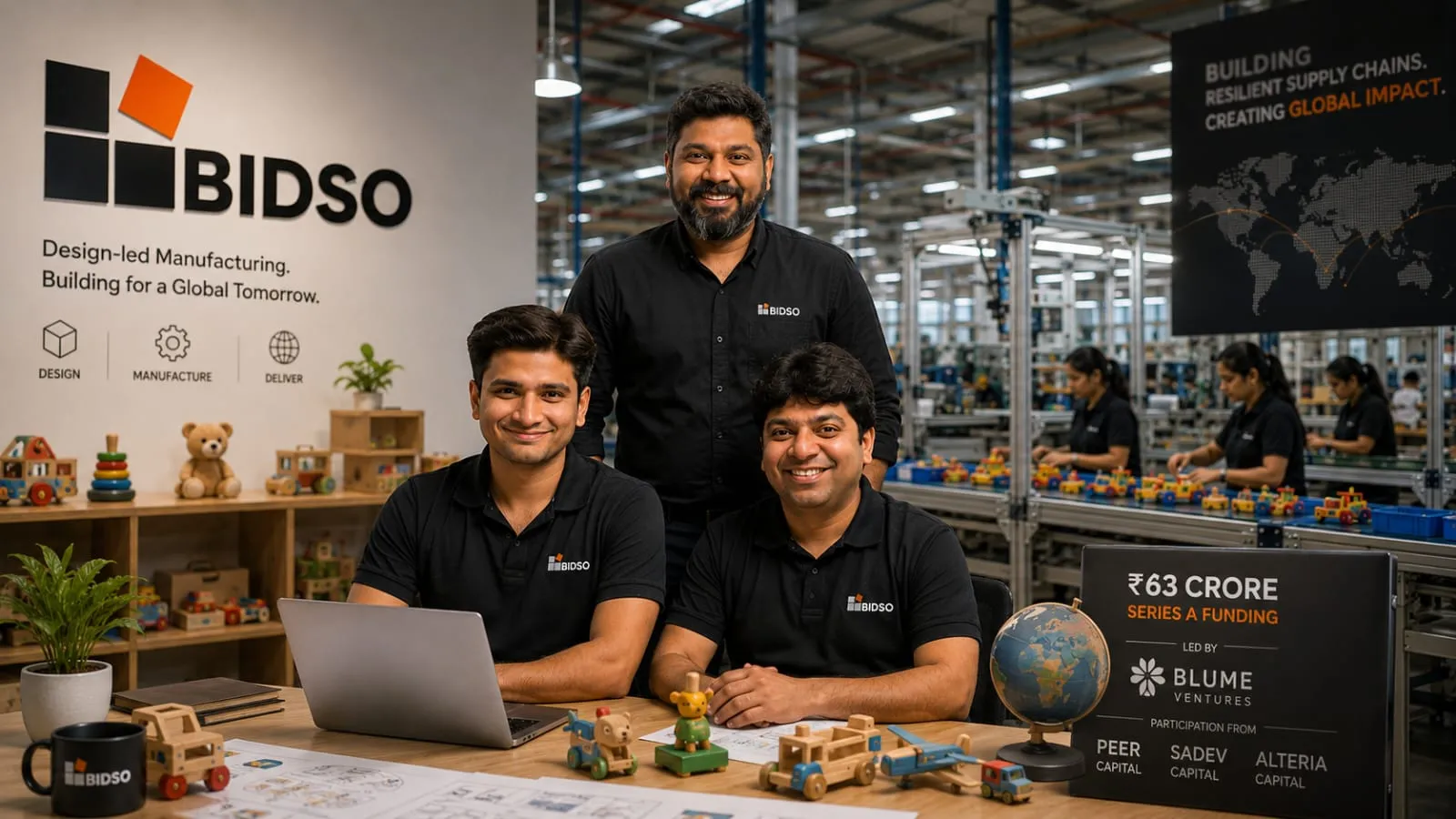
This broader movement increasingly gained visibility after BIDSO, a Bengaluru-based design-led manufacturing platform focused on toys and consumer products, raised ₹63 crore in a Series A round led by Blume Ventures, including ₹51 crore in equity and ₹12 crore in venture debt. Existing investors Peer Capital, Sadev Capital and Alteria Capital also participated in the round as the company outlined plans involving stronger manufacturing capability, expanded production and broader global ambitions. The funding itself increasingly appeared significant because it reflected growing investor confidence not simply around products but around manufacturing ecosystems capable of supporting larger supply-chain opportunities.
Viewed independently, Bidso’s funding round may initially appear like another startup capital announcement. Viewed through a broader funding and market lens, however, it increasingly resembles a larger story involving how India’s manufacturing narrative itself may be entering a different chapter.
Investor Interest Increasingly Appears To Be Moving Beyond Traditional Technology Categories
Historically, startup investment environments frequently concentrated around sectors where scale appeared highly visible and immediate. Software businesses often attracted significant capital because digital products frequently scaled without requiring extensive operational infrastructure. Manufacturing businesses, by contrast, frequently demanded physical assets, operational systems and execution environments involving greater complexity and longer timelines before returns became visible.
Increasingly, however, investor behavior appears changing in meaningful ways. Capital environments increasingly seem recognizing opportunities involving production ecosystems and industrial infrastructure previously viewed as less venture-friendly. Global shifts involving supply-chain diversification and broader conversations surrounding alternatives to concentrated manufacturing markets increasingly appear reshaping investor assumptions around what future opportunities may look like.
This transition increasingly matters because manufacturing itself frequently creates value across multiple layers simultaneously. Production businesses often influence logistics ecosystems, supplier environments, employment structures and broader industrial capability. Investors increasingly appear recognizing that building products frequently depends not only on consumer demand itself but also on creating systems capable of producing and delivering those products efficiently.
The broader significance increasingly suggests future startup opportunities may increasingly emerge not only from software interfaces but also from the systems operating behind them.
Supply Chains Increasingly Appear To Be Becoming A Larger Investment Theme
Part of the significance surrounding Bidso’s funding story increasingly involves broader conversations surrounding supply chains themselves. Historically, manufacturing frequently operated through fragmented structures where production, design and distribution often existed separately. Companies frequently depended on multiple layers of intermediaries and production environments where scalability occasionally created operational challenges.
Increasingly, however, newer manufacturing businesses appear building integrated systems capable of combining multiple functions simultaneously. Bidso itself operates around a design-led and manufacturing-focused approach while integrating product development, engineering and production environments directly into broader supply systems. The company’s FOCO model also allows expansion without requiring extensive asset ownership, creating a more flexible operating environment capable of supporting scale.
This increasingly matters because modern manufacturing increasingly appears moving beyond factory output alone. Businesses increasingly seem positioning themselves as ecosystem partners rather than production vendors. The broader significance increasingly suggests manufacturing itself may increasingly become a platform business where capability and coordination create competitive advantage alongside physical production.
India’s Industrial Story Increasingly Appears To Be Entering A Different Phase
Another important dimension emerging beneath these funding developments increasingly involves broader changes occurring across India’s industrial landscape itself. Over recent years, policy initiatives and global manufacturing conversations increasingly continued highlighting India’s potential role inside changing supply-chain environments. Discussions surrounding "China+1" strategies and diversification efforts increasingly contributed toward larger conversations involving manufacturing opportunities and export potential.
Importantly, these developments increasingly appear influencing startup behavior itself. Businesses increasingly seem positioning around long-term manufacturing capability rather than short-term output alone. Startups increasingly build around engineering, design and operational systems capable of serving global demand environments. Bidso itself has highlighted ambitions involving international expansion while leveraging design-led manufacturing capabilities built around consumer products and toys.
This broader transition increasingly matters because industrial ecosystems frequently evolve gradually before visible momentum emerges. The broader significance increasingly suggests India’s next startup chapter may increasingly include businesses building not only digital products but also the systems capable of manufacturing them at scale.
The Larger Story Increasingly Extends Beyond One Funding Round Alone
The broader significance surrounding Bidso and similar manufacturing startups may ultimately involve what they reveal regarding how India’s startup ecosystem itself increasingly evolves. Historically, startup conversations frequently associated innovation primarily with software, platforms and digital experiences because those sectors often represented the most visible symbols of growth.
Viewed through a broader lens, however, manufacturing funding stories increasingly resemble more than industrial announcements or startup rounds. They increasingly appear connected to larger realities involving supply chains, industrial capability and how economies increasingly build long-term competitive strength.
The larger funding story therefore may not simply involve another Series A round or another manufacturing startup attracting investor attention. Increasingly, it may involve recognizing that some of India’s next large startup opportunities may emerge not only from products consumers interact with directly, but also from the production ecosystems quietly operating behind them.