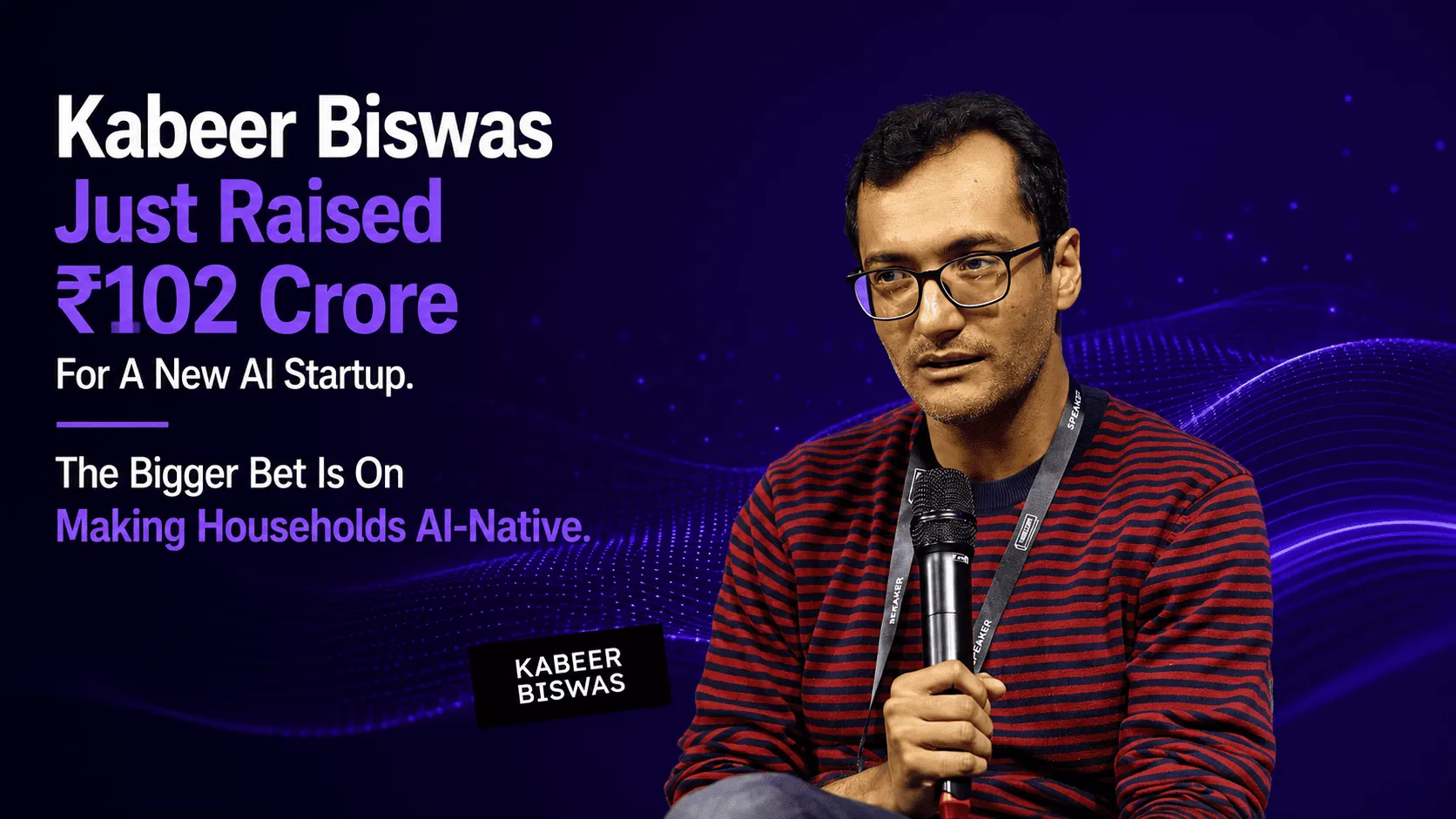
After Helping Build India's Convenience Economy Through Dunzo, Kabeer Biswas Is Returning With A New Idea: What If Artificial Intelligence Could Run Parts Of Your Everyday Life?
For most entrepreneurs, building a venture-backed startup is difficult enough.
Building one, navigating a highly competitive market, experiencing both rapid growth and public challenges, and then returning to raise fresh capital for an entirely new venture is considerably harder. Yet that is precisely what Kabeer Biswas has done. The entrepreneur best known for co-founding Dunzo has secured ₹102 crore in seed funding for his new startup, M, attracting backing from some of India's most influential investors, including Peak XV Partners, Blume Ventures and CRED founder Kunal Shah. The size of the round is notable, but the real story lies in what investors believe Biswas is building next.
Unlike Dunzo, M is not trying to move products from one place to another.
Instead, it is attempting to solve a different problem emerging in the AI era: decision overload. Modern consumers manage dozens of subscriptions, service providers, household expenses, maintenance schedules, appointments and daily tasks. Technology has made these services accessible, but it has also increased complexity. Consumers now spend significant time coordinating, comparing and managing information scattered across apps and platforms. M's vision is to use artificial intelligence as a personal concierge capable of handling many of those responsibilities automatically.
The idea reflects a growing belief within the technology industry that the next major AI opportunity may not be in workplaces alone.
It may be inside people's homes.
Why Investors Are Betting On A Founder Before A Product
One of the most interesting aspects of the funding round is how early it arrived.
Unlike many startups that raise large amounts of capital after demonstrating substantial traction, M secured significant investor backing while still operating largely in stealth mode. This highlights an increasingly important trend in venture capital: investors are often willing to back experienced founders long before a business reaches scale. In sectors evolving as quickly as artificial intelligence, the quality of the team can matter as much as the product itself.
Kabeer Biswas enters this venture with something many first-time founders lack.
He has already built and scaled a consumer technology company through multiple phases of growth. Dunzo helped pioneer hyperlocal commerce in India and became one of the country's most recognizable startup brands. Although the company's later challenges received considerable attention, investors often focus on the lessons founders gain from navigating difficult markets. Experience managing rapid growth, fundraising cycles, operational complexity and consumer behavior can become valuable assets when building a second company.
The funding therefore represents more than confidence in an idea.
It represents confidence in a founder who has already spent years understanding how Indian consumers adopt technology.
The Next AI Battle May Be Consumer Convenience
Much of the AI conversation today revolves around productivity.
Companies compete to build tools that help professionals write emails, analyze documents, generate code and automate workplace tasks. While these markets are attracting enormous investment, many entrepreneurs believe an equally significant opportunity exists in consumer applications. Millions of people still spend large portions of their day coordinating services, making routine decisions and managing household operations that technology has not fully simplified.
This is where M appears to be positioning itself.
The company reportedly aims to function as an AI-powered concierge capable of helping consumers navigate everyday life more efficiently. Rather than requiring users to jump between dozens of applications, the platform seeks to create a more unified experience where artificial intelligence can understand needs, recommend actions and coordinate outcomes. If successful, the product would move beyond information delivery toward actual task management.
That distinction is important.
The most valuable AI businesses of the next decade may not be the ones that simply answer questions. They may be the ones that complete tasks on behalf of users.
A New Category Is Emerging

The rise of AI assistants is creating an entirely new category of technology companies.
The first generation of consumer internet businesses connected users to information. The second generation connected users to services. Increasingly, entrepreneurs are attempting to build systems capable of managing those services autonomously. Instead of booking appointments manually, comparing providers or coordinating multiple tasks individually, consumers may eventually rely on AI agents to perform much of that work.
Investors are paying close attention because the market potential is enormous.
Every household operates as a complex network of recurring decisions. Bills must be paid, services renewed, repairs scheduled and purchases coordinated. These activities consume time but rarely create value for consumers. Businesses capable of automating even a portion of those responsibilities could become deeply integrated into everyday life, creating engagement levels that few applications achieve.
M is entering this market at a moment when AI capabilities are advancing rapidly.
Large language models and agent-based systems have made it increasingly feasible to imagine software that does more than provide recommendations. The next step is software that acts.
What This Funding Says About India's AI Ecosystem
The funding round also highlights a broader shift occurring across Indian venture capital.
For years, much of India's startup ecosystem was defined by e-commerce, fintech and consumer internet businesses. Those sectors remain important, but investors are increasingly directing attention toward artificial intelligence. The technology is creating opportunities to build globally relevant products while leveraging India's growing pool of engineering and product talent.
The willingness of investors such as Peak XV, Blume and CRED to back an AI-focused venture at this stage signals how strongly they believe the market opportunity is evolving.
Rather than viewing artificial intelligence as a feature, many investors now view it as the foundation of entirely new business models. Companies built around AI-native experiences could potentially reshape categories ranging from commerce and healthcare to education and personal services. Founders capable of identifying these opportunities are attracting significant attention even before products reach mass adoption.
That trend is likely to accelerate.
As AI capabilities improve, venture capital firms will increasingly search for entrepreneurs capable of building businesses around entirely new forms of consumer behavior.
The Real Bet Is Bigger Than A Concierge App
Viewed narrowly, M appears to be building a digital concierge.
Viewed more broadly, it represents a much larger idea. The startup is effectively betting that households will eventually rely on artificial intelligence in the same way they currently rely on smartphones. Instead of opening multiple apps and managing countless tasks manually, consumers may increasingly delegate those responsibilities to intelligent systems capable of coordinating services on their behalf.
Whether that vision becomes reality remains uncertain.
The consumer AI market is still young, competition is intensifying and user behavior often evolves more slowly than technology itself. Yet investors backing the company clearly believe that a significant shift is underway. They are not simply funding another consumer application. They are funding a hypothesis about how people will interact with technology in the coming decade.If that hypothesis proves correct, Kabeer Biswas may once again find himself helping define a new category.The first time, it was convenience.This time, it may be autonomy.


