FundingLatest Deals8 MIN READ

Just 1% of Stocks Account for 95% of Global Equity Gains in 2026

Global stock markets are reaching new highs, but beneath the headline returns lies a striking reality: just 1% of listed companies are responsible for nearly 95% of equity wealth creation in 2026. As mega-cap technology firms dominate global indices, investors face growing concentration risk hidden behind the illusion of diversification.

By Nisha Omkumar · Author29 May 2026New
Just 1% of Stocks Account for 95% of Global Equity Gains in 2026

As global markets post headline-grabbing returns, a startling truth hides beneath the surface — most of the world's wealth creation is being captured by a breathtakingly small club of companies. What does this mean for your portfolio?

By The Impactful Global Indian — Markets Desk

The global stock market looks like a celebration from the outside. Indexes are hitting new highs, analyst forecasts are bullish, and financial television anchors speak of a broadening bull market with the enthusiasm of festival season. But strip away the headline numbers, and an uncomfortable truth emerges: the party is happening in one very exclusive room, and most investors are standing outside with their noses pressed against the glass.

A remarkable — and deeply unsettling — phenomenon has taken hold of global equity markets in 2026: just one percent of listed stocks worldwide are responsible for generating approximately 95 percent of all equity wealth created this year. For the everyday investor, for the Indian diaspora professional managing a 401(k) or a Demat account, this is not a footnote. It is the entire story.

The Illusion of Broad-Based Growth

Goldman Sachs Research forecasts global equity returns of 11 percent for 2026, including dividends. Bank of America projects S&P 500 earnings growth of 14 percent. The FTSE All World Index returned a staggering 23.1 percent in 2025. These are the numbers that make headlines — the numbers that cause fund managers to smile and retail investors to feel reassured that their money is working hard for them.

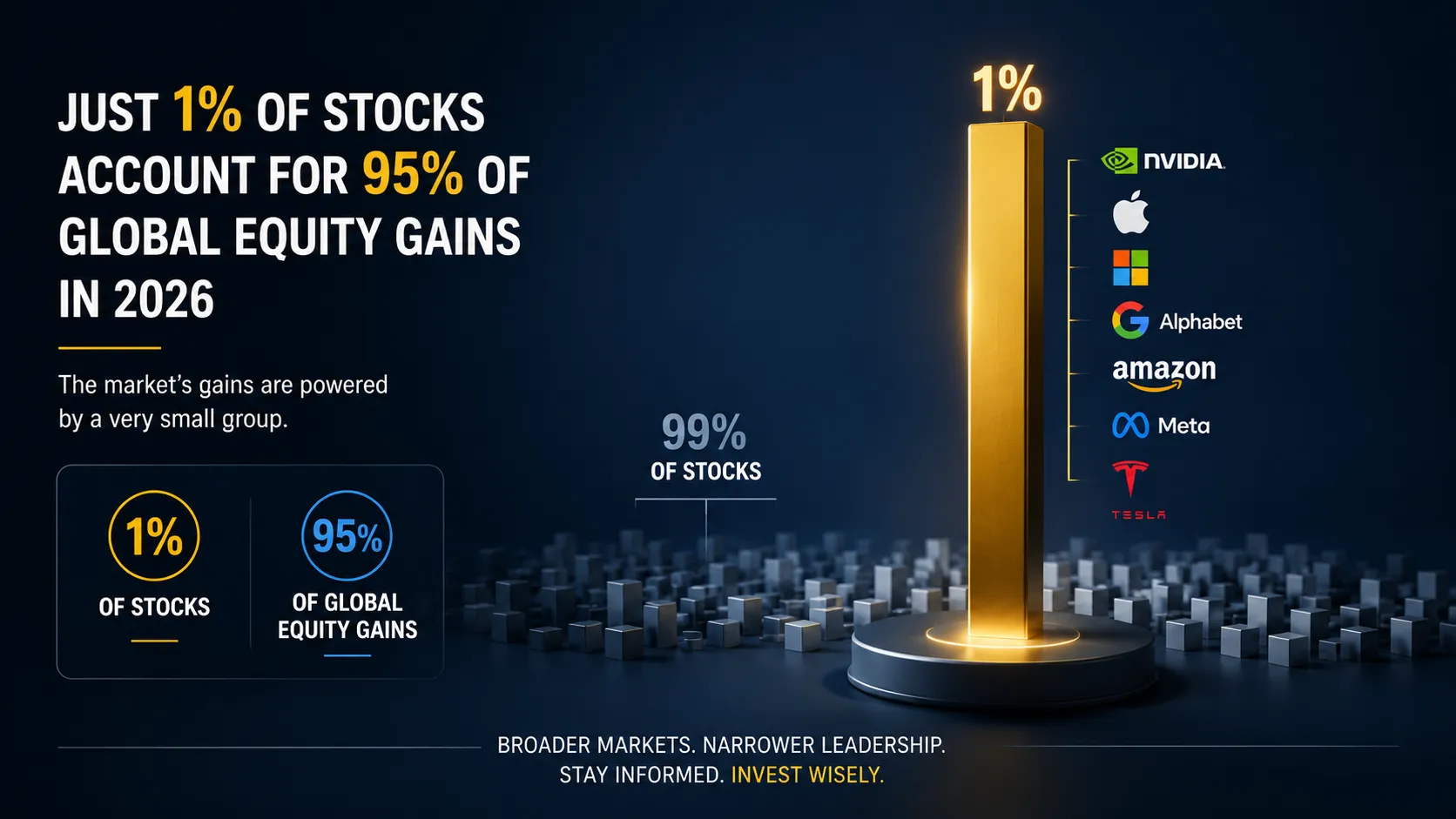
But the data beneath the surface tells a profoundly different story. The top 10 stocks in the FTSE USA alone now control nearly 40 percent of the index — a level of concentration not witnessed since the 1960s. Inside the S&P 500, just five mega-cap names — NVIDIA, Apple, Microsoft, Alphabet, and Amazon — collectively account for roughly 26 percent of the entire index. According to Goldman Sachs Asset Management, in 2025, the top technology stocks alone were responsible for 53 percent of the S&P 500's total return. In 2026, that concentration has, if anything, intensified.

"The top 2 stocks in the FTSE USA weigh more than the combined weight of the entire Energy, Utilities, Real Estate, Telecommunications, and Basic Materials industries."

— LSEG / FTSE Russell Research, January 2026

Read that again. Two companies — outweighing five entire industries. This is not diversification. This is concentration masquerading as an index fund.

The New Magnificent Architecture of Wealth

The stocks doing the heavy lifting are well known to any market watcher: the so-called Magnificent Seven — Alphabet, Amazon, Apple, Meta, Microsoft, NVIDIA, and Tesla. These seven companies, operating at the crossroads of artificial intelligence, cloud computing, and consumer technology, have restructured what it means to participate in equity market growth.

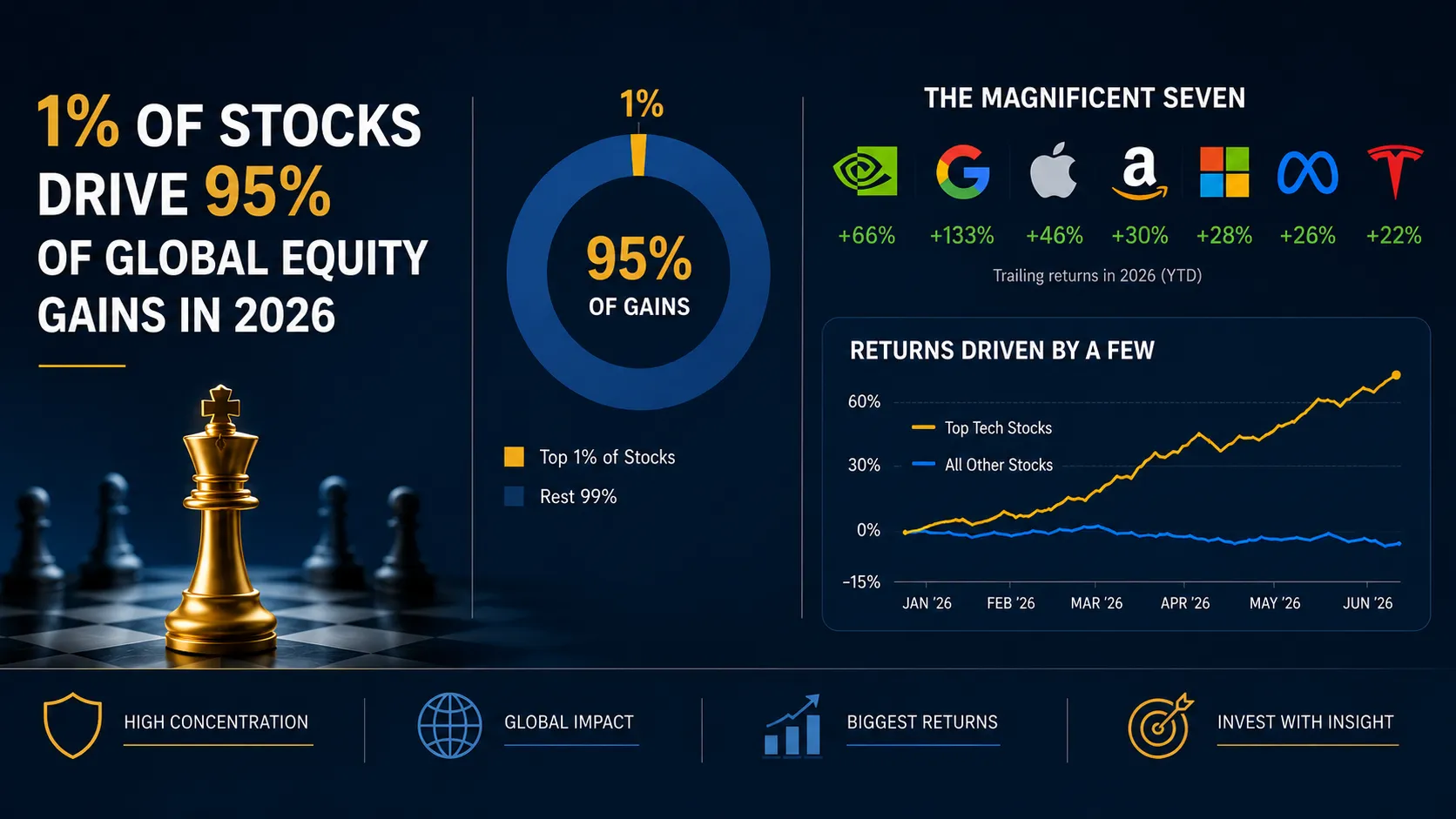
NVIDIA, the undisputed torchbearer of the AI infrastructure era, returned 66 percent over the trailing year. Alphabet surged 133 percent. Apple climbed 46 percent. Amazon gained 30 percent.

Investors who held these names through the volatility — through the VIX spike above 31 in late March 2026, through trade friction anxieties, through geopolitical noise — were richly rewarded.

Those who did not are looking at a market that appears to be working, while their portfolios tell a quieter, more sobering story.
ChatGPT Image May 29, 2026, 01_41_34 PM.png

What This Means in Plain English

If you hold a diversified index fund, you may believe your money is spread across hundreds or thousands of companies. In reality, a market-cap-weighted S&P 500 tracker places roughly one rupee of every four — or one dollar of every four — in just five technology corporations. Diversification, as traditionally understood, is no longer what the label says it is.

An Indian Perspective: Why This Matters to You

For the Global Indian — whether you are a software engineer in Silicon Valley managing a portfolio, a finance professional in London with ISA investments, or a Mumbai-based investor with exposure to international equity funds — the implications of this concentration are not abstract. They are personal.

Indian investors have increasingly embraced international equity exposure through Liberalised Remittance Scheme (LRS) investments, international mutual funds, and NRI brokerage accounts. Many of these vehicles are benchmarked against or heavily correlated with the S&P 500 or global indices. What they may not realise is that their global diversification often means concentrated exposure to the same seven American technology companies, wrapped in different product names.

Emerging markets, including India, offer a genuine alternative narrative. U.S. Bank's latest market analysis confirms that emerging markets are leading major global stock index gains this year — between 8.6 percent and 20.9 percent — with nine of eleven S&P 500 sectors still positive year to date.

"Every bull market since 2016 has been a mega-cap story. The question for 2026 is whether the rest of the market finally catches up — or whether the leaders stumble first."

India's own equity markets, underpinned by domestic consumption growth, a young demographic, and increasing corporate earnings quality, present a story of breadth rather than concentration.

The Risk No One Is Talking About

Concentration at this scale is not merely an academic curiosity. It is a structural risk.

Goldman Sachs Asset Management has been explicit: elevated concentration alongside narrow market leadership creates greater sensitivity to earnings disappointment and the increased probability of a disorderly market correction.

In other words, if NVIDIA misses a quarter, if Apple faces a regulatory setback in the EU, if Alphabet stumbles in the AI race — the shockwaves do not stay contained within one stock. They ripple across every index fund, every ETF, every pension portfolio that has, knowingly or unknowingly, concentrated its bets on this handful of names.

Morningstar's 2026 Outlook is pointed on this: history shows that narrow market leadership can precede weaker returns. The dot-com era saw the top 10 US stocks surge from 15 percent to 24 percent of total market capitalisation between 1997 and 2000. We know how that ended.

JP Morgan's research notes that the recent rise in stock market concentration has been the steepest in 60 years.

Is There a Broadening? The Green Shoots

Not all the data is cause for alarm.

There are genuine signs that the market's leadership is beginning to broaden, and for patient, diversified investors, this could represent one of the most compelling opportunities in a generation.U.S. Bank's latest analysis notes that equity performance is increasingly broad-based, with six S&P 500 sectors having advanced more than 10 percent year to date in 2026.

Analysts now project S&P 500 earnings growth of 22 percent for 2026 and 16 percent for 2027 — and crucially, much of that growth is expected to come from sectors beyond technology.Goldman Sachs' broadening bull market thesis suggests that diversification across styles — growth versus value — and across geographies is becoming the dominant investment theme.Developed Asia, ex-Japan, and emerging markets have the strongest forward earnings-per-share growth estimates globally. For Indian investors, this is a signal worth heeding.

What Should the Smart Global Indian Investor Do?

Audit your actual concentration. Pull up every fund you hold and examine the top 10 holdings. You may be surprised to find the same five or seven names appearing across all of them. True diversification requires intentional action, not just multiple fund names.

Consider equal-weight and factor-based strategies. Equal-weight S&P 500 funds distribute capital evenly across all 500 companies, dramatically reducing mega-cap concentration. Factor ETFs targeting value, dividend quality, or small-cap growth offer genuine breadth.

Lean into the India growth story with eyes open. India's equity market offers structural tailwinds — domestic consumption, infrastructure spending, a digital economy boom — without the concentration risk embedded in US large-cap indices.

Maintain a watch on emerging market diversification. Emerging markets are outperforming in 2026. A deliberate allocation beyond the US mega-cap universe is not just prudent risk management — it may be the alpha opportunity of this decade.

Do not confuse index returns with your returns. The headline says markets are up 11 percent. Your portfolio may tell a different story if your holdings skew toward the 99 percent of stocks that are not driving those gains.

ChatGPT Image May 29, 2026, 01_45_48 PM.png

The Bottom Line

Markets are up. That is true.Wealth is being created. That is also true.

But the distribution of that wealth creation is more unequal than at almost any point in modern financial history.Just one percent of stocks — a handful of American technology giants sitting at the apex of the AI revolution — are capturing nearly all of the gains that millions of investors worldwide believe they are participating in equally.

For the Global Indian — ambitious, globally connected, financially savvy, and increasingly sophisticated in investment thinking — this is a moment that demands clarity over comfort.The stock market is not broken.But the idea that an index fund automatically delivers broad-based wealth participation?That idea may need urgent revision.The question is not whether the global bull market continues. Goldman Sachs, Bank of America, and T. Rowe Price all suggest it will.The question is whether you are positioned in the one percent that is driving it — or watching from the sidelines of the other 99.

TagsGlobal MarketsStock MarketEquity InvestingS&P 500Magnificent SevenNVIDIAAppleMicrosoftAmazonAlphabetPortfolio DiversificationWealth CreationNRI InvestingIndia InvestingGlobal Equity Trends

Reader reviews

Sign in to rate and review this article.
Loading reviews…