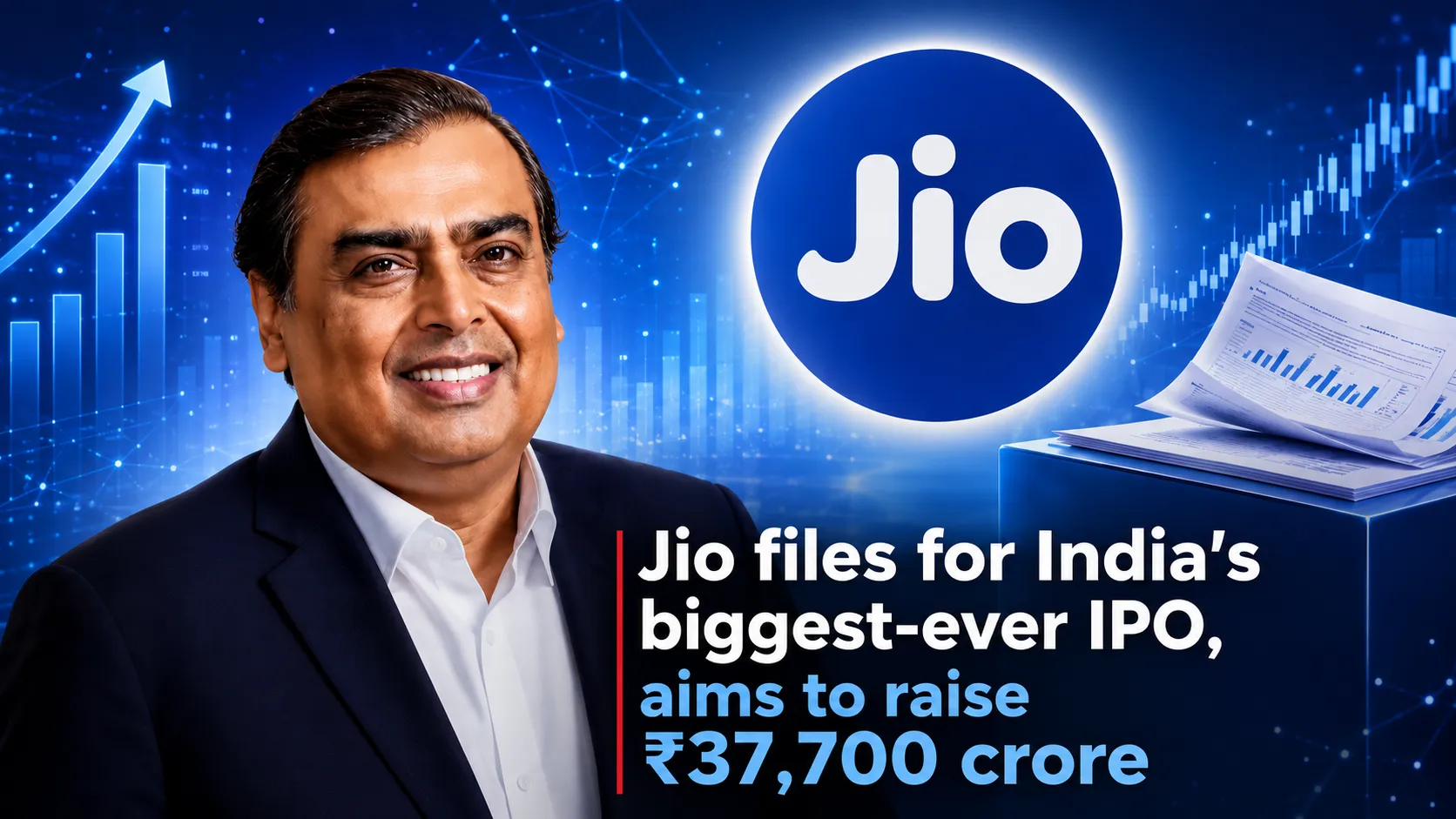
For a company that has spent the better part of a decade as the crown jewel of Reliance Industries without a standalone stock ticker of its own, Jio Platforms Limited is finally preparing to step into the spotlight on its own terms. The Draft Red Herring Prospectus filed with the Securities and Exchange Board of India on June 19, 2026, is not just another regulatory filing — it is the opening chapter of what market watchers across Dalal Street, GIFT City and global institutional trading desks are already calling the most consequential Indian IPO of the decade.
The announcement itself was delivered with characteristic theatre. Reliance Industries Chairman and Managing Director Mukesh Ambani used the stage of the company's 49th Annual General Meeting to confirm what investors had speculated about for years — that Jio, the digital services arm that transformed India's telecom landscape after its 2016 launch, would finally list independently. He described the moment as one of deep personal and corporate significance, framing the IPO as a value-unlocking event for the millions of shareholders who have backed Reliance's transformation from an energy and materials conglomerate into a digital-first enterprise.
What makes this listing extraordinary is not simply its scale, though the numbers alone are staggering. According to the DRHP, Jio Platforms is looking to raise approximately ₹37,700 crore — a figure north of $3.8 billion at current exchange rates — entirely through a fresh issue of up to 27 crore equity shares. There is, notably, no offer-for-sale component. Every single rupee raised in the offering is earmarked to flow back into the business itself, primarily toward prepaying outstanding borrowings at Reliance Jio Infocomm Limited, the material operating subsidiary that runs the day-to-day mobile and broadband network. The remainder is expected to support general corporate purposes, including continued investment in artificial intelligence infrastructure and network expansion.
To put the scale of this offering into perspective, one only has to look at the recent history of India's largest public issues. The Life Insurance Corporation of India IPO in 2022, at the time hailed as a watershed moment for the country's capital markets, raised approximately ₹21,000 crore. The Hyundai Motor India listing in 2024, which brought one of the country's most recognisable automotive brands onto the bourses, raised around ₹27,870 crore. If Jio Platforms manages to raise the estimated ₹37,700 crore, it would comfortably surpass both, cementing its place as the single largest capital markets event in Indian history — and doing so at a moment when the broader IPO pipeline, dented earlier in the year by crude oil volatility and geopolitical uncertainty stemming from the closure of the Strait of Hormuz, has been unusually quiet.
The valuation conversation around Jio Platforms has been equally dramatic. Analyst estimates place the company's potential enterprise value anywhere between $120 billion and $170 billion, a band wide enough to reflect just how much uncertainty still surrounds the final pricing. Some of that uncertainty was resolved earlier this year when Reliance made a structural pivot that surprised even seasoned IPO watchers: in May 2026, the company revised the offering from a mixed structure — combining a fresh issue with an offer-for-sale by existing marquee investors — to a 100 percent fresh issue. This followed what several people familiar with the process described as a valuation disagreement between Reliance and some of Jio's existing financial backers, including global names such as KKR, Vista Equity Partners, Silver Lake, and sovereign wealth funds from the Gulf region including Saudi Arabia's Public Investment Fund, Abu Dhabi Investment Authority, and Mubadala. Rather than exit through the IPO, these investors have chosen to hold their positions — a signal, according to market commentary, of continued long-term conviction in Jio's growth trajectory rather than a rush for the exits.
That decision alone has been read by many institutional investors as a bullish tell. When marquee global private equity and sovereign investors — the kind of capital that typically demands liquidity events on a defined timeline — opt to stay invested through what could be the largest IPO in a market's history rather than cash out, it tends to suggest confidence that the post-listing valuation trajectory has considerably more room to run. It also means that public market investors coming in through the IPO will, at least initially, be buying into a cap table still dominated by Reliance Industries, which held a commanding 66.43 percent stake in Jio Platforms as per the DRHP.
Beyond the financial engineering, the underlying business telling this story is formidable by any global standard. As of March 31, 2026, Jio Platforms reported a subscriber base exceeding 524 million customers — a number that industry insiders note is comparable to the combined population of several mid-sized countries, served through a technology stack built almost entirely in-house. The company employed 28,163 full-time staff as of the same date, working across network infrastructure, proprietary software platforms, custom operating systems, connected devices, and a sprawling suite of digital applications. This is not merely a telecom operator counting SIM cards; Jio has methodically built out consumer and enterprise offerings spanning mobile and fixed broadband, digital entertainment through JioHotstar, music streaming via JioSaavn, cloud storage through JioAICloud, gaming with JioGames, and a fast-growing enterprise stack offering connectivity, cloud solutions, Internet of Things services, unified communications, managed security, and private 5G networks for corporate clients.
The regulatory clock is now the primary variable determining when Indian retail and institutional investors will actually get a chance to participate. SEBI's standard review process for a DRHP typically takes anywhere from 30 to 75 days, and the regulator has already sought clarifications from Jio Platforms as part of that routine process, according to disclosures around June 25, 2026. Based on that timeline, most market analysts now peg the earliest realistic listing window at some point between August and October 2026 — though, as with any IPO of this magnitude, further delays cannot be ruled out given the scale of due diligence involved and the sheer size of the capital being raised.
Leadership continuity has also been a talking point in recent weeks. Jio Platforms' draft papers revealed a change at the very top of the operating structure: Pankaj Pawar, who also serves as Managing Director of Reliance Jio Infocomm Limited, was named Chief Executive Officer, taking charge on March 24, 2026, a day after his predecessor Kiran Thomas stepped down from the role on March 23. Pawar, 53, brings deep operational experience within the Reliance ecosystem to a role that will be under intense public scrutiny once the company lists, given that quarterly results, subscriber metrics, and margin trends will now be dissected by public market analysts in a way that was simply not possible while Jio remained a private subsidiary.
Price band, lot size and the exact subscription window remain officially unconfirmed, notwithstanding informal market chatter of a price range loosely clustered around the ₹1,100 to ₹1,300 mark — figures market participants are quick to caution are indicative estimates rather than anything close to official guidance. That clarity will only emerge once SEBI issues its formal observations on the draft prospectus and Reliance moves to file the Red Herring Prospectus ahead of the actual subscription window. What is structurally confirmed, however, is that existing Reliance Industries shareholders will receive a reserved quota within the issue — a customary but meaningful gesture that rewards long-term RIL investors with priority access to what could be one of the most oversubscribed IPOs in Indian market history — alongside a separate reservation carved out for eligible Jio employees.