A New AI Funding Race Is Beginning To Move Beyond Software
Artificial intelligence has already rewritten many of the rules that historically governed technology investing. Only a few years ago, billion-dollar startup rounds represented rare moments reserved for exceptional companies approaching public-market scale. Today, the AI boom has altered those expectations entirely. Funding rounds involving tens of billions of dollars increasingly dominate conversations across Silicon Valley as investors race to identify where the next technological transformation may emerge. Companies building language models, AI infrastructure, advanced chips and cloud ecosystems have collectively attracted unprecedented levels of capital. Yet even within an environment increasingly defined by extraordinary fundraising, Jeff Bezos’ latest AI ambitions are beginning to stand apart.
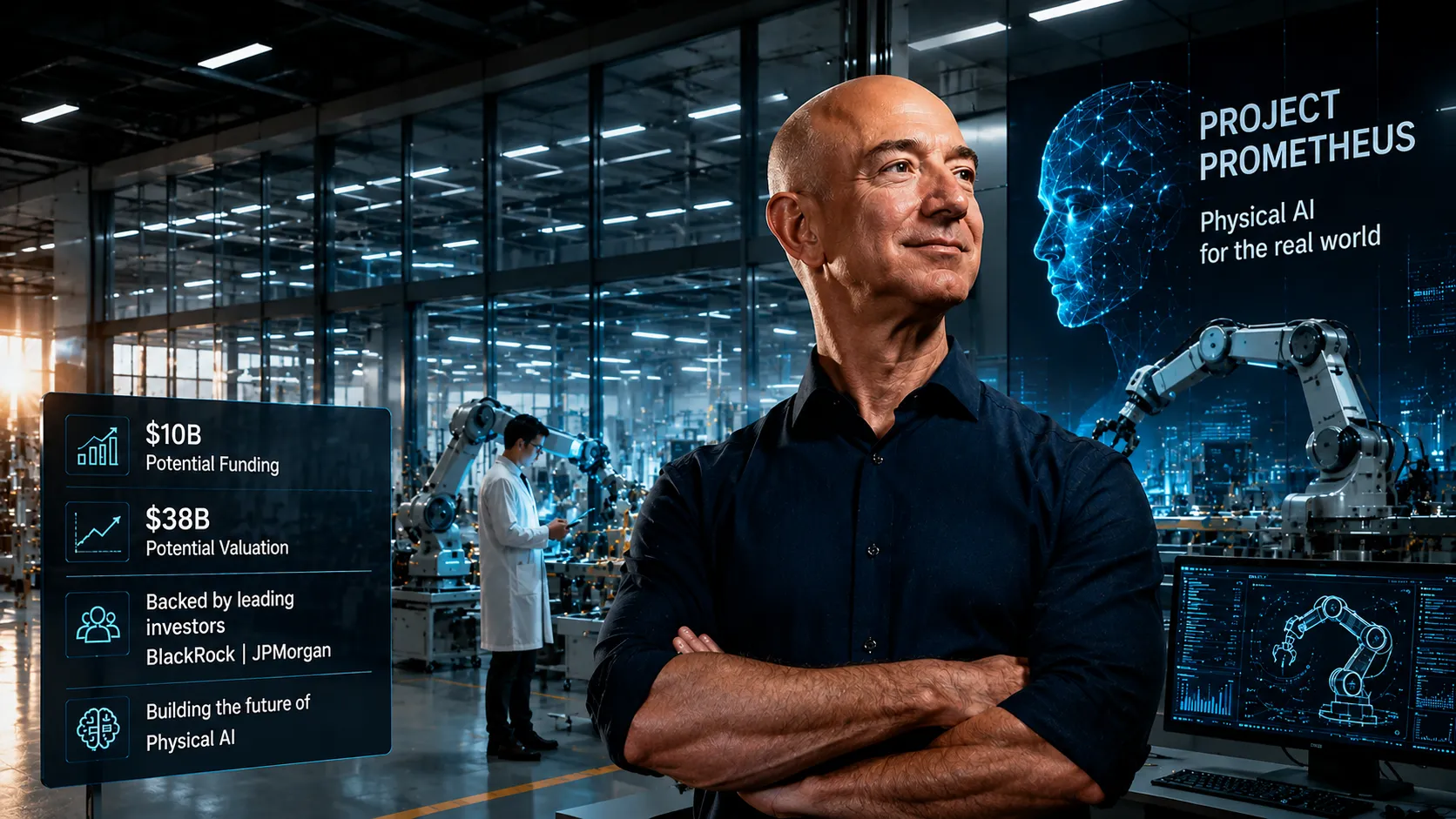
Reports indicate that Project Prometheus, the AI venture associated with Jeff Bezos, is approaching a $10 billion funding round that could value the company at roughly $38 billion. The scale itself is remarkable. A company operating largely outside public visibility has already generated enough investor interest to potentially become one of the most valuable artificial intelligence businesses globally. Major financial institutions and investors reportedly exploring involvement include firms such as BlackRock and JPMorgan, suggesting that Project Prometheus is attracting attention not simply from venture investors but from institutions increasingly positioning themselves around AI’s long-term economic impact. This distinction matters because funding at such scale increasingly reflects broader conviction around technological direction rather than enthusiasm around individual products alone.
What makes the story particularly notable is that Project Prometheus does not appear to be competing directly inside the crowded landscape of chatbot applications and consumer-facing AI assistants. Instead, reports increasingly suggest that the company is pursuing a far broader thesis involving physical intelligence and industrial systems. That approach potentially places it in an entirely different category from many first-generation AI startups.
Jeff Bezos Appears To Be Chasing A Different Artificial Intelligence Future
Throughout his career, Jeff Bezos frequently built businesses around long-term structural shifts rather than immediate opportunities. Amazon itself was founded around an early belief that internet commerce would eventually reshape consumer behavior. Blue Origin reflected a similar willingness to pursue long-horizon industries before broader markets fully matured. Artificial intelligence increasingly appears positioned as the next chapter in that approach.
Unlike companies focused heavily on conversational systems or software productivity, Project Prometheus reportedly aims to build what industry observers increasingly describe as physical AI — systems designed to interact with engineering environments, manufacturing processes and real-world industrial systems. Rather than operating purely through text and software interfaces, these systems could eventually assist with optimization, automation and decision-making across complex operational environments.
The distinction may appear subtle at first glance, yet the implications could become substantial. The first wave of AI largely focused on improving interactions between humans and digital systems. Physical AI introduces a broader possibility where intelligence increasingly interacts directly with machinery, industrial processes and infrastructure itself. In practice, this could eventually influence sectors ranging from aerospace and semiconductor manufacturing to logistics, industrial design and advanced robotics.
For investors, this represents a very different opportunity profile. Software businesses can become enormous, but industrial ecosystems frequently operate at global scale involving trillions of dollars in infrastructure and operational spending. If artificial intelligence begins integrating deeply into those environments, entirely new categories of economic value could emerge.
Why Investors Increasingly Believe AI’s Biggest Opportunity May Still Be Ahead
Much of the initial excitement surrounding artificial intelligence revolved around visible consumer experiences. Chatbots transformed search. AI tools accelerated content creation. Productivity systems automated workflows. These developments helped introduce AI capabilities into everyday environments and accelerated adoption worldwide.
Yet technology cycles frequently evolve through recognizable stages. Early excitement often focuses on visible products because they attract immediate attention. Over time, however, investors increasingly begin shifting attention toward infrastructure and deeper structural opportunities capable of supporting larger ecosystems.
Artificial intelligence increasingly appears to be entering that phase.

Across technology markets, conversations are gradually expanding beyond applications and moving toward systems capable of reshaping industries themselves. Infrastructure environments, industrial intelligence and specialized AI ecosystems are increasingly becoming areas where investors believe long-term value may accumulate. Project Prometheus appears positioned around precisely this transition.
Reports suggest the company aims to train systems using industrial and scientific datasets capable of supporting operational intelligence rather than relying solely on internet-scale content environments. This approach reflects a broader belief emerging across technology ecosystems: future AI systems may derive competitive advantages from specialized real-world data and domain expertise rather than generic information alone.
If that assumption proves correct, AI companies capable of integrating directly into industrial environments could eventually create advantages extending far beyond software interfaces.
A Separate $100 Billion Vision Adds Another Layer To The Story
Part of the broader attention surrounding Bezos’ AI ambitions stems from another initiative that generated significant discussion earlier this year. Separate reports suggested Bezos was exploring a $100 billion investment structure designed around acquiring manufacturing businesses and introducing AI-driven operational systems across industrial sectors.
Importantly, this proposed initiative remains distinct from Project Prometheus’ reported $10 billion fundraising effort.
The larger vehicle reportedly focuses on identifying manufacturing businesses capable of benefiting from artificial intelligence transformation. Rather than functioning as a traditional venture fund, the structure would potentially combine ownership of industrial operations with AI deployment strategies designed to modernize efficiency and productivity.
The distinction matters because it suggests Bezos’ broader ambitions may involve much more than startup creation alone. Instead of building isolated software environments, the strategy increasingly appears centered around creating interconnected ecosystems involving operational infrastructure, industrial systems and AI capabilities.
If pursued successfully, such an approach could represent one of the most ambitious attempts to integrate artificial intelligence directly into large-scale physical industries.
Observers have already compared aspects of the initiative to SoftBank’s Vision Fund strategy because of its scale and long-term ambition. Yet there may be important differences. Whereas earlier investment waves frequently focused on digital growth businesses, Bezos’ approach increasingly appears connected to industries involving tangible assets and operational systems.
Talent Is Quietly Becoming One Of AI’s Most Valuable Assets
Funding often dominates headlines because investment numbers attract immediate attention. Yet across AI ecosystems, talent increasingly functions as an equally important signal.
Reports indicate that Project Prometheus has recruited researchers and engineers from organizations including OpenAI, DeepMind, Meta and other leading artificial intelligence institutions. These hiring patterns matter because technology ecosystems often reveal strategic direction through talent movement long before products become visible publicly.
Artificial intelligence increasingly differs from previous technology sectors because access to expertise itself has become a competitive advantage. Computing infrastructure can be purchased. Capital can be raised. Building teams capable of defining entirely new categories of intelligence remains considerably more difficult.
Investors increasingly interpret movement involving senior researchers and engineering leaders as early signals indicating where future ecosystems may emerge.
Project Prometheus’ hiring strategy therefore may reveal ambitions extending beyond one product or platform.
Why This Could Become One Of Technology’s Defining Investment Stories
Technology cycles occasionally produce funding events that later become symbolic moments representing larger transitions. Certain investments become historically important not because of capital alone, but because they reveal where influential investors believe future industries may emerge.
Cloud infrastructure investments helped define earlier computing eras. OpenAI’s rise signaled the arrival of generative AI.Project Prometheus increasingly appears connected to a broader thesis altogether the belief that artificial intelligence’s next chapter may extend beyond digital experiences and become deeply integrated into the systems powering the physical world itself.Whether that vision succeeds remains uncertain.
But the scale of capital discussions, industrial ambitions and ecosystem planning already suggests something larger may be unfolding.
Artificial intelligence transformed software.The next stage may involve transforming industries.