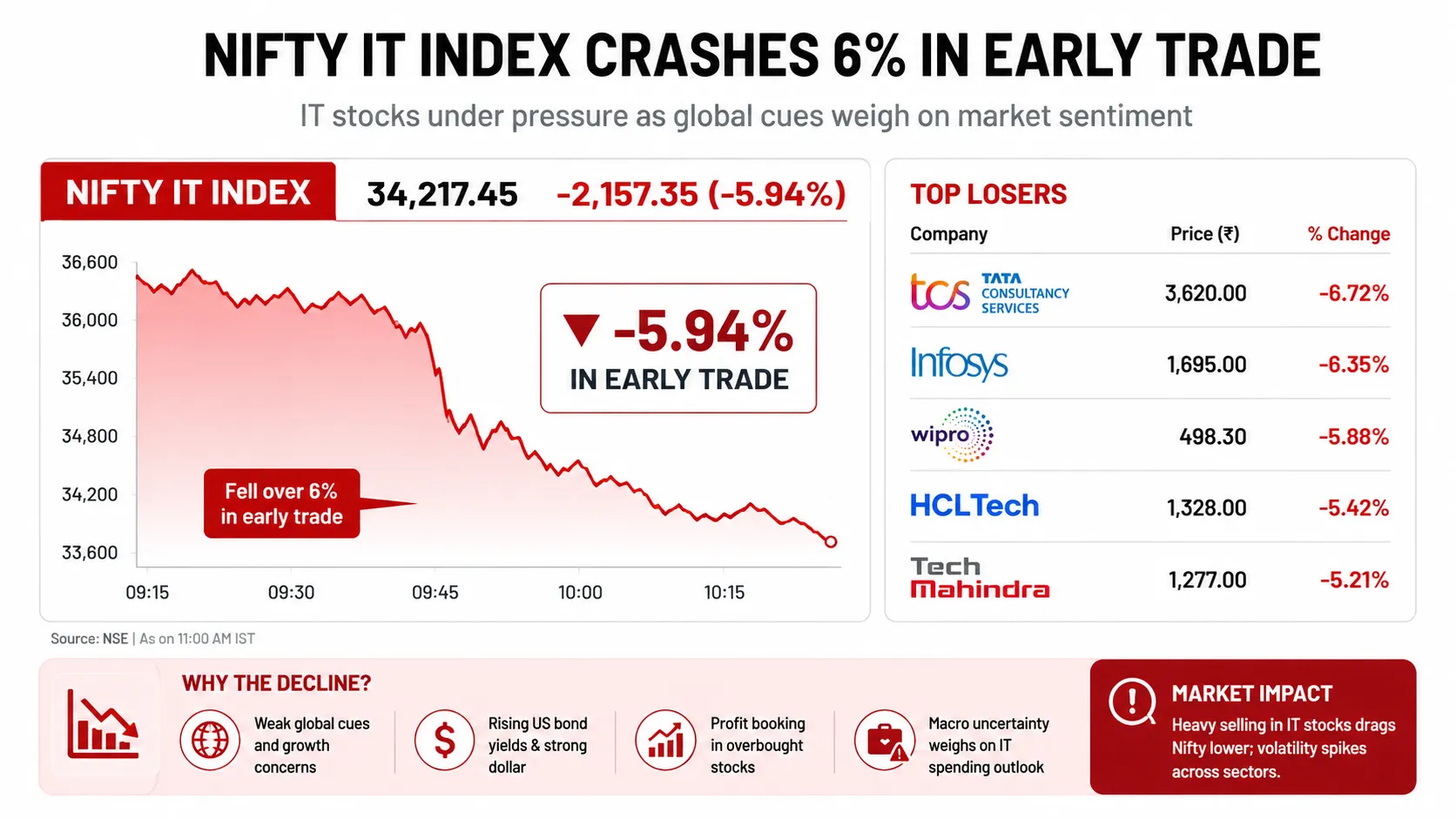
The Nifty IT index plunged nearly 6% on June 19 after Accenture cut its revenue outlook, triggering a broad sell-off in Infosys, TCS, HCLTech, and Wipro. The Sensex fell over 700 points, snapping a five-day winning streak — and investors are bracing for more pain.
The party on Dalal Street ended with a bang — and it wasn't a good one.
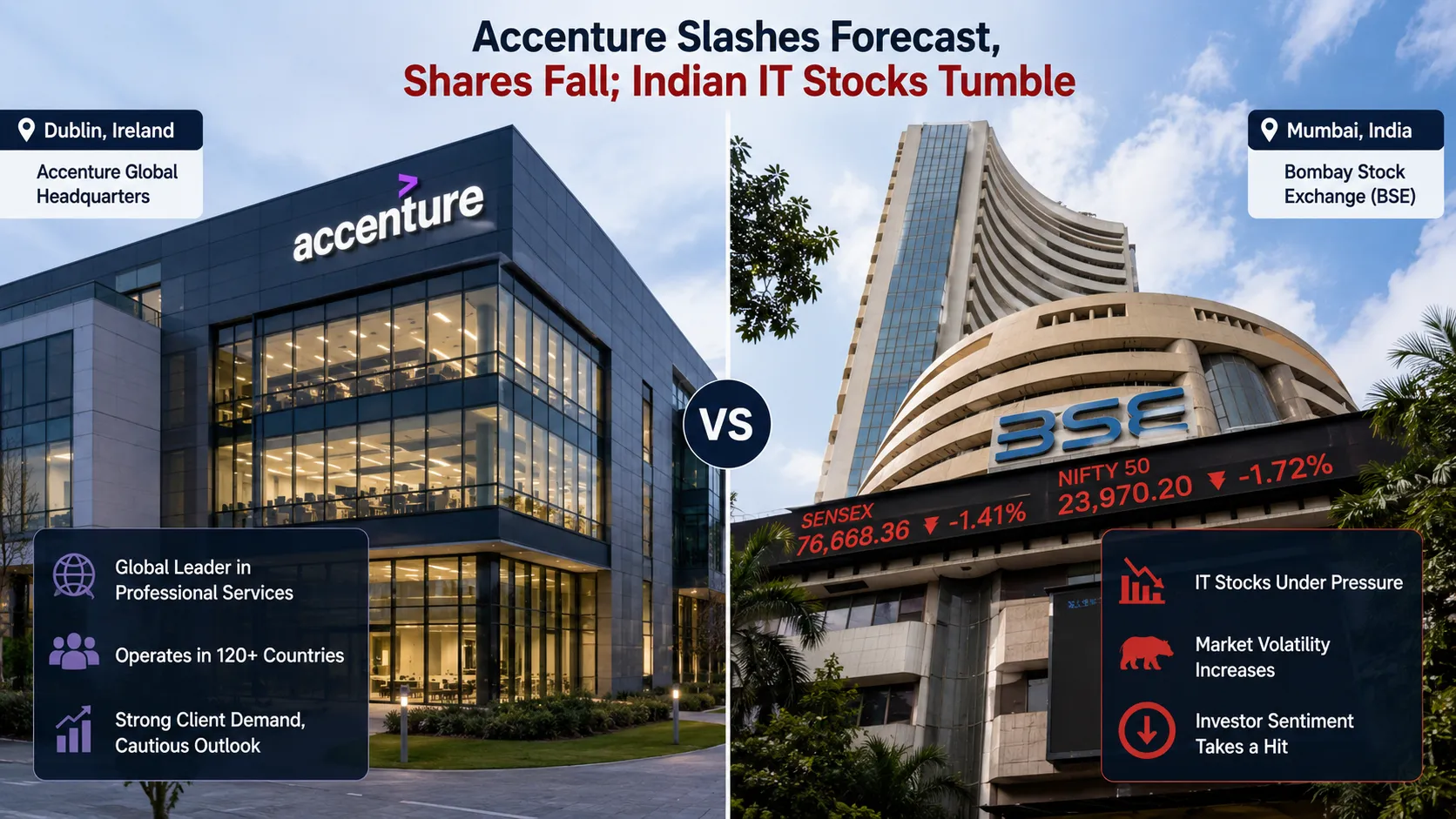
Just a day after the Sensex closed above 77,000 for the first time and the Nifty settled at 24,168, Indian equity benchmarks came crashing down on June 19. The trigger? A single earnings report from a global consulting giant based 8,000 miles away in Dublin, Ireland.
Accenture, the world's largest technology services firm, lowered its full-year revenue growth forecast and warned of business disruption in the Middle East. The news sent shockwaves through India's $315 billion IT sector, wiping out nearly Rs 2 lakh crore in investor wealth within the first hour of trade. The Nifty IT index plunged nearly 6% in early trade, making it the worst-performing sectoral index on the street.
Infosys tumbled over 8%. TCS fell more than 6%. Tech Mahindra dropped around 5%. HCLTech lost over 5%. Wipro declined nearly 4%. The selling pressure extended beyond frontline names, with Mphasis, Persistent Systems, Coforge, KPIT Technologies, and LTIMindtree all recording steep declines.
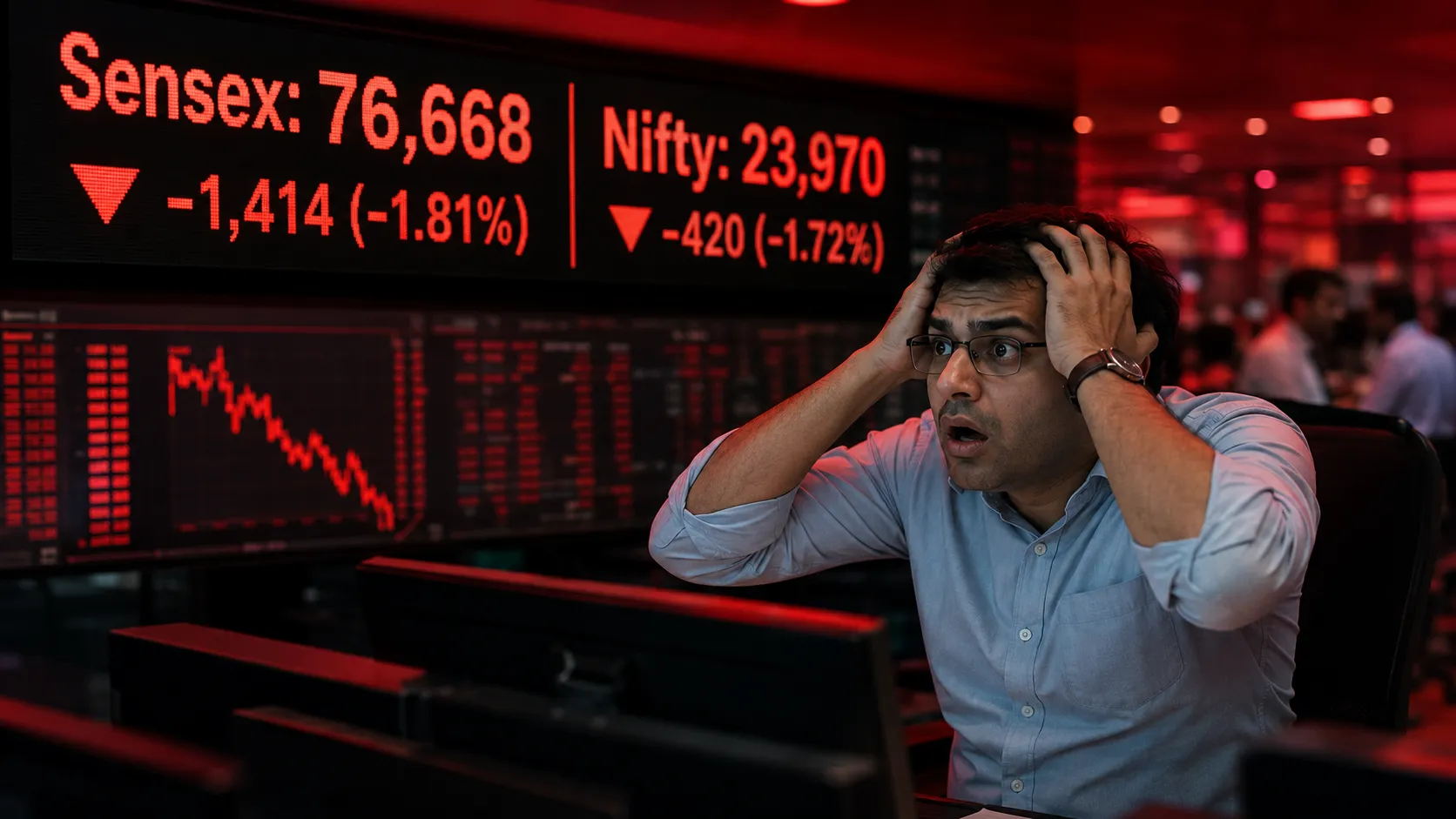
The broader market followed suit. The BSE Sensex fell over 741 points, or 0.96%, to 76,668. The NSE Nifty 50 slipped 197 points, or 0.82%, below the crucial 24,000 mark to 23,970. After five straight sessions of gains — the longest winning streak in months — the bulls finally ran out of steam.
What Did Accenture Say That Was So Bad?
The trigger came from Accenture's third-quarter earnings announcement, where the company narrowed its fiscal 2026 revenue growth forecast to 3-4% in constant currency terms, down from its earlier projection of 3-5%. Excluding the impact of its US federal business, the company now expects growth of 4-5%, compared with its previous estimate of 4-6%.
Accenture reported third-quarter revenue of $18.72 billion, up 6% from a year earlier. New bookings stood at $19.3 billion, lower than the year-ago period. The company also projected fourth-quarter revenue in the range of $17.75 billion to $18.4 billion — below Wall Street expectations.
Julie Sweet, Accenture's Chair and CEO, said clients are continuing to spend on large business transformation projects, including those involving artificial intelligence. She noted that the company has seen an increase in large deals worth more than $100 million and plans to strengthen its AI, cybersecurity and cloud offerings through acquisitions.
But investors focused on the negatives. Management disclosed that conflict-related disruptions in the Middle East had affected regional operations during the quarter, with the possibility of additional impact in the coming months. The weaker bookings, elongated deal cycles, and delayed conversion of large deals pointed to a slower-than-expected demand recovery.
The market's reaction was swift and brutal. Accenture shares tumbled nearly 18% in US trading. Indian IT ADRs also came under pressure, with Infosys ADRs sliding close to 10% and Wipro ADRs ending lower.
Why Indian IT Stocks Are So Sensitive
The sharp reaction reflects the deep interdependence between Indian IT companies and their global clients, particularly in the United States. A large portion of revenue for domestic IT companies comes from overseas clients. Any indication of weaker demand, delayed deal closures, or slower discretionary spending tends to weigh heavily on sector sentiment.
Analysts were quick to interpret Accenture's guidance as a negative read-through for Indian IT companies. Morgan Stanley analysts said investors had projected a weaker-than-usual start to the 2027 fiscal year but remained optimistic about an improvement in the second quarter. "However, with this commentary from Accenture, we think hopes of any meaningful improvement in growth in 2Q could start fading away," they said.
Goldman Sachs analysts also projected a negative read-across for Indian IT companies, citing "continued low visibility on demand outlook". Broader macroeconomic headwinds are impacting business visibility for IT companies, as clients adopt a cautious approach toward technology investments and hold off on non-essential tech spends.
The concerns come at a time when Indian IT stocks were already under pressure from fears that AI could disrupt the traditional, labour-intensive business model of the sector. Accenture's commentary reinforced those fears — even as the company highlighted that AI is emerging as a meaningful growth driver.
"Accenture suggests that AI is emerging as a meaningful growth driver, but it is not yet strong enough to fully offset ongoing pressure on discretionary technology spending and delays in client decision-making," said Choice Institutional Equities in a report. "As a result, the recovery trajectory for Indian IT is expected to remain gradual rather than witness a broad-based acceleration in FY27."
The Numbers: A Rs 2 Lakh Crore Bloodbath
The scale of the sell-off was staggering. Nearly Rs 2 lakh crore in market capitalisation was wiped out from Sensex-listed companies within the first hour of trade. The combined valuation of Sensex companies fell from Rs 4,77,60,908 crore in the previous session to Rs 4,75,65,708 crore.
The Nifty IT index plunged 5.52% to 26,894.05, moving close to its 52-week low of 27,078. Infosys emerged as the top loser on the Nifty, tumbling 7.69%, followed by TCS, which fell 5.82%. Tech Mahindra declined 4.70%, while HCLTech shed 4.39%.
But there were some silver linings. Defensive sectors outperformed amid the risk-off sentiment. The Nifty Pharma index rose 0.27%, while the Nifty Healthcare Index gained 0.28%. The Nifty Media index advanced 1.01%, emerging as the best-performing sector.
Among Nifty gainers, NTPC jumped 1.24%, Bharat Electronics rose 1.22%, Bajaj Finance gained 0.60%, and Power Grid advanced 0.36%. ICICI Bank added 0.22%, while Reliance Industries traded higher ahead of its closely watched annual general meeting later in the day.
Broader market segments showed surprising resilience. The Nifty Smallcap 100 gained 0.14%, and the Nifty Microcap 250 climbed 0.63%. This suggests that the selling pressure remained largely concentrated in IT heavyweights rather than being broad-based.
What Should Investors Do Now?
Market participants believe the sharp reaction reflects concerns over the pace of recovery in global technology spending rather than any company-specific issue for Indian IT firms. But that doesn't make the pain any less real.
Sandeep Shah, Director - Research Analyst at Equirus Securities, said that despite material corrections in sector valuations amid rising macroeconomic and geopolitical uncertainties, as well as concerns over the evolving role of System Integrators in enterprise AI adoption, investors should remain selective.
"We continue to recommend selecting stocks which have decent growth visibility through a well-balanced portfolio of cost takeout and discretionary/AI-led transformational spending," Shah said. "We prefer Infosys and Tech Mahindra among large-caps, and Mphasis, eClerx and KPIT Technologies among mid-caps on a relative basis".
Choice Institutional Equities echoed similar views, remaining positive on select names despite the near-term headwinds. Among Tier-1 IT companies, Infosys and Tech Mahindra remain the preferred picks.
The Bigger Picture: A Sector at a Crossroads
The June 19 sell-off is more than just a one-day reaction to Accenture's earnings. It reflects deeper anxieties about the Indian IT sector's future. The $315 billion industry that powered India's economic growth for two decades is facing headwinds on multiple fronts.
First, the AI disruption. As Accenture's commentary suggests, AI is emerging as a growth driver, but it is also disrupting traditional service delivery models. Indian IT companies, which built their businesses on labour arbitrage, are being forced to reinvent themselves as technology partners rather than cost-saving vendors.
Second, geopolitical uncertainty. The Middle East conflict that Accenture cited is a reminder that global disruptions can hit Indian IT companies hard. The sector's dependence on Western clients makes it vulnerable to any shock that affects corporate spending.
Third, valuation concerns. Even after the correction, many IT stocks trade at valuations that assume a robust recovery. Accenture's cautious outlook suggests that recovery may be slower than expected.
The Bottom Line
June 19, 2026, will be remembered as the day Accenture's warning ended the five-day bull run on Dalal Street. Nearly Rs 2 lakh crore was wiped out. The Nifty IT index crashed 6%. Infosys fell 8%.
But the story is not just about one day. It is about a sector at a crossroads, facing structural challenges from AI, geopolitical uncertainty, and a slow recovery in global tech spending. The question for investors is not whether IT stocks will recover — they will. The question is how long the recovery will take, and which companies will emerge stronger.
For now, the bulls are licking their wounds. The Sensex has fallen below 77,000. The Nifty is trading below 24,000. And investors are watching Accenture's next move — because if the global bellwether sneezes, Indian IT catches a cold. Today, it caught a very bad one.