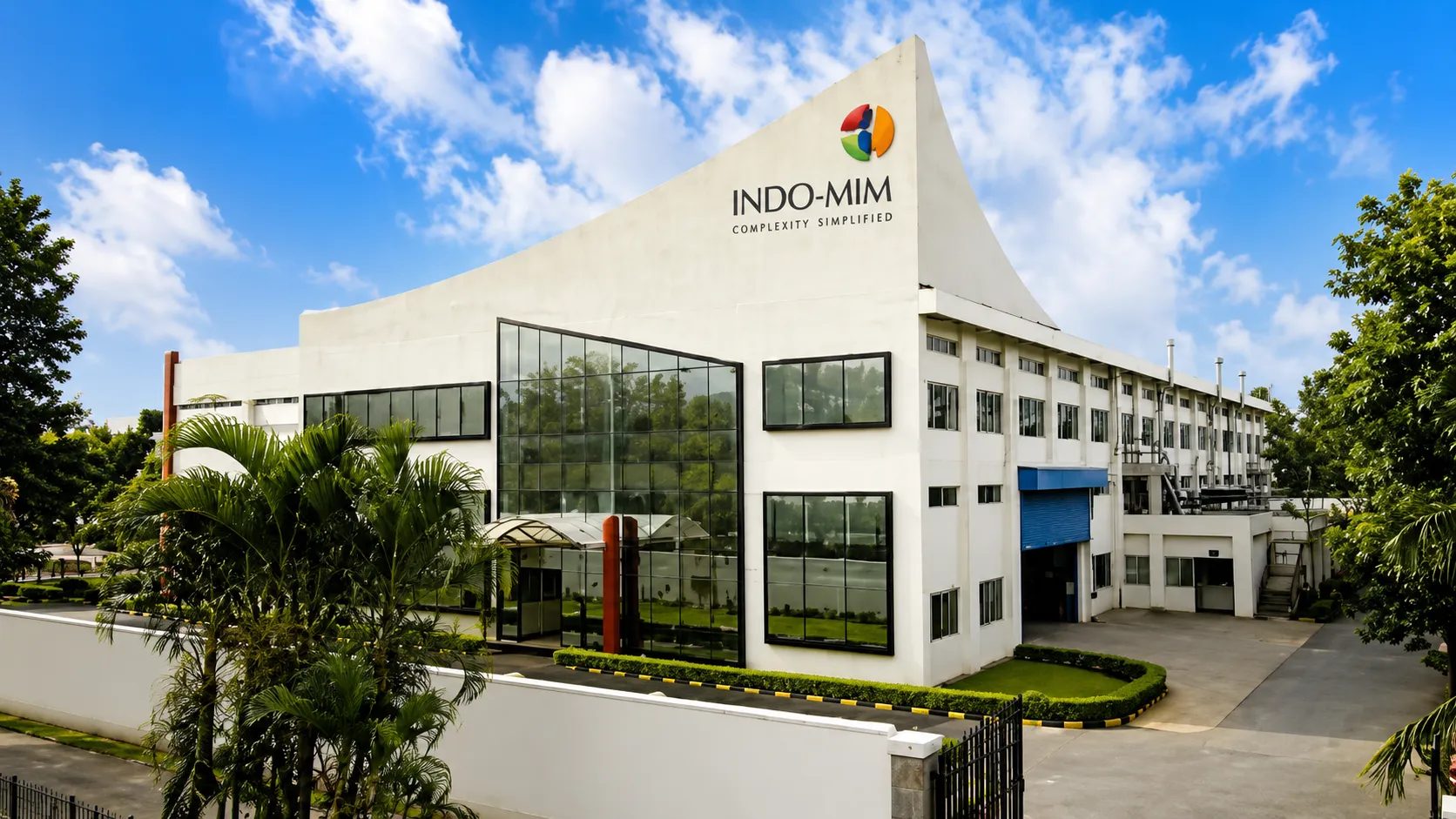
Precision engineering components manufacturer Indo-MIM opens its initial public offering for subscription today, Thursday, July 23, 2026, marking one of the more closely watched primary-market listings of the current earnings season — not necessarily because of the size of the issue, but because of the timing. The company is bringing its public issue to market at a moment when India's benchmark indices are firmly in retreat, the Sensex having shed over 700 points in the previous session alone, foreign institutional investors continuing to sell, and crude-oil-driven inflation worries weighing on overall risk appetite. For any company launching an IPO into that kind of backdrop, the test is not merely whether the underlying business is sound, but whether investors are in a mood to commit fresh capital to a new listing at all. Indo-MIM operates in the specialised world of metal injection moulding, or MIM, a manufacturing process that combines the design flexibility of plastic injection moulding with the material properties of traditional metal components, allowing for the mass production of small, intricate, high-precision metal parts used across a wide range of industries. The company's client base and end markets typically span sectors such as automotive components, medical devices, firearms and defence-adjacent hardware, consumer electronics, and industrial equipment — categories where the ability to produce complex geometries at scale, with tight tolerances and consistent material properties, commands a meaningful pricing premium over more conventional metal-forming techniques like casting or machining. Bengaluru-headquartered, the company has built its business over several years into what industry trackers describe as one of the more globally competitive Indian players in the MIM space, exporting a substantial share of its output to customers in North America and Europe, alongside serving a growing domestic industrial and automotive component market. The decision to price and launch the IPO on July 23 rather than wait for calmer market conditions reflects a calculation that many Indian companies going public have had to make repeatedly through 2025 and 2026: primary-market windows in a volatile macro environment can close as quickly as they open, and issuers with board approvals, regulatory clearances, and merchant banker syndicates already in place often choose to proceed rather than risk a longer delay that could coincide with even worse market conditions, or with a crowded pipeline of competing issues once sentiment does eventually improve. Indo-MIM's management and its book-running lead managers appear to have made that calculation, betting that the company's differentiated, export-oriented manufacturing story will resonate with a specific segment of institutional and retail investors even if the broader market mood remains cautious. The broader context of India's IPO market in 2026 is itself worth unpacking to understand where Indo-MIM's listing fits into the bigger picture. The year has seen a mixed bag of outcomes for new listings, with some issues — particularly those tied to sectors seen as structural growth stories, such as select financial services, consumer, and technology-adjacent businesses — seeing strong demand and healthy listing-day pops, while others have struggled to generate the same enthusiasm, particularly those launched during periods of broader market weakness or FII outflows. Just this week, financial media coverage has highlighted the contrasting fortunes of recently listed names: BlueStone, the jewellery-focused company, saw a dramatic eighteen-fold jump in trading volumes as investors actively traded the counter, while Bharat Coking Coal, another relatively recent listing, has seen its shares give back over 10 per cent of their value on a year-to-date basis as early investors booked profits following a strong initial post-listing rally. That dispersion in outcomes underscores just how selective and outcome-dependent India's current primary market environment has become, with investors increasingly discriminating between businesses they view as durable, differentiated growth stories versus those they see as more opportunistic listings riding a temporary wave of primary-market enthusiasm.
For Indo-MIM specifically, the investment case that the company and its bankers are likely to lean on centres around several pillars: the structural growth in demand for precision-engineered metal components as automotive manufacturers, medical device companies, and industrial equipment makers increasingly favour MIM technology over older manufacturing methods for cost and design-flexibility reasons; the company's established export relationships with customers in developed markets, which provide a degree of revenue diversification and currency exposure that purely domestic-focused manufacturers lack; and the broader narrative around India's growing role as a global manufacturing and component-sourcing hub, a theme that has gained additional momentum through 2025 and 2026 as global supply chains have continued to diversify away from overwhelming concentration in China toward alternative manufacturing bases including India, Vietnam, and Mexico. That said, prospective investors evaluating the issue will also need to weigh several risk factors that are typical of export-oriented, niche industrial manufacturers of this kind. Currency fluctuation risk is one obvious consideration, given the company's substantial exposure to international customers billed in foreign currencies, particularly at a moment when the Indian rupee has been under pressure amid the broader risk-off market environment. Customer concentration risk is another factor worth scrutinising closely in the company's prospectus, as specialised industrial manufacturers of this kind often derive a meaningful share of revenue from a relatively small number of large anchor customers, making the business more sensitive to shifts in any single customer relationship than a more diversified consumer-facing business might be. Additionally, given that a portion of the company's end-market exposure reportedly touches defence-adjacent and firearms-related component manufacturing, some institutional investors — particularly those managing funds with specific environmental, social, and governance mandates that exclude defence and weapons-adjacent exposure — may choose to sit out the issue regardless of the underlying financial merits, a dynamic that can meaningfully affect institutional demand for such offerings. From a broader market-structure perspective, Indo-MIM's listing also serves as something of a live test case for how India's primary market is currently absorbing new supply amid an environment of Q1 FY27 earnings season volatility and persistent foreign investor selling in the secondary market. Merchant bankers and market strategists have been watching closely to see whether domestic institutional investors and retail subscribers step in with sufficient enthusiasm to compensate for what has, in recent weeks, been a noticeably more cautious foreign institutional investor base, which has been net sellers of Indian equities amid the broader risk-off mood driven by rising crude prices and West Asia geopolitical tensions. A strong domestic subscription response to the Indo-MIM issue, even amid otherwise weak secondary-market conditions, would be read as an encouraging signal that India's deepening base of domestic mutual fund and retail investor capital can provide a meaningful cushion for the primary market even when global capital flows turn more cautious — a theme that has been building steadily over the past several years as India's mutual fund systematic investment plan, or SIP, culture has continued to expand participation from smaller towns and cities across the country. Retail investors weighing whether to apply for the Indo-MIM issue will, as with any IPO, need to balance the specific merits of the business against the broader question of whether launching into a weak market environment provides an attractive entry valuation, or whether it instead signals underlying caution about near-term growth prospects that the company and its bankers may have wanted to avoid discussing too explicitly in a stronger market window. Market commentary through the day has generally suggested a "watch closely, don't rush" posture among retail-focused advisory desks, with several counselling investors to pay close attention to subscription levels in the institutional and non-institutional investor categories over the coming two to three days before deciding whether and how much to apply for in the retail category, a fairly standard piece of primary-market advice that nonetheless carries added weight given the choppy broader conditions the issue is navigating.

As trading in the issue gets underway today and continues over the coming days ahead of an eventual stock exchange listing, Indo-MIM's IPO will offer one of the more interesting near-term data points for gauging investor risk appetite in India's current market environment — a genuine test of whether a well-regarded, export-oriented niche manufacturer can successfully raise capital and generate investor enthusiasm even when the broader macro backdrop is working firmly against it. It is worth placing this listing within the longer arc of India's specialised manufacturing sector's relationship with public markets. For years, Indian investors have overwhelmingly gravitated toward listed opportunities in sectors that are easier to intuitively understand — consumer brands, banks, IT services companies, and large-cap industrial names with long public track records. Niche, business-to-business precision manufacturing companies like Indo-MIM have historically found it harder to command the same investor mindshare, not because their underlying economics are necessarily weaker, but because the specialised, technical nature of their end markets makes it more difficult for retail investors in particular to build conviction around the growth story without deeper sector expertise. That dynamic has been slowly shifting over the past few years, however, as India's growing narrative around becoming a global manufacturing and component-sourcing alternative to China has gained mainstream traction, giving companies like Indo-MIM a more accessible growth narrative to present to a broader investor base than might have been possible in earlier market cycles. Grey market premium trends, closely tracked by retail investors ahead of any Indian IPO as an informal, unofficial gauge of expected listing-day performance, will also be watched closely over the subscription period for signs of how the issue is being received outside the formal bidding process. While such grey market indicators are unofficial and can be volatile, sometimes swinging meaningfully based on little more than day-to-day market sentiment, they have historically served as a reasonably useful, if imperfect, leading indicator of listing-day demand for Indian IPOs, and market commentators will likely reference movements in Indo-MIM's grey market premium repeatedly over the coming days as one of several signals used to handicap the eventual listing outcome. The anchor investor allocation process, typically concluded a day or two ahead of the public subscription window opening, also offers an early read on institutional appetite for an issue, with the quality and reputation of participating anchor investors — domestic mutual funds, insurance companies, and foreign institutional investors — often serving as a signal that other market participants use to calibrate their own subscription decisions. Strong anchor book participation, even amid a broader environment of foreign institutional investor selling in the secondary market, would suggest that specific, well-resourced institutional investors see enough differentiated value in Indo-MIM's business model to make a dedicated allocation decision independent of the broader market's cautious mood, a detail that retail investors evaluating the issue over the coming days would do well to factor into their own subscription decisions.
Post-listing performance expectations also merit a word of caution for prospective subscribers. Indian markets have, in recent listing cycles, shown a growing tendency to punish IPOs that debut at aggressive valuations relative to comparable listed peers, even when the underlying business fundamentals are sound, reflecting a broader maturation of India's investor base toward more disciplined, valuation-conscious primary market participation rather than the reflexive listing-day enthusiasm that characterised earlier retail-investor-driven IPO cycles. Whichever way Indo-MIM's issue and eventual listing play out, the episode will add one more meaningful data point to the ongoing conversation about how resilient India's domestic capital-raising ecosystem truly is when tested against genuine external headwinds, rather than the relatively benign market conditions many of 2025's most successful listings enjoyed. Investment bankers advising on the deal have reportedly stressed to prospective anchor and institutional investors that the company's order book visibility and long-term customer contracts provide a degree of earnings predictability that should, in theory, insulate the stock somewhat from the kind of broader index-level volatility currently gripping the secondary market — a pitch that will be tested in real time as subscription numbers roll in over the coming days. Retail investors are advised, as always, to read the red herring prospectus in full and to consult a registered financial advisor before applying, given the sector-specific and customer-concentration risks unique to a specialised industrial manufacturer of this kind. Market watchers will also be tracking the qualified institutional buyer subscription figures closely once bidding concludes, since that category's response is often viewed as the most sophisticated, valuation-sensitive gauge of institutional conviction in an issue, distinct from the sometimes more sentiment-driven retail and high-net-worth individual subscription categories.