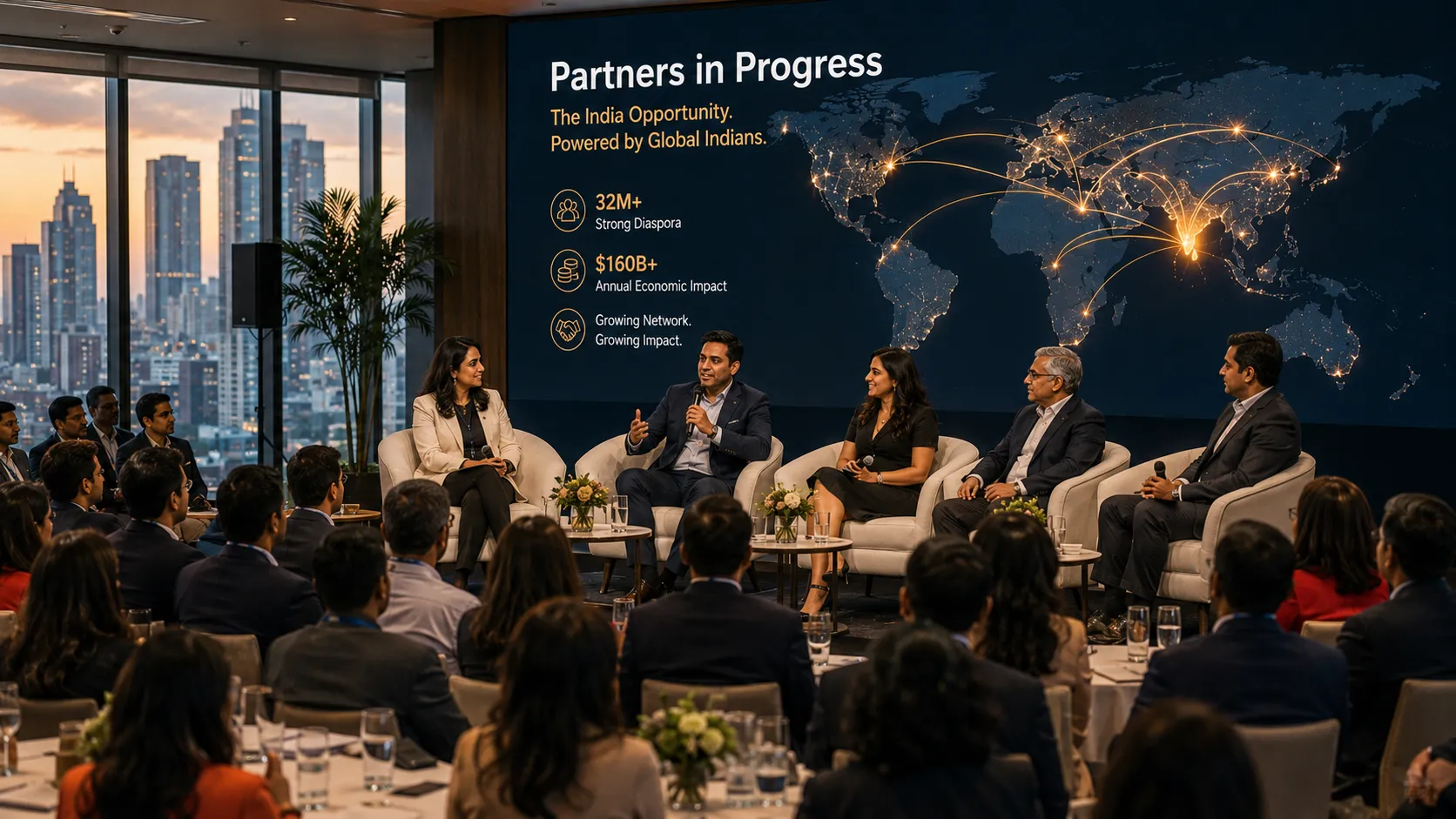
San Francisco, March 23, 2026: Indiaspora released a report that should be required reading for every person of Indian heritage who holds capital, expertise, or influence anywhere in the world. India and its Diaspora: Partners in Progress is the most comprehensive assessment ever published of the global Indian diaspora's expanding role in shaping India's future. It arrives as the diaspora completes its most consequential transition: from a source of remittances to a multi-dimensional force of capital, capability, and credibility helping accelerate India's rise toward its India@100 vision.

The foundational numbers are staggering. More than 35 million people of Indian heritage live in over 200 countries. Their estimated annual income is $730 billion. The Indian diaspora is not only the largest in the world — it is also one of the most economically successful, with disproportionate representation in the highest-income, highest-influence professional categories in every country where it has significant presence. In the United States, Indian Americans are disproportionately represented among tech founders, executives, medical professionals, academics, and philanthropists. In Singapore, the Indian community has influenced commerce, law, and governance across generations.
The most structurally significant finding is the transition in how diaspora capital flows into India. Traditional remittances hit a record $138 billion in 2026. But these flows are increasingly supplemented by direct venture capital investment, startup co-founding, angel networks, and fund management. The diaspora has fundamentally transitioned from passive remitters to active venture capitalists, accelerating India's emergence as a premier global startup hub. The Indiaspora Founders Circle — including figures like Muktesh (Micky) Pant, Dr. Dev Joneja, and Anil Bansal — represents the organised version: diaspora leaders writing cheques and actively mentoring founders.
The 2026 Indiaspora Forum aimed to deepen engagement across sectors ranging from business and innovation to culture and philanthropy. Shoba Viswanathan, Indiaspora's EVP and Chief Engagement Officer, described the goal as bringing together individuals 'not only successful, but also motivated to collaborate, shape policy, and contribute meaningfully on a global scale — a collective force for good.' This framing captures something important about the diaspora's 2026 posture: it is no longer simply exporting talent. It is beginning to operate as a coordinated force with the scale to genuinely accelerate national development.
The report also identifies the most significant structural constraint: the absence of a comprehensive, actionable database matching specific expatriate expertise with domestic industrial need. Unlike Taiwan, which has systematically integrated its expatriate engineers into its semiconductor industry, India's diaspora engagement remains largely event-driven. The June 5 RBI investment relaxations address the capital dimension of this gap. The expertise dimension remains the more complex and more valuable challenge to solve.

For the readers of The Impactful Global Indian — by definition people living at the intersection of Indian heritage and global ambition — the Indiaspora report is both a mirror and a map. A mirror reflecting the extraordinary scale of what the global Indian community has achieved. A map charting the territory of what is still possible if that achievement is directed, with intentionality, toward India's development. The $730 billion in annual diaspora income is a number worth sitting with. India's GDP is approximately $4 trillion. The diaspora's annual income is nearly 20% of that — deployed with the right policy environment, it could be transformative.