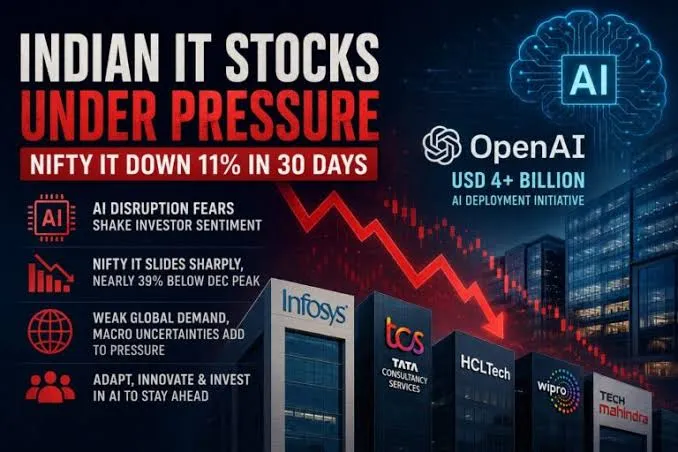
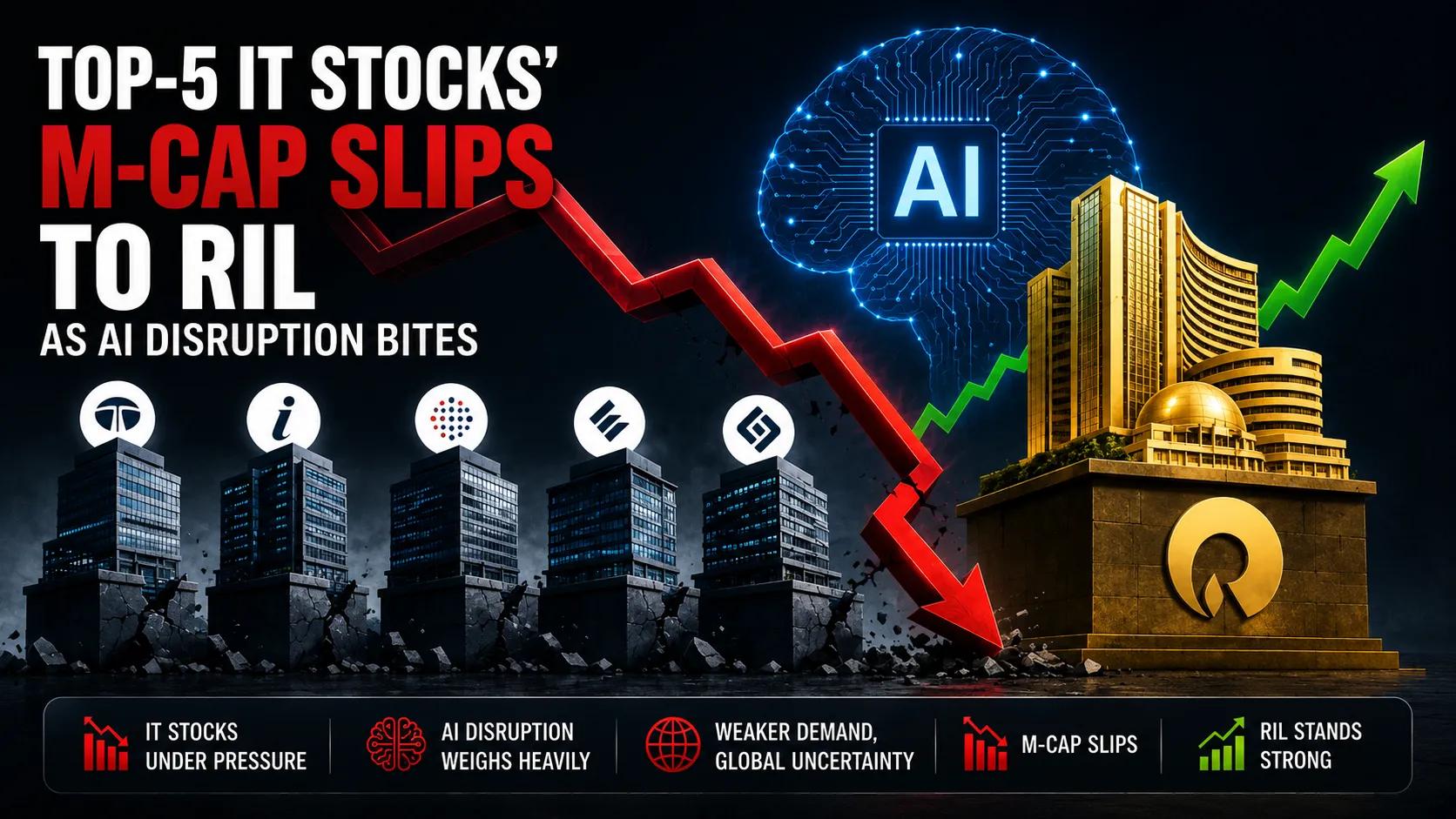
Mumbai: India's top five information technology services companies have collectively shed more than 46 percent of their combined market capitalisation since reaching record levels in August 2024, a decline that has brought their combined valuation down to approximately ₹18.15 lakh crore, a figure now roughly comparable to the standalone market capitalisation of Reliance Industries, India's single most valuable listed company. The scale of this valuation compression across Tata Consultancy Services, Infosys, Wipro, HCL Technologies, and Tech Mahindra represents one of the more significant sector-wide re-ratings witnessed in Indian equity markets in recent years, reflecting a fundamental reassessment by investors of the sector's growth prospects amid a rapidly evolving global technology services landscape.
The combined market capitalisation of these five companies had peaked at approximately ₹33.71 lakh crore in August 2024, meaning the current level represents a decline of more than fifteen lakh crore rupees in absolute terms, a staggering figure that underscores just how significantly investor sentiment toward India's historically dominant IT services export sector has shifted over the intervening period. This decline has occurred even as several of these companies have continued to report positive, if modest, revenue and profit growth, highlighting that the market's reassessment has been driven substantially by concerns about future growth trajectory rather than purely by current period financial performance.
THE ARTIFICIAL INTELLIGENCE DISRUPTION NARRATIVE
At the core of this sustained valuation compression lies growing investor concern about how artificial intelligence-driven changes to enterprise technology spending patterns are reshaping demand for the kind of traditional, labour-intensive technology services that have historically formed the backbone of Indian IT companies' business models. As enterprises worldwide increasingly explore and adopt AI-powered tools capable of automating tasks that previously required substantial human resource deployment, ranging from software testing and maintenance to certain categories of application development and business process outsourcing, the fundamental demand equation for traditional IT services delivery has come under sustained pressure.
Brokerages covering the sector have pointed to this dynamic as a structural, rather than purely cyclical, challenge facing Indian IT companies, distinguishing it from previous periods of sector weakness that were more directly tied to macroeconomic cycles in key client markets like the United States and Europe. This structural framing has proven particularly consequential for how investors have chosen to value the sector, given that structural challenges typically warrant more sustained valuation multiple compression compared to cyclical downturns, which markets have historically been more willing to look through given expectations of eventual recovery once the underlying macroeconomic cycle turns favourable again.
ANALYST COMMENTARY ON SPENDING SHIFTS
Multiple global and domestic brokerages tracking the sector have noted that spending on AI tokens and cloud infrastructure is increasingly taking share away from traditional technology services demand, a dynamic that has been further reinforced by commentary from global technology consulting peers, including Accenture, whose own results and management commentary have added to broader market concerns about the pace and durability of any eventual recovery in enterprise technology services spending. This convergence of concerning signals from multiple angles, spanning both Indian IT companies' own results and broader industry commentary from global peers, has reinforced the bearish narrative that has weighed on sector valuations throughout the current period.
Specific brokerage assessments have highlighted that the sector remains effectively stuck at a relatively modest two to three percent annual revenue growth rate over the trailing three-year period, a pace considerably below the double-digit growth rates that characterised the sector during earlier, more favourable periods of its multi-decade growth history. This persistently subdued growth trajectory has led several analysts to explicitly caution that recovery prospects for the sector remain genuinely unclear, even as individual companies have periodically offered more optimistic forward guidance during their own quarterly earnings announcements.
THE Q1 FY27 EARNINGS CONTEXT
This broader valuation compression narrative provides important context for how markets have reacted to the sector's June quarter results, with TCS's own Q1 FY27 numbers showing consolidated net profit that, while representing a modest year-on-year increase, actually declined on a sequential basis compared to the preceding quarter, illustrating the continued challenging demand environment even for the sector's largest and most diversified player. Management commentary accompanying these results has generally struck a cautiously optimistic tone regarding demand improvement expected in the coming quarters, even as brokerages have, in several cases, expressed scepticism about the pace and magnitude of any such recovery given the structural nature of the AI-driven disruption discussed above.
This tension between somewhat more optimistic management guidance and more cautious analyst assessments has become a recurring feature of how the market has processed each successive quarter's results from India's major IT companies, with the ultimate resolution of this tension likely to play a significant role in determining whether the sector's valuation begins to stabilise and potentially recover, or whether further compression remains likely as the market continues digesting the full implications of the ongoing AI-driven transformation of the global technology services landscape.
COMPARISON WITH RELIANCE INDUSTRIES
The comparison between the combined market capitalisation of India's top five IT companies and the standalone valuation of Reliance Industries carries particular symbolic significance within Indian equity market circles, given that TCS specifically had, at various points over the preceding decade, competed closely with Reliance for the position of India's most valuable listed company. The current situation, wherein the combined value of five major IT companies together barely matches the valuation of Reliance alone, represents a dramatic reversal of fortune that vividly illustrates the scale of the sector-wide re-rating that has occurred, even as Reliance itself has also experienced periods of valuation correction over the same broader timeframe, with its own market capitalisation having declined by approximately 16.7 percent from its own peak levels reached around the same period in 2024.
This comparative context underscores that while Reliance has also faced its own valuation headwinds over the period, the scale and severity of the decline experienced by the IT sector has been considerably more pronounced, reinforcing the narrative of a genuine, sector-specific reassessment occurring within India's technology services industry, distinct from the more general market volatility that has affected virtually all sectors amid the broader macroeconomic uncertainty characterising 2026.
IMPLICATIONS FOR INDIA'S BROADER SERVICES EXPORT NARRATIVE
Beyond its direct implications for IT sector investors, this sustained valuation compression carries broader significance for India's overall economic narrative, given the historically outsized role that information technology services exports have played in India's foreign exchange earnings, employment generation, particularly for the country's substantial pool of engineering graduates, and broader positioning as a global services hub. Any sustained structural challenge to this sector's growth trajectory carries implications that extend well beyond equity market valuations, touching on broader questions about employment trends within India's technology workforce and the sector's continued contribution to the country's overall economic growth and export earnings.
Policymakers and industry bodies have, in response to these emerging challenges, increasingly emphasised the importance of Indian IT companies successfully pivoting toward higher-value AI and digital transformation consulting services, rather than remaining overly reliant on traditional, more easily automated service delivery models, viewing this transition as essential to the sector's long-term competitiveness and growth prospects in an industry landscape being fundamentally reshaped by the same artificial intelligence technologies that have, in the near term, contributed to the current period of sustained valuation pressure.
INVESTOR POSITIONING GOING FORWARD
For investors evaluating exposure to India's IT services sector amid this sustained valuation compression, the central question revolves around whether current valuations, having already declined so substantially from 2024 peaks, now adequately reflect the sector's more challenging growth outlook, potentially presenting an attractive entry point for longer-term investors willing to look through near-term uncertainty, or whether further downside risk remains given the continued lack of clarity around the pace and scale of any eventual demand recovery. This debate has become increasingly central to portfolio allocation discussions among both domestic and international institutional investors covering Indian equities, with views varying considerably based on individual analysts' assessment of how quickly and successfully the sector's major players can adapt their business models to the new AI-influenced competitive landscape.
HISTORICAL PRECEDENT: HOW THE SECTOR HAS NAVIGATED PREVIOUS DISRUPTIONS
India's IT services sector has, over its multi-decade history, successfully navigated several previous periods of significant technological and business model disruption, including the transition from mainframe-era computing to client-server architectures, the emergence of cloud computing as an alternative to traditional on-premise IT infrastructure, and the broader shift toward agile and DevOps-based software development methodologies. In each of these previous instances, the sector's major players ultimately demonstrated an ability to adapt their service offerings and business models to capture value from the emerging technology paradigm, even as each transition initially generated similar investor anxiety about the potential for disruption to threaten the sector's established competitive position.
This historical pattern of successful adaptation offers some basis for cautious optimism among longer-term investors regarding the sector's ability to similarly navigate the current AI-driven transformation, even as most analysts acknowledge that the current disruption carries certain distinct characteristics, including the potential for AI to directly automate substantial categories of billable services work in a manner that previous technology transitions did not replicate to the same degree, making direct historical comparisons an imperfect guide to how the current transition will ultimately unfold.
EMPLOYEE WORKFORCE IMPLICATIONS
Beyond its direct implications for company valuations and investor returns, the ongoing AI-driven transformation of India's IT services sector carries significant implications for the substantial workforce employed across the industry, with several major companies having already signalled more measured hiring plans compared to previous years, alongside continued emphasis on reskilling existing employees toward higher-value AI and digital transformation-related capabilities. This workforce transition represents one of the more consequential, if less immediately visible to equity market participants, dimensions of the broader structural change currently reshaping India's technology services industry, carrying implications that extend well beyond the immediate concerns of equity investors to touch the livelihoods of millions of technology professionals across the country.
VALUATION MULTIPLE COMPRESSION IN DETAIL
The sustained decline in the combined market capitalisation of India's top five IT companies has been driven substantially by valuation multiple compression, meaning investors are now willing to pay considerably less per unit of earnings or revenue for IT services companies compared to the multiples that prevailed during the sector's 2024 valuation peak. This multiple compression reflects the market's reassessment of appropriate growth and risk assumptions for the sector, with price-to-earnings ratios across several major IT companies having declined meaningfully from their previous levels, even as absolute earnings for most companies in the cohort have continued to grow, albeit at a considerably more modest pace than historical norms.
This distinction between earnings growth and valuation multiple trends is an important one for investors to understand, as it clarifies that the sector's substantial market capitalisation decline reflects primarily a reassessment of the multiple investors are willing to assign to a given level of earnings, rather than an outright collapse in the underlying earnings themselves, a nuance that carries meaningful implications for how investors might think about the sector's potential for valuation recovery should sentiment eventually improve, even without a dramatic acceleration in underlying revenue growth.
For now, India's IT services sector finds itself at something of a crossroads, with the ultimate direction of both its business fundamentals and market valuation likely to depend substantially on how effectively its major players can navigate the ongoing AI-driven transformation over the coming several years.
DEAL PIPELINE AND BOOKINGS AS A FORWARD INDICATOR
Beyond quarterly revenue and margin figures, analysts increasingly emphasise total contract value bookings and deal pipeline commentary as a more forward-looking indicator of the sector's eventual growth trajectory, given the typically extended lag between deal signing and actual revenue recognition that characterises large, complex technology services engagements. Several major IT companies have, through recent quarters, reported relatively healthy total contract value figures even as actual revenue growth has remained subdued, a divergence that some analysts interpret as an encouraging signal of eventual growth acceleration once these signed deals progress through their implementation and ramp-up phases, while others caution that the composition of these deals, including a growing proportion tied to cost-takeout and efficiency-focused engagements rather than growth-oriented digital transformation initiatives, may not translate into revenue growth at the same rate that similarly-sized deal bookings would have generated in previous years.
SHAREHOLDER RETURNS AND CAPITAL ALLOCATION AMID THE DOWNTURN
Even as their core business growth has slowed, most major Indian IT companies have continued to maintain relatively generous shareholder return policies, including substantial dividend payouts and share buyback programmes, reflecting their typically strong balance sheets and cash generation capabilities even during periods of subdued revenue growth. This continued emphasis on shareholder returns has provided some degree of support for investor sentiment even amid the broader valuation compression discussed throughout this analysis, offering income-focused investors a degree of consolation even as capital appreciation prospects have remained constrained by the sector's ongoing growth challenges.