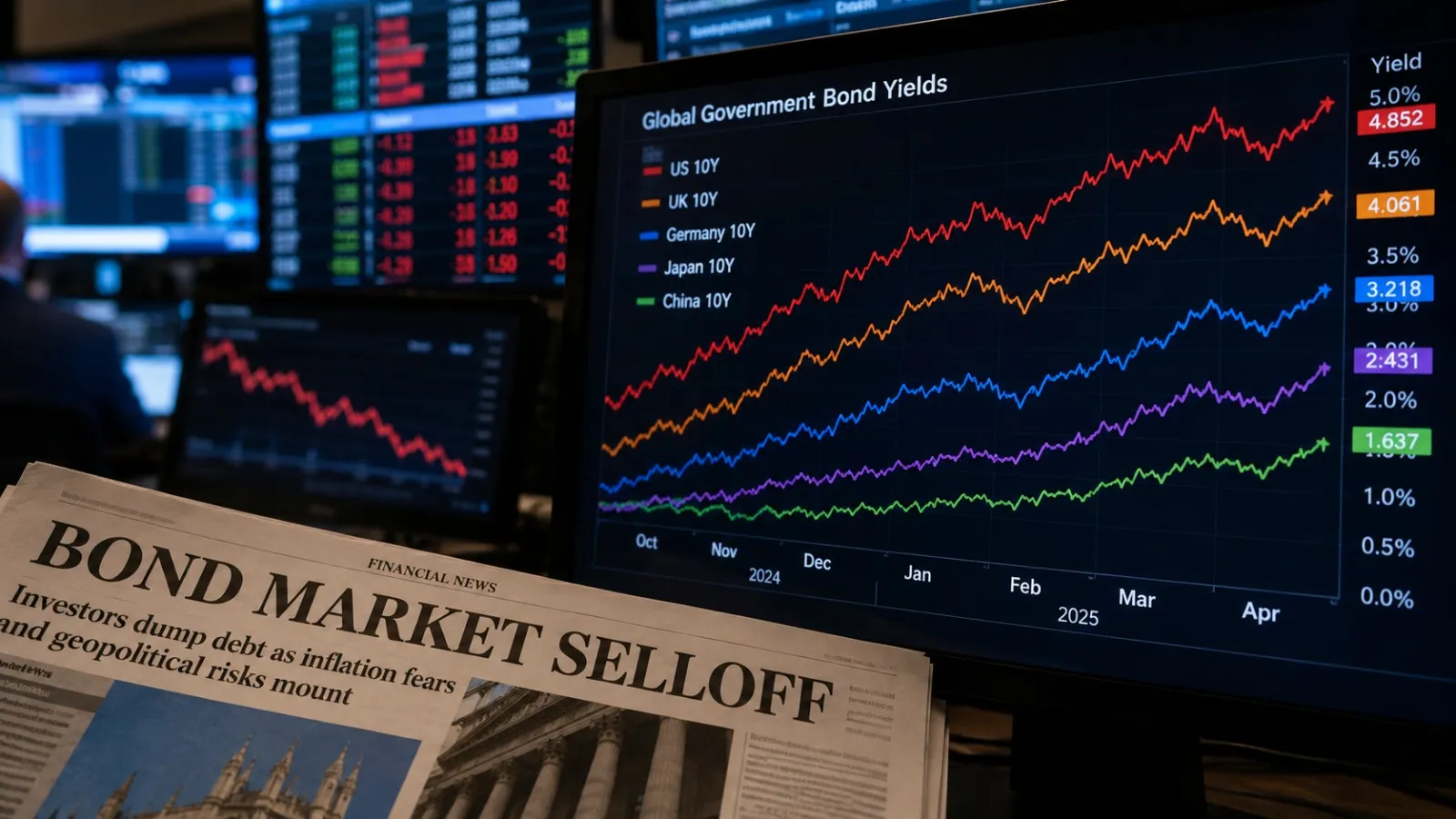
India's government bond market is bracing for a genuinely volatile stretch of trading, with fixed income strategists projecting that yields on the benchmark 10-year government security could swing within a wide 6.70 to 6.85 per cent range over the coming sessions as investors weigh a complex and, in places, contradictory set of forces. On one side sits the increasingly familiar story of crude-oil-driven inflation risk, with Brent prices above $90 a barrel raising fears of imported inflation feeding through into the broader economy; on the other sits a steady and continuing wave of foreign capital inflows tied to India's landmark inclusion in major global bond indices, a structural tailwind that has been quietly reshaping the demand dynamics of India's sovereign debt market over the past several years.
This tug-of-war between a near-term inflationary headwind and a longer-term structural demand tailwind has left bond market participants describing the current environment as one of the more genuinely two-sided periods in recent memory, with the ultimate direction of yields likely to hinge on which of these two forces proves dominant in the days and weeks immediately ahead.
The stakes of this particular tug-of-war extend well beyond the trading desks that most directly monitor government bond yields on a daily basis, given how directly movements in India's benchmark sovereign yield curve feed through into borrowing costs across the broader economy — from corporate debt issuance to, ultimately, the mortgage and consumer loan rates that shape household borrowing decisions across the country.
Market participants describe the current setup as unusually finely balanced, noting that neither the inflationary headwind nor the index-inclusion tailwind is currently strong enough to decisively overwhelm the other, leaving the bond market in a genuinely data-dependent posture where each new piece of information — on crude prices, on inflation, or on foreign inflows — has the potential to meaningfully shift near-term positioning.
The Inflation Side Of The Equation
India's retail inflation had already climbed above the Reserve Bank of India's medium-term target of 4 per cent in the most recent reading available prior to the latest crude price spike, a development that had already begun to complicate the more dovish rate-path narrative several brokerages had been building through earlier parts of the year. The subsequent, sharp escalation in the US-Iran conflict, and the accompanying surge in Brent crude prices past $90 a barrel, has added a fresh and significant layer of upside inflation risk, given the direct pass-through from global energy prices into India's domestic fuel, transportation and broader consumer price indices.
Some brokerages, including Capital Economics and ICICI Securities Primary Dealership, have specifically flagged the possibility of renewed rate hike action from the Reserve Bank of India later in the year should this inflationary pressure prove persistent rather than transient, a marked shift from the more benign inflation outlook that had prevailed for much of the preceding several months, when several analysts had instead been debating the timing of potential future rate cuts rather than hikes.
The Index Inclusion Tailwind
Working in the opposite direction, India's bond market continues to benefit from a powerful structural tailwind tied to the country's ongoing inclusion in major global emerging market debt indices, a process that has been unfolding in phases over the past couple of years and has driven substantial, sustained foreign portfolio inflows into Indian government securities. Foreign investors have net purchased more than $4.3 billion of Indian bonds over a recent seven-week stretch alone under the country's fully accessible route for foreign investment in government debt, flows that reflect the passive, index-tracking capital that is mechanically required to flow into Indian bonds as the country's weighting within these benchmark indices has progressively increased.
Bloomberg Index Services has indicated it will make its next announcement regarding further potential India-related index adjustments in the middle of the year, a development that fixed income strategists say could serve as an additional catalyst for further inflows, adding a further layer of anticipation to an already closely watched market dynamic. This index-driven demand represents a structurally different, and generally considerably more stable, source of foreign capital than the more tactical, sentiment-driven foreign equity flows that have shown greater volatility through the recent period of geopolitical and market stress.
How Fixed Income Strategists Are Positioning
Given this genuinely two-sided setup, fixed income desks at India's major banks and asset management firms have broadly converged on a strategy of expecting continued intraday and week-to-week volatility within the current yield range, rather than committing to a strong directional call in either direction until greater clarity emerges on both the trajectory of the US-Iran conflict and its impact on crude prices, and the pace of further index-inclusion-related foreign inflows. Canara Robeco Mutual Fund's chief investment officer for fixed income has been among the strategists publicly noting that continued intraday trading within the current range, with index-inclusion developments acting as a key directional trigger, is the most likely near-term scenario for the market.
This wait-and-watch positioning reflects a broader recognition among fixed income market participants that the current environment features two powerful, genuinely opposing forces of comparable near-term magnitude, making high-conviction directional bets considerably riskier than they might be in a more one-directional market environment.
The RBI's Delicate Balancing Act
For the Reserve Bank of India's monetary policy committee, the current environment presents a genuinely difficult balancing act between two competing considerations: the need to guard against a renewed bout of imported inflation tied to elevated global oil prices, and the desire to avoid tightening monetary policy prematurely in a way that could dampen India's still-recovering growth momentum or create unnecessary friction with the favourable foreign capital inflow dynamics currently supporting the bond market.
Central bank watchers note that the RBI has, over recent policy cycles, generally sought to look through temporary, geopolitically-driven inflation shocks where possible, rather than reacting reflexively to every short-term spike in headline inflation figures. Whether this more patient posture remains appropriate will likely depend heavily on how persistent the current crude-oil-driven inflation pressure proves to be over the coming weeks, and specifically on whether the ongoing US-Iran conflict shows credible signs of de-escalation that could allow oil prices to retreat from their current elevated levels.
Corporate Bond Market Spillover Effects
The volatility in government bond yields has also begun to show signs of spilling over into India's corporate bond market, where borrowing costs for both financial and non-financial issuers are typically priced with reference to the sovereign yield curve. Corporate treasurers planning debt issuances in the coming weeks are understood to be watching the government bond market's next moves closely, with several issuers reportedly weighing whether to accelerate planned bond issuances to lock in current borrowing costs before any further potential upward movement in yields, or to delay issuance in the hope that yields ease as the current bout of volatility eventually subsides.
This kind of corporate issuance timing sensitivity is a familiar pattern during periods of elevated government bond market volatility, and treasury advisory firms say they have seen a modest uptick in client inquiries specifically focused on debt issuance timing strategy over the past several sessions, reflecting the practical, real-economy implications of the current bond market uncertainty extending well beyond the trading desks that most directly monitor government security yields on a minute-to-minute basis.

How Retail Bond Investors Are Affected
While government bond market volatility of this nature is most directly relevant to institutional participants — banks, mutual funds, insurance companies and foreign portfolio investors — it also carries meaningful, if less immediately visible, implications for retail investors, particularly those holding fixed income mutual funds, whose net asset values move inversely with bond yields. A period of sustained yield volatility of the kind currently unfolding can therefore translate into more volatile returns for retail investors holding debt mutual fund schemes, even those investors who may not directly follow day-to-day government bond market movements.
Financial advisors have, through this period, generally counselled fixed income mutual fund investors to focus on their own investment time horizon rather than reacting to short-term net asset value fluctuations, noting that longer-duration debt funds, in particular, tend to experience more pronounced short-term volatility during periods like the present one, even as their longer-term return profile remains tied primarily to the average yield levels prevailing over the full holding period rather than any single period of heightened volatility.
How Banks And Insurers Are Positioned
India's banks and insurance companies, which collectively hold substantial portfolios of government securities both as regulatory requirements and as core investment holdings, represent another important category of market participant closely monitoring the current bout of yield volatility. For banks specifically, movements in government bond yields directly affect the mark-to-market valuation of their statutory liquidity ratio holdings, a dynamic that can have a meaningful, if generally well-managed, impact on quarterly treasury income depending on the specific direction and magnitude of yield movements during any given reporting period.
Insurance companies, which typically hold longer-duration government bonds to match their long-term policyholder liabilities, are generally somewhat less sensitive to short-term yield volatility given their longer investment horizons, though sustained shifts in the yield curve can still meaningfully affect their asset-liability matching strategies and, over time, the pricing of new insurance products tied to prevailing interest rate levels.
Pension funds and provident fund managers, who similarly hold substantial long-duration government bond allocations on behalf of millions of Indian retirement savers, represent a further important category of institutional holder for whom sustained yield volatility carries direct, if generally gradual and long-horizon, implications for retirement corpus valuations and, ultimately, the returns delivered to India's broader retirement savings ecosystem.
A Global Context For India's Bond Market Story
India's current bond market dynamics are unfolding against a broader global backdrop in which several major emerging market economies are simultaneously navigating their own versions of this same tension between near-term inflation risk and longer-term structural capital inflow trends, driven by a broadly similar combination of elevated global energy prices and shifting developed-market monetary policy expectations. This shared global context means that India's bond market performance through the current period is likely to be watched closely by international investors as something of a bellwether for how well-positioned emerging market debt more broadly is to weather the current combination of geopolitical and monetary policy headwinds.
Analysts note that India's specific combination of a large, increasingly liquid domestic government bond market, a credible and independent central bank with a well-established inflation-targeting track record, and now, the structural tailwind of global index inclusion, gives the country a somewhat differentiated positioning relative to several emerging market peers navigating the current environment with less developed domestic capital markets or less established monetary policy credibility.

The Mechanics Of How Index Inclusion Flows Work
For readers less familiar with the technical mechanics, index inclusion works through a comparatively straightforward, if consequential, process: when a major bond index provider adds a country's sovereign debt to one of its widely tracked benchmark indices, the large pool of global institutional capital that passively tracks that index — through index funds, exchange-traded funds and institutional mandates benchmarked against the index — is mechanically required to purchase a proportional allocation of that country's bonds, generating sustained, largely price-insensitive buying pressure that unfolds over the specific phase-in period the index provider designates.
This mechanical, structural nature of index-inclusion-driven demand is precisely why fixed income strategists view it as a fundamentally different and more stable category of foreign inflow than the more tactical, sentiment-driven foreign portfolio flows into Indian equities, which can reverse quickly in response to shifting risk appetite. Bond index inflows, by contrast, tend to continue flowing in on a broadly predictable schedule tied to the index provider's own inclusion timetable, largely independent of near-term market sentiment swings of the kind currently being driven by the US-Iran conflict and its associated oil price shock.
What Comes Next
With both the crude-oil-and-geopolitics narrative and the ongoing bond index inclusion story likely to remain live through the coming weeks, fixed income strategists broadly expect the current elevated volatility in Indian government bond yields to persist for some time, with the specific direction of any sustained move likely to be determined by whichever of these two competing forces gains the upper hand in the period ahead.
For now, market participants across both the government and corporate bond markets appear to be settling into a posture of heightened vigilance rather than strong directional conviction, a stance that reflects the genuinely unusual combination of simultaneous inflationary and structural-demand forces currently shaping one of the more closely watched corners of India's broader financial markets.