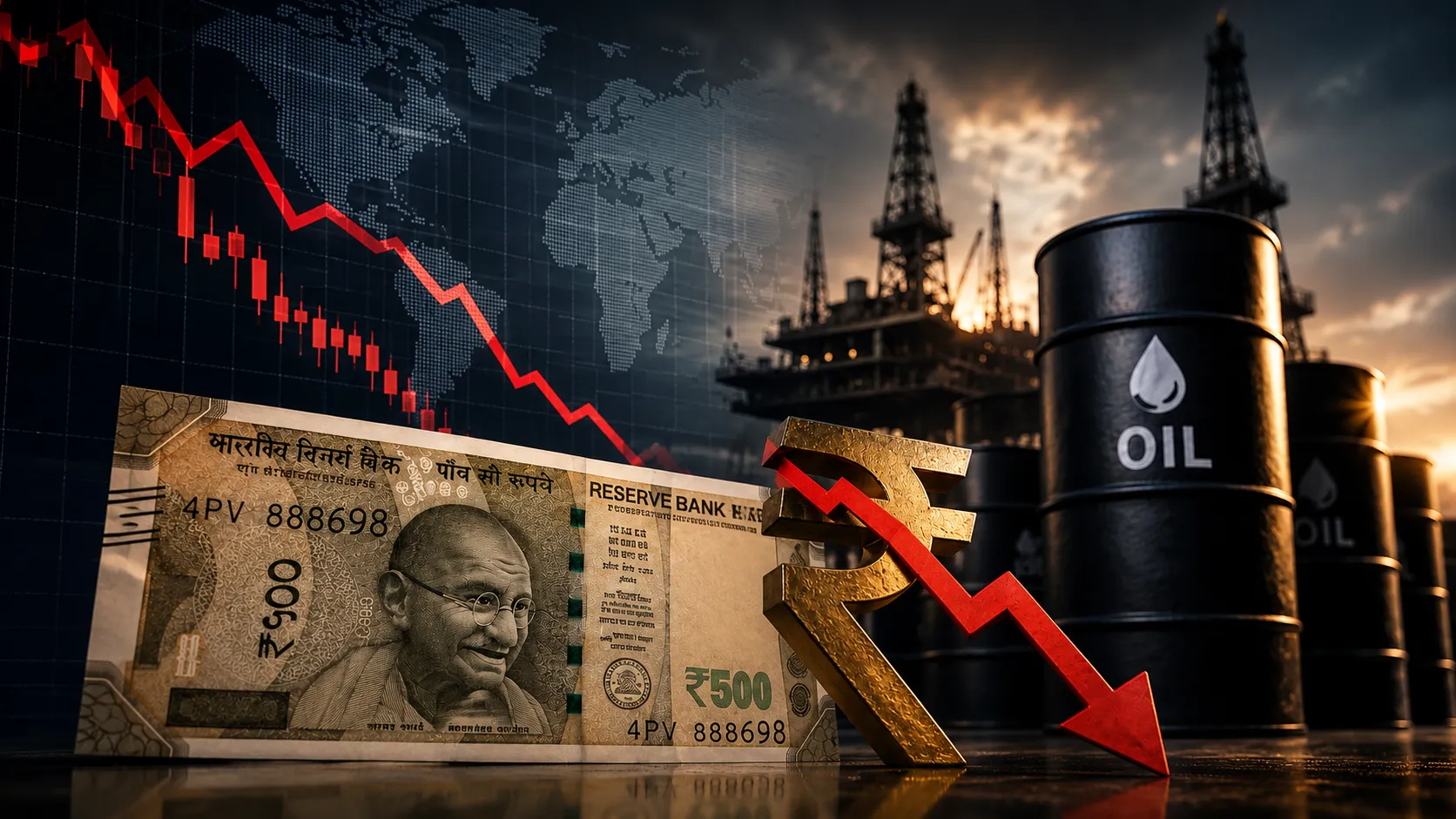
The Indian rupee has continued to trade on the back foot against the US dollar, weighed down by a combination of forces that currency strategists describe as an unusually challenging simultaneous squeeze: a broadly strengthening US dollar, driven by shifting Federal Reserve rate expectations, on one side, and elevated global crude oil prices, driven by the escalating US-Iran conflict, on the other. The domestic currency has struggled to hold onto even modest gains through recent sessions, trading weaker in line with a broader basket of Asian currencies that have similarly come under pressure from this same combination of global forces.
This dual-pressure dynamic represents a particularly difficult environment for the rupee to navigate, given that the two forces reinforce rather than offset one another: a stronger dollar makes all dollar-denominated imports, oil prominent among them, more expensive in rupee terms, while simultaneously elevated crude prices independently widen India's import bill and current account deficit — a combination that leaves the currency exposed to pressure from multiple directions simultaneously rather than facing a single, more manageable headwind.
Currency traders describe the current environment as one requiring particularly close, near-continuous monitoring, given how quickly sentiment can shift based on incremental developments on either the Gulf conflict front or incoming US economic data that could further reshape Federal Reserve rate expectations, leaving the rupee's near-term trajectory unusually sensitive to headline risk from multiple, largely unrelated sources simultaneously.
Currency desks at India's major banks have reported a noticeable pickup in client inquiries around hedging strategy in recent sessions, a pattern consistent with the broader uncertainty currently characterising the rupee's near-term outlook and one that underscores how directly this currency volatility is being felt across India's broader corporate and financial sector.
Breaking Down The Dual Pressure
On the dollar-strength side of the equation, a widely tracked probability gauge for a US Federal Reserve interest rate hike in September has climbed meaningfully in recent days, following hawkish commentary from a senior Federal Reserve official suggesting borrowing costs may need to stay elevated for longer to combat inflation risk reignited by the recent oil price spike. Higher US rate expectations typically strengthen the dollar broadly, as global capital gravitates toward higher-yielding dollar-denominated assets, drawing liquidity away from emerging market currencies including the rupee.
On the oil side, Brent crude's climb past $90 a barrel, driven by escalating military tensions between the United States and Iran, has directly raised the cost of India's single largest import category, given the country's dependence on imported crude for close to 90 per cent of its total oil requirements. This combination — a stronger dollar making imports costlier in relative terms, and oil prices themselves rising in absolute terms — has left the rupee facing what currency desks describe as a genuinely compounding, rather than merely additive, source of pressure.
Currency analysts note that this specific combination of simultaneous dollar strength and oil-driven pressure is comparatively rare, since the two forces do not always move in tandem — a period of dollar weakness, for instance, has at times historically helped cushion the rupee even amid elevated oil prices, a natural offsetting mechanism that is notably absent from the current environment.
How The RBI Has Historically Responded
The Reserve Bank of India has, over past episodes of similar currency pressure, employed a range of tools to manage excessive rupee volatility, including direct intervention in the spot and forward currency markets through the sale of dollar reserves, adjustments to banking system liquidity conditions, and, on occasion, more targeted measures aimed at specific categories of capital flows. India's substantial foreign exchange reserve position, built up over several years of careful reserve management, provides the central bank with meaningful firepower to smooth excessive currency volatility without needing to defend any specific rupee level in an unsustainable manner.
Market participants note that the RBI has, in recent policy communications, generally emphasised a preference for managing currency volatility rather than targeting any specific exchange rate level, a stance consistent with the central bank's broader, longer-standing approach of allowing the rupee to find its market-driven level over time while smoothing excessive short-term volatility that could otherwise destabilise broader financial market conditions.
The Forward Premium Market's Signal
India's currency forward market, where market participants transact in contracts for future rupee-dollar exchange rates, has also been closely watched by traders as an additional signal of market expectations for the currency's trajectory. Forward premiums — the difference between spot and forward exchange rates — have shown some widening in recent sessions, reflecting elevated near-term uncertainty and a market that is pricing in continued rupee softness over the coming weeks, consistent with the broader combination of dollar strength and oil-driven pressure currently weighing on the currency.
Corporate treasurers managing dollar-denominated payables and receivables have reportedly stepped up hedging activity through this forward market in recent sessions, seeking to lock in exchange rates before any further potential rupee depreciation, even at the cost of paying elevated forward premiums given the currently heightened volatility priced into these contracts.
How Different Sectors Are Affected
A weaker rupee carries meaningfully different implications for different segments of India's corporate sector. Import-dependent businesses, particularly those in sectors such as aviation, chemicals and oil marketing that rely heavily on dollar-denominated raw material or fuel purchases, face direct cost pressure from a weaker currency, a dynamic that compounds the separate cost pressure many of these same sectors are already facing from elevated global crude oil prices.
Conversely, export-oriented sectors that earn a substantial share of revenue in dollars, including information technology services, pharmaceuticals and certain segments of textiles and engineering exports, generally benefit from rupee weakness, since the same dollar revenue translates into a larger rupee amount when converted, providing a partial, if incomplete, offsetting benefit within the broader Indian corporate sector even as the overall economy navigates the challenges of a weaker currency.
Comparing The Rupee To Regional Peers
Currency strategists tracking the broader Asian currency complex note that the rupee's recent weakness has not occurred in isolation, with several other major regional currencies also facing similar pressure from the combination of dollar strength and elevated oil prices. This shared regional weakness offers some useful context for interpreting the rupee's specific performance, suggesting that at least part of the currency's recent softness reflects broader emerging-market and Asian currency dynamics rather than factors specific to India's own economic fundamentals.
Even so, analysts caution that India's specific vulnerability to oil price shocks, given its heavy reliance on imported crude, means the rupee can, at times, underperform some regional peers with less direct oil price sensitivity during periods of Gulf-driven crude price volatility of the kind currently unfolding, a dynamic that makes the rupee a particularly closely watched barometer for how markets are pricing India-specific risk within the broader emerging Asia currency complex.
Inflation And Import Bill Implications
Beyond its direct market implications, sustained rupee weakness carries meaningful knock-on effects for India's broader inflation outlook, given how directly currency depreciation feeds into the domestic price of imported goods, oil prominent among them. This dynamic adds a further layer of complexity to the Reserve Bank of India's monetary policy calculus at a moment when the central bank is already navigating separate inflationary pressure directly tied to elevated global crude prices, effectively compounding two related but analytically distinct inflation transmission channels — one via the exchange rate, one via the commodity price itself — simultaneously.
Economists tracking India's external sector note that the combination of a wider import bill, driven by both higher oil prices and a weaker currency, is likely to place renewed pressure on India's current account deficit for the current fiscal year, a metric that had shown signs of improvement in recent quarters but which now faces a meaningfully more challenging backdrop given the current combination of global pressures.
The Foreign Portfolio Flow Connection
Currency and equity market dynamics remain closely intertwined for India, given that foreign portfolio investors evaluating Indian equity and debt investments must factor in currency risk alongside the underlying asset performance itself. A weakening rupee can, at the margin, dampen the effective returns foreign investors realise on Indian assets when converted back into their home currency, a dynamic that adds an additional layer of complexity to how global institutional investors are weighing India exposure amid the current combination of currency and broader market volatility.
This currency-flow relationship works in both directions: sustained rupee weakness can, at times, discourage fresh foreign portfolio inflows or even prompt existing foreign holders to reduce India exposure specifically to limit currency-related losses, while a stabilising or appreciating rupee can conversely serve as an additional draw for foreign capital independent of the underlying equity or bond market performance, making the currency's trajectory an important variable that extends well beyond its direct economic implications.
Historical Context: How The Rupee Has Weathered Past Storms
India's currency has navigated numerous previous episodes of significant external pressure over the past decade and a half, from the 2013 taper tantrum to various Gulf-driven oil shocks and, more recently, the currency volatility associated with the post-pandemic global monetary tightening cycle. Each of these episodes has left the RBI and India's broader policy establishment with an increasingly refined toolkit for managing currency volatility, even as no two episodes have unfolded in an identical manner given the differing specific combinations of domestic and global factors at play in each instance.
This accumulated experience provides some reassurance to market participants navigating the current bout of rupee weakness, even as the specific combination of forces currently in play — simultaneous dollar strength and an active, still-escalating Gulf conflict — represents a genuinely challenging environment that will continue to test the effectiveness of this policy toolkit in the weeks ahead.
What Retail Consumers Should Know
For ordinary Indian households, rupee weakness translates most directly and visibly into higher prices for imported goods, ranging from consumer electronics and automobiles that rely on imported components to, most immediately and broadly felt, higher fuel prices at the pump given India's heavy reliance on imported crude oil. Financial advisors generally note that while individual consumers have limited ability to directly hedge against currency movements, understanding the broader currency and oil price dynamics can help households anticipate and plan for potential near-term increases in the cost of imported goods and travel-related expenses.
Indian students and families with education or medical expenses denominated in foreign currencies, along with those planning international travel, are also directly affected by rupee weakness, with financial planners increasingly advising clients with known future foreign currency obligations to consider partial currency hedging strategies during periods of heightened volatility like the present one.
India's Remittance Economy And The Silver Lining
Not every consequence of rupee weakness is negative for Indian households. India remains the world's largest recipient of international remittances, driven substantially by its vast diaspora population working in the Gulf, North America and other major overseas markets, and a weaker rupee means each dollar, euro or dirham sent home converts into a larger rupee amount for recipient families, providing a meaningful, if partial, offsetting benefit for the millions of Indian households that rely on remittance income as a significant component of their overall finances.
This remittance dynamic has historically provided a degree of natural economic cushioning during periods of rupee weakness, even as economists are careful to note that this benefit accrues unevenly across the population and does not fully offset the broader economy-wide costs of currency depreciation, including higher inflation and a wider import bill that affects all consumers regardless of whether their households receive remittance income.

What Comes Next
With both the underlying drivers of rupee weakness — Federal Reserve rate expectations and the US-Iran conflict's impact on oil prices — likely to remain live through the coming weeks, currency strategists broadly expect continued volatility in the rupee's trading range, with the RBI's currency desk likely to remain actively engaged in smoothing excessive swings even as the central bank continues to avoid targeting any specific exchange rate level.
For now, market participants across corporate treasuries, currency trading desks and the RBI's own policy circles appear to be settling into a posture of heightened vigilance, watching both Gulf conflict headlines and evolving US monetary policy signals with equal intensity as they navigate what has become one of the more genuinely multi-directional currency pressure environments India has faced in recent years.
Whatever the near-term trajectory, the rupee's current struggles serve as a timely reminder of how tightly interconnected India's currency, inflation and monetary policy outlook remain with global developments well beyond its own borders, a dynamic likely to keep the currency desk among the most closely watched corners of Indian financial markets in the weeks ahead.