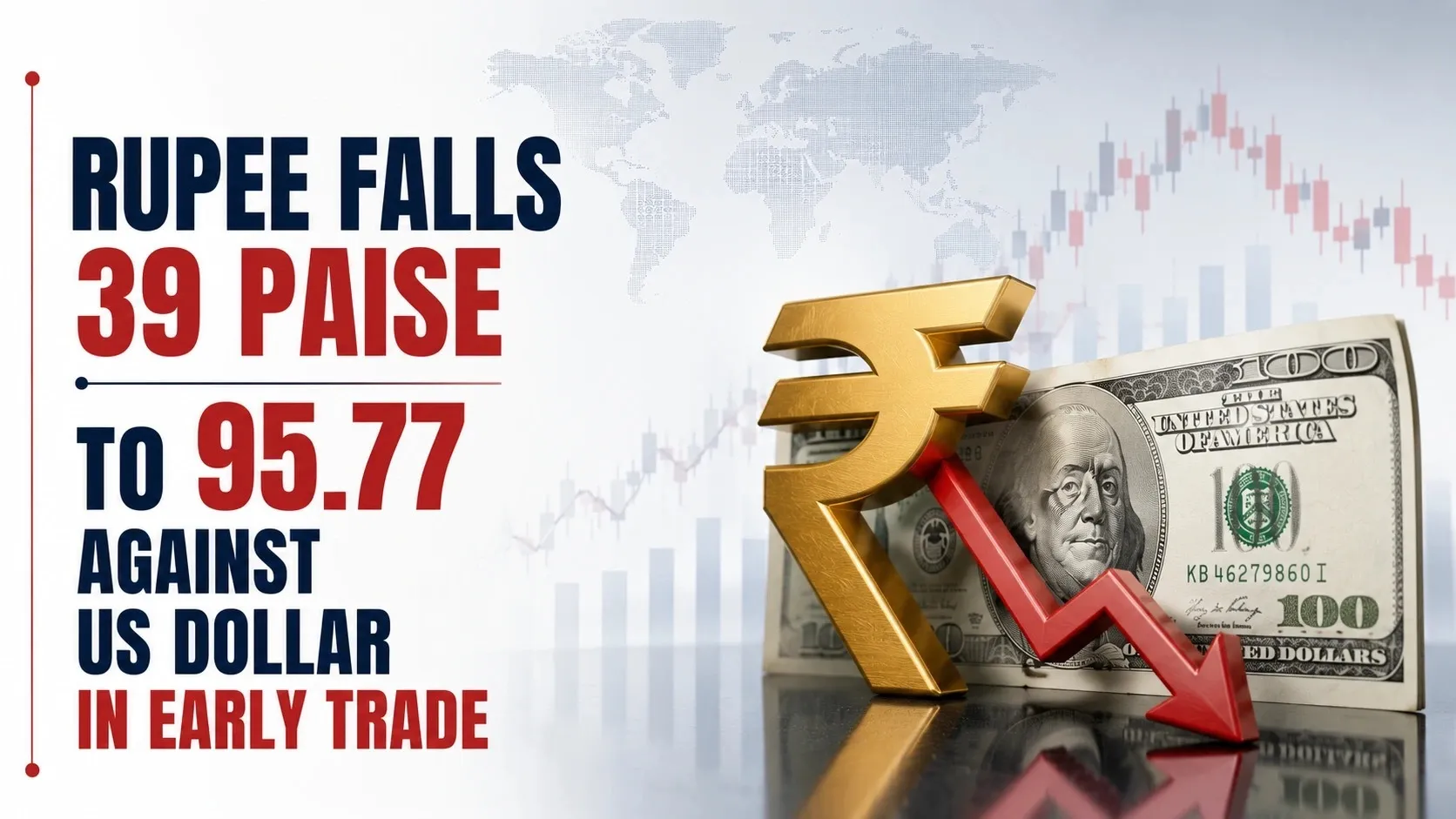
Mumbai: The Indian rupee continues to trade under significant and sustained pressure against the US dollar, with the currency pair hovering near record-low territory around 95.6, having recently ranged between approximately 95.2 and 95.8 in trading sessions through the middle of 2026. This persistent weakness marks one of the more challenging periods for the domestic currency in recent memory, driven by a confluence of global and domestic factors that show little sign of abating in the immediate term, placing the Reserve Bank of India in an increasingly delicate position as it weighs the costs and benefits of more active currency market intervention.
The rupee's trajectory through 2026 has been shaped by a complex interplay of forces, some rooted in India-specific developments and others reflecting broader shifts in global capital flows and monetary policy expectations. Understanding this trajectory requires examining both sides of the currency pair: the factors driving continued dollar strength globally, and the India-specific pressures that have compounded the domestic currency's vulnerability during this period.
THE DOLLAR SIDE OF THE EQUATION
A significant part of the rupee's weakness reflects not any unique India-specific crisis, but rather a broader strengthening of the US dollar against a wide basket of global currencies through 2026. The dollar index, a widely used gauge of the greenback's strength relative to a basket of major trading partner currencies, has firmed to levels near 99, driven substantially by persistently sticky US inflation readings that have remained stubbornly elevated around 3.8 percent, well above the Federal Reserve's traditional target range.
This inflation persistence has had significant implications for global monetary policy expectations, with markets increasingly pricing in a slower and more gradual pace of interest rate cuts from the Federal Reserve than had been anticipated earlier in the year. The appointment of Kevin Warsh as the new Federal Reserve Chair has added a further layer of uncertainty to these expectations, with markets closely parsing his early policy signals ahead of key Federal Open Market Committee meetings for clues about the likely trajectory of US monetary policy through the remainder of the year. When US inflation remains elevated and the prospect of Federal Reserve rate cuts gets pushed further into the future, the dollar index has historically tended to firm as a consequence, with corresponding downward pressure on emerging market currencies, including the Indian rupee.
INDIA-SPECIFIC PRESSURES: OIL, TRADE DEFICIT, AND CAPITAL OUTFLOWS
Layered on top of this broader dollar strength are several distinctly India-specific factors that have compounded pressure on the rupee. Chief among these is India's heavy dependence on imported crude oil, a dynamic that has become particularly consequential given the sustained volatility in global oil prices stemming from the ongoing conflict between the United States and Iran and its repeated disruptions to shipping through the Strait of Hormuz. As a nation that imports the overwhelming majority of its crude oil requirements, India's trade balance is directly and immediately sensitive to movements in global oil prices, with sustained elevation in crude costs translating almost mechanically into a wider trade deficit and correspondingly greater demand for dollars to settle these import payments.
This oil-driven trade deficit pressure has been compounded by broader patterns of foreign capital outflows from Indian financial markets, as international investors have grown increasingly cautious about emerging market exposure amid the heightened geopolitical uncertainty. While domestic institutional investors have repeatedly stepped in to offset foreign selling in equity markets, the net effect of these combined capital flow dynamics has nonetheless placed additional pressure on the rupee, given the direct relationship between net capital flows and currency demand and supply dynamics.
THE RBI'S POLICY DILEMMA
The Reserve Bank of India's Monetary Policy Committee has, through its recent policy meetings, held the benchmark repo rate steady at 5.25 percent for three consecutive reviews, maintaining a neutral policy stance even as the rupee has continued to weaken. This decision to hold rates rather than cut them, despite growing calls from some quarters of the economy for monetary easing to support slowing growth, reflects the delicate balancing act facing the central bank between supporting economic activity and avoiding actions that could further destabilise the currency.
Cutting interest rates, while potentially supportive of domestic growth by reducing borrowing costs for businesses and consumers, carries the risk of further widening the interest rate differential between India and other major economies, particularly the United States, potentially accelerating capital outflows and adding further downward pressure on the rupee. This is precisely the kind of trade-off that has kept the RBI in a holding pattern through recent policy reviews, even as the central bank has simultaneously revised down its growth forecast for the current fiscal year to 6.6 percent and revised up its inflation projection to approximately 5.1 percent, reflecting the compounding effects of rupee weakness on imported inflation.
DIRECT MARKET INTERVENTION AS A TOOL
Beyond its interest rate decisions, the Reserve Bank of India retains the option of direct intervention in foreign exchange markets, selling dollars from its reserves to help slow the pace of rupee depreciation and smooth out excessive volatility in the currency's trading range. Such intervention has historically been a key tool in the RBI's currency management toolkit, allowing the central bank to moderate the pace of currency movements without necessarily needing to adjust its broader interest rate stance.
However, this approach carries its own inherent limitations, given that India's foreign exchange reserves, while substantial by historical standards, remain finite relative to the scale of potential capital outflows that could occur should the current geopolitical and macroeconomic pressures intensify further. Market participants have noted that the RBI's approach to intervention has generally been characterised by a preference for smoothing excessive volatility rather than attempting to fight the underlying fundamental trend too aggressively, a strategy that reflects lessons learned from previous episodes of currency stress in India's economic history, where overly aggressive defence of a particular currency level ultimately proved unsustainable and costly in terms of depleted reserves.
IMPLICATIONS FOR THE BROADER ECONOMY
The rupee's sustained weakness carries wide-ranging implications across multiple dimensions of the Indian economy. For consumers and businesses reliant on imported goods and raw materials, a weaker rupee translates directly into higher domestic currency costs, contributing to the kind of imported inflation pressure that has already begun showing up in India's consumer price data. For India's export-oriented sectors, conversely, rupee weakness can provide a competitiveness boost, making Indian goods and services relatively cheaper for foreign buyers, though this benefit is often partially offset in practice by the higher cost of imported inputs that many exporters themselves rely upon in their production processes.
For the government's fiscal position, a weaker rupee increases the domestic currency cost of servicing any foreign currency-denominated debt obligations, while also potentially affecting the calculus around fuel subsidies and taxation given the direct link between currency movements and domestic fuel pricing. These multifaceted implications underscore why currency stability remains such a closely watched and carefully managed variable within India's broader macroeconomic policy framework.
WHAT COULD CHANGE THE TRAJECTORY
Looking ahead, several factors could plausibly alter the rupee's current trajectory in either direction. On the downside risk scenario, further escalation in Middle East tensions that meaningfully disrupts global oil supplies, or a sustained further strengthening of the US dollar driven by persistently hawkish Federal Reserve policy expectations, could each independently exert additional downward pressure on the currency. Conversely, any genuine and durable diplomatic resolution to the US-Iran conflict, bringing sustained relief to global oil prices, combined with a moderation in US inflation that opens the door to more decisive Federal Reserve rate cuts, could provide meaningful support for rupee appreciation over the coming months.
Domestic factors will also play a role, including the performance of India's export sectors, the trajectory of foreign portfolio investment flows into Indian equity and debt markets, and the RBI's own evolving policy stance as it continues to navigate the competing pressures of supporting growth, managing inflation, and maintaining currency stability. For now, market participants appear to be settling into an expectation of continued rupee volatility within a relatively wide trading range, with the currency's ultimate trajectory likely to be determined substantially by factors outside India's direct control, reinforcing the theme that has come to define much of India's macroeconomic narrative through 2026: a fundamentally resilient domestic economy navigating an unusually turbulent external environment.
IMPACT ON IMPORT-DEPENDENT AND EXPORT-ORIENTED SECTORS
The rupee's sustained weakness carries sharply divergent implications across different segments of Indian industry, depending on each sector's specific exposure to imported inputs versus export revenues. Sectors heavily reliant on imported raw materials, machinery, or components, including large parts of India's electronics, chemicals, and capital goods manufacturing industries, face rising input costs as the weaker currency increases the domestic price of every dollar-denominated purchase, a dynamic that can squeeze profit margins unless companies are able to pass these higher costs through to end customers, itself a challenging proposition in a domestic demand environment already grappling with elevated inflation.
Conversely, India's export-oriented sectors, including information technology services, pharmaceuticals, and various categories of manufactured goods destined for international markets, can potentially benefit from rupee weakness, as it makes their offerings more price-competitive in dollar terms for overseas buyers while also boosting the rupee value of dollar-denominated export revenues once repatriated. However, this benefit is frequently partially offset by the fact that many export-oriented businesses themselves rely on imported inputs or components, meaning the net impact of currency movements often varies considerably even within the same broadly export-oriented sector, depending on each company's specific import-export revenue mix.
HISTORICAL CONTEXT: HOW THE RUPEE HAS EVOLVED
Placed in a longer historical context, the rupee's current level near 95.6 against the dollar represents a continuation of a multi-decade trend of gradual currency depreciation that has characterised India's post-liberalisation economic history, reflecting the cumulative effect of persistent, if generally moderate, inflation differentials between India and its major trading partners, combined with periodic episodes of more acute currency stress triggered by specific domestic or global shocks. What distinguishes the current period is less the direction of the trend, which has been broadly consistent for decades, than the pace and scale of depreciation witnessed within a relatively compressed timeframe, driven substantially by the unusual combination of simultaneous oil price and global capital flow shocks stemming from the Middle East conflict.
Economists studying this pattern have generally cautioned against reading too much into any single period of accelerated currency movement, noting that the rupee has historically demonstrated a capacity to stabilise and even partially recover once the specific triggering shocks begin to fade, a pattern that offers some historical basis for cautious optimism about the currency's prospects should the current Middle East tensions eventually find a durable diplomatic resolution.

IMPLICATIONS FOR NRI REMITTANCES AND OVERSEAS INDIANS
For the substantial population of non-resident Indians and overseas workers who regularly remit funds back to India, the rupee's weakness carries a notably different set of implications compared to its impact on domestic businesses and consumers. A weaker rupee effectively increases the domestic currency value of remittances sent from abroad, providing a modest silver lining for families dependent on this income source, even as this benefit needs to be weighed against the broader inflationary pressures that the same currency weakness is simultaneously generating within the domestic economy. India has historically ranked among the world's largest recipients of remittance inflows, making this dynamic a meaningful, if often understated, dimension of how currency movements affect different segments of Indian society in divergent ways.
TRAVEL, EDUCATION AND OVERSEAS SPENDING IMPACT
Indian students pursuing overseas education, alongside outbound tourists and businesses with dollar-denominated expenses abroad, face the more direct and immediate cost implications of rupee weakness, as tuition fees, travel expenses, and other dollar-denominated costs become correspondingly more expensive when converted into rupee terms. This has prompted many families planning overseas education expenditure to increasingly explore currency hedging strategies, including forward contracts and other financial instruments designed to lock in exchange rates ahead of anticipated future dollar expenditure, reflecting a broader trend of growing financial sophistication among Indian households navigating an increasingly volatile currency environment.