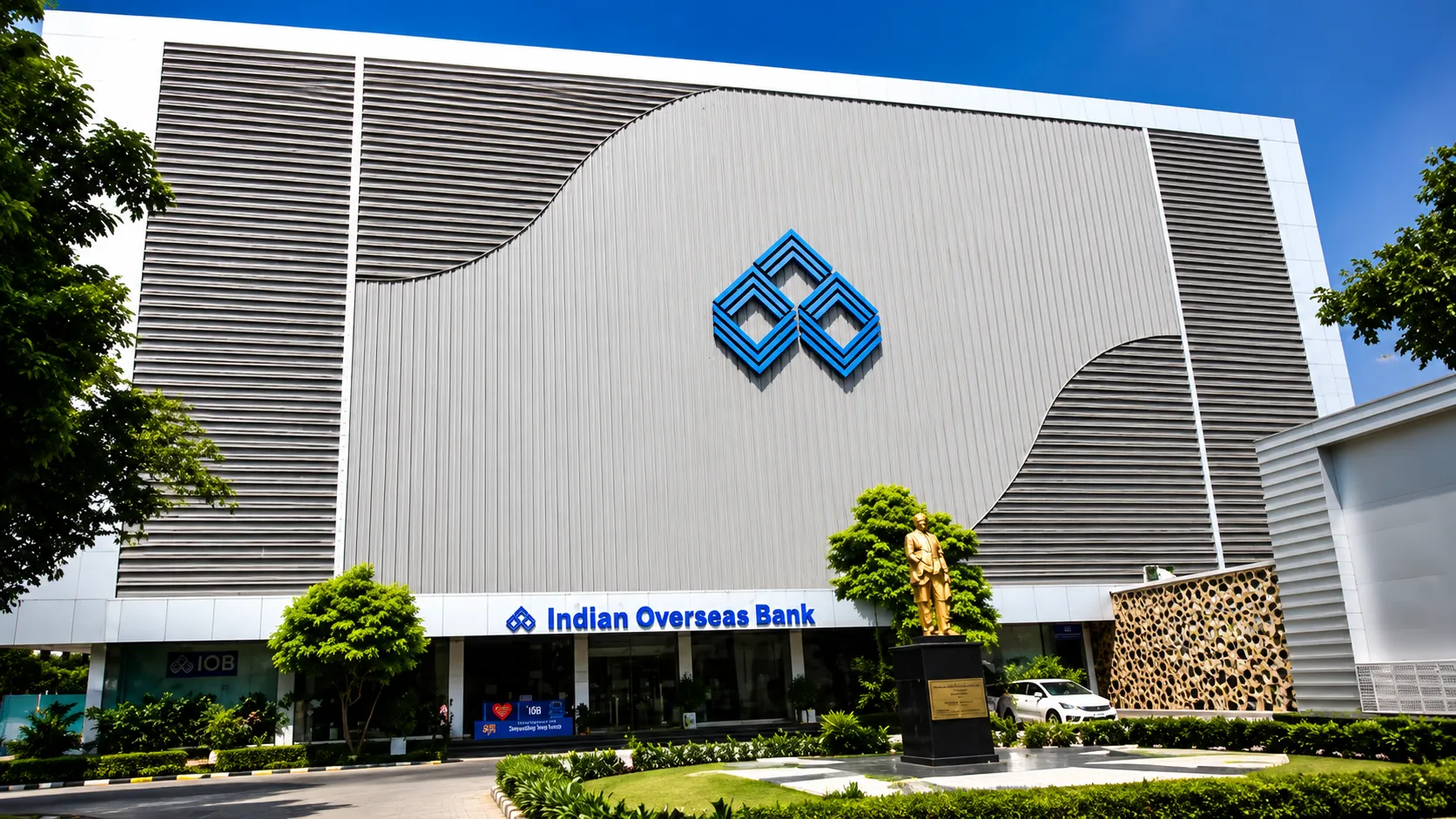
Indian Overseas Bank, the Chennai-headquartered public sector lender, reported a 49 per cent year-on-year jump in net profit for the first quarter of financial year 2027, with the improvement led primarily by a meaningful reduction in both gross and net non-performing asset ratios, which fell by 64 basis points and 14 basis points respectively during the quarter. The results extend a multi-year asset quality turnaround story at a bank that, for much of the previous decade, ranked among the more stressed institutions within India's public sector banking system, having spent several years under the Reserve Bank of India's Prompt Corrective Action framework, a regulatory mechanism designed to restrict the lending and expansion activities of banks facing significant capital adequacy or asset quality concerns.
IOB's emergence from this constrained regulatory status in recent years, followed by a sustained period of improving financial performance culminating in this quarter's sharp profit growth, represents one of the more notable individual turnaround stories within the broader, well-documented recovery narrative that has characterised India's public sector banking system as a whole over the preceding several years.
The results place IOB firmly within a cohort of public sector banks delivering some of this earnings season's sharpest percentage profit gains, a pattern that has increasingly drawn attention from both domestic and international investors seeking exposure to India's broader banking sector recovery story beyond the more heavily tracked private sector banking names.
Bank management, presenting the results, is understood to have emphasised the sustained, multi-quarter nature of the asset quality improvement underlying this period's profit growth, seeking to reassure investors that the results reflect durable underlying operational progress rather than a one-off or accounting-driven improvement in headline numbers.
A History Worth Understanding
Indian Overseas Bank's asset quality challenges trace back to the broader corporate lending stress that affected numerous Indian public sector banks in the years following the aggressive credit expansion cycle of the early-to-mid 2010s, when large corporate loan exposures, particularly in sectors such as infrastructure, power and steel, that had appeared sound during a period of strong economic growth, subsequently soured as economic conditions shifted and several large borrowers faced financial distress. IOB's exposure to this broader corporate stress cycle was, at its peak, severe enough to place the bank among the group of public sector lenders placed under the RBI's Prompt Corrective Action framework, which imposed restrictions on the bank's ability to expand its loan book and required a specific, regulator-monitored path toward capital and asset quality restoration.
The bank's subsequent exit from this restrictive framework, achieved through a combination of government-backed capital infusions, aggressive resolution of stressed assets, and a broader strategic refocus toward more conservative, diversified lending practices, set the stage for the kind of steady, multi-year financial performance improvement that has now culminated in this quarter's dramatic profit growth.
Banking historians note that IOB's specific path out of the Prompt Corrective Action framework, which required the bank to demonstrably meet a range of capital adequacy and asset quality thresholds before restrictions could be lifted, offers a particularly well-documented case study of how India's regulatory framework for managing distressed public sector banks has functioned in practice over the preceding several years.
Breaking Down This Quarter's Asset Quality Improvement
The specific magnitude of this quarter's non-performing asset improvement — a 64 basis point decline in the gross NPA ratio and a 14 basis point decline in the net NPA ratio — represents a meaningfully faster pace of improvement than the more gradual, incremental progress many public sector banks have reported in recent quarters, suggesting IOB's management has continued to prioritise aggressive resolution of remaining legacy stressed assets even as the bank's overall asset quality metrics have already improved substantially from their crisis-era peaks.
This continued asset quality improvement has a direct and substantial mechanical effect on reported profitability, since a lower non-performing asset base requires correspondingly lower provisioning charges, freeing up a larger share of the bank's core operating income to flow through to the bottom line — a dynamic that helps explain why banks in the later stages of an asset quality recovery cycle, like IOB, have been among the sector's standout percentage earnings growth performers this reporting season.
Credit Growth And Deposit Trends
Beyond the asset quality story, IOB's results are understood to reflect continued, measured credit growth across the bank's retail, agriculture and micro, small and medium enterprise lending segments, areas that have become an increasingly central focus for the bank's growth strategy as it has moved away from the concentrated large corporate lending exposures that contributed to its earlier asset quality challenges. This shift toward a more diversified, retail-oriented loan book mirrors the broader strategic repositioning that has characterised India's public sector banking system as a whole over the preceding several years.
Deposit growth has similarly continued at a steady pace, with the bank's improving financial health and public profile, following its emergence from the constraints of the Prompt Corrective Action framework, understood to have supported continued customer confidence and deposit mobilisation across both its traditional South Indian stronghold markets and its broader pan-India branch network.
How IOB Fits Within The Broader PSU Bank Recovery Story
IOB's results this quarter form part of a broader pattern across India's public sector banking system this earnings season, with several institutions — including Punjab National Bank, which separately reported a 214 per cent profit surge within the same reporting window — posting some of the sector's sharpest percentage earnings gains as their respective asset quality recovery journeys continue to mature. This pattern reflects the specific dynamics of institutions emerging from a period of depressed, crisis-era profitability, where even modest absolute improvements in provisioning requirements can translate into dramatic percentage gains in reported net profit given the comparatively low base from which these banks are growing.
Analysts covering the broader public sector banking space note that this pattern of dramatic percentage earnings growth is likely to moderate over coming quarters as these banks' asset quality metrics continue converging toward more normalised levels, meaning the exceptionally high percentage growth rates seen this quarter across several public sector banks, IOB included, should be understood as reflecting a specific, transitional stage of the broader recovery cycle rather than a sustainable, ongoing growth rate investors should expect to persist indefinitely.
How The Stock Reacted
IOB's stock, like several other public sector banking names that have posted strong asset-quality-driven earnings surprises this quarter, is understood to have seen a positive market reaction following the results announcement, extending the broader re-rating trend that has characterised India's public sector banking stocks over recent years as their improving fundamental performance has become increasingly evident in successive quarterly results.
Analysts covering the stock have generally noted that IOB's valuation, even after this period of improving performance and associated stock price appreciation, continues to trade at a discount to several stronger private sector banking peers, a gap that some analysts view as offering continued re-rating potential should the bank's asset quality and profitability trends continue on their current improving trajectory, even as others caution that this valuation discount may, in part, reflect legitimately lingering concerns about the bank's longer-term structural profitability relative to India's strongest banking franchises.
IOB's Regional Strength And Franchise Value
Indian Overseas Bank has historically maintained a particularly strong presence across South India, with deep-rooted customer relationships and branch density in Tamil Nadu and neighbouring states that predate the bank's later period of asset quality stress. This established regional franchise, analysts note, represents a valuable, if sometimes underappreciated, asset that has helped support the bank's deposit mobilisation and customer retention efforts even through the more difficult years of its turnaround journey, providing a stable foundation upon which the bank's broader recovery has been built.
The bank's international presence, reflected in its name, also distinguishes it from several domestically focused public sector banking peers, with IOB maintaining select overseas branches and correspondent banking relationships that support trade finance and remittance business tied to India's substantial diaspora population and international trade relationships, an additional business line that, while not the primary driver of this quarter's results, contributes to the bank's overall diversified revenue base.
Lessons From IOB's Recovery For The Broader Sector
IOB's journey from a bank constrained by the RBI's Prompt Corrective Action framework to one now posting some of the sector's sharpest percentage profit gains offers instructive lessons for how India's broader public sector banking system has approached asset quality recovery over the preceding several years. Banking sector analysts point to IOB's experience as validating the broader policy approach of combining capital support with strict, regulator-monitored resolution timelines as an effective framework for turning around even severely stressed public sector banking institutions.
This template, having now been validated across multiple public sector banking recovery stories including IOB, PNB and several other institutions, is likely to continue informing how Indian banking regulators approach any future instances of significant asset quality stress within the public sector banking system, reinforcing confidence that the sector has developed a genuinely effective playbook for managing and resolving such challenges when they arise.
The Path Forward For Priority Sector Lending
As a public sector bank, IOB carries specific priority sector lending obligations under Indian banking regulations, requiring the bank to direct a mandated proportion of its overall lending toward sectors including agriculture, micro and small enterprises, and other socially and economically important segments of the economy. Management commentary suggests the bank has increasingly sought to view these priority sector obligations not merely as a regulatory compliance requirement but as a genuine growth opportunity, given the substantial and often underserved credit demand within these segments across the bank's traditional South Indian markets and beyond.
This shift in framing, from viewing priority sector lending as a compliance burden to treating it as a genuine business opportunity, mirrors a broader evolution in how India's public sector banks have approached this segment of their lending portfolio over recent years, with several institutions, IOB included, reporting improving profitability metrics within their priority sector books as underwriting practices and risk assessment methodologies for these traditionally harder-to-evaluate borrower segments have continued to improve.

Employee Morale And Institutional Culture
Banking sector analysts note that institutional culture and employee morale represent an often underappreciated, if difficult to precisely quantify, factor in any bank's turnaround journey, given how directly frontline employee engagement and customer service quality affect a bank's ability to retain and grow its customer base during a recovery period. IOB's management has, in various internal and external communications, emphasised efforts to rebuild employee morale and institutional pride following the difficult years of the bank's asset quality crisis and regulatory restrictions, framing the current run of improving financial results as validation of the broader organisational turnaround effort extending beyond pure balance sheet metrics.
This cultural dimension of the bank's turnaround, while less immediately visible in quarterly financial results than metrics like profit growth or NPA ratios, is viewed by several banking sector consultants as an important, complementary factor supporting the sustainability of IOB's broader financial recovery, since a genuinely re-engaged workforce is generally better positioned to deliver the kind of consistent customer service and prudent underwriting discipline required to sustain a multi-year turnaround trajectory of this nature.
What Comes Next
Looking ahead, analysts tracking IOB say the key metrics to watch in coming quarters include whether the current rapid pace of asset quality improvement can be sustained as the stock of easily resolvable legacy stressed assets continues to diminish, the bank's ability to grow its loan book at a healthy, sustainable pace without reintroducing asset quality risk, and whether the bank's return on assets and return on equity metrics continue to converge toward levels more comparable to India's stronger public and private sector banking peers.
For now, this quarter's results stand as further evidence that India's broader public sector banking recovery story continues to deepen, with IOB's specific trajectory — from a bank once constrained by regulatory restrictions tied to its asset quality challenges to one now posting some of the sector's sharpest percentage profit gains — offering a particularly vivid illustration of just how substantially the broader public sector banking landscape has been transformed over the preceding several years.
Investors and analysts alike will be watching subsequent quarters closely to see whether IOB can continue building on this quarter's momentum, a track record that, if sustained, could support further re-rating of a stock that many analysts still view as trading at a meaningful discount to its improving underlying fundamentals.