Mumbai: Indian equity markets are staring down a turbulent start to Tuesday's trading session, with early indicators pointing to one of the sharper opening declines investors have witnessed in recent weeks. GIFT Nifty futures, the most widely tracked barometer for how Dalal Street is likely to open, were seen trading at 24,125, down 270.50 points or 1.11 percent, as of the early morning session on July 21, 2026. The signal is unambiguous: unless global sentiment turns around dramatically before the opening bell, both the BSE Sensex and the NSE Nifty 50 are headed for a gap-down opening that could rattle an already jittery market.
The weakness comes at a delicate moment for Indian equities, which have spent the better part of the past several weeks caught between two powerful and opposing forces. On one side, a resilient domestic earnings season, led by strong showings from index heavyweights, has offered pockets of optimism. On the other, an increasingly volatile geopolitical backdrop centred on the Strait of Hormuz has kept traders on edge, injecting a fresh layer of risk into every session. Tuesday's anticipated fall appears to be the latter force reasserting itself.
FOREIGN INVESTORS TURN CAUTIOUS, DOMESTIC BUYERS HOLD THE LINE
Data for July 20 shows a clear divergence in institutional behaviour that market watchers say is worth paying close attention to. Foreign institutional investors, or FIIs, were net sellers to the tune of ₹1,121.04 crore, continuing a pattern of caution that has characterised much of their activity through the geopolitically charged summer months of 2026. Domestic institutional investors, or DIIs, however, took the opposite side of the trade, pumping in a net ₹1,312.03 crore, a move that has repeatedly cushioned the market from steeper corrections whenever foreign money has headed for the exits this year.
This tug-of-war between FIIs and DIIs has become one of the defining features of the current market cycle. Foreign investors, wary of the unpredictable trajectory of the US-Iran conflict and its knock-on effects on crude oil prices, have been trimming exposure to emerging markets broadly, and India has not been immune. Domestic mutual funds, insurance companies, and increasingly retail-driven systematic investment plans, meanwhile, have continued to funnel fresh capital into equities, providing a structural floor that many analysts believe has prevented what could otherwise have been a much sharper drawdown.
WHAT IS DRIVING THE GAP-DOWN SIGNAL
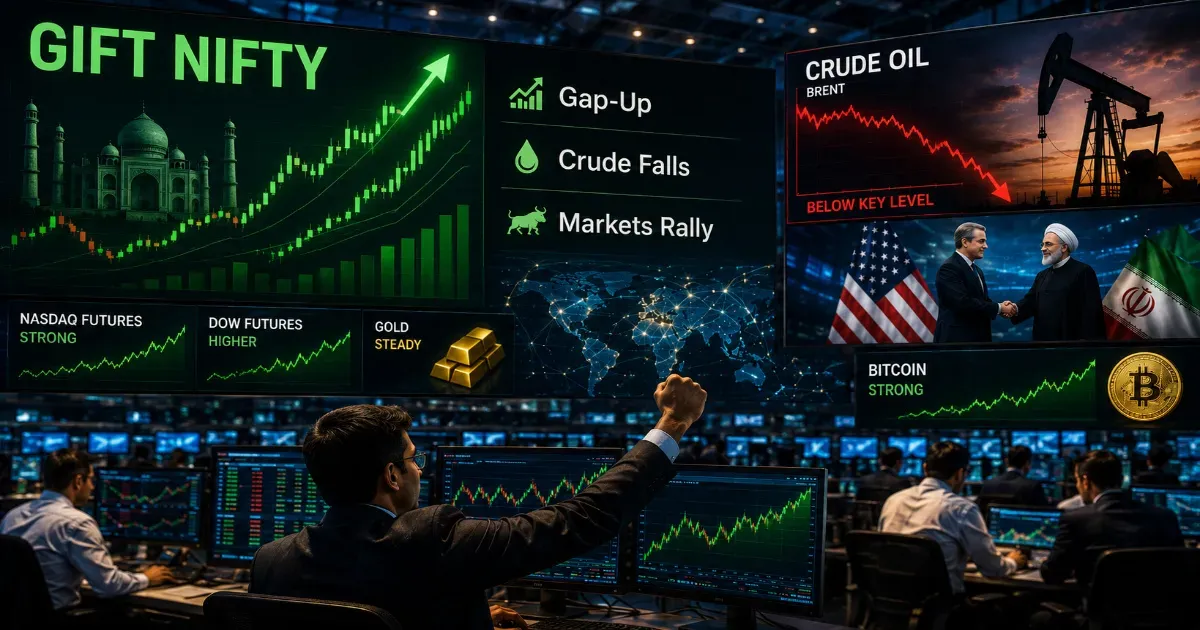
The immediate trigger for Tuesday's expected weak opening lies not in domestic factors but in the escalating conflict thousands of kilometres away in the Persian Gulf. Iran's attack on a Qatari liquefied natural gas tanker near the strategically vital Strait of Hormuz — a chokepoint that handles roughly a fifth of the world's oil traffic — has reignited fears of a broader supply disruption. The incident has come even as Washington and Tehran continue to negotiate the terms of a permanent ceasefire, underscoring just how fragile the current truce remains.
Brent crude, the international benchmark that Indian refiners and policymakers watch most closely, has been on a rollercoaster through the month of July, swinging between the low seventies and briefly touching levels above ninety dollars a barrel as hostilities have flared and ebbed in quick succession. For India, which imports the overwhelming majority of its crude oil requirements, every dollar increase in the price of Brent translates into a wider trade deficit, added pressure on the rupee, and a fresh set of headaches for the Reserve Bank of India's inflation calculus.
Asian markets more broadly reflected this unease heading into the new week. Regional bourses saw a mixed but generally cautious tone, with chip-heavy indices in Northeast Asia among the hardest hit as investors weighed the prospect of prolonged supply-chain disruption against still-resilient corporate earnings closer to home.
EARNINGS SEASON OFFERS A COUNTERWEIGHT
Even as geopolitical risk dominates the headlines, market participants are quick to point out that this is far from a one-dimensional story. The June quarter earnings season, officially known as Q1 FY27 results, has been gathering pace through the second half of July, with several bellwether companies posting numbers that have, on balance, exceeded muted expectations. Information technology majors have delivered sequential revenue growth that, while modest by historical standards, has been enough to spark a broad-based rally in the sector over the past fortnight. Banking names have also shown resilience, with several private and public sector lenders reporting healthy growth in net interest income alongside improving asset quality metrics.
This has created an unusual market dynamic in which the underlying corporate fundamentals appear considerably healthier than the headline index movements would suggest. Sector rotation has been a defining feature of trading through July, with capital flowing rapidly between IT, banking, and defence-linked stocks depending on the news flow of the day, while broader indices have oscillated within relatively tight ranges compared to the volatility seen in individual sectors.
THE RUPEE FACTOR
Compounding the market's challenges is the continued weakness in the Indian rupee, which has been trading under sustained pressure against the US dollar for much of 2026. A combination of a strengthening dollar index, driven by persistently sticky inflation readings out of the United States, and India's own widening trade deficit amid costlier oil imports has kept the domestic currency on the back foot. Every fresh escalation in the Middle East conflict tends to compound this pressure, as it simultaneously strengthens the dollar's safe-haven appeal while pushing up the oil import bill that India must settle in that very currency.
The Reserve Bank of India has intervened periodically to smooth out excessive volatility, but policymakers have been careful not to fight the underlying trend too aggressively, mindful of the limited ammunition available in the form of foreign exchange reserves relative to the scale of potential capital outflows should the geopolitical situation deteriorate further.
WHAT MARKET PARTICIPANTS ARE WATCHING
For traders navigating Tuesday's session, several factors are likely to determine whether the opening weakness deepens into a broader sell-off or proves to be a temporary blip before buyers step back in. Chief among these is the trajectory of crude oil prices through the day, given how tightly correlated Indian equity sentiment has become with developments in the Strait of Hormuz. A further escalation, particularly any incident that threatens to meaningfully choke off shipping through the waterway, could trigger a sharper and more sustained sell-off. Conversely, any signs of renewed diplomatic engagement between Washington and Tehran could see sentiment reverse quickly, given how often markets have whipsawed on headlines through this conflict.
Domestic triggers will also play a role. With the Q1 FY27 earnings season now in full swing, individual stock reactions to quarterly results are likely to generate significant intraday volatility even as the broader indices grapple with the macro overhang. Investors will be parsing management commentary closely for forward guidance, particularly from export-oriented sectors that could be more exposed to any disruption in global trade flows stemming from the ongoing conflict.
THE BROADER PICTURE
Zooming out, Tuesday's anticipated weak opening is best understood as part of a broader pattern that has come to define Indian markets through much of 2026: a structurally resilient domestic growth and earnings story being periodically buffeted by an unusually volatile external environment. The Reserve Bank of India's own growth projections, alongside independent assessments from firms such as Deloitte, continue to point to India remaining among the fastest-growing major economies globally, even as near-term estimates have been trimmed to account for the drag from elevated energy prices and softer global demand.
For long-term investors, market strategists have repeatedly counselled against reading too much into single-session moves, however sharp, arguing that the fundamental drivers of Indian equity returns — a young and growing consumer base, ongoing formalisation of the economy, and a still-nascent manufacturing renaissance — remain firmly intact. For traders with shorter time horizons, however, Tuesday promises to be another session of navigating headline risk in real time, with the Strait of Hormuz once again commanding as much attention on trading floors in Mumbai as any domestic data release or earnings report.
As the opening bell approaches, all eyes will be on whether the GIFT Nifty's overnight signal holds through the cash market session, or whether, as has happened repeatedly through this volatile year, Indian markets find a way to claw back losses by the closing bell.
SECTOR-WISE POSITIONING AHEAD OF THE OPENING BELL
Traders positioning themselves ahead of Tuesday's session are likely to pay close attention to how different sectors respond to the overnight cues. Oil marketing companies, which bear direct exposure to crude price swings through their refining and retail margins, are expected to see outsized volatility, with under-recoveries on fuel pricing likely to widen if Brent crude sustains its recent gains. Aviation stocks, similarly sensitive to fuel costs given that aviation turbine fuel constitutes a substantial share of airline operating expenses, could also see pronounced swings as investors reassess margin assumptions for the current quarter.
Defence and domestic manufacturing stocks, by contrast, have in recent sessions shown a degree of insulation from the broader geopolitical anxiety, in part because heightened global tensions have, somewhat counterintuitively, been read by some investors as a tailwind for companies positioned to benefit from increased government spending on indigenous defence production and strategic self-reliance initiatives. This divergence in sectoral response underscores the increasingly nuanced way in which Indian markets are processing the ongoing Middle East crisis, treating it less as a uniform negative for all risk assets and more as a differentiated set of winners and losers depending on each sector's specific exposure to energy costs, import dependence, and government policy priorities.
Banking stocks, which carry substantial weight in both the Sensex and the Nifty 50 given their large index representation, will also be closely tracked, particularly as several major lenders continue to report their June quarter results through this week. Positive surprises on asset quality or credit growth from these results could provide a meaningful offset to the broader macro-driven weakness, illustrating once again how idiosyncratic, company-specific news flow is increasingly competing with top-down geopolitical narratives for control of daily market direction.

TECHNICAL PICTURE AND TRADER SENTIMENT
From a purely technical standpoint, chartists tracking the Nifty 50 have pointed to a series of well-defined support and resistance bands that have held through much of July's choppy, range-bound trading. The index's recent tendency to trade within its tightest weekly range of the year, even amid substantial single-stock volatility, has led some technical analysts to characterise the current phase as one of consolidation rather than outright directional conviction in either direction. A decisive break below key support levels on the back of Tuesday's anticipated weak opening could embolden bears to target deeper corrections, while a swift intraday recovery, a pattern that has repeated itself on several occasions this year, would reinforce the view that dip-buying appetite among domestic investors remains a powerful stabilising force. Options market positioning, often used by traders as a proxy for sentiment, has similarly reflected this tension between caution and resilience. Elevated implied volatility readings around key event risk windows, including days when major geopolitical headlines are anticipated, have become a recurring feature of the market's options chain through 2026, with premiums richening ahead of weekends and key policy announcements out of both Washington and Tehran, only to compress again once immediate uncertainty passes.
RETAIL INVESTOR BEHAVIOUR IN FOCUS
One of the more structurally significant developments to watch through this period of volatility is the behaviour of India's rapidly expanding base of retail investors, many of whom have entered the market in recent years through systematic investment plans and direct equity participation facilitated by increasingly accessible digital trading platforms. Unlike institutional investors, who often adjust portfolio exposure in response to macro developments in real time, India's retail investor base has, on balance, demonstrated a pattern of continued, disciplined participation even through periods of heightened volatility, a behavioural shift that market strategists credit with meaningfully altering the market's resilience compared to earlier cycles of foreign capital-driven volatility.
This growing domestic investor base, channelling steady monthly inflows through mutual fund systematic investment plans regardless of short-term market gyrations, has become an increasingly important structural feature underpinning Indian equity markets, providing a persistent bid that has repeatedly absorbed foreign selling pressure without triggering the kind of sharp, cascading declines that characterised earlier periods of FII-driven outflows in India's market history.