India's export engine has quietly crossed a milestone that policymakers in New Delhi have been chasing for years, with merchandise exports reaching $441.8 billion and services exports touching $421.3 billion, bringing the country's combined overseas trade in goods and services to a figure just shy of $863 billion. Behind the headline number lies a more textured and, in many ways, more interesting story: a small cluster of countries — the United Arab Emirates, the United Kingdom, and Australia — have emerged as the standout beneficiaries of India's rapidly expanding network of free trade agreements, suggesting that years of painstaking negotiation are finally translating into measurable commercial outcomes.
For a country that has historically struggled to convert trade diplomacy into trade volumes, this is no small thing. India has, for much of its post-liberalisation history, been criticised — sometimes fairly, sometimes not — for negotiating free trade agreements more as geopolitical statements than as genuine commercial instruments. The India-ASEAN FTA, signed well over a decade ago, drew persistent criticism from domestic industry for widening India's trade deficit with the bloc rather than narrowing it. The latest export data suggests a different pattern may be emerging with the newer generation of agreements — one where Indian exporters are actually using the preferential access they have been granted, rather than simply watching imports flow in on more the favourable terms.
The UAE relationship is perhaps the clearest example of this shift. The India-UAE Comprehensive Economic Partnership Agreement, which came into force in 2022, was among the first big-ticket trade deals India signed after a long hiatus from major bilateral negotiations. It eliminated or significantly reduced tariffs on a wide swathe of goods moving between the two countries, from gems and jewellery to textiles, engineering goods, and pharmaceuticals. Years on, the agreement appears to be doing exactly what it was designed to do: Indian exporters, particularly in labour-intensive sectors like textiles, leather, and gems and jewellery, have leaned into the UAE market, using it both as a significant destination in its own right and, in many cases, as a re-export and logistics hub for onward trade into Africa and the wider Gulf region.
The United Kingdom's emergence as a key beneficiary tells a related but distinct story. The India-UK Comprehensive Economic and Trade Agreement, one of the most closely watched trade deals of the past several years given London's post-Brexit search for new trading partnerships, has begun to show up meaningfully in the export data. British consumers and businesses have increased their sourcing of Indian textiles, leather goods, engineering products, and IT-enabled services, sectors where India has long held a comparative advantage but had previously faced tariff and non-tariff barriers that made UK market entry more expensive relative to competitors like Vietnam or Bangladesh. With those barriers now substantially reduced under the agreement, Indian exporters appear to be capturing market share that had, for years, gone to rival low-cost manufacturing hubs.
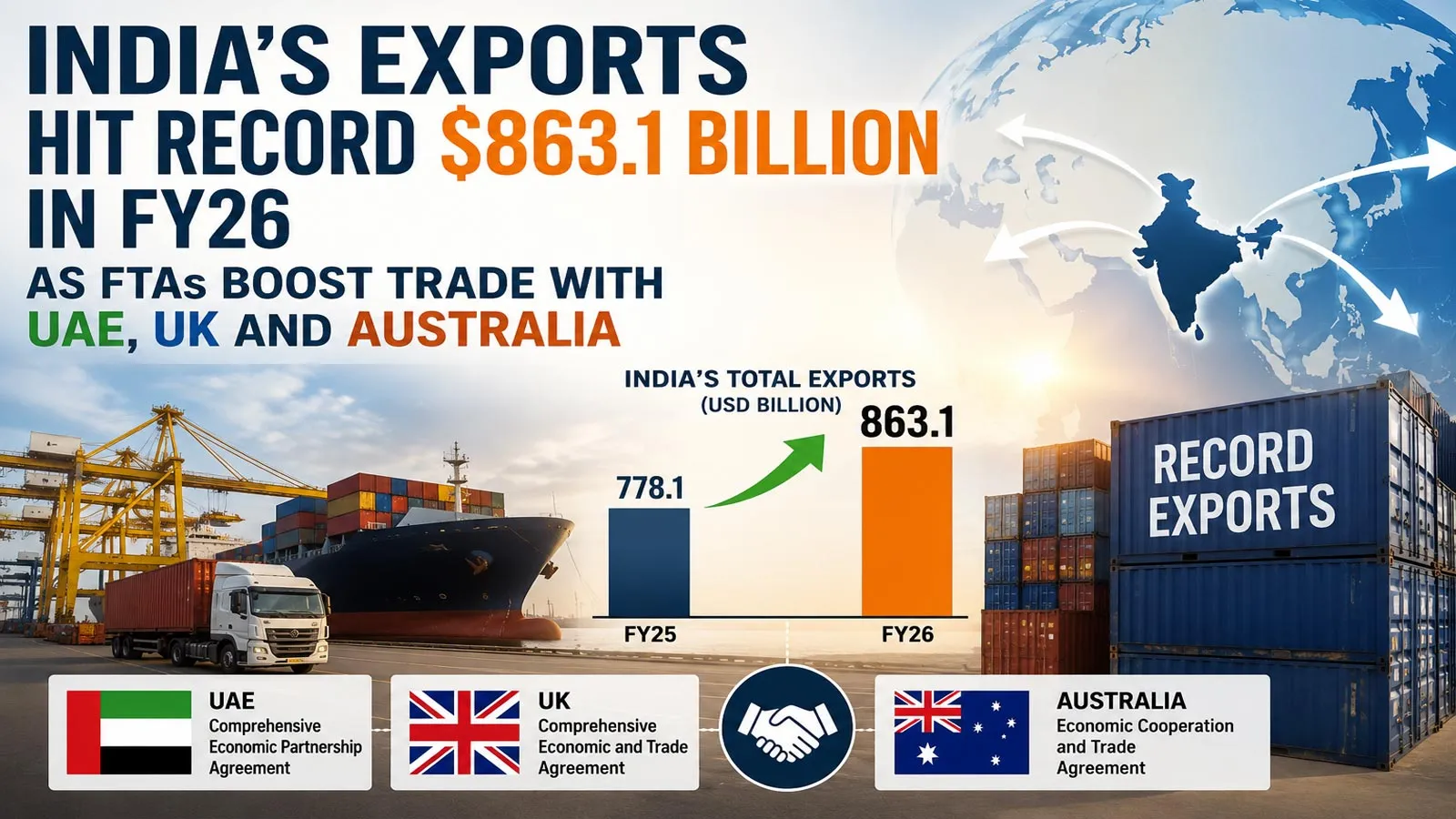
Australia rounds out the trio, with the India-Australia Economic Cooperation and Trade Agreement continuing to deliver dividends years after it first came into effect. The agreement has been particularly consequential for sectors like pharmaceuticals, engineering goods, textiles, and gems and jewellery, mirroring some of the same product categories that have benefited from the UAE and UK deals. Australia's relatively small population but high per-capita income makes it a premium rather than high-volume market for many Indian exporters, and the steady, compounding growth in bilateral trade suggests Indian companies have found a genuine commercial foothold there rather than a one-off spike tied to preferential tariff timing.
The scale of the combined export number — $441.8 billion in goods and $421.3 billion in services — is itself worth dwelling on. It places India's total exports of goods and services at a level that, only a decade ago, would have seemed a distant aspiration for policymakers still wrestling with a persistently wide current account deficit and a merchandise trade balance that rarely moved in India's favour. Services exports in particular have been the quieter, steadier engine of India's external accounts for years, powered overwhelmingly by information technology and IT-enabled services, business process outsourcing, and increasingly by professional and consulting services delivered out of India's rapidly multiplying global capability centres. The fact that services exports now sit within striking distance of merchandise exports underscores just how central the technology and services sector has become to India's trade identity — a far cry from the commodity- and textile-dominated export basket of decades past.
None of this growth has occurred in a vacuum, and industry watchers have been careful to note that India's export story is unfolding against a genuinely turbulent global backdrop. The United States, historically India's single largest export destination, has in recent months pursued a more assertive and unpredictable tariff policy under the Trump administration, including a new Section 301 duty regime that briefly threatened to impose steep additional levies on Indian goods. In a partial reprieve that has offered Indian exporters some breathing room, the Centre has confirmed that a substantial 45 per cent of India's exports to the US remain outside the new 10 per cent Section 301 duty altogether, after New Delhi was placed in a lower tariff tier following negotiations that saw the originally proposed levy trimmed down from an initially discussed 12.5 per cent. That outcome, while still leaving a meaningful share of trade exposed to additional costs, represents a materially better result than exporters had feared earlier in the year, and helps explain why the broader export numbers have continued to climb even as US trade policy has grown more unpredictable.
Commerce Secretary Rajesh Agarwal has been vocal about the government's broader posture on trade policy, reiterating New Delhi's commitment to what officials describe as an open, transparent, and predictable trade and investment regime — language that is clearly aimed as much at reassuring foreign investors and trading partners as it is at signalling domestic policy direction. That messaging matters considerably at a moment when protectionist rhetoric is on the rise across major economies, and when India itself has faced periodic criticism, including notably from figures within its own industry establishment, for retaining tariff and regulatory structures that some argue hold back the very export competitiveness the government says it wants to unlock. Infosys co-founder N R Narayana Murthy, among the most closely watched voices in Indian industry, has publicly argued that the country can no longer be content with protectionism and that MSMEs in particular need to be freed from excessive regulatory and inspection burdens if they are to become more meaningful contributors to India's export story — a viewpoint that has found increasing resonance within policy circles even as implementation remains a work in progress.
The MSME question is, in fact, central to where this export growth story goes from here. Large corporates and well-capitalised exporters have historically been best positioned to navigate the paperwork, certification requirements, and working capital demands of exporting under free trade agreements, while smaller enterprises — despite often having globally competitive products — struggle to access the same opportunities. Policymakers have repeatedly flagged the need for a stronger domestic venture capital and financing ecosystem to help smaller exporters scale, alongside efforts to reduce what officials and industry leaders alike have described as an excessive burden of inspections and compliance requirements that disproportionately affects smaller firms. Whether India can broaden the base of companies benefiting from its FTA network, beyond the large corporates that have so far captured the bulk of the gains, will likely determine whether the current export momentum can be sustained and, ideally, accelerated over the coming years.
There is also a structural story unfolding beneath the export numbers that deserves attention: the explosive growth of India's global capability centres, or GCCs. These centres, established by multinational corporations to house everything from software engineering and data analytics to finance, legal, and increasingly research and development functions, have become an enormous and growing contributor to India's services exports. Industry estimates put the number of GCCs operating in India at more than 2,100 by the end of 2025, with projections suggesting that figure could climb past 4,000 by 2030 — a near-doubling in under five years. This is not merely an IT services story; increasingly, GCCs are taking on higher-value functions, deepening their strategic role within their parent organisations rather than serving purely as cost centres. That shift has direct implications for the composition and resilience of India's services exports, potentially insulating them somewhat from the kind of commoditised, price-sensitive competition that has periodically squeezed margins in traditional IT outsourcing.
Sector-specific trends within the merchandise export basket also merit a closer look. Electrical equipment, automobiles, and capital goods have been singled out as key drivers of India's broader industrial expansion, according to recent trade and industrial output data, even as analysts caution that risks from an uncertain monsoon and volatile global demand conditions remain on the horizon. The automobile sector in particular has benefited from India's growing positioning as a manufacturing and export base not just for domestic consumption but for global markets, a trend that dovetails with the government's long-running push to position India as a credible alternative manufacturing hub amid global supply chain diversification away from China.
Public sector banks have played a supporting, if less glamorous, role in this export growth story as well. Aggregate business at India's public sector banks has crossed ₹283 lakh crore, with retail and MSME lending posting strong double-digit growth — a trend that speaks directly to the financing needs of exporters, particularly smaller ones, who require working capital lines, export credit, and trade finance instruments to fulfil international orders. The health of this lending channel is, in many ways, as important to sustaining export momentum as the trade agreements themselves, since even the most generous tariff preferences are of limited use to exporters who cannot access the capital needed to scale production and fulfil larger international orders.
As India marks 35 years since the landmark 1991 economic liberalisation reforms this year, the export data offers a useful, if partial, scorecard on how far the country's trade integration with the world has come. The liberalisation era fundamentally reoriented India's economy away from import substitution and toward greater global engagement, and the current wave of free trade agreements — with the UAE, the UK, Australia, and others still under negotiation or recently concluded — represents, in many respects, a natural extension of that original opening. Yet economists and commentators marking the anniversary have also been careful to note that India's reform journey remains unfinished business in critical respects, with weak public services, persistent job creation challenges, and pockets of continued protectionism all cited as areas where the promise of 1991 has yet to be fully realised.
For exporters on the ground — from textile units in Tiruppur and Surat to pharmaceutical manufacturers in Hyderabad and gems and jewellery businesses in Mumbai and Jaipur — the abstractions of trade policy and bilateral agreements translate into very concrete outcomes: new buyers, easier customs clearances, and, crucially, better margins on goods that previously faced tariff walls in destination markets. The fact that three such different economies — a Gulf trading hub, a mature Western European-adjacent economy, and a resource-rich Pacific nation — have all emerged as standout beneficiaries of India's FTA strategy suggests the approach is working across a genuinely diverse set of market conditions, rather than succeeding only in a narrow set of circumstances. Whether that success can be replicated with other major trading partners still under negotiation, from the European Union to more complex discussions with the United States, will be one of the defining trade policy questions for India over the remainder of this decade.
The ongoing negotiations with the European Union offer a useful preview of the scale of opportunity, and complexity, that still lies ahead. Talks between New Delhi and Brussels over a comprehensive trade and investment agreement have continued in fits and starts for years, complicated by EU demands around environmental and labour standards, carbon border adjustment mechanisms that could affect Indian exporters in carbon-intensive sectors, and India's own sensitivities around agricultural market access and data localisation requirements. A successful conclusion to those talks would represent a considerably larger prize than any of the agreements currently driving the UAE, UK, and Australia numbers, given the EU's status as one of the world's largest single markets, but it would also require India to navigate a far more complex set of regulatory and political trade-offs than it faced in its more recently concluded agreements.
The India-US trade relationship, meanwhile, continues to sit in a more ambiguous position — simultaneously India's most important single-country export destination and the source of its most unpredictable tariff-related headline risk over the past year. Even with 45 per cent of exports to the US currently shielded from the new Section 301 duty, exporters in exposed categories have had to contend with a level of policy uncertainty that makes long-term planning and capital investment considerably more difficult than under a more predictable tariff regime. Industry bodies have continued to press New Delhi to pursue a more comprehensive bilateral trade agreement with Washington that could provide durable, negotiated certainty in place of the current arrangement, which remains vulnerable to further shifts in US trade policy.
Currency dynamics have also played a supporting role in shaping India's export competitiveness through this period. A relatively stable rupee, even amid bouts of global risk aversion tied to geopolitical developments in West Asia and elsewhere, has helped Indian exporters maintain predictable pricing for their overseas buyers, an important consideration for sectors like textiles and engineering goods where contracts are often negotiated months in advance of actual shipment and payment. Any significant rupee volatility, in either direction, tends to complicate margin planning for exporters who typically operate on relatively thin margins in highly competitive global product categories, making currency stability a quiet but important enabler of the kind of sustained export growth reflected in the latest trade data.